





Convenience food trends 2026 are being set inside the prepared food case, not the packaged aisle. Prepared food is now the single largest in-store category at US convenience stores, ahead of packaged beverages on both sales and gross profit. That shift changes who your buyer is and what evidence they expect before they hand over shelf or menu space. If your team is still pitching convenience as a packaging format, you are arguing the wrong point. The demand signals below show what consumers are actually asking convenience food to do for them.
Key takeaways
- Convenient is the leading demand signal in the US grab-and-go universe at 19% claim share, up 9.4% on last year. Convenience has become table stakes, so your pack and menu claims need a second reason to buy sitting alongside it.
- Energy is the fastest-moving attribute in that same universe, growing 34.7% in the past year from a 6.7% share. R&D teams still have room to build a functional energy cue into everyday formats before the claim gets crowded.
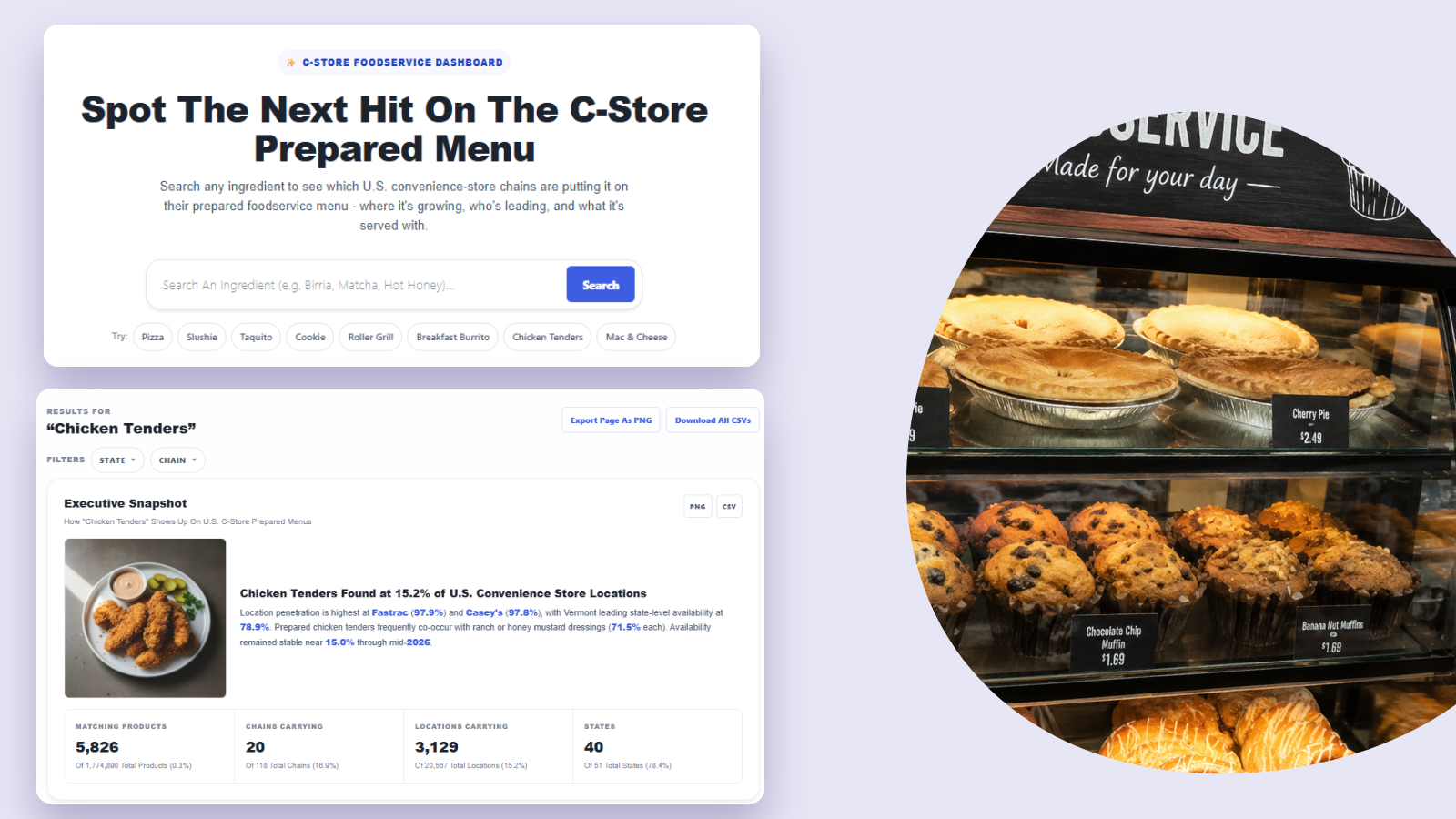
- Prepared chicken tenders reach 15.2% of tracked US convenience store locations, and only 20 of 118 tracked chains carry them. Distribution is the constraint rather than demand, which makes location penetration the number your sales team should be quoting.
- Roughly one third of convenience store shoppers plan to stop at a quick service restaurant within 30 minutes of their visit. That abandoned trip is the whitespace your foodservice or CPG pitch should be sized against.
Convenience food trends 2026: what the data shows now
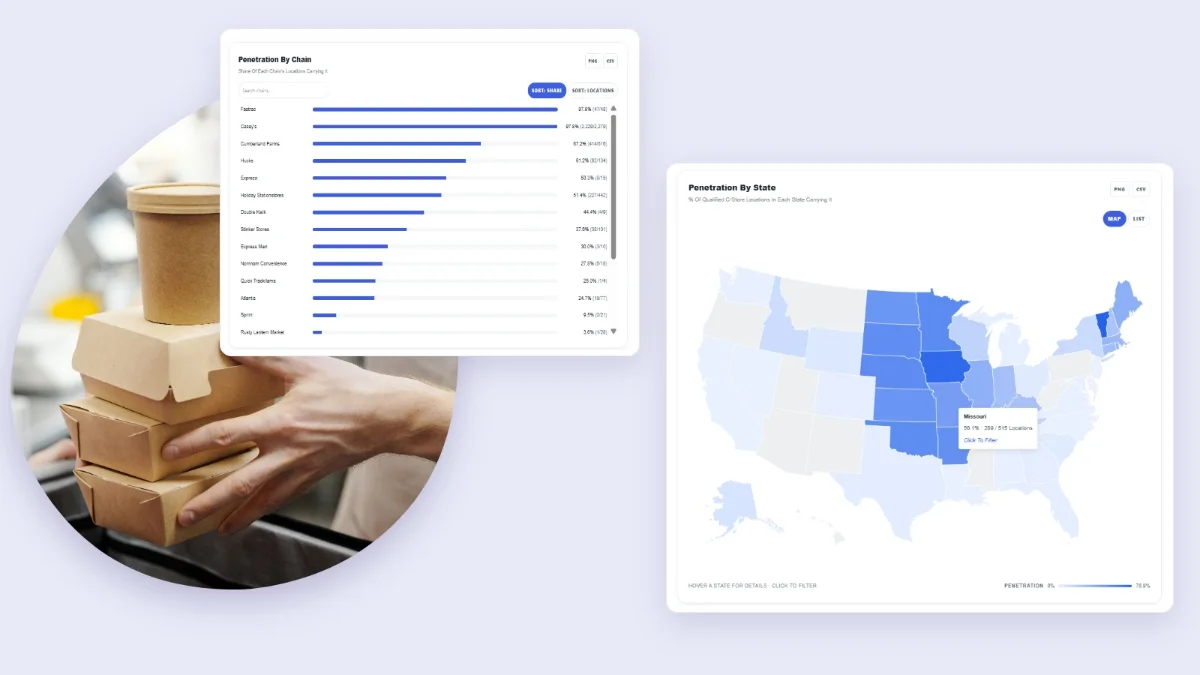
Prepared food penetration by chain and by state across tracked US convenience store locations.
Convenience food trends 2026 describe a change in what people expect from a fast purchase. The old trade-off was speed against quality. Consumers now expect a prepared item to arrive quickly and still carry a functional payoff, a recognisable flavour and a clean ingredient story. That expectation lands hardest on convenience operators and on the CPG brands supplying them.
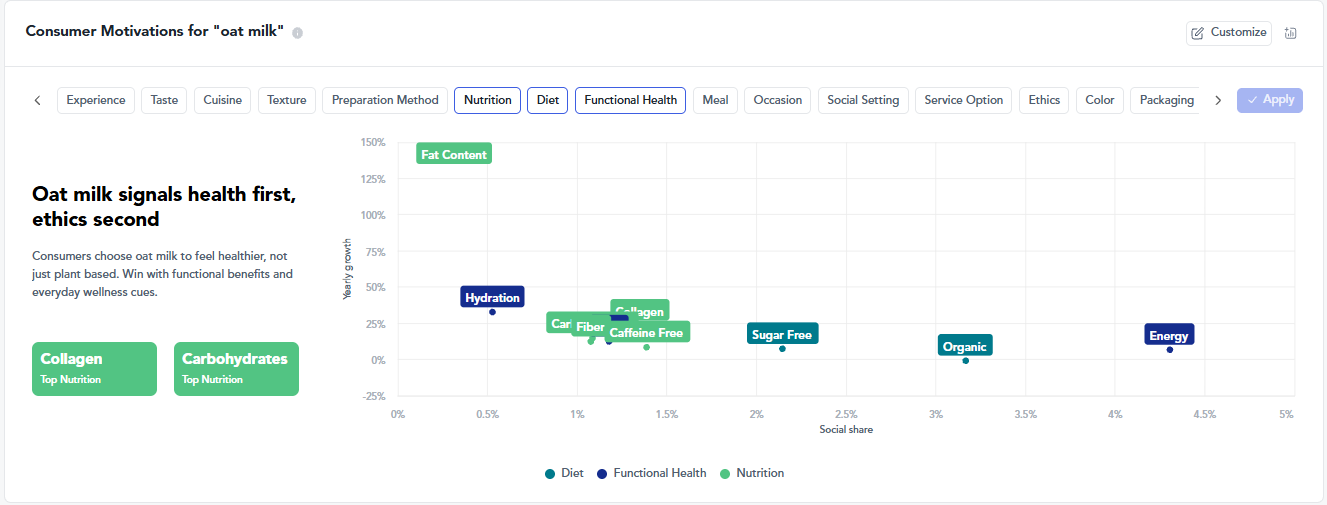
Across the Tastewise food intelligence US consumer panel, convenient leads every demand signal in the grab-and-go universe at 19% claim share, up 9.4% on last year. Fresh sits at 13% with 25.1% growth and easy at 12% with 12.6% growth. Energy carries the fastest velocity at 34.7%, with comfort cues close behind at 32.1%. These are demand signals and menu presence, not consumer penetration figures.
The opportunity is in the pairing. Convenience is broadly expected, so the claim that differentiates is the one stacked on top of it. A product innovation programme built on high-familiarity savoury or sweet bases with one added functional claim de-risks the concept while still reading as new to the shopper.
Convenience store food trends on the prepared menu
Tastewise tracks prepared foodservice items across 118 US convenience store chains, covering 20,567 locations, 51 state-level markets and 1,774,890 product listings. That view separates what is being talked about from what a shopper can actually buy on a given corner.
Chicken tenders make a useful benchmark. They appear at 15.2% of tracked convenience store locations and are carried by 20 of the 118 chains. Availability held close to 15% from March through June 2026, so this is a settled position rather than a spike. For an item that reads as a c-store staple, that is a narrow footprint.
Chain-level penetration tells the sharper story. Fastrac carries prepared tenders at 97.9% of its locations and Casey’s at 97.8%, while most tracked chains sit far below. At state level, Vermont leads at 78.9% and Missouri sits at 50.1%, or 259 of 515 tracked locations. The distance between the leaders and the field is the sell-in argument, and a retail sales conversation should open on it.
The external picture supports the same read. Foodservice accounts for 28.5% of inside sales and 38.9% of inside gross profit at US convenience stores. Prepared food alone would rank as the number one in-store category, according to NACS in-store sales data. Prepared food sales were close to flat in 2025. Growth is coming from operators who differentiate, not from the channel lifting everyone.
Consumer signals driving convenience food market trends
Convenience food market trends make more sense when you look at what gets served alongside the hero item. In the prepared c-store data, chicken tenders co-occur with ranch and honey mustard at 71.5% each, and with french fries at 36.3%. The flavour system, not the protein, is doing the differentiation work.
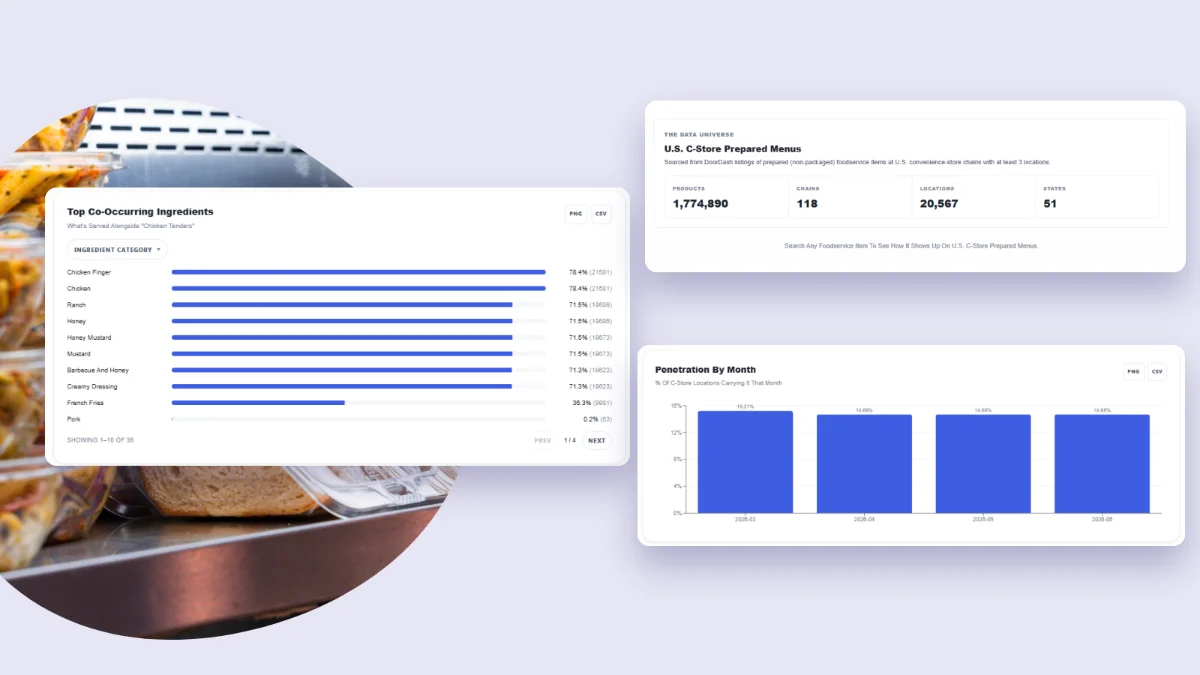
Top co-occurring ingredients and month-by-month availability across tracked c-store prepared menus.
The same pattern shows up on the consumer side. Within the high protein snack universe, egg bites register as an emerging signal at 25.5% growth with 30.9% menu presence, and meat sticks are growing 28.4%. Both are formats that deliver protein without asking the shopper to change a habit. The wider format picture sits in the snack trends analysis.
Two counter-signals deserve attention. The on the go claim fell 13.3% in the grab-and-go universe and healthy fell 23.6%, while convenient rose. People are still buying fast solutions, but the language they use has moved from lifestyle framing to plain utility. Clean label is growing 113.4%, though from a very small base of 0.15% claim share, so treat it as an early signal rather than a mainstream expectation.
Where the market opportunity sits
The gap is between conversation and distribution. Grab-and-go demand signals rose 27.7% in the past 12 months across the US panel, while a benchmark prepared item sits at 15.2% of locations. Meanwhile roughly one third of convenience store shoppers plan to stop at a quick service restaurant within 30 minutes, a leak NACS sizes at more than $100 billion a year. Retail-side context on the same shopper sits in the supermarket food trends analysis.
The risk of waiting is that the differentiators get standardised. Ranch and honey mustard already travel with 71.5% of prepared tender listings, so the obvious pairings are taken. Brands moving now can own the second-layer claim, whether that is an energy cue, a protein format or a single-serve pouch. Brands waiting will be pitching into a shelf where the position is already defined, which is where a retail shelf strategy has to be settled early.
The format recommendation is specific. Move away from bulky multi-serve packaging toward single-serve and dual-compartment configurations built for daytime and active consumption. Convenient, quick and morning all grew in the past year, with morning up 15%. That points at a daypart, not only a pack size.
How an innovation team would use this, illustrated
The scenario below is illustrative and generic. It is not a named client outcome.
An R&D innovation manager at a snack brand needs to justify formulation spend on a premium grab-and-go line. Rather than commissioning a study, they pull the grab-and-go demand signals first. They confirm that energy and comfort cues are both rising while healthy framing is falling. Then they check which convenience chains already carry adjacent prepared items, and at what location penetration. The output is a concept brief with a claim hierarchy and a target chain list, built from live signals instead of assumption.
What your team should do next
R&D: pair a high-familiarity base with one added functional claim. Energy at 34.7% growth and protein at 7% share carry the clearest headroom in the grab-and-go universe. Validating a concept against live demand signals is faster than a formulation cycle built on assumption.
Marketing: test claim language before you print it. Convenient, easy and quick are all rising while healthy is falling, which suggests utility framing beats wellness framing in this channel right now. Food marketing built on the wrong claim wastes the pack real estate you fought to win.
Sales: lead with location penetration rather than social volume. A buyer at a chain sitting near 20% penetration in a category where Fastrac and Casey’s run close to 98% has a concrete gap to close, and that framing converts better than a trend claim. The same logic applies when you benchmark against the largest CPG food companies moving into the channel.
About this data
The signals in this article come from Tastewise, which analyses billions of real consumer data points across social platforms, digital recipe and menu listings, and convenience store product listings to give a live view of convenience food trends 2026.
- Consumer panel, grab-and-go universe: 169,748 people and 287,733 posts across the US panel, up 27.7% in the past year.
- Operator coverage in that universe: 28,501 menu items across 16,014 restaurants and 344 chains.
- C-store prepared menu coverage: 1,774,890 product listings across 118 chains, 20,567 locations and 51 state-level markets. Source is prepared, non-packaged foodservice items at chains with at least three locations.
- Refresh cadence: prepared menu penetration is tracked monthly, with readings here from March to June 2026.
By pairing consumer demand signals with verified location-level availability, your team can tell the difference between a trend that is being discussed and one a shopper can actually buy today.
FAQs about convenience food trends
Convenience as a baseline expectation, functional claims stacked on top of it, and a widening gap between demand and distribution. In the Tastewise US grab-and-go universe, convenient leads all demand signals at 19% claim share with 9.4% growth, while energy is the fastest riser at 34.7%. Prepared food is also now the largest in-store category at US convenience stores.
The prepared menu moves faster than the packaged shelf and is distributed far less evenly. Chicken tenders, a reasonable benchmark, appear at 15.2% of tracked US convenience store locations. Chain-level penetration ranges from close to 98% at leaders such as Fastrac and Casey’s down to a small fraction elsewhere. Packaged assortment is more standardised, so the sell-in argument is different.
Utility claims are outperforming wellness claims in this channel. Convenient, easy, quick and morning all grew in the past 12 months, while healthy fell 23.6% and the on the go phrasing fell 13.3%. Clean label is growing quickly at 113.4% but from a very small base, so treat it as an early signal rather than a mainstream expectation.


We’d love to learn your goals and see how Tastewise fits
We’d love to learn your goals and see how Tastewise fits
Get a personalized demo
Good taste. Wise move.
Your demo request is confirmed. We’ll reach out within one business day to schedule your walkthrough.
What happens next

See what’s driving demand, then turn it into a sell-in story for retailers and operators.
- Connect consumer panels, market trackers, and agents into one evidence view
- Get the “why” behind what’s changing, with explainable demand drivers
- Walk away with a buyer-ready narrative and next steps to activate
Trusted by





“Tastewise is my secret tool for knowing what consumers want next and why.“