





AI Survey Agent for Concept Validation
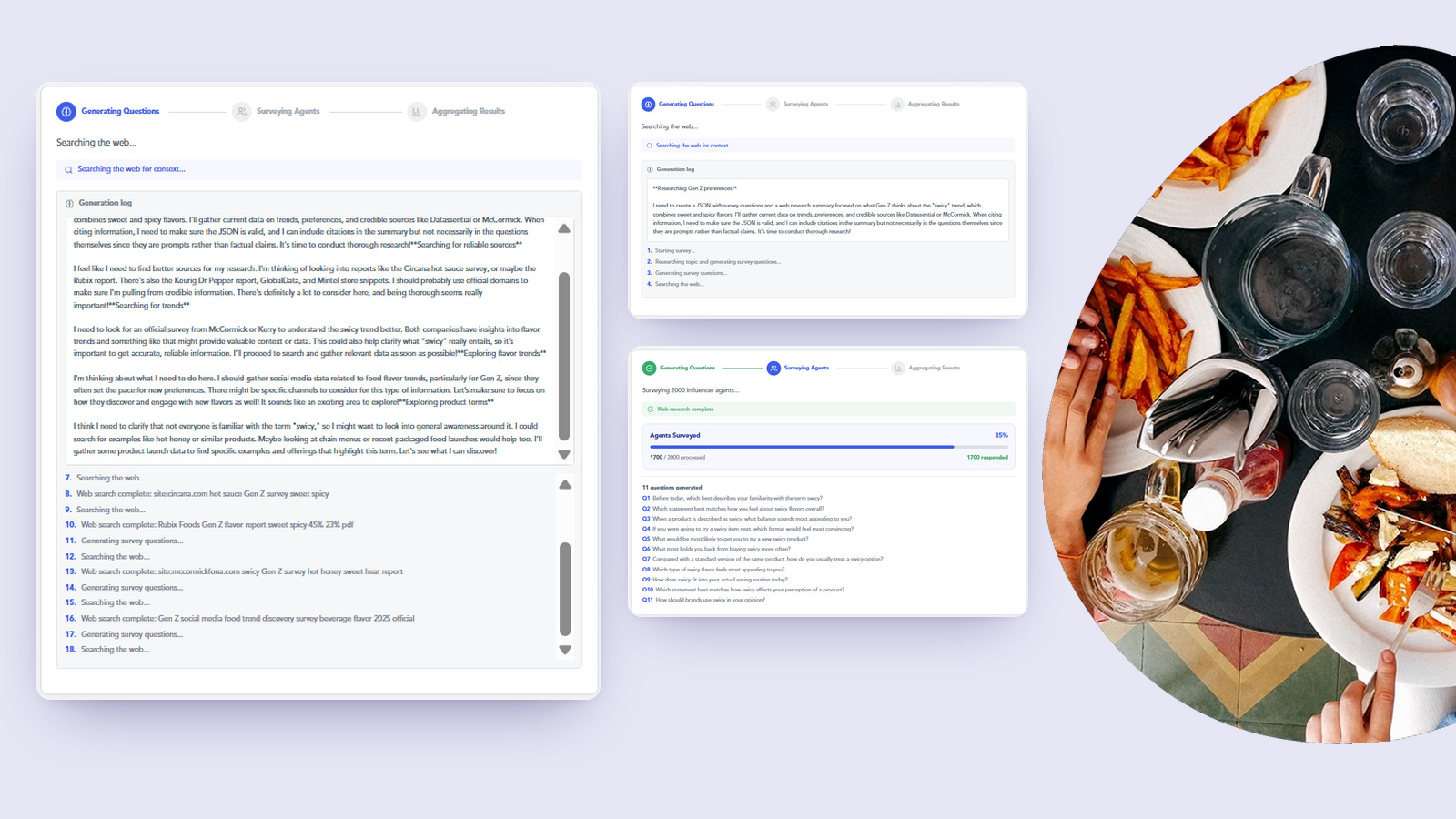
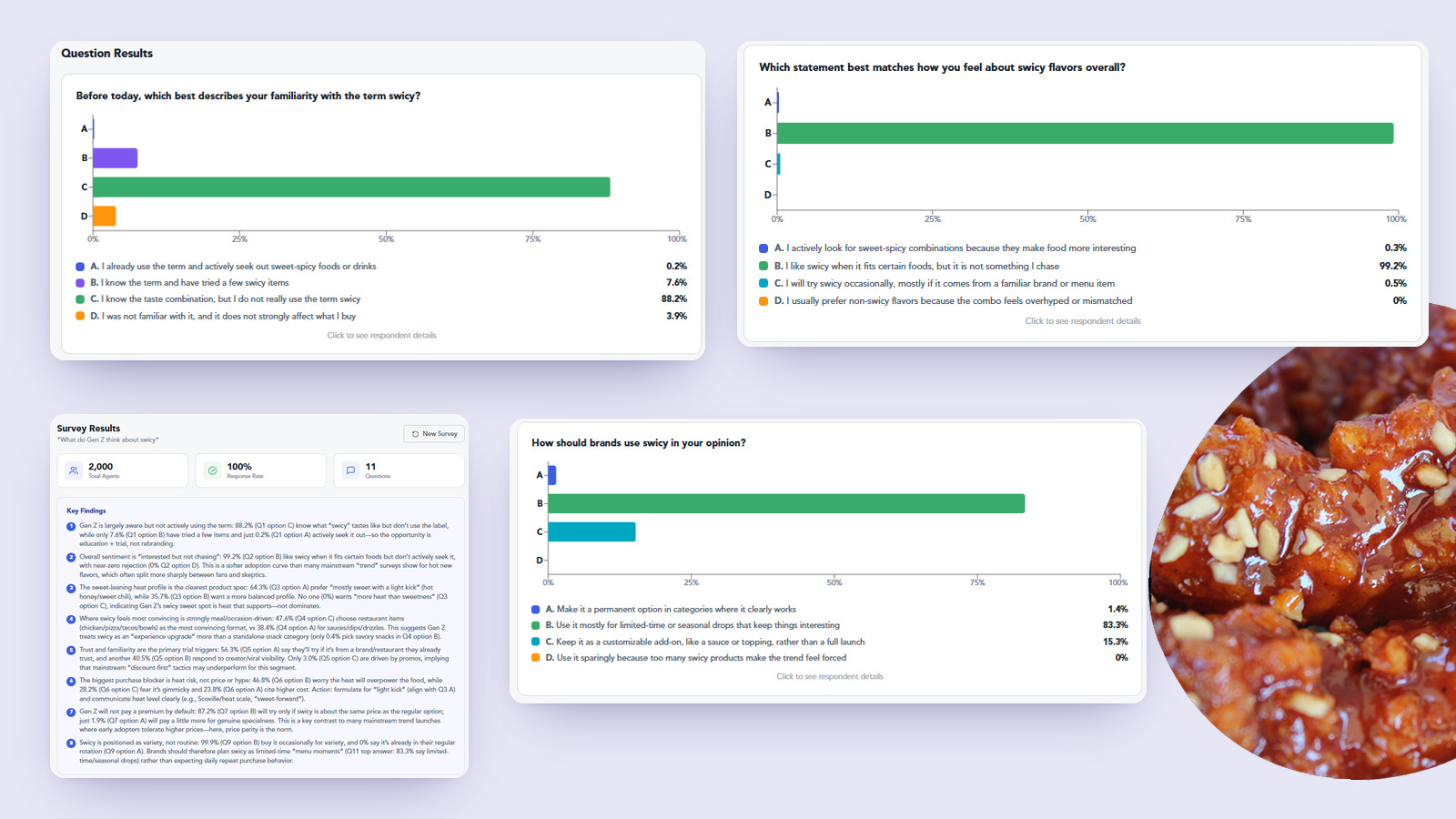
The AI survey agent runs a synthetic survey on the audience you choose: one framed question, a thousand Census-calibrated respondents, and a statistically validated read with segment breakdowns, back in 48 hours rather than six weeks.
Trusted by 80% of the world’s leading food & beverage brands · since 2018










Satiety language outperforms the protein number
Respondents who chose the cottage cheese cup cited staying full longer more often than they cited grams of protein, and the preference strengthens among daily GLP-1 users. Greek yogurt held its ground on taste familiarity rather than on function.
Ask the questions your budget made you skip
The AI survey agent is the consumer research capability your team has been rationing. It puts a concept, a claim or a price in front of a modelled target audience and returns a statistically validated answer, so the question you parked last quarter gets settled this week.
A validated answer in 48 hours
One framed question returns a statistical result across segments in two days, so the answer arrives while the decision is still open rather than after the planning cycle has closed.
Reach the questions observed data cannot
How consumers would react to a new price, a new claim, a new format or a concept that has not launched. The would-they questions that behavioural data alone can never answer.
Segment-level reads, not one average
Every result breaks down by the audience segments you actually plan against, with verbatim quotes alongside the distribution so you get the reasoning and not just the number.
Evidence that survives internal review
Confidence scores and statistical validation flags ship with every finding, and the method is grounded in peer-reviewed research, so the number holds up when insights leadership pushes back.
Powered by Tastewise’s real-time food data
Generic AI answers as itself: one model, one voice, no persona and no calibration, returning one plausible-sounding answer. A synthetic survey works differently. A thousand distinct respondents are built from US Census demographics and public consumer survey data, each given an identity, behavioural guardrails and response calibration tuned to how real Americans answered benchmark surveys. Findings are then cross-checked against observed behaviour across the Tastewise consumer panel, foodservice tracker and eRetail tracker, and the method is grounded in peer-reviewed research published in 2025 by researchers affiliated with EPFL and Stanford.
The deepest food-data layer in the industry.
From one question to a validated read
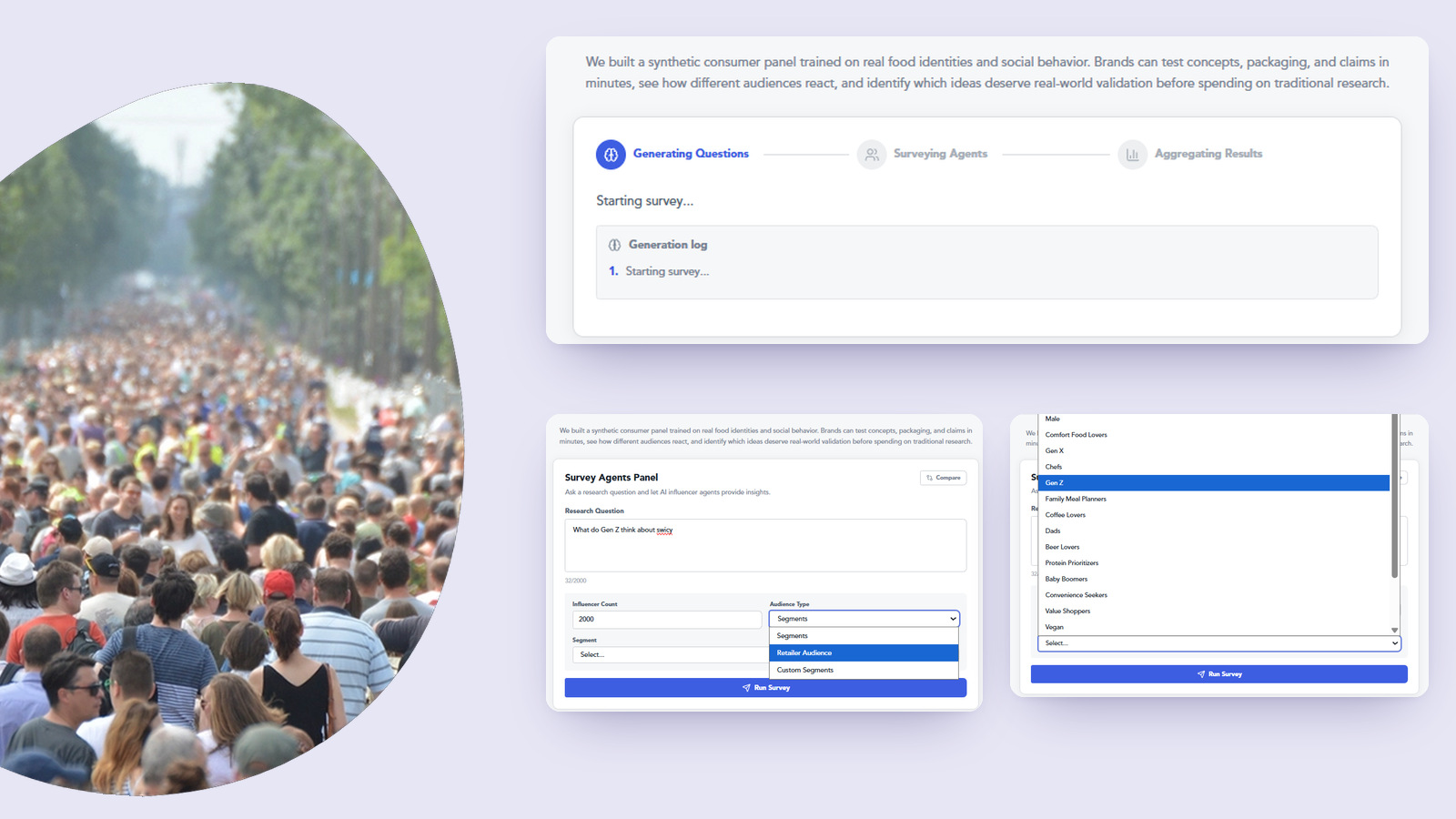
Three steps. One validated data layer. From a plain-language consumer question to a segment-level readout you can take into the room.
Frame the question and the audience
Submit one consumer question in plain language and name the audience you want it put to. No screener design, no fieldwork vendor, no six-week lead time.
The panel answers individually
A thousand respondents each answer in their own voice, not as one aggregate. Every one carries a demographic profile, a persona identity and calibration to real benchmark survey responses.
Get the segment-level readout
Responses become distributions, themes and quotes, cross-checked against what real consumers are observed doing before anything reaches you.
Tastwise’s AI survey agent vs commissioning a study
Without the Tastewise AI survey agent
- Four to eight weeks to a result
- Budget covers one or two questions
- Follow-up means a new brief and a new budget
- One blended average across the sample
- Method sits with the vendor
With the Tastewise AI survey agent
- A validated read in 48 hours
- Ask the questions you had to park
- Re-run with one variable changed
- Breakdown by the segments you plan against
- Confidence score and validation flags on every finding
How brands shaping modern F&B decisions use Tastewise
From rationing questions to fielding them.
One study per quarter. The shortlist gets cut to fit the budget.
Every question on the list gets a validated answer.
From two concepts tested to the whole shortlist.
Concepts advance on internal conviction. Testing is the bottleneck.
The shortlist is screened before the stage gate, not after.
From claim debates to a claim read.
The messaging argument is settled by whoever is most senior.
The claim is chosen on a segment-level preference read.
More AI agents for food & beverage teams
The AI survey agent is one of the Tastewise agent family. Each runs on the same validated F&B data.
Marketing Agent
Build data-backed marketing strategies grounded in real consumer behavior and trend signals.
TradeShow Intelligence
Track competitor launches, innovation themes and buyer signals from industry events.
LTO Innovator
Design limited-time offers optimised for menu impact and consumer excitement.
Brand Navigator
Map brand portfolio health, competitive positioning and white space at a glance.
Blog Post Creator
Produce SEO-ready food editorial content backed by real trend and consumer signals.
Product Visualizer
Generate AI-rendered product imagery for concepts and campaigns before production.
Foodtok Growth Signals
Capture viral TikTok food moments and translate creator trends into activation ideas.
Recipe Innovation
Develop trend-grounded recipe concepts tuned for operator and retail channel fit.
Synthetic Survey Agent
Runs panels on-demand to validate concepts with target audiences.
See the AI survey agent run your question
80% of leading food brands use Tastewise to turn signal into decisions. Book a session and bring the concept your team has been arguing about internally. We will put it to a panel.
FAQs about Tastewise’s AI survey agent
What is the AI survey agent and how does it work?
The AI survey agent is the Tastewise agent for validating a concept, claim or price with a target audience. You submit one framed question in plain language and name the audience. The agent runs a synthetic survey across a thousand respondents built from US Census demographics and public consumer survey data, each answering individually, then aggregates the responses into distributions, themes and verbatim quotes. You get a statistically validated readout with segment breakdowns in 48 hours. Inside the platform it appears as Synthetic Survey Agent.
How accurate is a synthetic survey compared to real fieldwork?
Benchmarking shows a 92% match against traditional fieldwork and 90% test-retest reliability. Residual bias sits under 5% after US Census calibration, down from up to 86% before it. The methodology is grounded in peer-reviewed research published in 2025 by researchers affiliated with EPFL and Stanford. Every finding ships with a confidence score and statistical validation flags, so you can see how much weight a given result carries rather than taking the whole readout at face value.
How is the AI survey agent different from asking ChatGPT?
The difference is the research pipeline around the model, not the model itself. ChatGPT answers as itself: one voice, no persona, no calibration, one plausible-sounding answer. The AI survey agent constructs a thousand distinct respondents from real demographic data, gives each an identity and behavioural guardrails, tunes their responses to match how real Americans answered benchmark surveys, aggregates the results into findings, and cross-checks those findings against observed consumer behaviour. Five layers of research structure sit around the language model.
What kind of questions should I put to the AI survey agent?
The ones observed data cannot reach. How consumers would react to a new price, a new claim, a new pack format, or a concept that has not launched yet. If your question starts with “would they” or “which of these”, it is a fit for a synthetic survey. If it starts with “what are they already doing”, the Insights Agent is the better route, because that is a question about observed behaviour rather than stated preference.
Which markets does it cover?
The panel is currently modelled on the US consumer population. Respondents are built from US Census demographics and calibrated against how real Americans answered benchmark surveys, so results are representative of the US market specifically. That is narrower than the wider Tastewise footprint, which tracks observed behaviour across 4M+ foodservice locations and 39 markets, and it is deliberate: calibration is what produces the accuracy.
Is the AI survey agent enterprise ready?
Yes. It runs on the same platform already cleared by every customer AI committee that has reviewed Tastewise, and it is in use across insights, innovation and marketing teams at global food and beverage companies. Because the methodology is published and peer-reviewed rather than proprietary and unexplained, it can be defended in an internal methods review, which is usually the first question an insights function asks.
What is the difference between AI Surveys and AI Panels?
They sit on the same foundation and answer different shapes of question. The AI survey agent handles targeted validation: one framed question, one statistical result across segments, back in 48 hours. AI Panels handles strategic exploration: open, multi-angle, forward-looking questions that return a full multi-dimensional report. If you know the question, use the survey agent. If you are still working out what the question is, use AI Panels.