






AI concept testing for CPG innovation teams
The Marketing Tester Agent renders your pack, claim and concept for a named audience and shows you how it lands on a real shelf, so the idea is tested before the budget is committed.
Trusted by 80% of the world’s leading food & beverage brands · since 2018










Creatine, not protein, is the claim with room left to grow at 25.61%
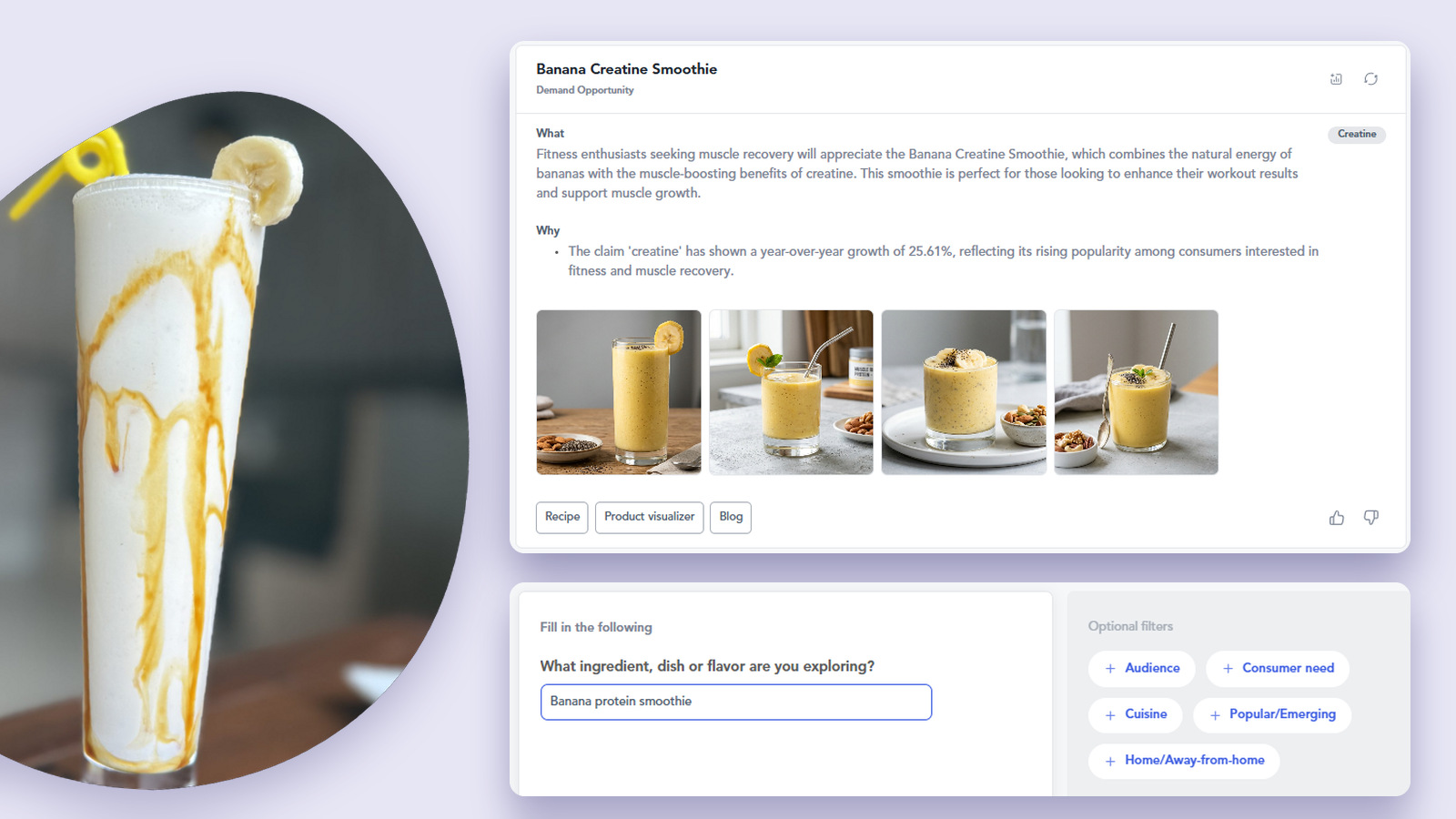
Protein is table stakes on a banana smoothie and does nothing to separate the concept. The creatine claim is up 25.61% in the past year among consumers focused on muscle recovery. The agent rebuilt the concept as a Banana Creatine Smoothie and rendered four pack directions for it.
AI concept testing that answers the go or no go question
The AI concept testing tool your innovation team has been missing. It builds the concept, shows the demand underneath it and renders it. Then it puts that concept in front of the audience you are actually selling to, before the budget is committed.
Concepts built on demand, not on instinct
Type an ingredient, dish or flavor and get a concept the data already supports, with the claim that carries it named for you.
Your buyer, not a national average
Set the panel across age, region, income and household, then test the concept against that exact group.
Something people can react to
Each concept ships with rendered pack visuals, so the panel responds to a product rather than to a paragraph of description.
Fewer concepts that die late
Automated concept testing kills the weak idea at the concept stage instead of in costing, and sends the survivor into the line review with evidence.
Powered by Tastewise’s real-time food data
Generic AI grades a concept against the open web, which is where marketing copy lives rather than where eating happens. The Tastewise concept testing platform runs on observed behavior: what people cook, order, post and buy, validated before any agent is allowed to act on it.
The deepest food-data layer in the industry.
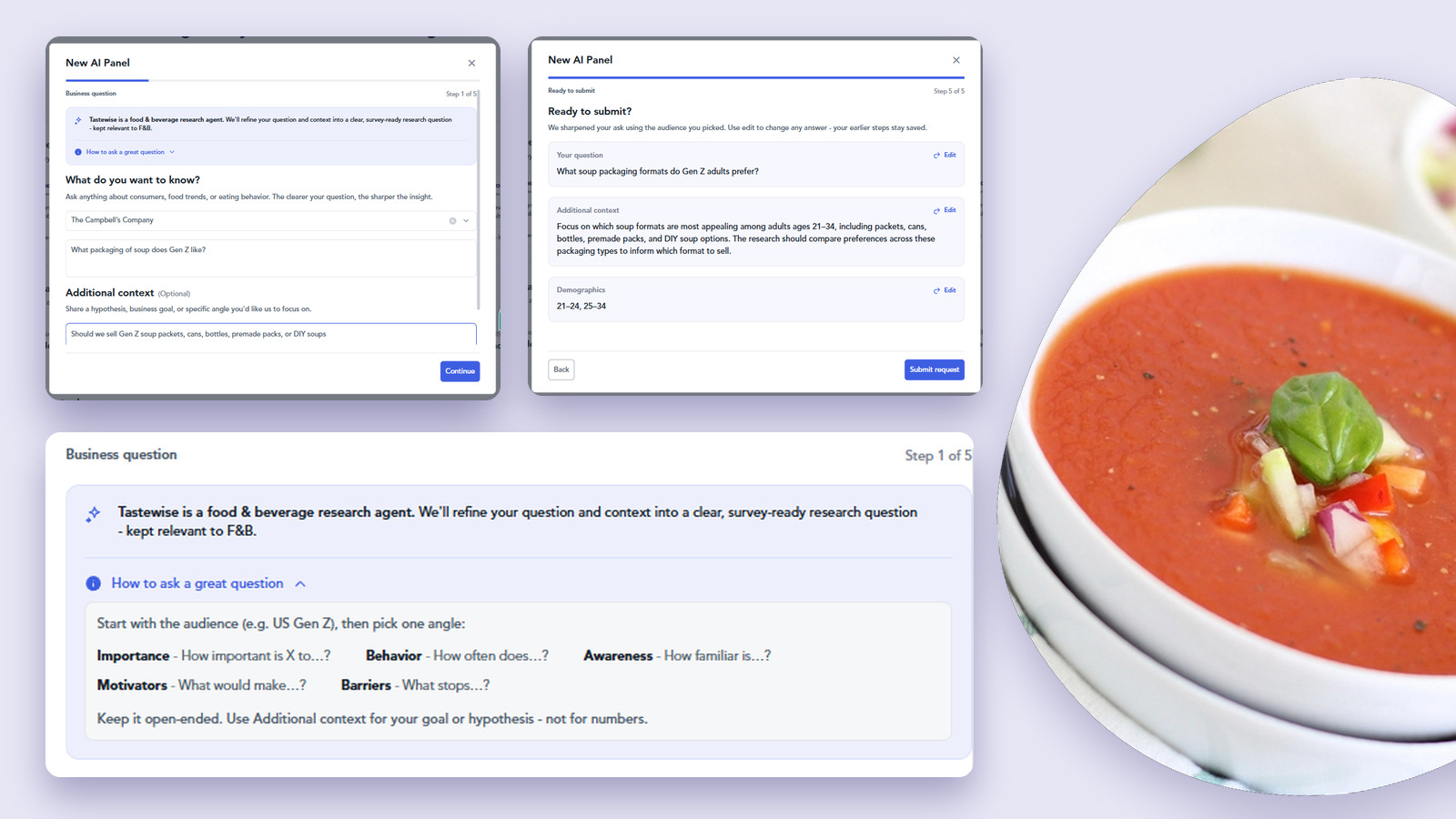
AI concept testing in three steps, idea to reviewed result
Three steps. One validated data layer. From a flavor you are curious about to a concept with panel evidence behind it, checked by a Tastewise analyst before it reaches you.
Enter the idea you are exploring
Type the ingredient, dish or flavor. Narrow it with filters for audience, consumer need, cuisine, lifecycle stage and channel.
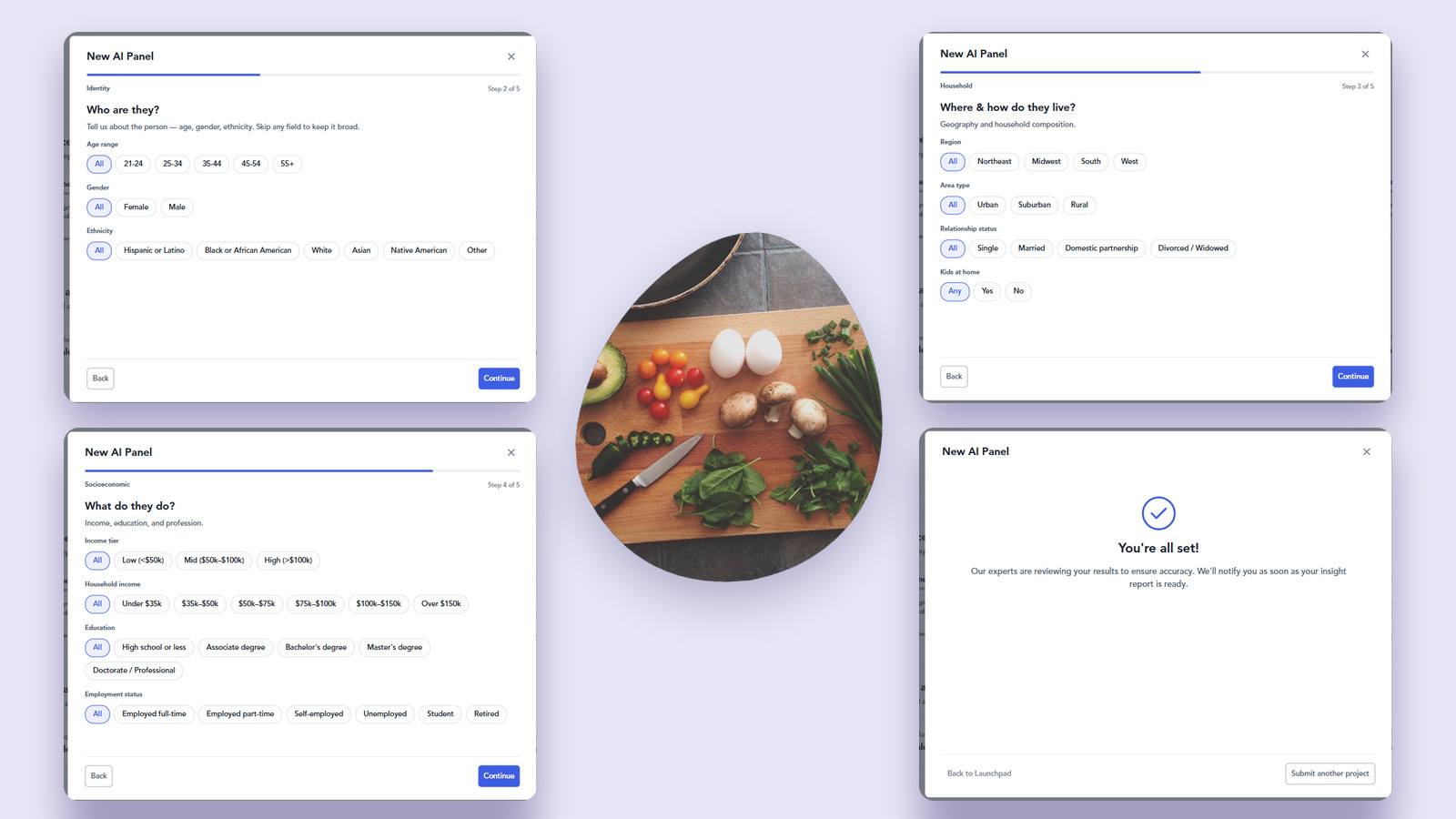
Define who answers
Build the panel across identity, household and socioeconomic detail, so the answer comes from your buyer rather than from a national sample you then have to caveat.
Get the expert reviewed result
The agent returns the concept, the claim movement behind it and rendered pack visuals, and a Tastewise analyst reviews the panel result for accuracy before you see it.
AI concept testing vs traditional concept testing
Without the AI Concept Testing Agent
- Six to eight weeks and a field cost per round
- One concept tested, the rest cut on instinct
- A written description respondents have to imagine
- A national sample you caveat in the readout
- Verbatims with no market context around them
With the Tastewise AI Concept Testing Agent
- A concept and the evidence behind it in one session
- Every concept on the roadmap gets a read
- Rendered pack visuals people can react to
- A panel set by age, region, income and household
- A result tied to live claim and demand movement
How brands shaping modern F&B decisions use Tastewise
From one concept a quarter to the whole list tested.
Budget covers a single round. Most ideas never get tested at all.
Every concept on the roadmap gets a read before the gate.
From choosing the claim in a workshop to choosing it on the data.
The lead claim is picked in a room. Nobody can say what is behind it.
The claim is picked on its movement. Saturated claims get dropped early.
From defending the idea to presenting the evidence.
The concept goes into the line review as an opinion with a mood board.
It goes in with panel results, the demand behind it and rendered packs.
More AI agents for food & beverage teams
The AI Concept Testing Agent is one of the Tastewise agent family. Each runs on the same validated F&B data, from the consumer signal that starts a concept to the operator-level sell-in story that lands it.
Marketing Agent
Build data-backed marketing strategies grounded in real consumer behavior and trend signals.
TradeShow Intelligence
Track competitor launches, innovation themes and buyer signals from industry events.
LTO Innovator
Design limited-time offers optimised for menu impact and consumer excitement.
Brand Navigator
Map brand portfolio health, competitive positioning and white space at a glance.
Blog Post Creator
Produce SEO-ready food editorial content backed by real trend and consumer signals.
Product Visualizer
Generate AI-rendered product imagery for concepts and campaigns before production.
Foodtok Growth Signals
Capture viral TikTok food moments and translate creator trends into activation ideas.
Recipe Innovation
Develop trend-grounded recipe concepts tuned for operator and retail channel fit.
Synthetic Survey Agent
Runs panels on-demand to validate concepts with target audiences.
Ready to see this agent in action?
80% of leading food brands use Tastewise to turn signal into revenue. Book a session and get the AI Concept Testing Agent built around your category and your next concept.
FAQ
What is AI concept testing and how does the Tastewise agent work?
AI concept testing is the practice of validating a product idea against real consumer behavior and a defined audience before you commit to production. The Tastewise agent is called the Marketing Tester Agent inside the platform. Give it an ingredient, dish or flavor. It surfaces the claim with real movement behind it, builds the concept, then renders pack visuals for it. You define the panel, the agent runs the concept past it, and a Tastewise analyst reviews the result before it reaches you.
How is AI concept testing different from asking ChatGPT to score my concept?
A general model grades your concept against the open web, which is mostly marketing copy, competitor claims and food media. It has no view of what people actually cooked, ordered or bought, and no way to hold a defined audience. Tastewise runs on 1T+ structured food and beverage data points and a 500K person panel, so an AI concept testing run can tell you a claim is saturated rather than just plausible. Every output traces back to the signal it came from.
Is AI concept testing accurate enough to make a launch decision on?
It is built to be defensible in the room. Signals pass through validation and confidence scoring before any agent acts on them, and panel results go through a human evaluation layer, so what you receive has been checked by a Tastewise analyst rather than generated and shipped. Teams typically use it to decide which concepts advance and which get cut, then take the survivors into the same stage gates they already run.
Which audience can I test a concept against?
You define it. Identity covers age band, gender and ethnicity. Household covers region, urban, suburban or rural, relationship status and kids at home. Socioeconomic covers income tier, household income band, education and employment status. Leave any field open to keep the read broad, or narrow all of them when the question is really about one segment. The concept testing software then tests against that group rather than against a national average.
What do I actually get back from an AI concept testing run?
Three things. The concept itself, written as a product a buyer would recognize. The evidence underneath it, naming the claim or consumer need and the movement behind it, for example a creatine claim up 25.61% in the past 12 months. And rendered visuals of the concept, with the option to push it straight into a recipe, a product visualization or editorial content from the same screen.
Is the Tastewise AI concept testing platform enterprise ready?
Yes. Tastewise is used by 80% of the world’s leading food and beverage brands and has been since 2018. Every agent run is traceable, every output citable and every decision auditable, which is the posture enterprise AI committees ask for. Full detail on security, privacy and compliance sits on the Tastewise trust page.
What is the difference between AI concept testing and AI Panels?
They sit on the same data foundation and answer different shapes of question. Use the AI concept testing agent when you have a concept or a flavor idea and need to know whether it holds up, with the concept and the visuals produced for you. Use AI Panels when the question is open and exploratory and you want a full research report rather than a verdict on a specific concept. If you know what you want to test, start here.