






Search K-12 foodservice menus by state and district
Search any ingredient and see how many K-12 schools have it on the menu, by month, by state and by district, so you know where your whitespace sits before you build the pitch.
Trusted by 80% of the world’s leading food & beverage brands · since 2018










Maryland leads Mid-Atlantic cream cheese adoption at 39.9% of schools
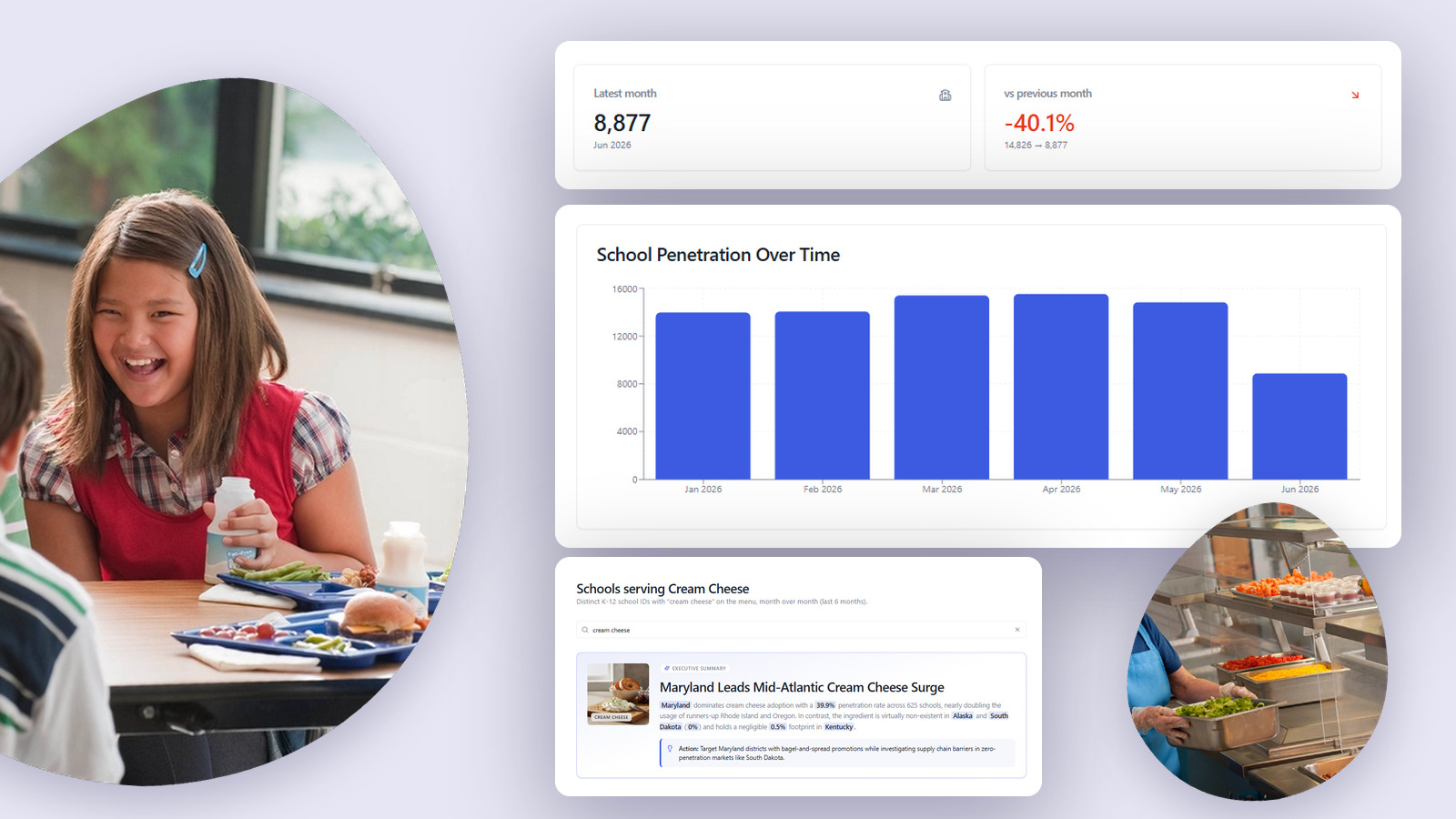
Cream cheese sits on the menu in 625 Maryland schools, 39.9% of the state’s tracked estate and roughly double the next two states, Rhode Island and Oregon. Montgomery County runs it in 205 of its 236 schools and Prince George’s County in 190 of 236. Alaska and South Dakota show no penetration at all.
Move on a K-12 foodservice account while the menu cycle is still open
Every view starts from the district’s own menu, not a national category average.
District-level menu proof
See the exact districts serving your ingredient and the share of their schools doing it, before you ask for the meeting.
State whitespace, mapped
Penetration by state shows where your ingredient is established and where nobody has it on the menu yet.
Menu movement month over month
Six months of school counts show whether an item is spreading, holding, or just following the school calendar.
A summary you can lift
Each search returns a headline finding and a recommended action, ready to drop into a national account deck.
K-12 foodservice data pulled from real school menus
Published district menus are read against the school roster, so every figure is a count of distinct schools rather than an estimate. Ingredient variants stay separate, so cream cheese frosting never inflates your cream cheese number.
The data layer behind every K-12 foodservice search

From ingredient to K-12 foodservice pitch in three steps
One search. Three views of the same menu reality: month, state, district.
Search the ingredient you sell
Type the ingredient or dish and pick the exact variant, so cream cheese frosting stays out of your cream cheese numbers.
Read penetration by state and district
The map gives share of schools per state and the table ranks districts by count and by share of their own school estate.
Take the summary into the account
The executive summary names the leading market, the zero-penetration markets and the action to run, in language you can lift into a deck.
Tastewise K-12 foodservice targeting with menu data versus without it
Without K-12 foodservice menu data
- District list bought from a roster vendor
- No view of what the district already serves
- One national pitch for every state
- Zero penetration read as no demand
- Seasonal dips mistaken for decline
With K-12 foodservice menu data
- District list ranked by share of schools already serving your item
- The district’s own menu, school by school
- State by state whitespace, so the pitch changes with the market
- Zero penetration read as a route-to-market gap
- Six months of counts, so the school calendar is visible
How teams selling into K-12 foodservice use Tastewise
From roster lists to districts ranked by menu fit.
Cold district lists. No menu context. Long qualification cycles.
Districts ranked by share of schools already serving the item.
From national averages to district-level evidence.
One category story for every state. The buyer brings better data.
State penetration and district share, named in the room.
From guessing what schools accept to reading what they serve.
Concepts built on assumptions about compliance and student appeal.
Formats checked against what districts already put on the menu.
More AI agents for food & beverage teams
The AI Sales Story Creator Agent is one of the Tastewise agent family. Each runs on the same validated F&B data, from AI sales forecasting food and beverage teams rely on, to operator-level sell-in intelligence.
Marketing Agent
Build data-backed marketing strategies grounded in real consumer behavior and trend signals.
TradeShow Intelligence
Track competitor launches, innovation themes and buyer signals from industry events.
LTO Innovator
Design limited-time offers optimised for menu impact and consumer excitement.
Brand Navigator
Map brand portfolio health, competitive positioning and white space at a glance.
Blog Post Creator
Produce SEO-ready food editorial content backed by real trend and consumer signals.
Product Visualizer
Generate AI-rendered product imagery for concepts and campaigns before production.
Foodtok Growth Signals
Capture viral TikTok food moments and translate creator trends into activation ideas.
Recipe Innovation
Develop trend-grounded recipe concepts tuned for operator and retail channel fit.
Synthetic Survey Agent
Runs panels on-demand to validate concepts with target audiences.

Ready to see this agent in action?
80% of leading food brands use Tastewise to turn signal into revenue. Book a session and get K-12 Menu Intelligence built around your product and your target districts.
FAQ
What is K-12 foodservice menu intelligence and how does it work?
It is a search over published K-12 school menus. You type an ingredient or dish, and it returns the number of distinct schools with that item on the menu in the latest month, the same count for the previous five months, penetration by state, and a district table showing how many of each district’s schools serve it. Every search also returns a written summary naming the leading market, the markets at zero, and a recommended action. You are reading what schools actually serve, not what a survey says they intend to serve.
Where does the K-12 foodservice menu data come from?
Yes. Sales Story Creator Agent is built for both independent operators and chain accounts. For independents, it surfaces local menu trends and cuisine-specific whitespace. For chains, it pulls category dynamics and competitive positioning across the full chain menu set, so national account managers arrive at QBRs with data the buyer did not bring to the table.
How is this different from asking ChatGPT about K-12 foodservice trends?
A general model has no school roster and no menu file, so it will describe school food in the abstract and cannot tell you that Chicago Public School District 299 serves cream cheese in 400 of its 800 schools while Tucson Unified is at 69 of 259. The difference is not phrasing, it is whether there is a countable menu behind the answer. Every figure here traces back to a named district and a named month.
Is the K-12 foodservice data enterprise ready for a national account review?
Yes. Counts are distinct schools with the denominator shown, so a category buyer can check the fraction rather than take a percentage on trust. Ingredient variants are held apart, which matters when a buyer challenges whether cream cheese frosting was counted as cream cheese. It runs on the same Tastewise data foundation and the same enterprise posture that customer AI committees have already cleared.
Can I see K-12 foodservice penetration for one state or district?
Yes, both. The state map gives share of tracked schools per state, with a hover reading like Nebraska at 5.1%, 60 of 1,181 schools, and it names the lowest-penetration district inside that state. The district table sorts by raw count or by share of the district, so you can separate the districts that matter by volume from the ones where you already own the estate.
Why do K-12 foodservice school counts fall in June?
Because the school year ends. Cream cheese counts ran between 13,900 and 15,500 schools from January to May 2026 and then dropped to 8,877 in June, a fall of 40.1% in one month. That is the academic calendar, not demand leaving the category. Read June and July against the previous June and July, and read the in-session months against each other.
Who uses K-12 foodservice menu data at a supplier or distributor?
K-12 and non-commercial channel sales teams use it to qualify districts before outreach. National account managers use it to bring district-level evidence into a review. Product and menu development teams use it to check that a format is already accepted in school menus before committing to a run. Distributors and brokers use it to prioritise a territory by where the item is established and where it is absent.