







The lentils price trend split in two over the past 12 months. Green lentil bids in Western Canada fell sharply after a 2025 surplus, then firmed as the 2026 crop shrank. Red lentils held a narrower range as India kept buying. Whether you are optimizing procurement budgets or analyzing trade shifts, keeping track of every macro lentils trend is critical to navigating supply chain volatility. This technical breakdown outlines key driver metrics, global production shifts and the supply signals that will shape pricing into 2027. It also follows lentils past the farm gate, onto US menus and shelves, using Tastewise data.
Key takeaways
- Western Canadian large green lentil bids sat at 25 to 27 cents per pound FOB farm in mid-September 2026, against 35 to 45 cents delivered for new-crop Lairds in late July 2025.
- Green lentil production fell 36% in Canada and 42% in the US in 2026, which is now supporting green prices.
- India may import 1.6 million tonnes of lentils in 2026/27, close to its record, with the basic import duty still at 10%.
- Agriculture and Agri-Food Canada cut its 2026-27 lentil ending stocks forecast to 1.09 million tonnes, from 1.54 million in July.
- Across Tastewise US menu data, lentil menu items grew 11% between August 2025 and August 2026, while the average lentil item price rose 2.3% to $13.32.
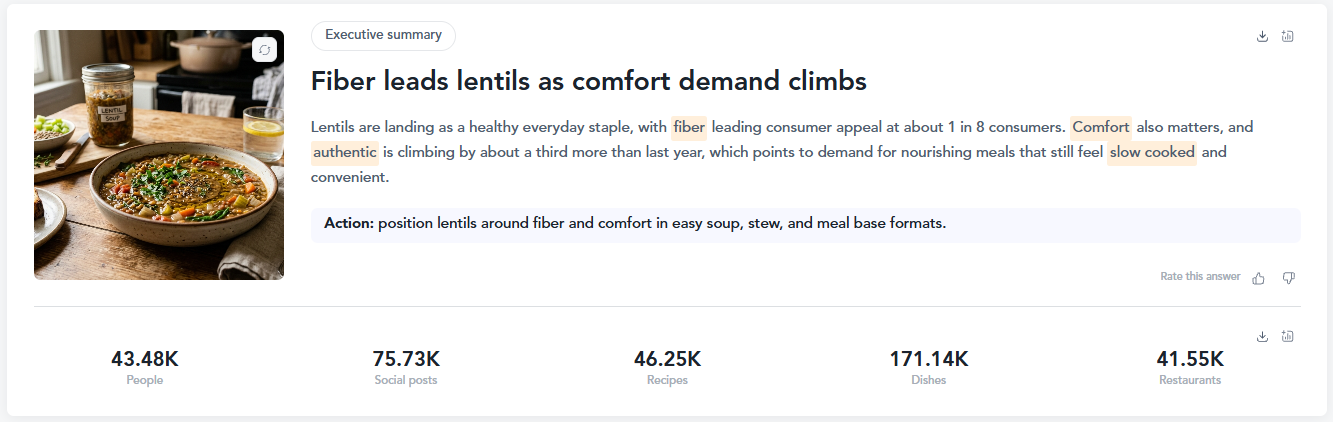
- Fiber is the fastest-rising reason to buy lentils, up 18% over the past year in Tastewise consumer interest data.
Lentils price trend chart (market benchmark comparison)
The lentils price trend depends on the class, the origin and the point in the supply chain where you buy. The table below maps the latest public benchmarks against volume shifts and trade balance indicators. Western Canadian bids are in Canadian cents per pound. FOB farm means the price paid at the farm before freight, so it sits below a delivered bid for the same lentil.
| Market and class | Lentils price trend | Volume shift | Lentils trend indicator for trade |
|---|---|---|---|
| Canada, large green | 35 to 45 cents/lb delivered for new-crop Laird in late July 2025. 12 to 25 cents/lb delivered for Laird and Eston in late April 2026. 25 to 27 cents/lb FOB farm for #2 in mid-September 2026. | Green production down 36% in 2026 | 2026-27 ending stocks forecast cut to 1.09 million tonnes |
| Canada, red | 27 to 29 cents/lb delivered for new-crop Crimson in July 2025. 15.5 to 25.5 cents/lb in late April 2026. About 26 cents/lb delivered for #2 in September 2026. | More than 570,000 tonnes shipped to India in the first half of 2026 | Competes with Australian reds in India |
| Canada, small green | 30 to 31 cents/lb delivered for new-crop Eston in July 2025. 22 to 23 cents/lb FOB farm for #1 in September 2026. | Buyers paying a slight premium for 2026 crop over 2025 crop | Stiff price competition from Russia |
| United States | Montana drought tightened green supply | Production down 42%, with area down 26% and most of the loss in Montana | Crop is mostly green lentils |
| India | Minimum support price of US$771 per tonne against imports near US$600 per tonne after duty in February 2026 | Domestic winter crop of about 1.99 million tonnes | Imports forecast at 1.6 million tonnes in 2026/27, basic duty at 10% |
| Australia | Actively offering red lentils into India | Crop expected at 2.25 to 3 million tonnes | Main rival to Canada in the Indian market |
| US foodservice (Tastewise) | Average lentil menu item at $13.32 in August 2026, up 2.3% | Lentil menu items up 11% | Share of operators listing lentils held steady |
The green premium collapsed. In late July 2025, Prairie Ag Hotwire data put new-crop Laird bids at 35 to 45 cents per pound delivered and new-crop Crimson at 27 to 29 cents. By late April 2026, Grainews reported green prices moving lower while reds were gaining, and the two classes now trade in the mid-20s.
Little of the farm-gate swing reached the menu. The top end of large green bids fell by about 40% between July 2025 and September 2026, even allowing for the shift from delivered to FOB farm pricing. Across Tastewise US menu data, the average lentil item price kept climbing over the same period. It rose in 16 of the last 22 months and reached $13.32 in August 2026.
That gap matters if you sell into foodservice or retail. Over this period, the menu price followed its own path, independent of the bin price. You can follow the menu side in more detail through Tastewise lentil soup menu data.
Key drivers behind the lentils trend breakdown
Three groups of factors moved the lentils trend over the past year. Trade policy and Indian demand set the direction. Weather and acreage decisions set the supply. Substitution between pulses and changing consumer needs set the pull from the end market.
Export and import volumes
- India still sets the direction. UkrAgroConsult expects India to import 1.6 million tonnes in 2026/27, close to the record 1.68 million tonnes bought in 2023/24.
- The expected duty hike did not arrive. In February 2026, analysts told Alberta Farmer Express that India would likely lift its lentil duty from 10% to 30% on April 1. Imports near US$600 per tonne were undercutting a minimum support price of US$771 per tonne. As of autumn 2026, the basic duty stands at 10%.
- Canada stayed a core supplier. More than 570,000 tonnes of Canadian lentils went to India in the first half of 2026, even with a good Indian winter crop of about 1.99 million tonnes.
Climatic and crop yield dynamics
- Drought cut the US crop. US lentil area fell 26%, and three-quarters of that loss was in drought-hit Montana, according to Western Producer. US production is down 42%, and most of it is green lentils.
- Canada corrected its green surplus. Green lentil production fell 36% in 2026. In August, Agriculture and Agri-Food Canada also trimmed its production estimate by 150,000 tonnes and cut 2026-27 ending stocks to 1.09 million tonnes, from 1.54 million in July.
- Australia is the swing crop for reds. Growers there expect 2.25 to 3 million tonnes, and exporters are already offering red lentils into India.
Market substitutions and demand
- Pigeon peas drive green lentil demand. Indian buyers switch to lentils when chickpeas or pigeon peas run short, and analysts expected reduced pigeon pea planting in India to support demand for Canadian greens.
- Russia competes on small greens. Traders describe stiff price competition from Russian small green lentils.
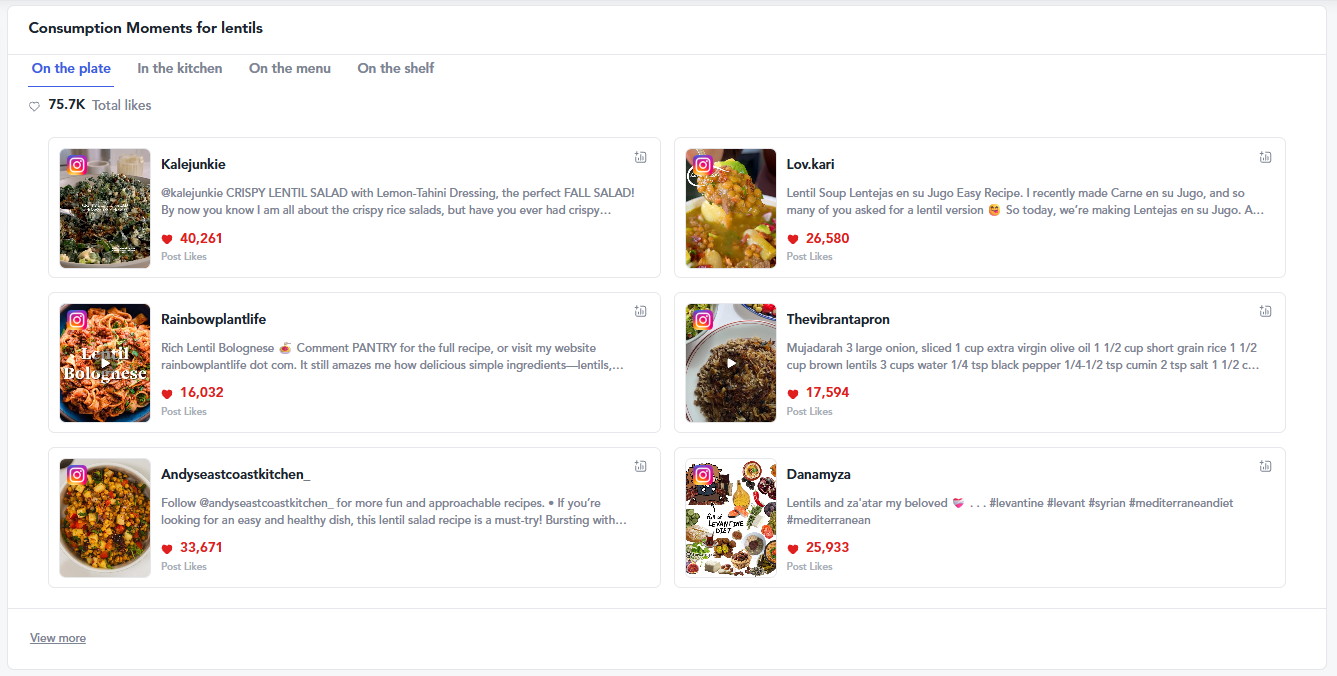
- US menus keep adding lentils. Across Tastewise US menu data, lentil menu items grew 11% between August 2025 and August 2026. The share of operators listing lentils held steady over the same period.
- Chains carry the scale. CAVA serves lentils in 393 locations, the most of any US chain, followed by Just Salad at 99. Corner Bakery Cafe grew its share of lentil-serving locations about fivefold, while Twin Peaks cut its share by about 80%.
- Dishes span cuisines. Best-selling lentil items include adai, dal tadka, dal makhani and Ethiopian misir. Chicken haleem appears among recent menu additions, and mujaddarah among recent price moves. Red lentil dal also appears on school menus, including Laguna Middle School in California.
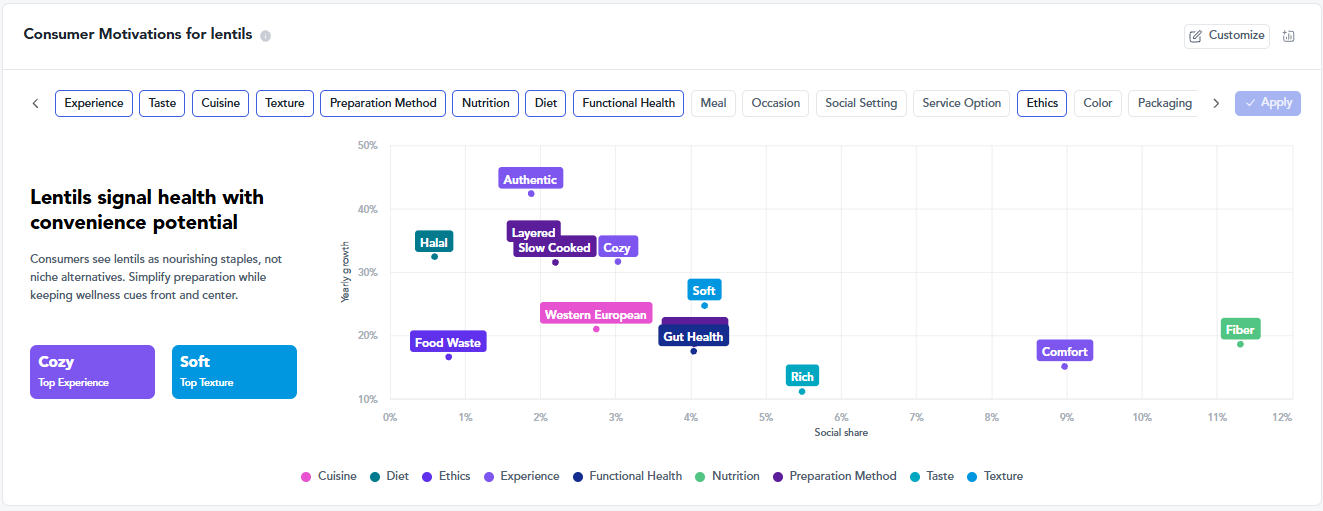
- Consumer needs are shifting toward function. A consumer need is the reason people give for choosing a food. Healthy and protein remain the largest consumer needs around lentils. Consumer interest share is the Tastewise measure of how much US food interest a topic captures. Fiber’s consumer interest share is up 18%, blood sugar is up 17% and energy is up 15%. Plant-based identity is losing ground, with vegan down 17% and vegetarian down 25%.
For lentils, the rise in fiber and blood sugar points to a buyer who wants a functional benefit first and a diet label second. That is useful for product innovation teams writing lentil claims for 2027.
Optimizing sourcing strategies around the lentils price trend
The lentils price trend rewards buyers who treat red and green lentils as separate markets. Reds respond to Indian demand and the Australian harvest. Greens respond to North American supply and the Indian pigeon pea crop. Split your exposure by class, and set separate price triggers for each.
Forward contracting needs a quality view this season. Rayglen’s September market comments show some buyers paying a slight premium for 2026 green lentils over 2025 stock. If your specification allows older crop, you can cover near-term needs from 2025 stock and forward contract 2026 crop for later deliveries.
Seasonal dips are easier to read for small greens. Demand for small greens is front-loaded, so prices tend to soften in spring as new crops from Europe, Morocco, Mexico and the US reach the market. Large greens were two to three cents per pound off their seasonal highs by late April 2026. Spring is the window to test bids if you buy greens.
Put the policy calendar next to the crop calendar. Indian duty rules carry expiry dates, and the 2026 decision point was March 31. Statistics Canada acreage reports, Agriculture and Agri-Food Canada supply updates and the Australian harvest each move bids. A sourcing plan that maps those dates in advance avoids buying into a policy surprise.
Menu and brand teams can plan around a steadier number. Red lentil bids slipped slightly over the year, while the average US lentil menu price rose 2.3%. Red lentil soups and dals already span a wide price range on US menus.
- Roti Mediterranean Bowls, Salads and Pitas ran a red lentil soup with pita as a limited-time item at $4.49.
- Erewhon sells a 32 oz mason jar of lentil soup at $21.75, which shows the premium ceiling for the same base.
- Gelson’s Kitchen added a heat and serve coconut lentil soup at $8.50, a format that sits between foodservice and grocery.
For foodservice operators, a red lentil soup or dal LTO gives you a quick read on price tolerance. For retail sell-in, Goya leads the US online beans, legumes and lentils shelf with 302 products, and Great Value averages $5.28 per product. Lead your lentil pitch with fiber and blood sugar claims, since those consumer needs are rising fastest. You can check class-level demand through Tastewise green lentil trend data and split red lentil demand.
Frequently asked questions about the lentils price trend
Western Canadian large green lentil bids were 25 to 27 cents per pound FOB farm in mid-September 2026, below the 35 to 45 cents delivered paid for new-crop Lairds in late July 2025. Red lentils traded around 26 cents per pound delivered over the same weeks.
Green lentils bottomed in spring 2026 at 12 to 25 cents per pound delivered. They have firmed since, as the 2026 crop came in smaller.
Green lentils were overproduced in 2025, and the surplus pushed bids down through spring 2026. The 2026 crop then came in smaller, with green lentil production down 36% in Canada and 42% in the US.
Russia added pressure by competing hard on price in small green lentils.
India is the largest lentil buyer in the world, so its import volume and duty policy set the direction for Canadian and Australian prices. Imports could reach 1.6 million tonnes in 2026/27, with the basic import duty held at 10%.
Analysts had expected the duty to rise to 30% on April 1, 2026. That increase did not arrive, which kept Indian demand open to imports.
Tighter Canadian supply and the size of the Australian crop are the two biggest swing factors. Agriculture and Agri-Food Canada cut its 2026-27 lentil ending stocks forecast to 1.09 million tonnes, while Australia expects a crop of 2.25 to 3 million tonnes.
Indian pigeon pea output is the third factor to watch, because lentils replace pigeon peas when that crop is short.
Only slightly over a 12-month window. The average US lentil menu item rose 2.3% to $13.32 between August 2025 and August 2026, while Western Canadian green lentil bids fell.
Across Tastewise US menu data, the average lentil item price rose in 16 of the last 22 months.
Lentil menu items grew 11% between August 2025 and August 2026 across Tastewise US menu data. CAVA leads all chains, with lentils in 393 locations.
Fiber is the fastest-rising consumer need around lentils, with its consumer interest share up 18% over the past year.



We’d love to learn your goals and see how Tastewise fits
We’d love to learn your goals and see how Tastewise fits
Get a personalized demo
Good taste. Wise move.
Your demo request is confirmed. We’ll reach out within one business day to schedule your walkthrough.
What happens next

See what’s driving demand, then turn it into a sell-in story for retailers and operators.
- Connect consumer panels, market trackers, and agents into one evidence view
- Get the “why” behind what’s changing, with explainable demand drivers
- Walk away with a buyer-ready narrative and next steps to activate
Trusted by





“Tastewise is my secret tool for knowing what consumers want next and why.“