







The top 10 protein foods are chicken breast, turkey breast, tuna and salmon, plus lean beef and eggs. Greek yogurt, cottage cheese, edamame and lentils round out the list. Each one gives you a different trade between protein, calories, fat and fiber. This guide ranks all ten per 100g using USDA FoodData Central values. It also shows how often each food comes up in US high-protein consumer data from Tastewise, so you can see which proteins people actually cook, order and buy.
Key takeaways
- Chicken breast carries the most protein per 100g on this list at 31 g, with turkey breast close behind at 30.1 g.
- Light tuna canned in water gets 88% of its calories from protein, the highest ratio of the ten foods.
- Plain nonfat Greek yogurt gives you 17.3 g of protein per 100 calories, the best ratio outside meat and fish.
- Chicken appears in about 1 in 5 US high-protein consumer conversations, more than any other whole food here.
- Beef’s share of high-protein conversation slipped only 1.3% over the past year, while protein powder’s fell 26.9%.
- Lentils add 7.9 g of fiber per 100g on top of 9 g of protein, the most fiber of the ten foods.
Top 10 protein foods chart per 100g comparison
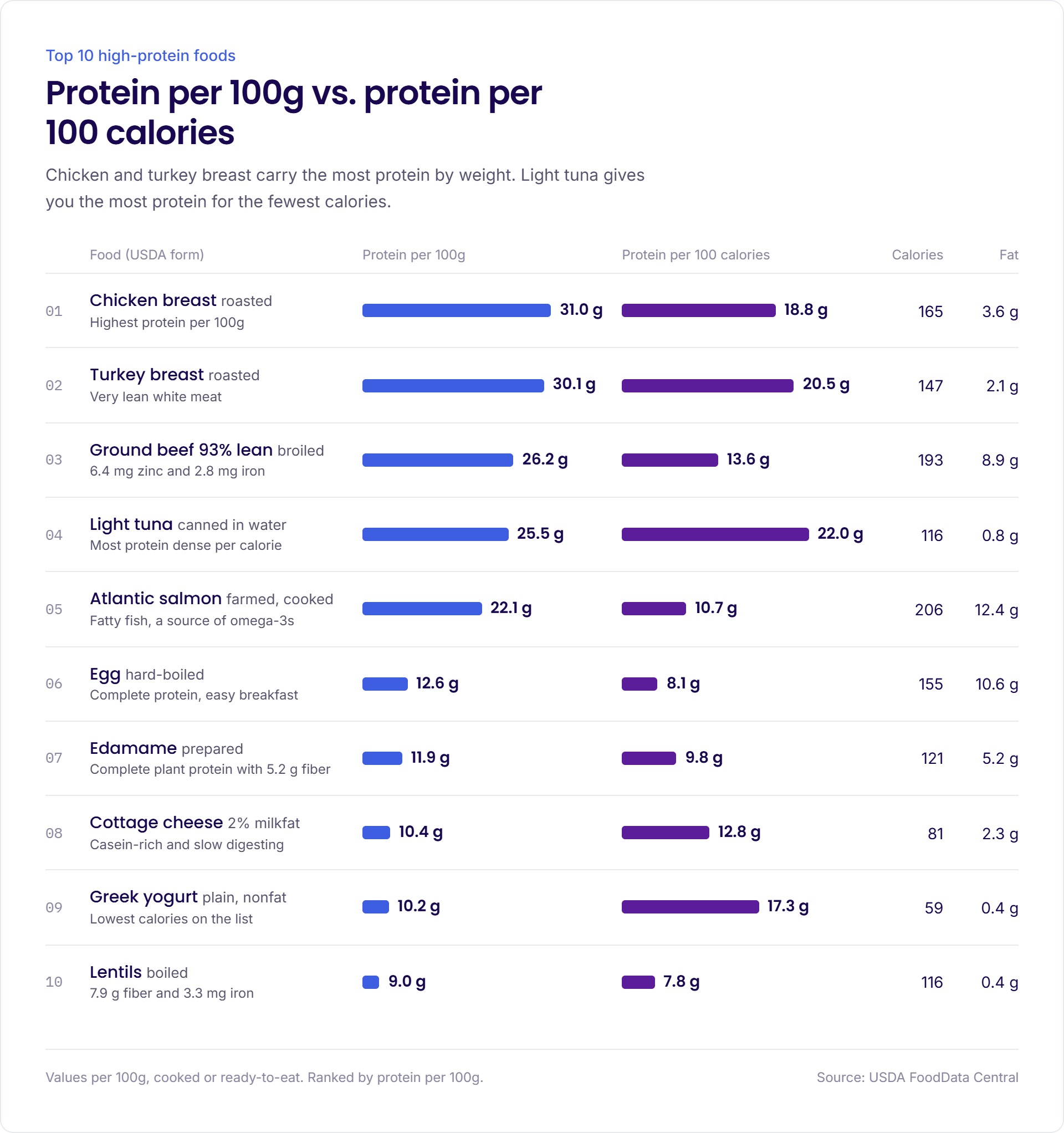
The chart below compares the top 10 highest protein foods per 100g in their cooked or ready-to-eat form. Protein per 100 calories shows how protein dense each food is, which matters most when you are watching calories. In short, chicken breast has the most protein per 100g at 31 g. Light tuna has the most protein per calorie at 22 g per 100 calories. Greek yogurt has the fewest calories at 59 per 100g, and lentils carry the most fiber at 7.9 g.
Source: USDA FoodData Central, SR Legacy entries. Protein per 100 calories is calculated from the USDA protein and calorie values.
Read the chart two ways. If you want the top 10 foods highest in protein per 100g, chicken breast, turkey breast and lean beef lead. If you want the most protein for the fewest calories, tuna, turkey and chicken lead, with Greek yogurt as the standout dairy option.
Top 10 protein-rich foods breakdown
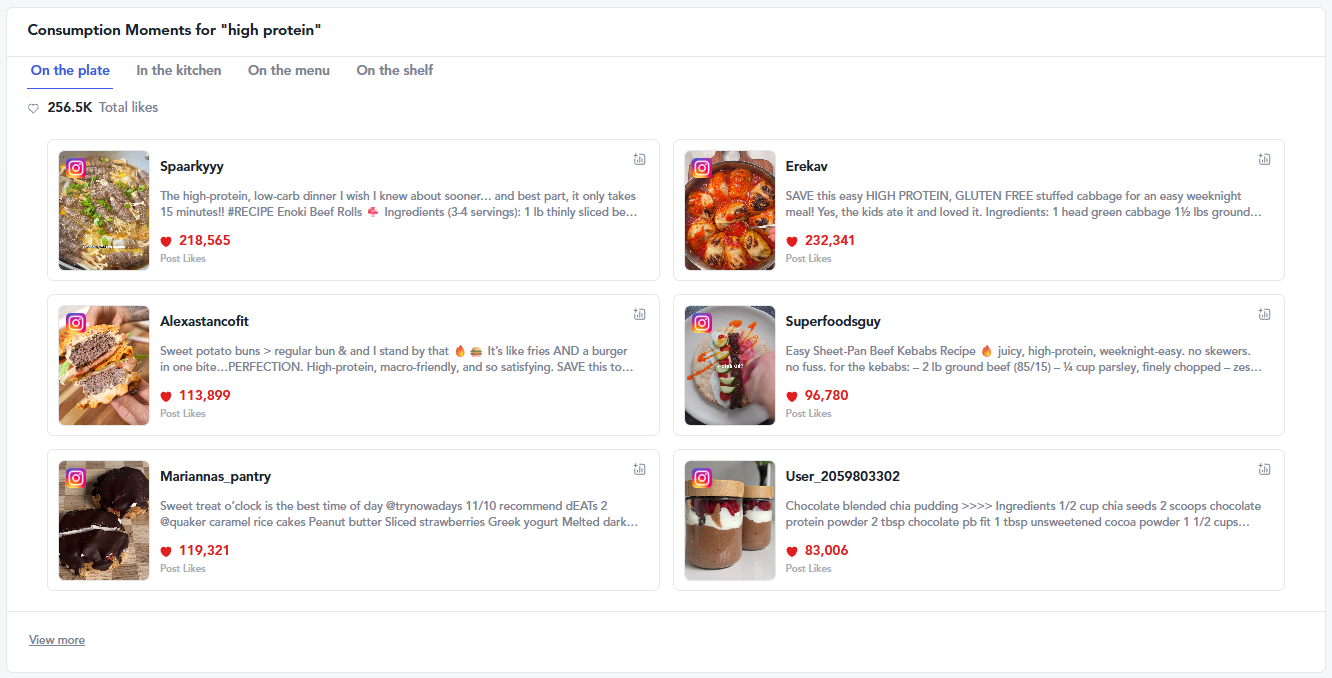
Each entry below covers protein per 100g, calories, fat and a practical pairing. It also shows where the food sits in US high-protein demand, measured as its share of high-protein consumer conversations in Tastewise data over the past 12 months.
1. Chicken breast
Roasted chicken breast delivers 31 g of protein and 165 calories per 100g, with 3.6 g of fat. That makes it the anchor of most top 10 lean protein foods lists and a default for muscle building. Pair it with rice and roasted vegetables for meal prep, or slice it into a grain bowl.
Chicken as a whole shows up in about 1 in 5 US high-protein consumer conversations, the highest of any food on this list. Chicken breast named specifically appears in about 1 in 21, and that share fell 10.6% over the past year.
2. Turkey breast
Roasted turkey breast gives you 30.1 g of protein for 147 calories and 2.1 g of fat per 100g. At 82% of calories from protein, it is one of the top 10 high protein low calorie foods. Use it in wraps, lettuce cups or a turkey burger when you want a leaner swap for beef.
Turkey appears in about 1 in 16 US high-protein consumer conversations. Its share fell 14% over the past year, faster than chicken or beef.
3. Tuna
Light tuna canned in water carries 25.5 g of protein and just 116 calories per 100g, with under 1 g of fat. It is the most protein dense food on this list per calorie, with 22 g of protein per 100 calories. Mix it with Greek yogurt instead of mayo, or add it to a salad or rice bowl.
Tuna shows up in about 1 in 40 US high-protein conversations. On the shelf, Bumble Bee sells albacore pouches labeled as a high-protein snack.
4. Salmon
Cooked farmed Atlantic salmon has 22.1 g of protein and 206 calories per 100g. Its 12.4 g of fat puts it outside the leanest group, and that fat includes omega-3s. Pair it with quinoa and greens, or flake it into a breakfast bowl.
Salmon appears in about 1 in 25 US high-protein consumer conversations, and its share eased 7.3% over the past year.
5. Lean beef
Broiled 93% lean ground beef gives you 26.2 g of protein and 193 calories per 100g. It also provides 6.4 mg of zinc and 2.8 mg of iron, more of both than any other animal protein here. Use it in tacos, burger bowls or a high-protein pasta sauce.
Beef appears in about 1 in 12 US high-protein conversations. Its share dipped only 1.3% over the past year, and ground beef rose 0.8%, making beef the steadiest protein on this list.
6. Eggs
A hard-boiled egg carries 12.6 g of protein and 155 calories per 100g, with a complete amino acid profile. Eggs are the easiest of the top 10 protein foods for breakfast. Eat them boiled, scrambled with vegetables or baked into egg bites.
Egg whites appear in about 1 in 26 US high-protein conversations. On menus, Starbucks sells egg white roasted red pepper egg bites alongside its protein lattes, and First Watch offers a Power Breakfast Bowl.
7. Greek yogurt
Plain nonfat Greek yogurt has 10.2 g of protein and only 59 calories per 100g. That gives you 17.3 g of protein per 100 calories, which makes it one of the top 10 high-protein foods for weight loss. Top it with berries and oats, or use it as a base for sauces and dips. For a side-by-side view, see our breakdown of cottage cheese vs Greek yogurt.
Greek yogurt appears in about 1 in 8 US high-protein conversations, the second highest share on this list after chicken.
8. Cottage cheese
Cottage cheese with 2% milkfat carries 10.4 g of protein and 81 calories per 100g. Most of its protein is casein, which digests slowly and suits an evening snack. Blend it into pancake batter, whip it into dips or eat it with fruit. Our look at the cottage cheese trend covers how it moved into recipes like these.
Cottage cheese appears in about 1 in 12 US high-protein conversations, level with beef and ahead of turkey.
9. Soybeans and edamame
Prepared edamame gives you 11.9 g of protein, 121 calories and 5.2 g of fiber per 100g. Soy is a complete plant protein, which puts edamame at the top of the top 10 protein foods veg list. Steam it as a snack, toss it into salads or blend it into a green hummus. Our soy protein comparison covers how soy stacks up against pea protein in products.
Edamame appears in about 1 in 90 US high-protein conversations, well behind tofu at about 1 in 35.
10. Lentils
Boiled lentils carry 9 g of protein, 7.9 g of fiber and 116 calories per 100g, with almost no fat. They also add 3.3 mg of iron, the most of any plant food here. Use them in soups, lentil salads, curries or lentil meatballs.
Lentils appear in about 1 in 45 US high-protein conversations, and their share fell 20.8% over the past year. That is a steep drop for a food with this much fiber, at a time when fiber mentions in high-protein conversations rose 3.9%.
Optimizing protein foods for muscle building and weight loss
Protein for muscle building
For muscle building, the International Society of Sports Nutrition recommends 1.4 to 2.0 g of protein per kg of body weight per day for most people who exercise. It suggests 20 to 40 g of high-quality protein per serving. For a 75 kg adult, that works out to about 105 to 150 g a day.
In practice, 100g of chicken breast or turkey breast covers most of one 20 to 40 g serving on its own. The same position stand notes that 30 to 40 g of casein before sleep can support overnight muscle protein synthesis, which is where cottage cheese fits.
Protein for weight loss
For weight loss, protein per calorie matters more than protein per 100g. Tuna, turkey breast, chicken breast and Greek yogurt all give you more than 17 g of protein per 100 calories. That lets you hit a protein target while staying in a calorie deficit. The same math applies to GLP-1 friendly foods, which lean on these proteins.
Animal and plant protein compared
Meat and fish on this list give you 22 to 31 g of protein per 100g with no fiber. Edamame and lentils give you 9 to 12 g of protein per 100g with 5 to 8 g of fiber. If you eat plant-based, pairing lentils with grains and adding soy foods helps you reach a complete amino acid profile across the day.
What US consumers are choosing
Tastewise data shows US high-protein eating moving toward whole foods. Protein powder’s share of high-protein conversation fell 26.9% over the past year and protein shakes fell 24.6%. Beef, cottage cheese and salmon held much closer to steady. Brands are responding with protein built into everyday formats, from protein water to Oats Overnight shakes with 20 g of protein and Pastabilities protein pasta.
On menus, high-protein items now appear at more than 44,000 US restaurants and 1,035 chains. Starbucks, Subway, Chipotle, IHOP and Smoothie King lead the operator list. For teams working on product innovation, the opportunity sits in foods people already eat. Coffee, breakfast bowls and pasta are all carrying protein claims today.
Frequently asked questions about top 10 protein foods
The top 10 protein foods are chicken breast, turkey breast, tuna and salmon, plus lean beef and eggs. Greek yogurt, cottage cheese, edamame and lentils round out the list.
Chicken breast leads with 31 g of protein per 100g. Chicken is also the most talked-about food in US high-protein conversations, appearing in about 1 in 5 of them.
Per 100g, chicken breast has 31 g of protein, turkey breast has 30.1 g and lean ground beef has 26.2 g. Tuna follows at 25.5 g and salmon at 22.1 g.
Among dairy and plant options, edamame has 11.9 g, cottage cheese 10.4 g, Greek yogurt 10.2 g and lentils 9 g per 100g.
Chicken breast, turkey breast, lean beef and tuna are the strongest picks for muscle building because 100g of each delivers 25 to 31 g of complete protein. Cottage cheese adds slow-digesting casein for the evening.
The International Society of Sports Nutrition recommends 1.4 to 2.0 g of protein per kg of body weight per day for most people who exercise.
Tuna, turkey breast, chicken breast and Greek yogurt are the best protein foods for weight loss. Each gives you more than 17 g of protein per 100 calories.
Lentils and edamame are useful additions because their fiber adds fullness for relatively few calories.
The top vegetarian protein foods on this list are edamame, lentils, eggs, Greek yogurt and cottage cheese. Edamame leads the plant options with 11.9 g of protein per 100g.
Tofu, another soy food, appears in about 1 in 35 US high-protein conversations, more than edamame or lentils.
Eggs, Greek yogurt and cottage cheese are the easiest high-protein breakfast foods. A hard-boiled egg has 12.6 g of protein per 100g and Greek yogurt has 10.2 g.
Breakfast comes up in about 1 in 6 US high-protein conversations, and chains like Starbucks and First Watch sell protein-forward breakfast items.
Light tuna canned in water has the most protein per calorie on this list, with 22 g of protein per 100 calories. About 88% of its calories come from protein.
Turkey breast is next at 20.5 g of protein per 100 calories.



We’d love to learn your goals and see how Tastewise fits
We’d love to learn your goals and see how Tastewise fits
Get a personalized demo
Good taste. Wise move.
Your demo request is confirmed. We’ll reach out within one business day to schedule your walkthrough.
What happens next

See what’s driving demand, then turn it into a sell-in story for retailers and operators.
- Connect consumer panels, market trackers, and agents into one evidence view
- Get the “why” behind what’s changing, with explainable demand drivers
- Walk away with a buyer-ready narrative and next steps to activate
Trusted by





“Tastewise is my secret tool for knowing what consumers want next and why.“