





From global snack aisles and dairy cases to frozen meals and protein shelves, the Top global CPG food companies operate at extraordinary scale. These CPG companies run multi-category portfolios across regions, and their decisions ripple through Supply Chain planning, ingredient sourcing, pricing, and product renovation worldwide.
In 2026, scale alone doesn’t win. Volatility in commodities, rapidly shifting health expectations, retailer pressure, and private label competition are forcing the biggest CPG companies to move faster and with more confidence. Innovation cycles are compressing. R&D budgets are under scrutiny. Sustainability expectations are rising. And the most effective leaders are treating data not as reporting, but as infrastructure for portfolio decisions.
What is a food CPG company?
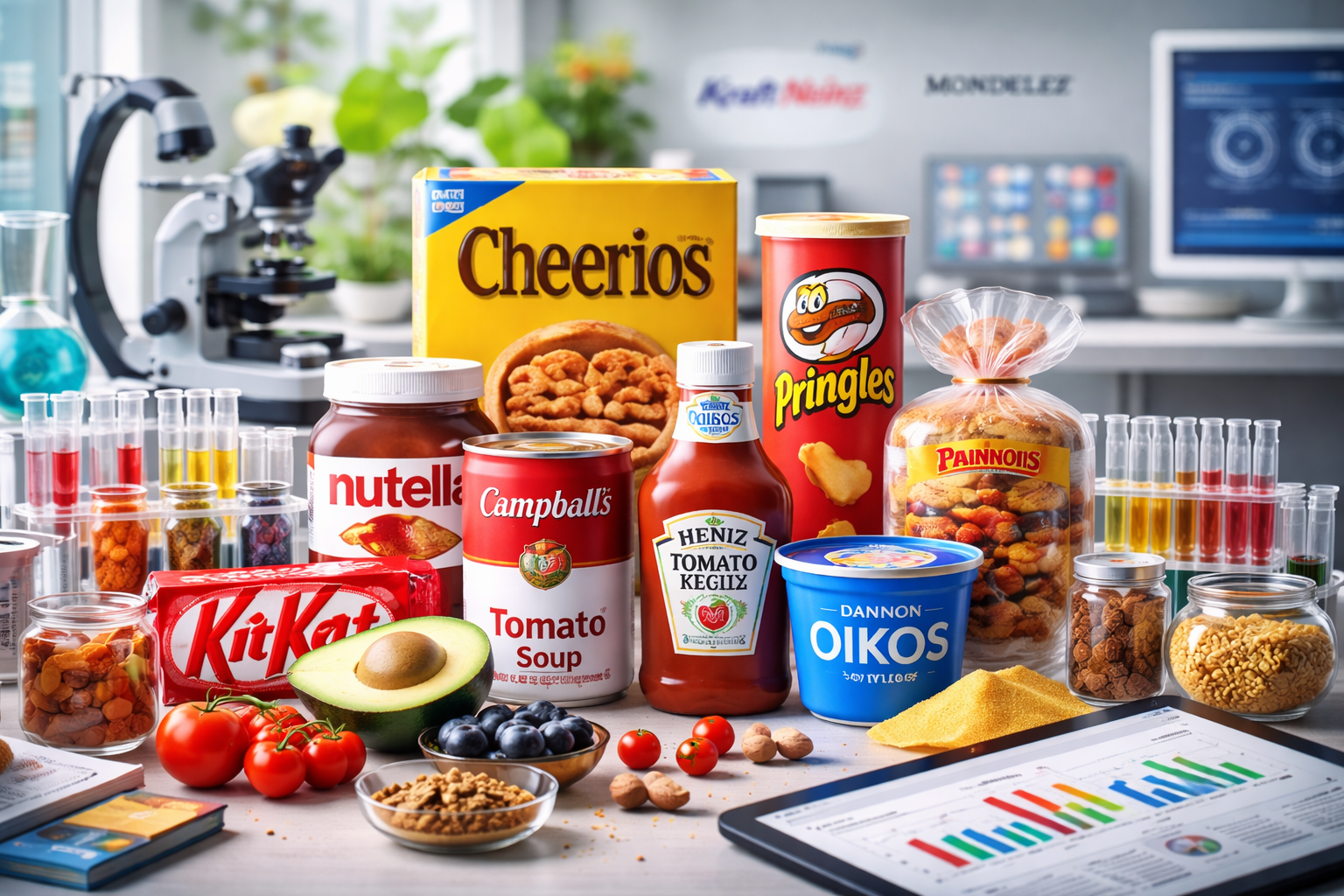
A food CPG company makes the packaged food and beverage products you see in supermarkets and convenience stores at massive scale. These are high-volume, branded goods designed for repeat purchase and distributed through retail, wholesale, and increasingly direct-to-consumer channels.
Integrating AI in food supply chain optimisation transforms CPG management by streamlining sourcing, manufacturing, packaging, logistics, and retail distribution.
What separates global leaders from smaller brands is not just size, it’s operational complexity: multi-billion-dollar networks, thousands of SKUs, global manufacturing footprints, and constant Portfolio optimization. In 2026, a food CPG company isn’t simply a manufacturer. It’s a data-driven portfolio operator balancing margin pressure, health shifts, Sustainability demands, and innovation speed across markets.
Top 10 Global CPG Food Companies (2026)
1) Nestlé
Nestlé is the world’s largest food company, spanning nearly every packaged food category. Its advantage comes from portfolio breadth, geographic diversification, and disciplined renovation at global scale.
| Headquarters | Switzerland |
| Scale signals | Global category breadth across food & nutrition |
| Portfolio strengths | Confectionery, dairy, frozen meals, nutrition, pet food |
| Innovation focus | Renovation, reformulation, premiumization, functional claims |
| 2026 priorities | R&D, Innovation Strategy, Sustainability, Portfolio, Supply Chain |
Nestlé stays ahead by prioritizing renovation decisions with speed and evidence, balancing health-led reformulation, premium cues, and region-specific optimization across a massive Supply Chain.
2) PepsiCo
PepsiCo is one of the most powerful global packaged food operators. While beverages are iconic, its snack business, especially Frito-Lay, sets the bar for scale, velocity, and repeatable innovation.
| Headquarters | United States |
| Scale signals | Global snack platform with high shelf velocity |
| Portfolio strengths | Snacks, cereals, dips, multicultural foods |
| Innovation focus | Better-for-you renovation, premiumization, selective acquisitions |
| 2026 priorities | Revenue, Market Share, Portfolio, Innovation Strategy, Supply Chain |
PepsiCo wins by scaling what repeats, turning fast-moving consumption signals into decisions that protect velocity across retailers and channels, including Foodservice.
3) JBS
JBS is one of the largest protein players in the world. Commodity scale anchors its business, while value-added innovation increasingly drives margin expansion.
| Headquarters | Brazil |
| Scale signals | Global beef and poultry footprint |
| Portfolio strengths | Beef, poultry, pork, prepared foods |
| Innovation focus | Value-added formats, prepared meals, branded growth |
| 2026 priorities | Supply Chain, Sustainability, Innovation Strategy, Portfolio, Revenue |
JBS stays competitive by investing where consumers pay for convenience and differentiation, while managing volatility through resilient sourcing and Supply Chain execution.
4) Anheuser-Busch InBev (or Unilever if focusing strictly on food/nutrition)
If your scope includes beverage-led packaged goods influence, AB InBev is a global heavyweight. If your scope is strictly food/nutrition, Unilever may be the more relevant substitute depending on your category definition.
| Headquarters | Global (AB InBev) / UK–Netherlands (Unilever) |
| Scale signals | Massive distribution and category leadership |
| Portfolio strengths | Beer & beverages (AB InBev) / Food & nutrition brands (Unilever) |
| Innovation focus | Portfolio focus, channel execution, scalable renovation |
| 2026 priorities | Market Share, Revenue, Portfolio, Innovation Strategy |
The competitive edge here is distribution strength plus disciplined portfolio decisions, doubling down on what grows and cutting friction from what doesn’t.
5) Tyson Foods
Tyson is one of the most influential protein companies globally. Growth and margin increasingly come from prepared and branded formats, not commodity output alone.
| Metric | Data |
| Headquarters | United States |
| Scale signals | Global protein production + branded prepared foods |
| Portfolio strengths | Poultry, beef, pork, prepared foods |
| Innovation focus | Convenience formats, flavor roadmaps, claim-led renovation |
| 2026 priorities | Foodservice, Supply Chain, R&D, Innovation Strategy, Revenue |
Tyson stays ahead by validating which flavors and claims drive repeat purchase, especially as many protein trends appear first in Foodservice before scaling into retail.
6) Mars, Inc.
Mars is one of the largest privately held packaged food companies, anchored by global confectionery and expanding into better-for-you snacking through strategic portfolio moves.
| Headquarters | United States |
| Scale signals | Global confectionery dominance + snack adjacency |
| Portfolio strengths | Confectionery, snacks, pet food |
| Innovation focus | Format innovation, portion cues, selective wellness extensions |
| 2026 priorities | R&D, Innovation Strategy, Portfolio, Revenue |
Mars remains competitive by protecting iconic brands while carefully expanding into adjacent snack behaviors, scaling only what shows durable repeat demand.
7) The Coca-Cola Company
Coca-Cola is beverage-led but remains a global packaged goods leader due to unmatched distribution power, brand strength, and portfolio management across markets.
| Headquarters | United States |
| Scale signals | Global distribution + channel execution |
| Portfolio strengths | Beverage platforms and global brand portfolio |
| Innovation focus | Channel-first innovation, format strategy, portfolio optimization |
| 2026 priorities | Market Share, Revenue, Supply Chain, Portfolio |
Coca-Cola stays ahead through execution, scaling winning formats quickly across regions while optimizing production and Supply Chain flexibility.
8) Mondelez International
Mondelez owns the global snacking aisle, where shelf freshness, flavor rotation, and scalable innovation determine who wins across regions.
| Headquarters | United States |
| Scale signals | Global snack platforms with high frequency purchase |
| Portfolio strengths | Biscuits, chocolate, baked snacks |
| Innovation focus | Premiumization, portion formats, scalable flavor pipelines |
| 2026 priorities | Innovation Strategy, R&D, Portfolio, Revenue |
Mondelez stays competitive by separating short-term hype from scalable innovation, protecting retailer confidence by reducing SKU bloat and focusing on what repeats.
9) The Kraft Heinz Company
Kraft Heinz anchors the center-store with sauces, condiments, meals, and cheese. The 2026 challenge is modernization without eroding trust.
| Headquarters | United States |
| Scale signals | Category anchors with strong household penetration |
| Portfolio strengths | Sauces, condiments, meals, cheese |
| Innovation focus | Renovation, clean label, global flavor inspiration |
| 2026 priorities | R&D, Innovation Strategy, Supply Chain, Portfolio |
Kraft Heinz stays ahead by pressure-testing renovation moves before broad rollout, balancing taste equity with modernization and operational feasibility.
10) Danone
Danone sits at the center of health-led categories like yogurt, gut health, protein, and plant-based alternatives, segments that evolve quickly and regionally.
| Headquarters | France |
| Scale signals | Global leadership in functional dairy and nutrition |
| Portfolio strengths | Dairy, plant-based, infant nutrition |
| Innovation focus | Functional claims, protein formats, credible health positioning |
| 2026 priorities | Plant-based, Sustainability, Innovation Strategy, Portfolio, Market Share |
Danone stays competitive through precision, tracking which functional claims are durable, which are flattening, and where demand is strongest across channels.
What the world’s largest CPG food companies are prioritizing in 2026
Across the Top global CPG food companies, investment is converging around a few structural priorities:
- AI-driven decision-making that moves from reporting to predictive portfolio intelligence
- Supply Chain resilience through regionalization and manufacturing flexibility
- Premiumization where value perception supports higher price points
- Health-led renovation with credible claim strategy (not vague wellness messaging)
- Sustainability initiatives that can stand up to scrutiny and translate into real consumer behavior
In 2026, winning isn’t about launching more SKUs. It’s about launching the right SKUs, with proof. The Tastewise 2026 Food Trend Forecast highlights the demand signals influencing innovation and portfolio decisions across global CPG leaders.
How leading CPGs stay ahead with Tastewise

This is the most important section for conversion. It explains why these giants need tools like ours. Global giants have data, but they struggle with speed. Tastewise turns millions of consumption signals into actionable product concepts in seconds, not months.
Even the biggest CPG companies face the same bottleneck: they have information everywhere, but not aligned evidence that moves decision-making quickly. Syndicated data is backward-looking, social listening is volatile, and internal sales data is incomplete—a reality that often surfaces during platform comparisons for CPG teams. Without a unified, real-time source, organizations waste time debating trends instead of validating what actually deserves scale.
Tastewise closes that gap by integrating real-world consumption signals across retail, Foodservice, and social behaviors, so innovation and portfolio teams can act with confidence.
- Moving from survey-based guessing to consumption-based proof.
- Using Tastewise AI capabilities to simulate product concepts before R&D spends a dollar.
- Reducing the innovation cycle from 18 months to weeks.
See how the top players innovate.
FAQs about the top CPG food companies
Nestlé is widely considered the largest CPG food company in the world based on its scale and global portfolio breadth.
A food CPG company produces packaged food and beverage products at high volume, designed for repeat purchase and distributed across retail, wholesale, and often direct-to-consumer channels. These companies manage large-scale manufacturing, distribution, and portfolio renovation to stay competitive.
Food CPG companies use AI for trend prediction, concept screening, pricing and promotional optimization, forecasting, and parts of the Supply Chain, including demand planning and procurement. AI is increasingly used to reduce innovation risk by validating which ideas are likely to scale.



We’d love to learn your goals and see how Tastewise fits
We’d love to learn your goals and see how Tastewise fits
Get a personalized demo
Good taste. Wise move.
Your demo request is confirmed. We’ll reach out within one business day to schedule your walkthrough.
What happens next

See what’s driving demand, then turn it into a sell-in story for retailers and operators.
- Connect consumer panels, market trackers, and agents into one evidence view
- Get the “why” behind what’s changing, with explainable demand drivers
- Walk away with a buyer-ready narrative and next steps to activate
Trusted by




“Tastewise is my secret tool for knowing what consumers want next and why.“