





The current wave of fortnightly feast food trends captures how indulgence is showing up right now. Familiar foods are being pushed into bolder formats, paired with sharper contrasts, or layered with functional cues that feel easy to live with. This is not about rare ingredients or chef-led experimentation. It is about foods that feel instantly recognizable and slightly unexpected at the same time.
Across social conversation and early menu activity, indulgence is becoming more intentional. Consumers are choosing foods that feel comforting, expressive, and worth repeating. Carbs are showing up unapologetically. Sweetness is being balanced with salt. Wellness cues are being folded into everyday treats rather than positioned as trade-offs. These patterns sit at the center of how 2026 food trends are forming.
For R&D heads, brand managers, and menu innovation teams, the pressure point is timing. What starts as a small spike in Social Mention Volume can quickly become a buyer conversation or a menu test. The Fortnightly Feast view focuses on these short-cycle signals, helping teams see what is building momentum early enough to act with confidence.
What follows are five signals shaping next-gen indulgence right now. Each one shows how nostalgia, flavor contrast pairings, functional ingredients trends, and plant-based indulgence are converging in ways that feel commercially relevant, not experimental.
1. Chaotic comfort is turning classic dishes into sandwich formats
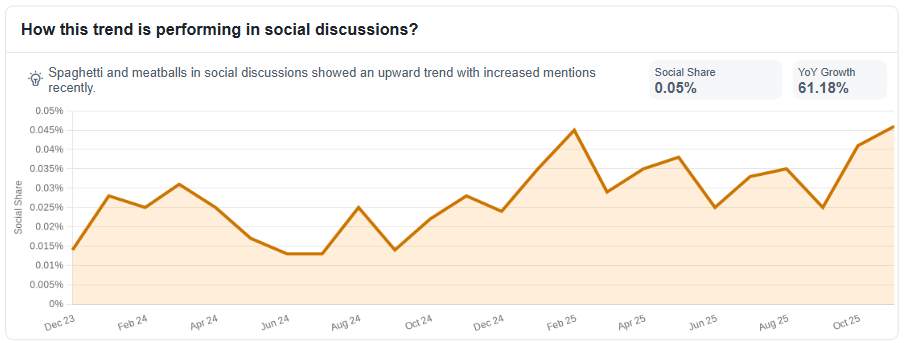
Spaghetti and meatballs leaving the bowl and landing in bread might sound playful, but the performance tells a more serious story. Social discussion around spaghetti and meatball sandwiches is up 61.2% compared to last year, driven by creators and operators leaning into carb-forward indulgence.
The appeal is straightforward. This format takes a deeply familiar dish and makes it louder, more portable, and more visual. Consumer sentiment skews toward words like comforting, indulgent, and satisfying. That matters, because these are the same attributes that define repeat ordering, not just curiosity clicks.
Menu penetration has remained relatively steady rather than spiking and collapsing, which suggests staying power. This aligns with a broader pattern where classic comfort foods are being reformatted rather than reinvented. The sandwich becomes the delivery system for excess and nostalgia at the same time.
What makes this signal useful for menu innovation strategy is not the novelty of spaghetti in bread. It is the repeatable logic behind it. The Fortnightly Feast analysis breaks down which demographics are engaging most with these formats and why certain sandwich constructions outperform traditional subs in both engagement and menu execution.
2. Salted honey is accelerating the move toward flavor contrast pairings
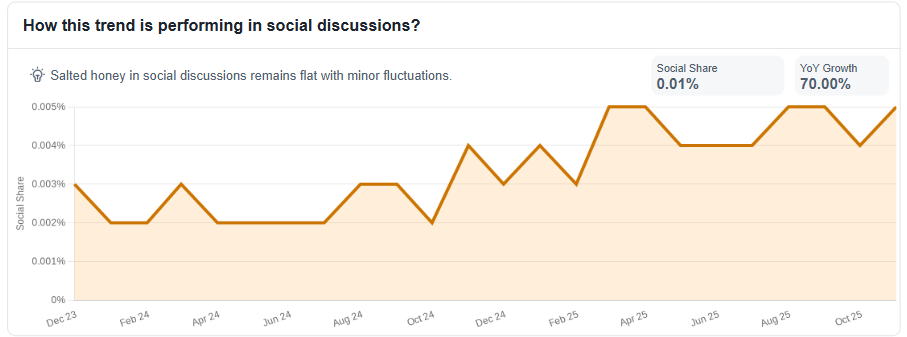
Salted honey is emerging as one of the clearest examples of how consumers are moving away from one-note sweetness. Social mentions are up 70% compared to last year in the US and 43% compared to last year in the UK, making it a fast-moving signal with cross-market relevance.
This pairing works because it feels familiar and elevated at the same time. Honey carries warmth and nostalgia. Salt sharpens the experience and signals intention. As a result, salted honey is showing up across categories, including pizza, fried chicken, roasted vegetables, biscuits, and beverages.
Consumer sentiment frames this pairing as indulgent but balanced. That balance is key. It allows brands to introduce contrast without asking consumers to relearn a flavor language. From an operator perspective, it also functions as a low-risk add-on that upgrades existing items rather than requiring full menu redevelopment.
Salted honey is only the starting point. Within the Tastewise platform, this pairing sits inside a wider flavor contrast matrix that includes sweet heat, dairy plus acid, and fruit plus savory cues. The Fortnightly Feast view maps which contrasts are gaining traction fastest and where they are most likely to convert into menu penetration.
3. Sweetcorn ice cream is testing the boundaries of seasonal indulgence
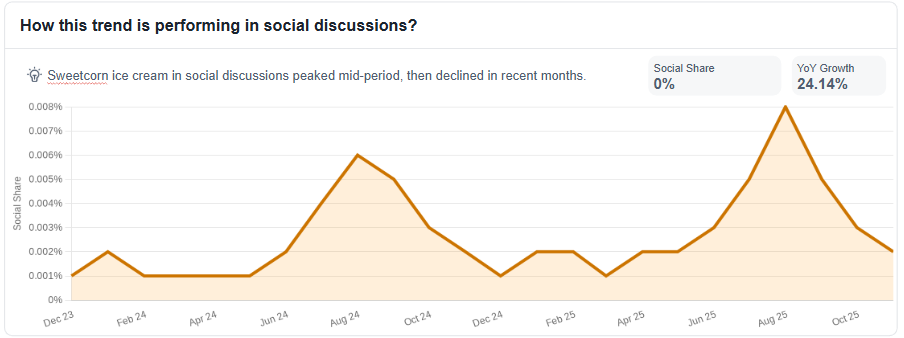
Sweetcorn ice cream is not everywhere, and that is exactly why it is interesting. Social discussion is up 24.1% compared to last year, while menu penetration has increased 12.5%, indicating early-stage experimentation rather than mainstream adoption.
This flavor sits at the intersection of savory familiarity and dessert curiosity. Corn is deeply nostalgic and widely consumed, yet rarely positioned as a sweet centerpiece. That tension drives engagement. The trend also over-indexes on vegan and tasty cues, connecting it directly to plant-based indulgence rather than novelty alone.
Seasonality plays a role here. Engagement peaks around warmer months, reinforcing its role as a limited-time or seasonal offering rather than a year-round staple. For brands, that creates a controlled testing ground. For operators, it provides a way to refresh dessert menus without introducing unfamiliar ingredients.
The key question is risk. The Fortnightly Feast analysis looks at where sweetcorn ice cream performs best, which channels support it most strongly, and how consumer sentiment differs between social curiosity and actual ordering behavior. This distinction is critical for deciding whether to test, where to test, and how far to scale.
4. Fiber is becoming the most visible functional cue in indulgent formats
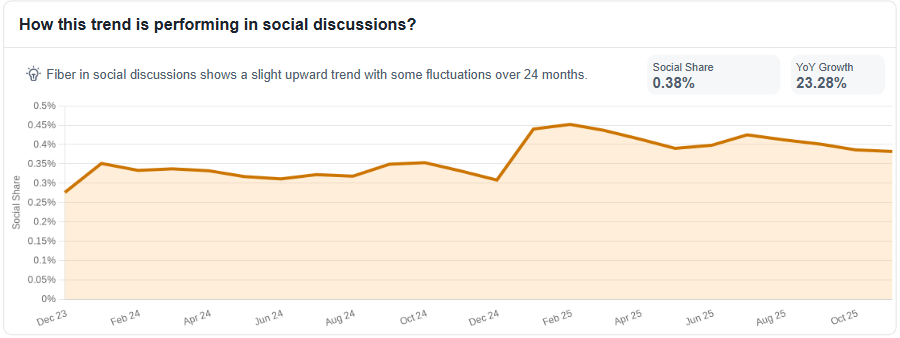
Protein fatigue is real, and consumers are not hiding it. Fiber is gaining attention as a functional ingredient that feels additive rather than restrictive. Social discussion around fiber is up 23.3% compared to last year, with strong engagement among Gen Z and Millennials.
What makes fiber stand out is how it is being delivered. Instead of supplements or overt health products, fiber is showing up in matcha lattes, iced coffees, functional sodas, smoothies, and boba-style beverages. These formats make fiber feel aesthetic, social, and easy to adopt.
Consumer sentiment frames fiber as supportive and routine-friendly. This positioning allows brands to integrate wellness into indulgent moments without undermining pleasure. From a menu and product development perspective, beverages act as low-friction entry points for functional ingredients trends.
Menu penetration data shows fiber steadily increasing, particularly in beverage-led concepts. The Fortnightly Feast view highlights which beverage categories are adopting fiber fastest and where there is still white space for innovation. This insight helps teams decide where functional upgrades feel credible rather than forced.
Curious how these signals show up in your category or with your audience? Book a demo to see how Tastewise turns fortnightly feast food trends into real-time, decision-ready intelligence for 2026 planning.
5. Strawberry rhubarb is reclaiming relevance through pairing power
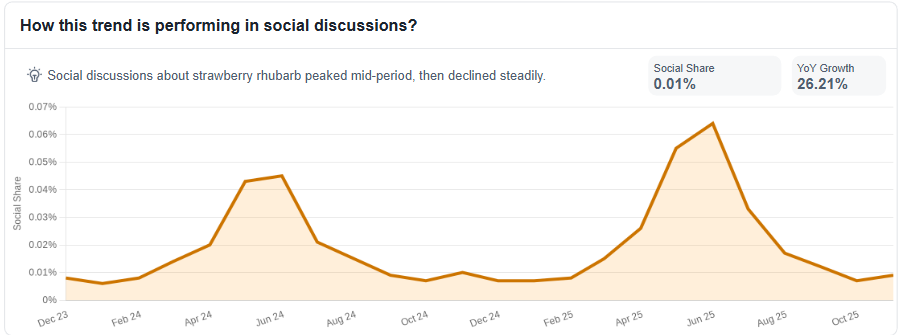
Strawberry rhubarb is back, and the pairing is doing the heavy lifting. Social mentions of the combination are up 26.2% compared to last year, outpacing growth for rhubarb alone. This indicates that consumers are responding to balance and familiarity rather than single-note nostalgia.
The appeal lies in contrast. Strawberry brings sweetness and approachability. Rhubarb adds tartness and structure. Together, they feel lighter and more versatile than traditional dessert flavors. As a result, this pairing is expanding beyond pies into frozen treats, beverages, jams, and bakery applications.
Seasonality still matters, but the usage occasions are broadening. This creates opportunities for repeatable summer cues that can be refreshed year after year. For brands targeting Gen Z and Millennials, strawberry rhubarb offers a way to reference heritage flavors without feeling dated.
The Fortnightly Feast analysis explores how this pairing performs across formats and where consumer sentiment is strongest. It also outlines how brands are modernizing classic combinations through format, texture, and channel choice rather than flavor overhaul.
Why these fortnightly feast food trends matter now
Taken together, these five signals point to a clear pattern. Indulgence is being built through contrast, familiarity, and intention. Consumers are not choosing between comfort and function. They are expecting both.
For innovation teams, this raises the bar on decision-making. Retailers and operators are not buying trends. They are buying proof. Social Mention Volume, Consumer Sentiment, and Menu Penetration provide that proof when read together rather than in isolation.
The Fortnightly Feast approach is designed to make these reads fast and defensible. Inside the Tastewise platform, teams can see how these trends perform by category, audience, and channel, then build buyer-ready narratives that answer three questions clearly. What is winning, who it is for, and why it belongs on the shelf or menu now.
FAQs About Fortnightly Feast Food Trends
Fortnightly feast food trends are short-cycle signals that show how indulgence, flavor, and functionality are evolving in near real time. They capture foods and ingredients gaining momentum across social conversation and early menu activity before they become mainstream. This makes them especially useful for teams planning innovation on tight timelines.
Traditional food trends are often retrospective and slow-moving. Fortnightly feast food trends focus on what is actively building attention right now. They reflect faster consumer feedback loops, where social engagement, consumer sentiment, and early menu adoption move within weeks rather than years.
Many of the behaviors shaping 2026 food trends are already visible today in formats like carb-forward sandwiches, flavor contrast pairings, functional ingredients, and nostalgic food innovation. Tracking these signals early helps brands and operators validate ideas, prioritize testing, and avoid chasing concepts that peak too quickly.
Fortnightly feast food trends are especially relevant for F&B R&D heads, brand managers, menu innovation teams, and marketing directors. These roles need fast, defensible inputs to guide product development, menu updates, and retailer conversations without relying on long-range forecasts alone.
Tastewise connects Social Mention Volume, Consumer Sentiment, and Menu Penetration into a single, real-time view. Teams can see how trends perform by audience, channel, and category, then turn that intelligence into decisions they can align on internally and sell externally.


We’d love to learn your goals and see how Tastewise fits
We’d love to learn your goals and see how Tastewise fits
Get a personalized demo
Good taste. Wise move.
Your demo request is confirmed. We’ll reach out within one business day to schedule your walkthrough.
What happens next

See what’s driving demand, then turn it into a sell-in story for retailers and operators.
- Connect consumer panels, market trackers, and agents into one evidence view
- Get the “why” behind what’s changing, with explainable demand drivers
- Walk away with a buyer-ready narrative and next steps to activate
Trusted by





“Tastewise is my secret tool for knowing what consumers want next and why.“