







Back in 2025, Tastewise’s trend prediction report boldly stated: “Swicy, swalty: fusion flavor profiles are on the rise.” A year later, the fusion of sweet and spicy flavors is reshaping the food and beverage landscape, with Lay’s Chips recently trademarking “Swicy.”
Our predictions don’t just match what consumers crave, they prove that Tastewise has an unbeatable knack for spotting what’s next before it’s even on the radar!
What is “Swicy,” and why is it everywhere?
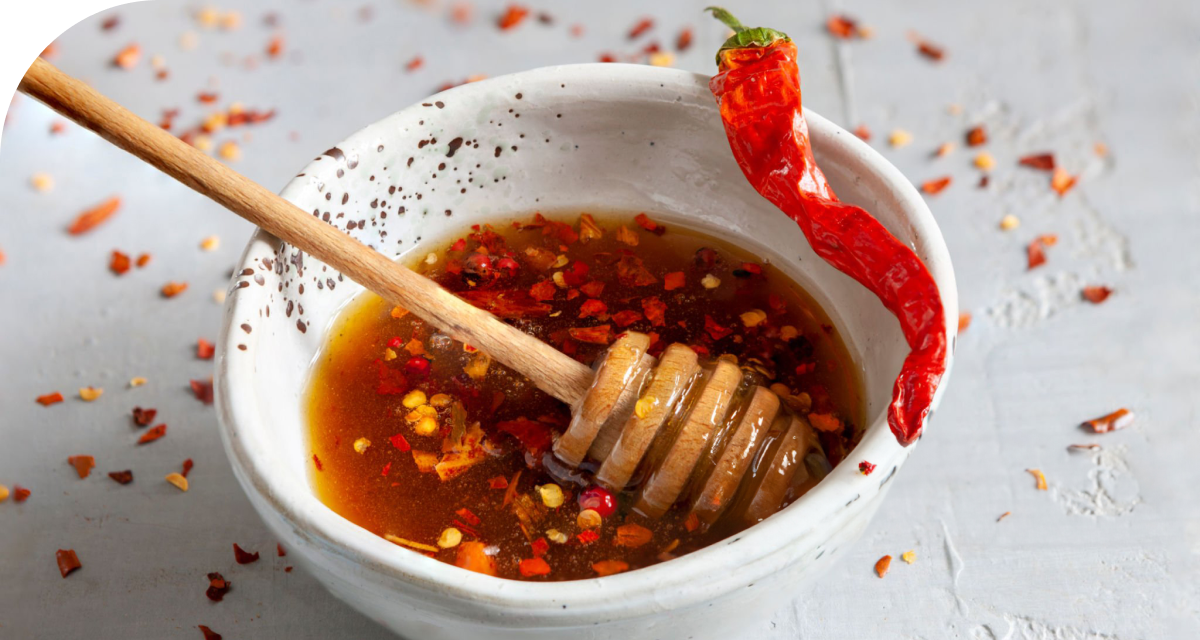
“Swicy”, that perfect mix of sweet and spicy, is captivating taste buds worldwide. From Mike’s Hot Honey’s innovative condiments to Starbucks’ spicy lemonades, this trend is a testament to the adventurous spirit of today’s consumers. As Mike Kurtz, founder of Mike’s Hot Honey, puts it:
“Sweet and spicy is such a versatile combination, it works across everything from snacks to main courses.”
Dominique Woolf, founder of The Woolf’s Kitchen, also explains:
“Sweet and spicy combos are nothing new, they’re rooted in cuisines like Thai, Korean, and Mexican. But now they’re stealing the spotlight in ways we’ve never seen before.”
With a marination process that ensures perfection, this medium-difficulty dish serves 4 and takes just 30 minutes, perfect for home chefs and food brands alike. We have to mention that the potential engagement reaches over 2.4 million. It’s a recipe that’s not just delicious but also marketable.
Understanding swicy in the context of global flavor fusion trends
Swicy sits within a broader wave of fusion flavor profiles, but it occupies a distinct position in that landscape. Unlike “salty-sweet” (think salted caramel or miso chocolate), which plays contrast through opposing tastes, swicy builds layered sensation: sweetness that opens the palate, followed by heat that extends the experience. Unlike “smoky-sweet” (barbecue, mezcal), which relies on aromatic depth, swicy is immediate and kinetic. And unlike “umami-spicy” (Sichuan mapo tofu, spicy miso ramen), which grounds heat in savory complexity, swicy keeps sweetness as the primary anchor, lowering the barrier for heat-averse consumers while still delivering excitement.
This hierarchy, where sweet leads and heat follows, is actually ancient. Korean tteokbokki balances gochugaru’s slow, fermented heat with the gentle sweetness of rice syrup. Mexican chamoy layered tamarind’s fruity tartness with chili powder decades before the term “swicy” existed. Thai sweet chili sauce has been a gateway flavor for millions of Western consumers experiencing Southeast Asian cuisine for the first time. What’s new isn’t the combination. It’s the naming of it, the cultural permission it grants, and the speed at which it’s crossing categories.
Flavor science: why sweet-spicy works neurologically
The appeal isn’t accidental. Capsaicin, the compound responsible for chili heat, binds to TRPV1 receptors, which the body interprets as warmth and mild pain. In response, the brain releases endorphins and dopamine, creating a mild euphoric effect. Sweetness, processed through entirely different taste receptors, doesn’t interfere with this pathway. It softens the perceived intensity of the heat and extends how long you stay at the table. The result is a sensory loop: sweetness invites you in, heat keeps you engaged, and the endorphin release makes you want another bite. It’s the same mechanism that makes spicy chocolate or hot honey genuinely difficult to stop eating.
Key ingredient reference
Hot honey — wildflower or clover honey infused with chili (typically cayenne or Calabrian), Scoville range roughly 500 to 2,000. Sweetness is forward and floral; heat is mild and lingering. Currently trending, with highest velocity in pizza, fried chicken, and charcuterie applications.
Gochujang — fermented Korean red chili paste, Scoville 1,500 to 10,000 depending on concentration. Complex, slightly funky sweetness from fermented rice; heat builds slowly. Pairs naturally with honey, maple, and brown sugar. Sits at a mature-trending inflection point.
Mango habanero — tropical sweetness from mango and passionfruit paired with habanero’s fruity, floral heat (typically diluted from its pure Scoville range of 100,000 to 350,000). Appeals to consumers who want intensity without fermented depth. Still emerging.
Pineapple habanero — similar to mango habanero but with sharper acidity. A regional favorite in Caribbean and Latin American-influenced applications. Emerging stage with room to scale.
Jalapeño honey — a softer entry point than gochujang or habanero, with grassy heat and clean sweetness. Broad demographic appeal and strong in snack, condiment, and cocktail formats.
What swicy trends mean in consumer demand
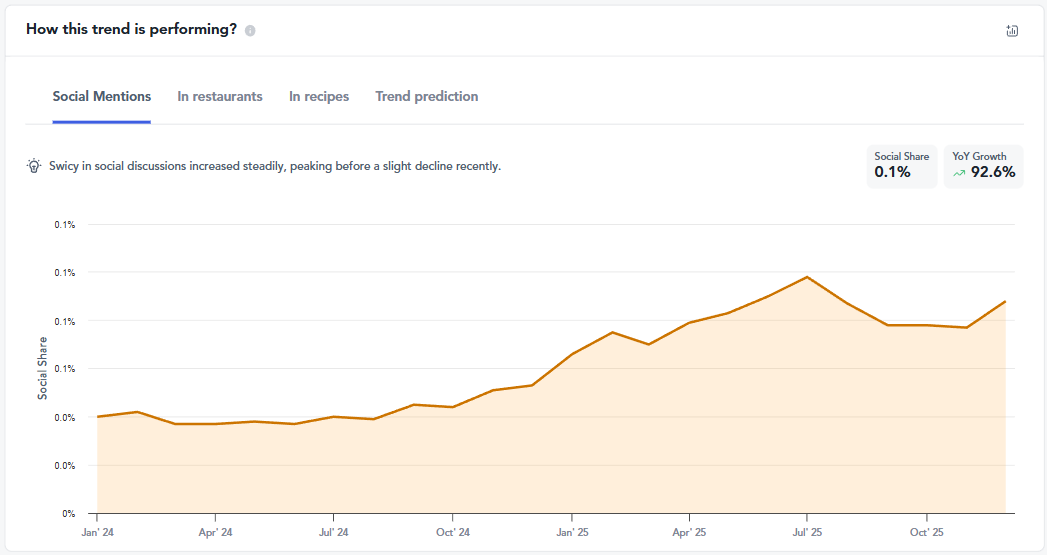
Consumer discussion around swicy is clearly anchored in sweetness. Sweet appears in 97% of swicy-related conversations, while spicy appears in 78%, establishing a consistent hierarchy where sweetness frames the experience and heat plays a supporting role. This framing widens appeal and lowers rejection risk, especially outside core heat-seeking audiences.
Texture and preparation cues reinforce this positioning. Around 17% of consumers associate swicy with fried foods, and 14% link it with crispy experiences. These associations indicate that swicy demand is strongest when paired with indulgent, high-sensory eating moments rather than lighter or functional occasions.
Demand concentration by channel
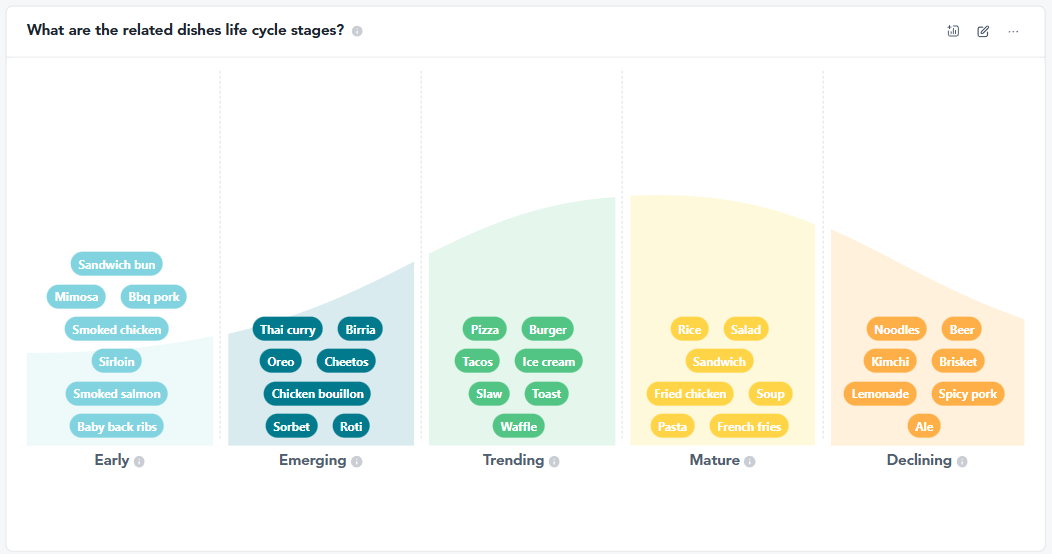
Swicy’s presence across dishes and restaurants shows concentration in formats that rotate flavors efficiently. In dish lifecycle data, swicy-linked dishes appear across trending and mature stages rather than being isolated in early experimentation. Pizza, burgers, tacos, fried chicken, sandwiches, and fries all sit in categories where flavor variation is already expected and operationally easy to execute.
This distribution supports controlled expansion. Swicy does not rely on a single cuisine or dish to carry demand, which reduces dependency risk for operators and retailers considering limited or regional rollouts.
How consumers are using swicy at home
At-home behavior shows swicy functioning as an add-on rather than a full recipe driver. Swicy appears more often in applications that modify existing meals, sauces, toppings, pickles, and seasonings, than in standalone dishes. This pattern favors repeat usage, as consumers can integrate swicy into multiple meals without changing cooking routines.
The popularity of refrigerator pickles and finishing sauces illustrates this behavior: swicy acts as a flexible upgrade rather than a commitment-heavy cooking decision.
Formats where swicy keeps velocity
Ingredient lifecycle data clarifies which executions are sustaining momentum. Hot honey sits firmly in the trending stage, alongside jalapeño and mango, indicating that sweet-forward heat is already normalized. Meanwhile, pineapple habanero, hatch chile, and Calabrian chili remain in emerging, suggesting room for controlled extension without crowding the category.
These signals align with the strong association between swicy and fried or crispy foods. Sauces, glazes, coatings, and snack applications allow consumers to control intensity while keeping usage frequent, which supports cleaner velocity over time.
How to deploy swicy trends without overextending
The data consistently points to swicy performing best when it enhances familiar foods rather than introducing new eating occasions. Deployment works when swicy is attached to formats consumers already understand: fried foods, sauces, snacks, and comfort dishes with established demand.
By anchoring swicy in proven formats and trending ingredients, brands and operators can scale participation while maintaining flexibility to rotate, regionalize, or ladder intensity over time.
Consumer need-states that make swicy defensible
Growth in consumer needs tied to swicy skews toward layered and indulgent experiences. “Stacked” flavor is growing +366%, “intense flavor” +300%, and “sweet and smoky” +214%. These need-states favor contrast and complexity rather than single-note heat.
Swicy fits naturally into this framework by delivering dual sensory cues, sweetness and heat, without requiring extreme spice tolerance. This positioning supports premiumization without narrowing the audience.
Real-life success stories of “swicy” flavors
Brands like Mike’s Hot Honey epitomize the trend’s potential. Mike’s versatility, ranging from squeeze packets to dip cups, caters to every occasion. Partnerships with Utz, Kellanova, and DiGiorno show how swicy complements everything from pizza to pretzels.
Similarly, 5-Hour Energy’s Watermelon Chili Lime collaboration highlights swicy’s resonance with Gen Z and Millennials, two demographics embracing bold and unexpected tastes.
Swicy’s role in national eating occasions like the Super Bowl
Swicy’s format and flavor signals align closely with how consumers eat during large national occasions. Super Bowl snacking behavior consistently favors fried, crispy, and shareable foods, the same contexts where swicy demand is already concentrated. With 17% of swicy usage tied to fried foods and 14% to crispy preparations, the flavor naturally fits high-volume snack occasions without requiring behavior change.
Ingredient signals reinforce this fit. Trending swicy anchors like hot honey and Asian-adjacent heat profiles show up most often in sauces, glazes, and coatings, which are core to wings, tenders, sliders, and snackable proteins that dominate Super Bowl menus. These formats support batch preparation, dipping, and customization, key mechanics of event-based eating.
Want to see what’s next for Super Bowl F&B demand?
The acceleration of layered flavor needs such as “stacked” (+366%) and “sweet and smoky” (+214%) also aligns with how brands position Super Bowl snacks: indulgent, bold, and built for sharing. Swicy delivers contrast without narrowing appeal, making it easier to deploy at scale during high-traffic moments.
For retailers and operators, this makes swicy a seasonal amplifier rather than a one-off novelty. Limited-time swicy snacks, sauces, and party formats can ride existing Super Bowl demand curves while reinforcing repeat behavior beyond the event.
The business of bold flavors: Lay’s trademarks ‘swicy’
Lay’s decision to trademark “Swicy” underscores how brands can leverage emerging trends for competitive advantage. This move cements the flavor’s cultural relevance and positions Lay’s as a leader in capturing consumer demand for bold and innovative snacks. Such steps are also strategic, enabling Lay’s to secure market share as the “Swicy” trend grows.
The numbers speak: The profitability of swicy flavors
- 27.82% growth in conversations about sweet and spicy flavors over the past year.
- 33.65% increase in honey usage within swicy-inspired recipes.
- Coca-Cola’s launch of a spicy soda and Starbucks’ spiced lemonade drinks signal the trend’s expansion beyond snacks into beverages.
Why swicy is here to stay
Experts like Tom Gatehouse, the senior trends strategist at Egg Soldiers, emphasize that while the term “Swicy” may fade, the flavor combination has enduring appeal. Its versatility across cuisines, from Mexican mole to Thai sweet chili, guarantees its longevity.
The food industry is already pushing boundaries with swicy-inspired jams, syrups, and even health-focused products, making this a trend with no expiration date.
Emerging food trends
Food trends emerge from a mix of cultural influences, global cuisines, and changing consumer behaviors. Social media, Gen Z’s adventurous palate, and heightened demand for unique taste experiences fuel these shifts. For brands, staying on top of trends is essential to staying relevant, meeting consumer expectations, and innovating effectively. Tastewise helps brands identify and act on these trends in real-time, so they can confidently lead the market instead of chasing it.
Fusion flavors like “swicy” reflect consumers’ desire for diverse and bold taste experiences. These combinations often have deep roots in global cuisines, making them timeless, though their popularity may ebb and flow. With Tastewise’s platform, brands can track the lifecycle of trends, pinpoint when they’ll peak, and discover creative ways to integrate these flavors into their product lineup.
How can brands effectively tap into a rising trend?
To leverage a trend, brands should start by understanding its drivers: Who’s talking about it? Where is it trending? And how can it fit into their product range? For example, condiments like hot honey and snacks featuring “swicy” flavors have resonated with Gen Z and Millennial audiences. Tastewise equips brands with data-driven insights to answer these questions, enabling faster, smarter execution and helping them capture trends before competitors do.
The rise of “Swicy” validates the power of predictive insights. Tastewise helps food and beverage brands stay ahead, offering actionable data to turn trends into profitable realities. From ad campaigns to product innovation, we empower brands to execute ideas effectively and scale their success in a competitive market.
How to successfully implement swicy flavors across different food categories
Swicy works differently depending on where you’re playing. A sauce station at a QSR has almost nothing in common with a CPG seasoning blend or a stadium catering rollout, so let’s walk through the formats most likely to apply to your business and what actually moves the needle in each one.
For quick-service and fast-casual operators
The highest-ROI entry point is the sauce station. A honey-sriracha or hot-honey glaze added as an optional topping or dipping sauce requires minimal kitchen investment, generates high perceived novelty, and tests consumer appetite without committing core menu items. Data suggests 15 to 25 percent uptake on optional swicy add-ons when placed adjacent to fried proteins such as wings, tenders, nuggets, and fries at the point of decision.
For fast-casual concepts, swicy marinades on rotating proteins offer flexibility without menu sprawl. A gochujang-maple marinade on grilled chicken or tofu can rotate across bowls, wraps, and salads without requiring a dedicated SKU. The key is announcing the flavor clearly. “Gochujang honey glaze” outperforms “spicy-sweet glaze” in consumer testing because specificity signals culinary intention rather than generic heat.
At the fast-casual to fine dining transition, swicy earns its place in unexpected applications: a chili-chocolate ganache on a dessert tasting menu, a chili-mango vinaigrette on a raw fish course, or a finishing drizzle of Calabrian chili honey on a cheese board. These applications succeed because swicy functions as punctuation rather than the main event.
For CPG product development
Shelf stability is the central formulation challenge. Honey-based swicy profiles perform well in shelf-stable sauces because honey’s low water activity inhibits microbial growth, allowing for clean-label formulations without preservatives. Gochujang-based products benefit from existing fermentation preservation, though oxygen exposure after opening remains a concern. Spouted or squeeze formats extend shelf life between uses.
For snack applications including coatings, seasonings, and dusted crackers, the balance shifts toward dry heat carriers such as cayenne, chili powder, and gochugaru flake, combined with sugar, honey powder, or tamarind powder. Honey powder delivers authentic sweetness with shelf-stable performance and mixes cleanly into seasoning blends. A useful starting benchmark: a 3:1 to 4:1 sweet-to-heat ratio by weight works well for broad consumer appeal, while a 2:1 ratio suits Gen Z-targeted SKUs where heat tolerance skews higher.
Packaging should communicate the dual sensation visually, using warm amber and red color systems with photography that shows both the sweet carrier (drizzling honey, ripe mango) and the heat indicator (visible pepper flake, chili slice) in the same frame. Front-of-pack descriptors that outperform in consumer research include “honey heat,” “sweet fire,” and the product’s specific ingredient pair such as “mango habanero” or “hot honey jalapeño,” all outpacing the generic “sweet and spicy.”
For foodservice, catering, and institutional operators
Large-format operations benefit most from swicy as a customization layer rather than a fixed recipe component. A hot-honey dispenser alongside standard condiments at a cafeteria station, or a swicy glaze offered alongside classic BBQ and plain options at a catering buffet, allows guests to self-select intensity without requiring separate production runs.
Cost-per-serving benchmarks for institutional scale: hot honey adds approximately $0.08 to $0.15 per serving when used as a finishing drizzle, while a gochujang marinade on proteins runs $0.12 to $0.20 per portion in bulk. Operational complexity stays low when swicy elements are treated as finishing condiments rather than built into recipe bases. This approach also makes allergen and heat-sensitivity management more straightforward.
Regional and seasonal calibration
Consumer heat tolerance and sweetness preference vary meaningfully by region and season. Southern US markets index toward honey-forward sweetness with familiar heat carriers like cayenne and Texas Pete-style hot sauce, where honey softens and contextualizes the spice. West Coast markets show stronger affinity for agave-habanero and mango-based profiles where fruit-forward sweetness is the dominant note. Midwest and mid-Atlantic markets respond well to the familiar reference point of honey mustard heat, making jalapeño honey a natural bridge flavor.
Seasonally, hot honey and chili-chocolate applications peak in fall and winter, aligned with warm comfort eating occasions. Mango habanero and pineapple habanero see summer velocity spikes, as their tropical sweetness fits outdoor, casual dining contexts. Operators planning limited-time swicy offers should map launch windows to these seasonal peaks rather than treating swicy as a flat year-round play.
FAQs about Swicy food trends
In consumer behavior data, swicy is defined by a sweet-first flavor expectation with secondary heat. Sweet appears in 97% of swicy usage, while spicy appears in 78%, indicating that consumers approach swicy as an indulgent, accessible flavor rather than a heat-forward challenge.
Swicy shows stronger alignment with snackable and add-on formats than full meals. Associations with fried (17%) and crispy (14%) foods point to sauces, coatings, and snack applications where flavor intensity and texture already justify bold seasoning.
Swicy is most often associated with Asian-adjacent flavor cues (around 16%), which aligns with ingredient signals like hot honey, chili-based sauces, and gochujang-style profiles. The demand is not cuisine-locked, but flavor-anchored, making it adaptable across categories.
Trending ingredients like hot honey, jalapeño, and mango anchor swicy in familiar sweet-heat territory, while emerging ingredients such as pineapple habanero and Calabrian chili provide extension space. This mix supports both near-term launches and controlled innovation pipelines.
Swicy demand concentrates in the same behaviors that dominate event eating: fried, crispy, shareable foods and bold sauces. Combined with rapid growth in layered flavor needs such as “stacked” (+366%) and “sweet and smoky” (+214%), swicy aligns naturally with high-volume snacking occasions.
The data shows swicy appearing across trending and mature dishes, supported by normalized ingredients and repeat-friendly formats. That distribution supports swicy as a repeatable flavor platform, not a one-cycle novelty.



We’d love to learn your goals and see how Tastewise fits
We’d love to learn your goals and see how Tastewise fits
Get a personalized demo
Good taste. Wise move.
Your demo request is confirmed. We’ll reach out within one business day to schedule your walkthrough.
What happens next

See what’s driving demand, then turn it into a sell-in story for retailers and operators.
- Connect consumer panels, market trackers, and agents into one evidence view
- Get the “why” behind what’s changing, with explainable demand drivers
- Walk away with a buyer-ready narrative and next steps to activate
Trusted by





“Tastewise is my secret tool for knowing what consumers want next and why.“