






The food trends in Mexico landscape is undergoing a structural reset, and the signals are already in the market. Mexican consumers are moving toward heritage ingredients and craft provenance while simultaneously demanding functional, on-the-go formats that fit modern urban life. The gap between where consumer demand is heading and where most brand portfolios currently sit is growing. Your R&D and insights teams have a narrowing window to move first.
Key takeaways
- Sazón is growing 68% in the past year at nearly 3% consumer share. It is the only trending ingredient in Mexico with both scale and velocity, making it a commercially defensible formulation platform, not a niche bet. Your team can build across marinades, snack dusting, and functional sauces without requiring consumer education.
- Mole (+23%), mole poblano (+40%), salsa macha (+40%), and adobo (+19%) are all growing simultaneously in the past 12 months. Traditional Mexican sauce infrastructure is being revalued as a premium innovation vehicle. Your innovation pipeline has access to established flavor equity that de-risks new product concepts.
- Casero” (homemade) is the largest trending consumer motivation in Mexico at 7.5% share, up 78% since last year. Consumers are using food choices as an identity claim around craft and provenance. Brands leading with authenticity framing will outperform those leaning on generic health messaging, which is declining at 30% in the same period.
- In Mexico’s plant-based food segment, gut health (+82%), antioxidants (+88%), and on-the-go (+153%) claims are growing while generic vegan positioning is down 8%. Functional specificity is the growth axis. Products with named functional benefits are winning; undifferentiated plant-based SKUs are not.
2026 food trends in Mexico overview

Mexican consumers are not abandoning tradition. They are reframing it. Heritage flavors and homemade credibility have become active lifestyle signals, not just culinary nostalgia. The consumer driving this shift is urban, health-aware, and time-constrained. They want food that reflects where they come from without making their lives harder.
The Tastewise consumer panel for Mexico tells a clear story across three signals. Sazón leads with 2.86% consumer share growing at +68% in the past year. It is the single ingredient combining meaningful reach with high velocity in the Mexican market. At the motivation layer, “casero” (homemade) sits at 7.47% share, up 78% in the past 12 months, making it the largest trending consumer need by size. Paired with “artesano” (artisanal) at 4% share growing 38%, a consistent craft-and-provenance cluster is forming that crosses ingredient choice, meal occasion, and packaging expectation.
The opportunity this creates is specific. There is a portfolio whitespace where familiar Mexican ingredient bases, including mole, sazón, adobo, and salsa macha, can anchor new product formats built around modern convenience and functional claims. Brands that move now are building on proven consumer equity, not testing an unknown hypothesis.
The 2026 food and beverage trend forecast covers the cross-market signals that put Mexico’s momentum in a global context.
Why sazón is the most important ingredient signal in Mexico right now
Sazón’s story is not just that it is growing. It is that it is growing at scale. Most trending ingredients in emerging markets carry dramatic growth rates on tiny bases, which makes them directional at best. Sazón is different. At 2.86% consumer share and +68% in the past year, it sits at the intersection of reach and velocity that defines a defend-and-extend play for incumbents and a build-ahead opportunity for challengers.
For comparison, carne (beef), the highest-reach ingredient in the Mexico consumer panel at 6.18% share, is growing at only +3.5% in the past 12 months. Sazón is growing roughly 20 times faster on a base that is already commercially meaningful. That pairing signals a category in early acceleration, not a niche discovery phase.
The formulation implications are broad. Sazón functions as a seasoning chassis that travels across snack dusting, sauce bases, marinades, and functional condiments. It does not require consumer education because the flavor equity is already established. What it requires is a brand willing to claim the space before a competitor does.
Your product innovation team can use this signal to build a concept pipeline that is already de-risked by consumer demand, rather than reverse-engineering from a shelf audit that is already 18 months behind.
Heritage Mexican sauces are not in revival. They never left
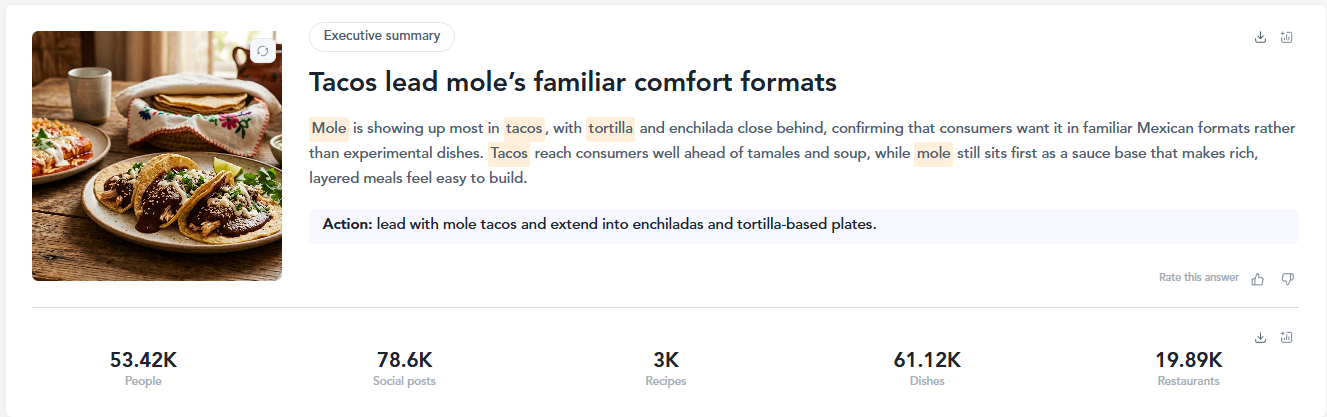
The simultaneous growth of mole (+23%), mole poblano (+40%), salsa macha (+40%), chimichurri (+24%), and adobo (+19%) in the past year is not a coincidence. It is a structural re-valuation of traditional Mexican sauce infrastructure. These are not niche ingredients catching a trend wave. They are category foundations being rediscovered as premium vehicles for modern product formats.
What the data shows at the consumer level is that Mexican consumers are applying heritage sauce profiles to new occasions and eating contexts. The motivation layer confirms this: “tradicional” sits at 5.07% consumer share, growing +13% in the past 12 months alongside the faster-growing craft cluster. Consumers are not choosing between tradition and modernity. They are demanding both in the same product.
The implication for brand teams is a clear de-risking signal. Launching against mole, chipotle, or adobo means building on established flavor equity that consumers already associate with quality and authenticity. The whitespace is not in the flavor itself. It is in the format. Single-serve squeeze pouches, dual-compartment mix-in formats, and clean-label configurations are under-supplied against the demand for heritage flavor in modern convenience packaging.
This is where the Mexico plant based food industry trends intersect with the heritage sauce story. Functional plant-based SKUs built on mole, adobo, or salsa macha flavor profiles have access to both the craft motivation cluster and the growing functional claim demand, a combination that undifferentiated vegan positioning cannot deliver.
Want to see how your team can map Mexico’s ingredient whitespace against your existing portfolio gaps?
What is actually happening in Mexico’s plant-based food segment
The headline figure is real: plant-based consumer reach contracted 30% in the past year. But reading it as a category-level decline misses the more important story underneath it. Tastewise data disaggregated by claim shows two divergent trajectories running simultaneously inside the same category.
Generic positioning is declining. Vegan as a label is down 8%, vegetariano down 9%, saludable (healthy) down 27%, and orgánico down 15% in the past 12 months. These are the claims that defined plant-based marketing for the past decade, and they are losing traction with Mexican consumers.
Functional specificity is growing. Gut health (salud intestinal) is up 82%, antioxidants up 88%, protein up 8%, on-the-go (sobre la marcha) up 153%, and “sin culpa” (guilt-free) up 116% in the same period. These are not fringe signals. They are a coordinated pivot in consumer motivation. The consumer is not leaving plant-based food. They are raising their expectations of it.
The ingredient-level evidence is consistent. Mezquite is up 52%, miso up 50%, shiitake mushrooms up 21%, and kéfir de leche (milk kefir) up 49% in the past year. All are emerging lifecycle ingredients in the Mexican consumer panel. These are the building blocks of a more sophisticated, fermented, and umami-forward plant-based innovation generation. Brands that are still leading with “vegan” as the primary claim are competing on a declining signal. The food marketing strategies that work in Mexico in 2026 are functional-claim-first and provenance-second.
Consumer motivation signals your brand brief should be built around
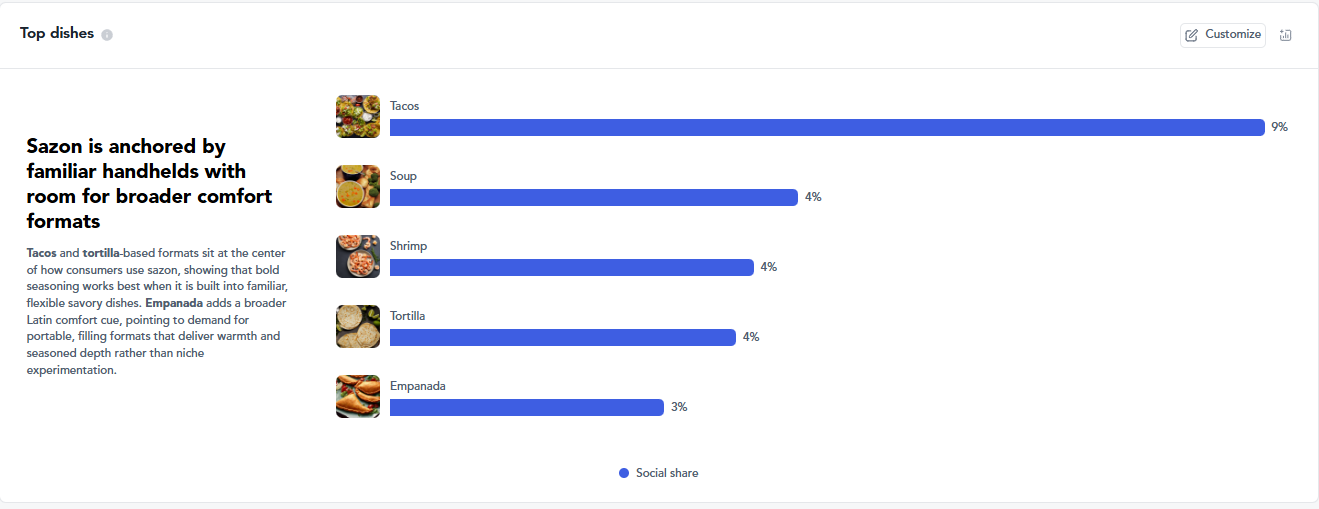
The motivation picture in Mexico is worth reading carefully, because the direction is counterintuitive for teams that built their Mexico strategy on health and wellness positioning.
“Casero” (homemade) at 7.47% consumer share, growing 78% in the past year, is not a cooking trend. It is an identity claim. Mexican consumers are actively choosing and signalling food that connects them to a sense of craft, care, and roots. “Antojo” (craving) is up 90% in the past 12 months. “Artesano” is up 38%. These are not functional motivations. They are emotional ones, and they are moving faster than any functional category in the Mexico panel.
The counter-signal matters just as much. “Saludable” (healthy) at 14.19% consumer share is declining at 30% in the past year. “Fitness” at 3.6% share is also down 30%. Generic health positioning in Mexico is not just plateauing. It is contracting, and it is doing so while craft and provenance messaging accelerates in the same consumer base.
The activation implication is direct. Brand campaigns in Mexico built on generic health claims are competing into a declining motivation. Campaigns built on craft, heritage, and real-ingredient provenance are riding the largest trending motivation cluster in the market. For R&D teams, this means the brief should lead with ingredient story and authenticity framing, with functional claims layered in as specifics (gut health, protein, antioxidants) rather than used as the headline.
The consumer marketing framework that wins in Mexico in 2026 is one that connects a specific functional benefit to a specific heritage ingredient base, not one that leads with category-level wellness language.
Key ingredients to build around in Mexico right now
These six ingredients are supported by both consumer-side momentum and lifecycle positioning in the Tastewise Mexico panel.
Sazón. 2.86% consumer share, +68% in the past year. Trending lifecycle. The primary formulation platform for any brand entering the authentic Mexican seasoning space.
Mole poblano. +40% in the past 12 months. Emerging lifecycle. Premium sauce base with deep heritage equity and growing demand in restaurant and retail applications.
Salsa macha. +40% in the past year. Trending lifecycle. Spicy, oil-based sauce format growing rapidly across both foodservice and retail.
Mezquite. +52% in the past 12 months. Emerging lifecycle. Functional plant-based ingredient with smoky flavor equity and growing visibility in health-focused Mexican consumers.
Pistacho. 1.05% consumer share, +29% in the past year. Trending lifecycle. Large enough to build around commercially; positioned at the intersection of premium snacking and high-protein demand.
Kéfir de leche. +49% in the past year. Emerging lifecycle. Fermented dairy ingredient growing alongside the gut health motivation signal; relevant for functional plant-adjacent positioning.
Regional opportunity: where demand is highest
Mexico City and Guadalajara are the two metros where functional lunch and plant-based protein demand is most concentrated, driven by urban professional consumers navigating dense commute schedules and growing nutritional awareness. The QSR and fast-casual channels in these markets are the fastest-growing environments for functional plant-based innovation, supported by high consumer traffic and existing operator readiness for new menu formats.
For brands planning market entry or portfolio expansion in Mexico, these two markets provide the test-and-learn environment before national scaling. Consumer motivation clusters around casero, artesano, and functional health claims are strongest here, which means campaign copy and on-pack claims tested in CDMX and Guadalajara will have a higher probability of translating to secondary cities.
The CPG insights playbook covers how enterprise teams structure their Mexico market sequencing for launch and expansion.
Strategic recommendations for R&D, marketing, and sales teams
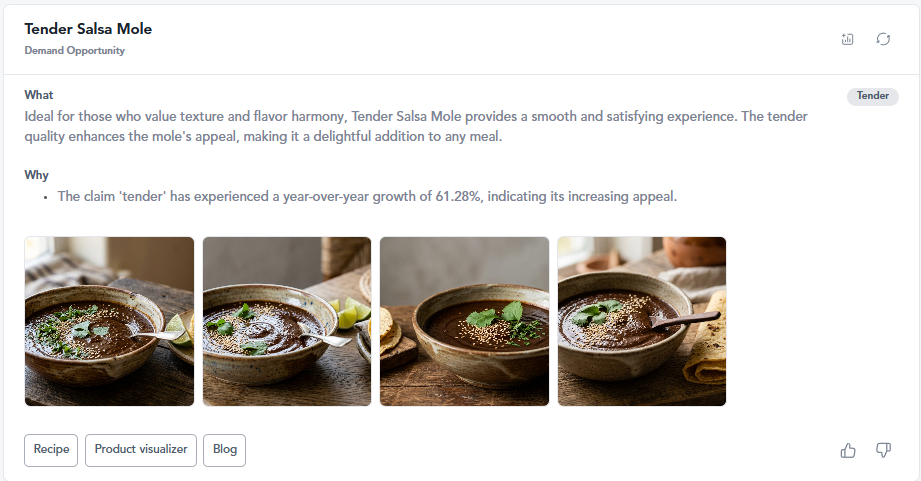
For R&D. The ingredient whitespace in Mexico is not in new flavors. It is in new formats built on established flavors. Sazón, mole, and salsa macha already carry consumer equity. Your team’s job is to put them into on-the-go, single-serve, or functional-claim-forward formats that are currently under-supplied relative to demand. Prioritize clean-label configurations and fermented ingredient inclusions (mezquite, miso, kéfir) to address the growing gut health motivation cluster.
For marketing. Stop leading with generic health claims in Mexico. The data is clear: saludable is contracting while casero, artesano, and antojo are accelerating. Your campaign copy should lead with ingredient provenance and craft authenticity, with specific functional claims (gut health, protein, on-the-go) as supporting proof points rather than primary hooks. This is not a local executional preference. It is a structural consumer motivation shift.
For sales. The sell-in story for Mexico retail and foodservice in 2026 is a whitespace story. Sazón growing 20 times faster than beef, mole in structural revival, functional plant-based claims outpacing vegan labels. These are the proof points that move a buyer from interest to order. Your pitch deck should lead with consumer data, not category size.
About this data
The insights in this post are powered by the Tastewise platform’s AI, which analyzes billions of real-life consumer data points across home cooking behavior, restaurant menu intelligence, and operator-level trend tracking to provide a real-time view of food and beverage trends in Mexico. The platform tracks over 115 million menu items and updates daily across the Mexican market. By blending consumer motivation signals with ingredient-level lifecycle data and operator menu penetration, Tastewise gives brand teams a single, current view of where demand is forming, before it shows up in retail sales data.
Related trends
The consumer signals shaping food trends in Mexico do not sit in isolation. The same craft, functional, and provenance motivations driving demand in the Mexican market are showing up across adjacent categories. The beverage trends report covers how functional hydration and clean-label claims are reshaping drink innovation across Latin America. The sandwich trends report shows how heritage flavor profiles and on-the-go format demand are intersecting in one of foodservice’s highest-volume categories.
FAQs about food trends in Mexico
The clearest velocity stories in the Mexico consumer panel right now are sazón (+68% in the past year at nearly 3% consumer share), mole poblano (+40%), salsa macha (+40%), and the “casero” (homemade) consumer motivation (+78% at 7.5% share). These signals are notable because they combine meaningful reach with high growth, not small-base percentage spikes that lack commercial scale. For a full view of the Mexico food trend report, the Tastewise platform pulls these signals in real time against your specific category and audience.
The Mexico plant based food industry is bifurcating, not contracting uniformly. Overall consumer reach for plant-based food is down 30% in the past year, but that headline figure masks two very different trajectories. Generic vegan and vegetarian positioning is declining. Functional plant-based claims are growing strongly: gut health (+82%), antioxidants (+88%), protein (+8%), and on-the-go (+153%). Brands that reframe their Mexico plant-based positioning around specific functional benefits rather than generic vegan labels are competing on the growth side of this split.
A food trend report for Mexico is most useful when it connects ingredient-level signals to consumer motivation data and lifecycle stage simultaneously. Knowing that sazón is growing is useful; knowing it is trending lifecycle at meaningful scale while growing alongside provenance motivations tells you the formulation strategy, the claim layer, and the campaign brief at the same time. The Tastewise platform delivers all three layers in a single view, which is why R&D teams using it are compressing validation cycles rather than waiting for lagged retail sales data to confirm what consumers already chose months ago.




We’d love to learn your goals and see how Tastewise fits
We’d love to learn your goals and see how Tastewise fits
Get a personalized demo
Good taste. Wise move.
Your demo request is confirmed. We’ll reach out within one business day to schedule your walkthrough.
What happens next

See what’s driving demand, then turn it into a sell-in story for retailers and operators.
- Connect consumer panels, market trackers, and agents into one evidence view
- Get the “why” behind what’s changing, with explainable demand drivers
- Walk away with a buyer-ready narrative and next steps to activate
Trusted by





“Tastewise is my secret tool for knowing what consumers want next and why.“