





Cheesecake trends in the US now run on two tracks. Tastewise menu data shows 1 in 5 US restaurants (20%) carry cheesecake, up 2.3% on last year. Social interest moved the other way and slipped 7.7%, with cheesecake at 0.6% of US food moments. Operators keep cheesecake on the menu while consumers look for new flavors and formats. That gap is where your next launch fits.
The opportunity for CPG and foodservice is clear: cheesecake is no longer a single product type. It’s a flavor system that keeps getting repackaged into new formats, textures, and consumption moments.
Key takeaways
- Cheesecake holds its place on 1 in 5 US restaurant menus (20%) and is still gaining menu share, even as social interest dipped 7.7%.
- Berry, chocolate and strawberry still lead cheesecake flavors, and berry appears on more cheesecake menus than any other ingredient.
- Japanese cheesecake grew 119% in the past year, the fastest global style. Basque cheesecake still reaches about 2x more cheesecake moments.
- Pistachio cheesecake is climbing on both fronts, up 20% in social interest and 15% on restaurant menus.
- Fresh cheeses from European baking traditions are reshaping the base, led by farmer cheese, skyr and quark.
- Fast casual, fine dining and bakeries are gaining ground on cheesecake menus, while QSR and casual dining lose share.
Flavor dominance is classic, but the winning strategy is pairing

Tastewise dish data shows what consumers pair with cheesecake. Across the Tastewise US consumer panel, cake-style builds lead by a wide margin, followed by cookies and brownies. These are the most-paired dishes right now:
- Cake (nearly 2 in 5 cheesecake moments, 40%)
- Cookie (8%)
- Brownie (2.1%)
- Speculoos (1.9%, up 30%)
- Banana pudding (0.9%)
This is a strong blueprint for product and menu builds. Most of the list is mature or cooling. Cake slipped 8% and brownie fell 26%, so the classic dessert mashup is losing pull.
Speculoos is the exception. It grew 30% while the rest of the top five declined, which makes biscuit-led crusts and toppings the safest new pairing to build around.
For foodservice, that points to pairing logic that fits how people order dessert:
- Speculoos or cookie butter crumb crusts on a house cheesecake
- Cheesecake layers inside cookie and cake builds
- Fruit-topped slices that lean on berry and strawberry
For CPG, one flavor platform can run across several formats:
- Cookie sandwiches with a cheesecake filling
- Ice cream mix-ins and swirls
- Dessert dips
- Snackable bites
That is where cheesecake consumer trends get practical. Your customers want familiar flavors in new executions.et practical. The demand is for familiar flavours in new executions.
Emerging flavors are driven by contrast and texture
The next layer of cheesecake flavors trending in the US comes from texture and tang. The fastest-growing cheesecake dishes in Tastewise data point to lighter, tangier and more visual styles.
Up-and-coming dishes (growth since last year)
- Yogurt cake (+244%)
- Japanese cheesecake (+119%)
- Sandwich cookie (+64%)
- Speculoos (+30%)
- Basque cheesecake (+9%)
Yogurt cake is the clearest signal. It reaches only 0.17% of cheesecake moments today, but it more than tripled since last year. Consumers want a tangier, lighter cheesecake, and yogurt delivers that without changing the format.
Texture claims point the same way. Silky grew 93% across US cheesecake moments, and glossy more than doubled from a small base. Consumers want cheesecake to feel smooth and rich at the same time.
The kataifi and knafeh crunch that spiked in early 2026 has since faded from US cheesecake. Treat crunch as a garnish, and build your core around smooth and tangy.
For product teams, this is where cheesecake trends shift from flavor to texture engineering:
- Swap part of the cream cheese for yogurt to add tang
- Promise a silky or smooth texture in pack and menu copy
- Add a glossy finish with a mirror glaze or fruit gel
Ingredients confirm the same pattern: fruit stays big, but pistachio is pulling focus
Tastewise ingredient data shows the most popular flavors in US cheesecake moments:
- Berry (nearly 1 in 10 cheesecake moments, 11%)
- Chocolate (7%)
- Strawberry (6%)
- Vanilla (3%)
- Cinnamon (1.9%)
Menus tell a stronger version of the same story. Berry appears on 1 in 3 US cheesecake menus (34%). Strawberry follows at nearly 1 in 4 (23%) and chocolate at nearly 1 in 5 (22%). The safe cheesecake play still wins on the menu.
Chocolate is the one to watch. It dropped 20% in social interest and 6% on cheesecake menus over the past 12 months. Lean on fruit for core SKUs, and use chocolate as a pairing.
Up-and-coming ingredients (growth in the past 12 months)
- Farmer cheese (+117%)
- Skyr (+81%)
- Quark (+57%)
- Biscoff spread (+37%)
- Berry compote (+13%)
Pistachio keeps pulling focus too. Pistachio cheesecake grew 20% in social interest and 15% on US restaurant menus, so the signal holds on both sides of the counter.
The fresh cheeses are the wildcard. Farmer cheese, skyr and quark all come from European baking traditions. Each brings a tangier, lighter base than cream cheese. For foodservice, that could show up as:
- A house cheesecake made with quark or farmer cheese
- Skyr cheesecake as a lighter dessert option
For CPG, it could mean:
- Cheesecake cups built on skyr for a higher-protein pitch
- Cheesecake-flavored snacks with a tangier dairy note
Cheesecake is turning into a format war: bars, shooters, cookies, and mini builds
mini builds
Format is where cheesecake picks up new demand. Small batch grew 56% as a cheesecake claim in the past 12 months, and loaded grew at the same pace. Consumers want cheesecake that feels handmade and generous, in sizes that fit one sitting.
Recipe behavior leans into easy, layered builds:
- No-bake builds, such as upside-down triple berry cheesecake
- Scoopable builds, such as cinnamon roll cheesecake served by the spoon
- Dessert mashups, such as peach cobbler cheesecake
Cinnamon runs through several of these. It is the only top-five cheesecake ingredient in the trending lifecycle stage, which suits seasonal and breakfast-adjacent formats.
For foodservice operators, this supports formats that improve speed and consistency:
- Cheesecake bites
- Cheesecake jars
- Scoopable cheesecake cups
- Cheesecake cookie builds
For CPG, it is a path to distribution-friendly cheesecake innovation:
- Frozen handheld cheesecake bites
- No-bake cheesecake kits
- Shelf-stable cheesecake-inspired cookies and cakes
This is where cheesecake trends become commercial. The base flavor is familiar. The format drives new demand.rcial. The base flavour is familiar. The format is what drives new demand.
Menu activity shows cheesecake can hold premium pricing while staying flexible
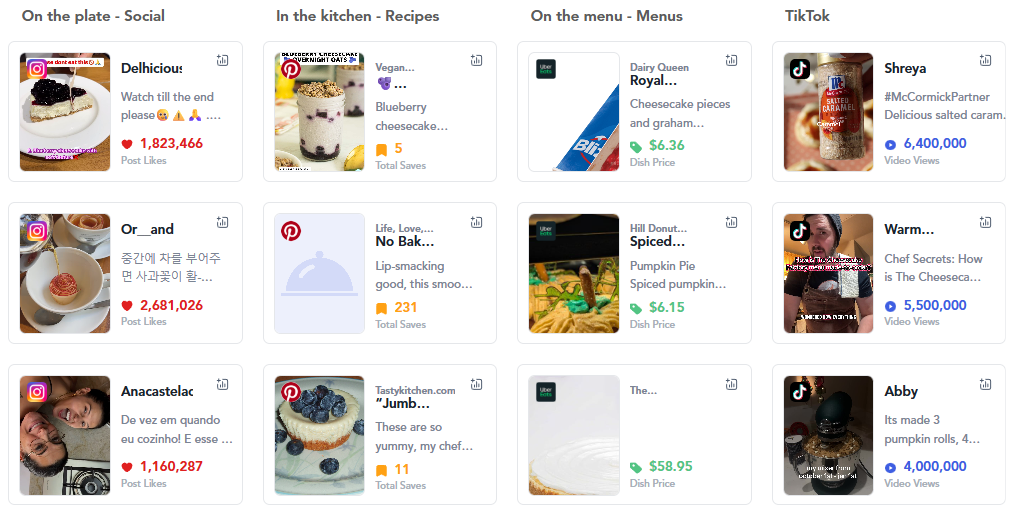
Cheesecake appears across every US restaurant segment, at a wide range of prices. Current menu items include:
- $5.94 (a classic cheesecake slice)
- $8.50 (Cookies & Cream Cheesecake at The Cheesecake Factory)
- $10.25 (Lemon Drop Cheesecake at The Cheesecake Factory)
- $12.49 (cheesecake crepe)
- $14.99 (strawberry cheesecake bowl)
The Cheesecake Factory shows how much room a premium slice still has. Its comparable restaurant sales rose 5.8% in the second quarter of fiscal 2026, ahead of the broader casual dining industry, according to the company’s earnings release.
Segment share shows where cheesecake is moving. QSR holds nearly 3 in 10 US cheesecake menus (29%), fast casual about 1 in 4 (26%) and casual dining 1 in 4 (25%). Fast casual’s share grew 2.2% and fine dining’s grew 5.6%. Casual dining’s share fell 7% and QSR’s fell 6%.
Chains are still moving inside QSR. Sonic Drive-In grew its cheesecake menu share nearly tenfold, even as QSR overall lost ground.
Cheesecake can live as:
- A low-ticket add-on dessert in QSR
- A mid-ticket premium add-on in fast casual
- A high-ticket dessert destination in full service
For foodservice teams, cheesecake works because the same flavor system scales up or down:
- Premium build: layered, plated, topped and finished with sauces
- Value build: cheesecake pieces, swirls or inclusions in frozen treats
That is why cheesecake menu trends stay active across segments. The product can be simplified and keep its core appeal.
Correlations reveal the strongest cheesecake “adjacencies” to build around
Tastewise affinity data shows which dishes and ingredients are most tightly tied to cheesecake. An affinity index of 60x means a dish appears alongside cheesecake 60 times more often than chance would predict.
- Basque cheesecake (60x)
- Japanese cheesecake (56x)
- Yogurt cake (27x)
- Speculoos (14x)
- Biscoff spread (13x)
- Berry compote (8x)
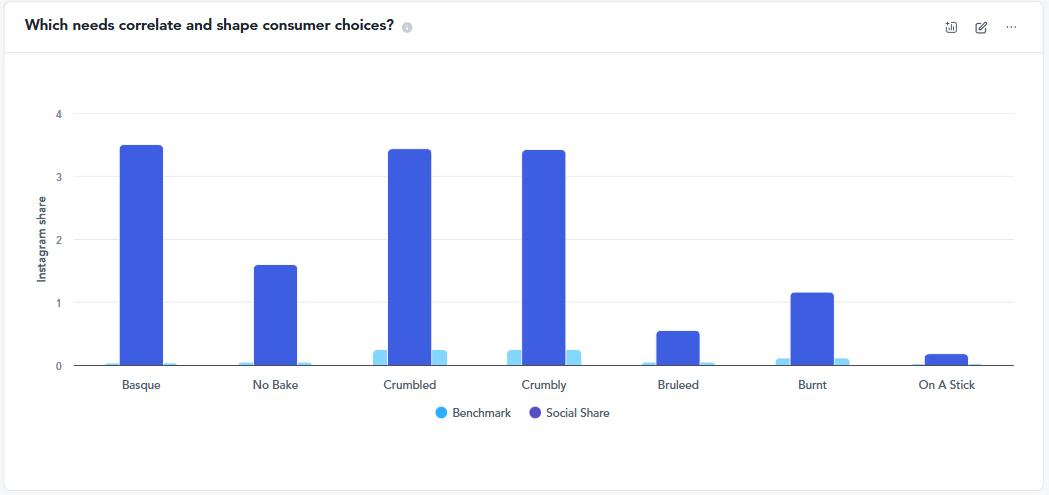
Basque cheesecake is the strongest anchor. It tops the affinity list and carries the biggest share of the global styles, which makes it a reliable driver of cheesecake interest. Basque is a technique cue as much as a flavor:
- burnt top
- lighter interior
- loose, crustless edge
- baked identity
That technique focus is easier for foodservice teams to execute and easier for CPG to translate into baked-style product claims.
Graham cracker is the menu-side anchor. It appears on nearly 1 in 10 US cheesecake menus (11%) with an affinity index of 68x, and it grew 8% compared with last year. The crust still matters, so test it before you change it.
Uncovering trending cheesecake flavors in modern foodservice
Cheesecake trends in foodservice now move on global styles, sweet-savory builds and botanical notes. The classic New York slice still anchors the menu. The growth sits in versions that look, taste and feel different from it.
Two viral global variations lead the shift. Basque burnt cheesecake reaches 1.65% of US cheesecake moments, about 2x more than Japanese fluffy cheesecake. Japanese cheesecake is growing nearly 14x faster, up 119% against 9% for Basque. Basque gives you a proven technique story today. Japanese gives you the faster-moving bet.
Flavor profiles and variations
The trending cheesecake flavors on US menus pair a familiar base with one premium cue. Pistachio is the strongest. Home bakers are building it into Dubai chocolate layered cheesecakes and pistachio Basque bakes.
Sweet-savory is the next step out. Home bakers are pairing burnt Basque cheesecake with black garlic, a savory note that keeps the caramelized top in the lead.
Botanical infusions are the smallest signal so far. In cheesecakes built on pistachio, matcha and similar flavors, fig honey nearly doubled (+96%). That points to floral sweetness as an early premium extract to test. Run it as a limited-time flavor and keep your core cheesecake flavour classic.
Regional and global preferences
Demand for global cheesecake flavours is shaping retail and dessert menus, and bakeries show it first. Cheesecake items on US bakery menus grew 19% over the past year. That outpaced American restaurants, which cut cheesecake items 7%, and Italian restaurants, which held flat.
Regional pricing shows where premium versions have room. Cheesecake menu items average $23.86 in Hawaii, $19.86 in Nevada and $18.38 in California, the three highest-priced states in the US.
For your next launch, give each cheesecake flavour one nuance an adventurous diner can name. That could be a burnt top, a fluffy crumb, a pistachio layer or a tangy fresh-cheese base. Test it as a limited-time offer in a bakery or fast casual setting first. Then extend the winner into product innovation for retail.
What to do with cheesecake trends right now (CPG + foodservice moves)
Here is what Tastewise social, menu and recipe data supports for your next cheesecake move:
Keep classic fruit as the volume base
Berry leads cheesecake flavors on social and appears on more cheesecake menus than any other ingredient. Anchor core SKUs and evergreen menu items in berry and strawberry. Use chocolate as a pairing while its interest cools.
Use pistachio to build premium extensions
Pistachio cheesecake is rising on social and on menus at the same time. Launch a pistachio layer or crust as your premium tier. Pair it with Dubai chocolate or a Basque bake for a limited-time offer.
Build tang and silky texture into the base
Yogurt cake, farmer cheese, skyr and quark are all growing as cheesecake cues. Test a partial swap of cream cheese for one of them, and call out a silky or smooth texture on pack and menu.
Lean into small-batch and scoopable formats
Small batch and loaded are both growing claims. Scoopable cups, no-bake jars and mashups such as peach cobbler cheesecake give you portable formats that still feel handmade.
Target fast casual and bakery menus first
Fast casual and bakeries are where cheesecake is gaining ground. Pitch new cheesecake flavors to these operators first, and treat QSR as a value channel for proven flavors.
Cheesecake is still a classic dessert. The growth comes from how brands rebuild it, with tangier bases, global styles and formats that travel. That is the current shape of cheesecake trends in the US.
FAQs about cheesecake trends
On menus, yes. Tastewise data shows 1 in 5 US restaurants (20%) carry cheesecake, up 2.3% on last year, and recipe interest is holding steady. Social interest dipped 7.7% over the same period. Tastewise forecasts consumer demand for cheesecake to keep climbing into 2027.
The most popular cheesecake flavors are still classic. Across US cheesecake moments, berry leads at nearly 1 in 10 (11%). Chocolate (7%) and strawberry (6%) follow, with vanilla and cinnamon behind them. On menus, berry and strawberry hold the top two spots. These flavors translate cleanly across menus, packaged desserts and mix-ins.
The fastest growth comes from tangy fresh cheeses and global styles. Farmer cheese grew 117% as a cheesecake ingredient, ahead of skyr (+81%) and quark (+57%). Among dishes, yogurt cake (+244%) and Japanese cheesecake (+119%) lead the risers.
Handmade, generous formats are gaining ground. Small batch and loaded both grew 56% as cheesecake claims. Recipe behavior favors no-bake, scoopable and mashup builds, such as peach cobbler cheesecake. That keeps cheesecake flexible for cups, jars, cookies and hybrid desserts.
Basque cheesecake has the strongest tie to cheesecake of any dish in Tastewise data, with an affinity index of 60x. It reaches 1.65% of US cheesecake moments, the largest share of the global styles. Its burnt top and crustless build give operators a technique story that is easy to execute and easy to name on a menu.
Biscuit-led pairings are the strongest bet. Speculoos (14x) and Biscoff spread (13x) over-index heavily with cheesecake, and speculoos kept growing while other top pairings cooled. Berry compote (8x) is the fruit-led option. These pairings scale across crusts, fillings, swirls and toppings.
Graham cracker and fruit are gaining on US cheesecake menus. Graham cracker grew 8%, berry 3.7% and strawberry 3.2% in the past year. Chocolate (-6%) and caramel (-10%) are losing menu share. Pistachio cheesecake is the premium riser, up 15% on menus.
Japanese fluffy cheesecake is the fastest-growing global style, up 119%. Basque burnt cheesecake reaches more consumers today but grows more slowly. European fresh cheeses are rising too, led by Icelandic skyr (+81%) and German quark (+57%). Each gives a cheesecake flavour a lighter, tangier finish.
Fine dining and fast casual are gaining share of US cheesecake menus, up 5.6% and 2.2%. Bakeries grew their cheesecake menu items 19%. QSR and casual dining still hold the most cheesecake menus but lost share, which makes them better homes for proven flavors.


We’d love to learn your goals and see how Tastewise fits
We’d love to learn your goals and see how Tastewise fits
Get a personalized demo
Good taste. Wise move.
Your demo request is confirmed. We’ll reach out within one business day to schedule your walkthrough.
What happens next

See what’s driving demand, then turn it into a sell-in story for retailers and operators.
- Connect consumer panels, market trackers, and agents into one evidence view
- Get the “why” behind what’s changing, with explainable demand drivers
- Walk away with a buyer-ready narrative and next steps to activate
Trusted by





“Tastewise is my secret tool for knowing what consumers want next and why.“