





Hydration launches are getting harder to call. Consumer buzz around electrolyte and functional water in the USA climbed 15.1% in the past year, and the ingredients that built the category are cooling at the same time. Magnesium holds one of the largest shares of that conversation and is down 11.5%, sitting in a declining lifecycle stage. If your team is weighing a salt-forward SKU against something else, an AI market trend prediction agent gives you the read that a single category growth number hides. That gap between a headline number and a decision is the whole reason this class of tool exists.
Key takeaways
- Electrolyte and functional water buzz grew 15.1% in the USA over the past year, while magnesium, sea salt and coconut water each posted declines inside that same category. Read the category number on its own and you brief the wrong SKU.
- The calm claim inside functional water is up 70.8% and anti bloat is up 29.4%, both moving faster than any classic electrolyte cue. Your innovation brief has a stronger case for a cortisol and bloat position than a sports recovery one.
- Adaptogen beverage buzz fell 14.1% in the past 12 months, yet the ritual claim attached to it rose 85.3% and comfort rose 110.6%. A campaign written in stress relief language is chasing a claim that dropped 41.2%.
- Gut health in savory snacks carries a thin base of 578 posts and fell 6.3% since last year, while probiotics inside it grew 25.5% and anti bloat grew 44.3%. Thin base plus fast claim growth is a watch item, not a launch case.
Key terms in AI trend prediction
Demand signal. What an AI trend prediction agent reports is a demand signal, not a sales figure. A signal is evidence that interest, ordering or cooking behavior around an ingredient, claim or format is moving, and it tells you the direction and the speed of that movement. It does not tell you how many units sold. Read it as a reason to look closer at a category, not as a count of buyers.
Conversation share. Conversation share measures how much of the talk inside a defined category attaches to one ingredient or claim. It is an index of attention within that category. It is not a share of the market and not a share of shoppers. Magnesium holds a 21.4 conversation share inside functional water while falling 11.5%, which is how an ingredient can be large and shrinking at the same time.
Claim. A claim is the reason a product gives a consumer to choose it: calm, anti bloat, ritual, premium, gut health. Claims move independently of the categories carrying them, which is why the claim layer often points somewhere the category number does not. Adaptogen beverage buzz fell 14.1% in the past 12 months while the ritual claim attached to it rose 85.3%.
Lifecycle stage. Lifecycle stage places a signal on its adoption curve, from emerging through growing, mature and declining. Two signals can grow at the same rate and sit in different stages, and the stage is what decides whether you lead, follow or wait. Ashwagandha inside functional water grows 27.8% from an early position. Magnesium declines from a large one.
Menu share. Menu share is the proportion of tracked foodservice menus carrying an item. It reads as operator commitment rather than consumer interest, because a menu costs money and lead time to change. Ashwagandha carries 1.4% menu share inside functional water, which is small in absolute terms and meaningful as confirmation that the format is already being sold.
Cross-source validation. Cross-source validation is the check that runs before a signal is reported: the same movement has to appear in consumer panel behavior, on foodservice menus and in retail movement. A signal visible in one channel measures interest. A signal that holds across all three is closer to repeat behavior, which is what a brief can be built on.
AI trend prediction starts beneath the category number
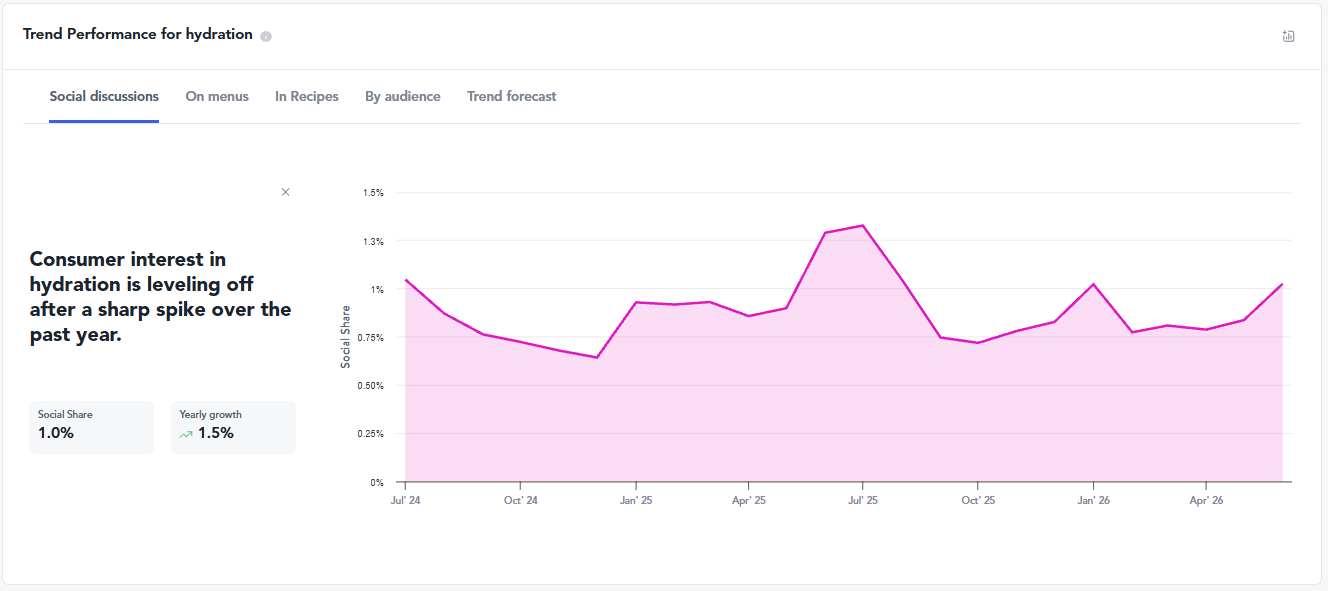
Consumers have stopped treating functional drinks and snacks as a single decision. The person buying electrolytes for a hangover, the person buying them for an afternoon slump and the person buying them for bloating are three different shoppers with three different triggers. Inside Tastewise consumer data, the afternoon occasion in functional water is up 53.1% and travel is up 31.6%, which tells you the format is escaping the gym bag. Salt cues are cooling while the reasons to drink are multiplying.
The Tastewise read on those same categories shows how easily one number misleads. Functional water conversation is growing, but celtic sea salt is down 33.2% and himalayan salt is down 25.6%, both in early lifecycle with real menu presence behind them. Ashwagandha, by contrast, is up 27.8% inside functional water and already carries 1.4% menu share, and chia is up 61.6%. Those are the signals a validated agent surfaces and a keyword tracker buries.
For your team the opportunity is a sharper brief rather than a bigger one. A hydration concept positioned on calm, bloat and afternoon energy has three growing claims behind it and a set of named ingredients to formulate against. A concept positioned on classic electrolyte replacement is arguing with its own category data. The same logic applies to any category where the headline is moving in one direction and the claims underneath it are moving in another.
What is an AI trend forecasting agent for food and beverage?
An AI trend forecasting agent for food and beverage is a software system that monitors ingredient, flavor, format and claim signals in near real time. It reads restaurant menus, retail velocity, consumer panels and home cooking data, then validates and explains each signal before a team sees it. The distinction from a static trend report is timing and depth. A report tells you what happened last quarter. An agent tells you what is accelerating now, which need state sits behind it, and where the lifecycle curve places it.
The Tastewise Trends Agent works this way across 4 million foodservice locations and 39 live markets. Every finding arrives with the need state, the audience and the lifecycle position attached, which is what lets an insights lead defend it in a room. The wider Tastewise agentic AI system runs the same validated data layer through the rest of the workflow, from concept scoring to sell-in narrative.
How does an AI market trend prediction agent differ from social listening?
Traditional market research reports publish weeks or months after behavior shifts, so your team reads them knowing the window has already moved. Social listening reads one noisy channel and rewards whatever spiked hardest, which is how a viral format with no repeat purchase behind it ends up in a line review deck. Neither approach separates attention from adoption.
An AI market trend prediction agent checks the same signal in more than one place before it reports. Tastewise Trends Agent cross references consumer panel behavior, foodservice menu presence and retail movement, and only a signal that holds across those layers reaches your team. The adaptogen picture makes the difference concrete. A single-channel read sees buzz down 14.1% and calls the trend dead. The claim layer shows ritual up 85.3%, intentional up 111.5% and slow living up 90.3%, which says the demand moved rather than left. That is the read the Tastewise AI food trend prediction accuracy speed argument rests on, and it is why one of our comparison pieces on AI platforms for food trend analysis leads with validation rather than volume.
Getting this wrong is expensive. An academic study of 36,994 line extensions using consumer panel data found roughly half fail within a year of launch, with failure approaching 80% by the third year.
AI trend prediction in practice: three role-specific use cases
Product innovation teams reading past the headline in functional hydration
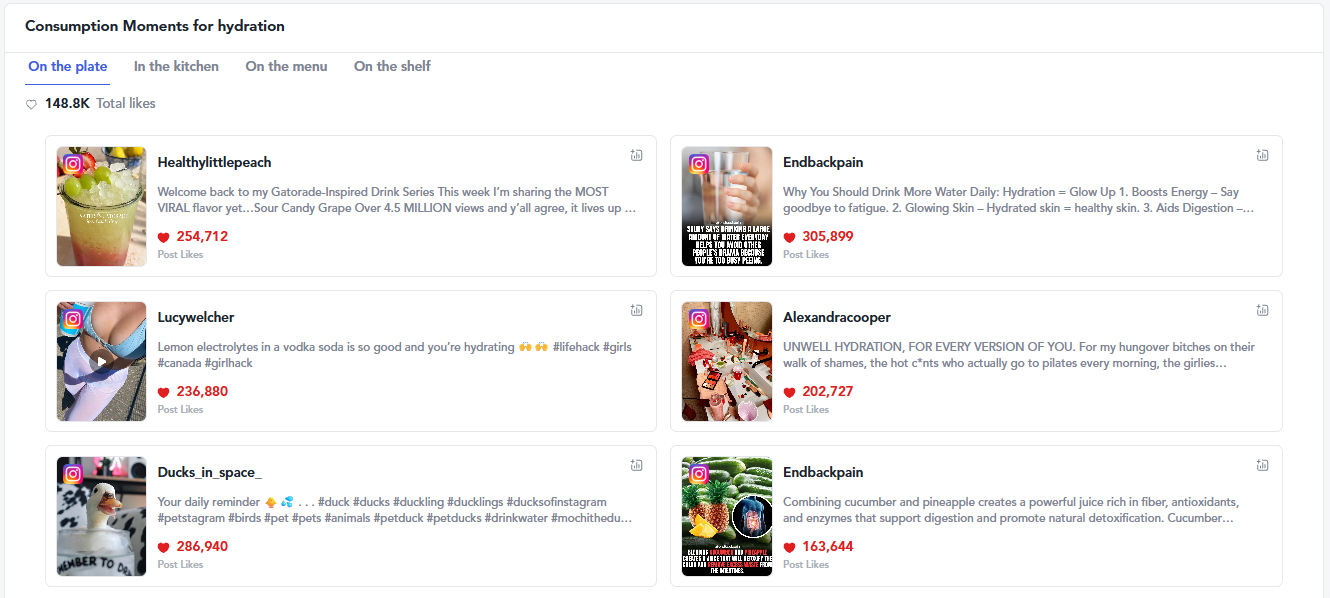
An innovation team weighing a functional hydration line usually starts with the category growth figure, and 15.1% growth over the past year reads like a green light for anything hydration shaped. The Trends Agent read splits that number apart. Magnesium sits at 21.4 share of the conversation and is down 11.5% in a declining stage, sea salt is down 11.9%, and coconut water is down 8.8%. Meanwhile calm is up 70.8%, cortisol is up 20.3% and creatine is up 52.7%.
That changes the brief. Rather than a fourth entrant against Propel and Stur on electrolyte parity, the defensible concept leads on afternoon calm and bloat, formulated around ashwagandha at 1.4% menu share and chia at 61.6% growth. The menu layer confirms operators are already selling the format, with electrolyte water at Nekter Juice Bar and hydration watermelon on the Smoothie King board. For teams working through this stage, the product innovation solution is where concept scoring and whitespace sit. Mademoiselle Desserts describe replacing weeks of desk research with a single afternoon between question and decision.
Consumer insights teams separating gut health demand from gut health noise
An insights manager asked to prove whether gut health in savory snacks is real faces the harder version of this problem, because the honest answer is not a clean yes. The Tastewise cut shows 578 posts in that specific space, down 6.3% since last year. A tool that only reported growth rates would hand back probiotics at 25.5%, prebiotics at 25.8% and anti bloat at 44.3% and let a leadership team read those as a launch case.
The defensible brief reports both. Claim momentum is genuine and the base is thin, which makes this a watch item with a named trigger rather than a Q1 commitment. Supporting detail sharpens it further, with cottage cheese up 21.0% and chickpea up 20.8% while sourdough bread falls 61.6%. Brands including Vegan Rob’s, Brad’s Plant Based and LAIKI already hold shelf space here, so the competitive read is part of the same answer. That combination of momentum, base size and competitive presence is what the Tastewise consumer insights platform is built to produce.
Marketing and brand teams finding the adaptogen angle that is still growing
A brand team building a Q1 adaptogen campaign has 48 hours and a category that looks like it is fading. Adaptogen beverage conversation is down 14.1% in the past 12 months and the adaptogens claim itself is flat at a 62.17 share. Stress relief is down 41.2%, mental health is down 40.7% and mood boosting is down 41.3%, so every line of copy written in therapeutic language is aimed at a shrinking audience.
Underneath that, the same data shows where the audience went. Ritual is up 85.3%, comfort is up 110.6%, cozy is up 70.0%, botanical is up 57.8% and the evening occasion is up 40.2%. An ashwagandha and reishi campaign framed as an evening ritual has five growing claims behind it and a premium claim up 45.8% to support the price. Teams running trend-led work through the consumer marketing solution get the audience, the claim language and the occasion in one pull. The Givaudan flavor team describes using Tastewise to surface flavor trajectories before the rest of the market notices them.
AI trend prediction for retail sell-in
The scenario below is illustrative rather than a case study of a named client.
Category management preparing a line review.
A category manager walking into a line review with a major grocery retailer needs more than a growth figure. Buyers hear category growth from every supplier in the room. What moves a decision is a specific read on where demand inside the category is heading, and why this SKU sits in that path.
Gut health in savory snacks shows both the trap and the fix. Presented as a growth story it collapses, because the space carries a thin base of 578 posts and fell 6.3% since last year, and a buyer with their own data will find that. Presented as a claim story it holds. Probiotics inside that space grew 25.5%, prebiotics grew 25.8% and anti bloat grew 44.3%, while the formats moving alongside them are cottage cheese at 21.0% and chickpea at 20.8% and sourdough bread falls 61.6%.
The approach is to lead with the claim layer, state the size of the base yourself, and show the competitive position rather than hide it. Vegan Rob’s, Brad’s Plant Based and LAIKI already hold shelf space in that set, which tells a buyer the shelf is forming rather than empty. The outcome is directional. The conversation shifts from a supplier asking for space to a category argument the buyer can carry to their own team, with the weak part of the evidence surfaced up front instead of found later. Tastewise builds this read for buyers inside the retail sales enablement solution.
AI trend detection mechanics
What makes a food trend signal valid rather than noise?
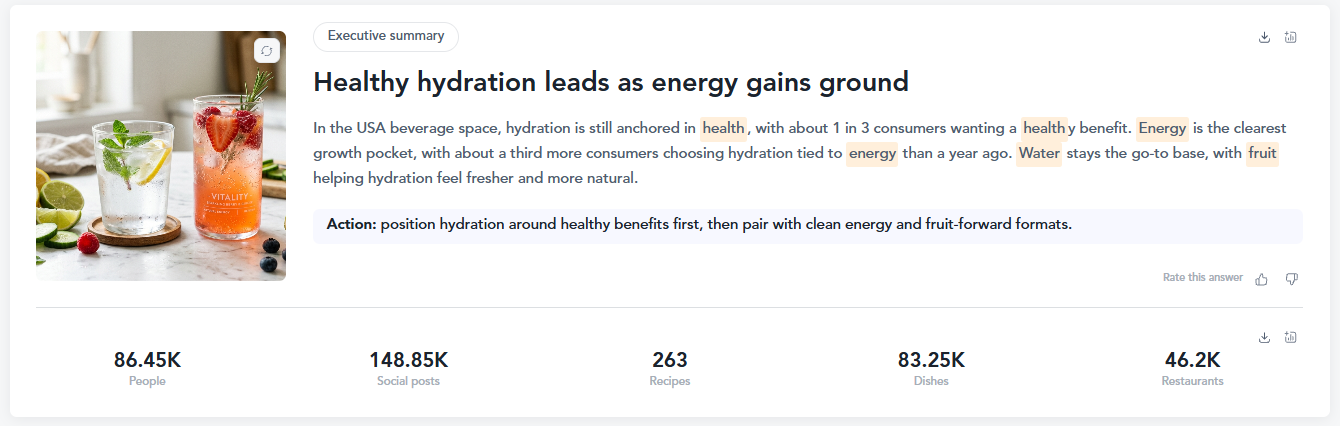
A valid signal appears in more than one channel and holds over time. Social attention on its own measures interest, and interest is cheap. When a claim rises in consumer conversation and shows up on menus and moves at retail, the behavior behind it is repeat rather than novelty. The functional water case is a useful test, because buzz and claims point in opposite directions there and only the claim layer survives the cross check.
How far ahead can AI detect a food trend?
Detection horizon depends on lifecycle stage rather than a fixed number of months. Signals in an emerging stage carry longer runway and thinner evidence, while a mature signal is easier to prove and harder to profit from. Ashwagandha inside functional water is a working example, holding 1.4% menu share against 27.8% growth, which is early enough to lead and established enough to defend.
Which data sources are most reliable for predicting food trends?
No single source is reliable on its own, which is the point of a multi-layer approach. Consumer panels show stated behavior, menu data shows operator commitment, and retail movement shows purchase. Tastewise combines those with recipe and home cooking data across 39 markets, and publishes the live read by category on the food trends tracker.
How is AI trend forecasting different from market research?
Traditional research asks people what they might do and reports it after fieldwork closes. Trend forecasting reads what people already did and models how fast it is scaling. Both have a place, and the practical difference for your team is that one arrives in time to change a brief and the other arrives in time to explain a result. Our longer piece on how Tastewise uses AI for food trend analysis walks through the classification and validation steps in more detail.
Where this leaves your next brief
The pattern across all three cases is the same. The category number tells you whether to pay attention and the claim layer tells you what to build. Teams that only read the first number ship concepts that argue with their own data, which is a large part of why line extension failure rates stay where they are. Tastewise customers report 25% faster movement to shelf and around six weeks saved per innovation cycle, which comes from cutting the validation loop rather than the thinking.
Pick one category on your roadmap this quarter and run it through both layers before the brief is written.
Frequently asked questions about AI market trend prediction agents
It can place a signal on a lifecycle curve and estimate remaining runway, which is more useful than a peak date. Magnesium in functional water is a good illustration, sitting in a declining stage with a 21.4 conversation share, so the volume is still large while the direction is set.
Yes, though the evidence available differs by market. Tastewise runs live consumer data across 39 markets, and coverage of foodservice and retail layers varies, so a non-USA read leans harder on the consumer panel. Ask which layers are available for your market before you build a brief on it.
A report is a snapshot with a publication date and the Trends Agent is a continuous read you can query against your own category and audience. The adaptogen example shows why that matters, because a report published on last year’s stress relief framing would miss the ritual claim rising 85.3% underneath it.
No, and the teams getting most out of these tools do not use them that way. An AI trend prediction agent compresses the gathering and validation work: what is growing, where it sits on the lifecycle curve, which claims carry it, and which channels confirm it. The judgment after that stays human. Whether a signal fits your brand equity, your formulation constraints and your competitive position is not a data question. Gut health in savory snacks is the clearest case, because the data can tell you claim momentum is real and the base is thin, and only your team can decide whether that reads as a watch item or a commitment for the next cycle.
Accuracy is a question about what happened after the call, so measure it against the behavior the signal predicted rather than against how loud the signal was. Something reported as emerging should go on to gain menu presence, move at retail and hold consumer engagement past the novelty window. The control that raises those odds sits before the report rather than after it. A claim confirmed in consumer conversation, on foodservice menus and in retail movement before it reaches your team has a far better chance of describing durable demand than one drawn from a single channel. Lifecycle stage belongs in the same measurement, because a call on an emerging signal carries longer runway and thinner evidence than a call on a mature one.
A fad concentrates in one channel, usually social, spikes quickly and never converts into repeat purchase. A signal holds in more than one place. It reaches menus, which operators only change when they expect an item to sell, and it keeps moving at retail after the first wave of curiosity passes. Base size is the second test. Gut health in savory snacks carries claims growing 25.5% and 44.3% on a base of 578 posts that fell 6.3% since last year, which reads as early movement rather than established demand. Treating that as a trend is how a team commits a launch to a space still deciding whether it exists.
Most teams connect it at two points. The first is before the brief is written, where claim, ingredient and occasion data sets the position instead of confirming one already chosen. That is the difference between a hydration concept built on calm and afternoon energy and one built on electrolyte parity. The second is concept validation, where a drafted concept is checked against current signals so a misalignment surfaces before consumer testing rather than after it. The same validated data then carries into sell-in, so the story a buyer hears matches the one the brief was built on. Our wider piece on food trend prediction covers the agentic workflow end to end.


We’d love to learn your goals and see how Tastewise fits
We’d love to learn your goals and see how Tastewise fits
Get a personalized demo
Good taste. Wise move.
Your demo request is confirmed. We’ll reach out within one business day to schedule your walkthrough.
What happens next

See what’s driving demand, then turn it into a sell-in story for retailers and operators.
- Connect consumer panels, market trackers, and agents into one evidence view
- Get the “why” behind what’s changing, with explainable demand drivers
- Walk away with a buyer-ready narrative and next steps to activate
Trusted by





“Tastewise is my secret tool for knowing what consumers want next and why.“