






Soy milk vs oat milk is one of the most common choices US coffee drinkers make at the counter. At Starbucks, swapping in a non-dairy milk is the second most requested drink customization, behind adding an espresso shot. The chain made that point when it dropped its non-dairy surcharge on soy, oat, almond and coconut milk in November 2024.
Behind that single swap sit two very different products. This guide compares both on nutrition, taste, coffee performance, sustainability and menu adoption. It uses Tastewise US data from October 2025 to August 2026, so you can see where demand is moving before your next launch.
Key takeaways
- Oat milk reaches nearly 2 in 5 US consumers who engage with milk alternative beverages (38%), about 10x soy milk at 3.7%.
- Nearly 1 in 5 US soy milk consumers choose it for protein (22%), almost 4x the rate among oat milk consumers (5.8%).
- Unsweetened soy milk carries about 7 g of protein per cup, more than double a typical oat milk at about 3 g.
- Oat milk appears at nearly 1 in 4 US restaurants serving milk alternative beverages (23%), against nearly 1 in 10 for soy milk (9%).
- Starbucks accounts for more than 1 in 4 US restaurant locations that serve oat milk (27%).
- Soy milk needs about 28 liters of water per liter produced, compared with 48 liters for oat milk.
What is the difference between soy milk and oat milk?
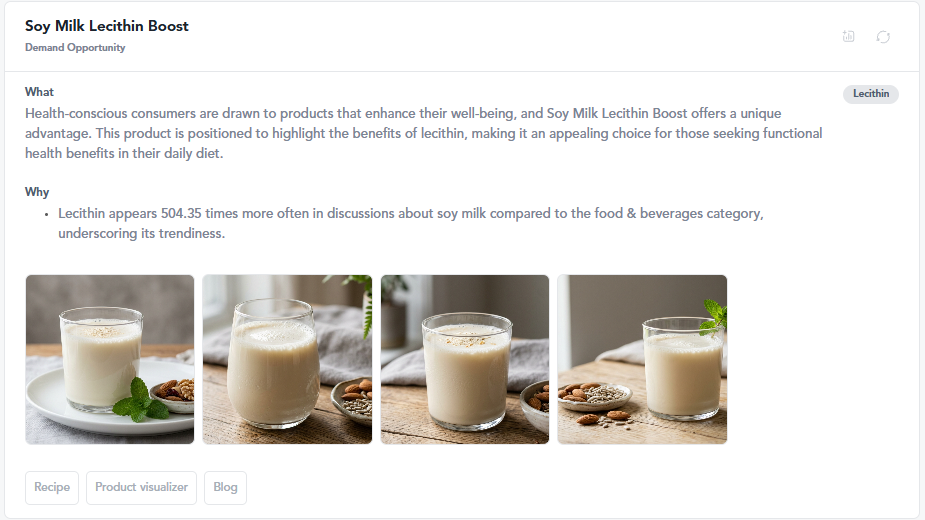
Soy milk and oat milk are both leading plant-based dairy alternatives. Soy milk is a legume-derived beverage with a complete protein profile. Oat milk is a grain-based beverage known for its naturally sweet taste, rich texture and strong barista-grade foam.
In the soy milk vs oat milk decision, that split shapes everything downstream. It decides which claim leads on the pack, which drinks a cafe builds and which consumers a launch should target. For the wider view of what consumers will reach for next year, the Tastewise trend forecast maps the flavors and formats to plan around.
Nutritional profiles & protein content
The soy milk vs oat milk protein gap shows up clearly on the label. A cup of Silk unsweetened soy milk lists 80 calories, 4.5 g of fat, 7 g of protein and 4 g of carbohydrates. A cup of Planet Oat original oat milk lists 120 calories, 5 g of fat, 3 g of protein and 16 g of carbohydrates.
Soy protein is also complete, carrying all nine essential amino acids. That is why protein in soy milk vs oat milk comparisons favor soy on both quantity and quality. Fortified soy milk is the only plant milk the Dietary Guidelines for Americans count in the dairy group.
Oat milk answers with fiber. A typical cup carries around 2 g, mostly beta-glucan, the soluble oat fiber linked to lower LDL cholesterol. Oat milk also carries more carbohydrates, which matters for anyone tracking sugar.
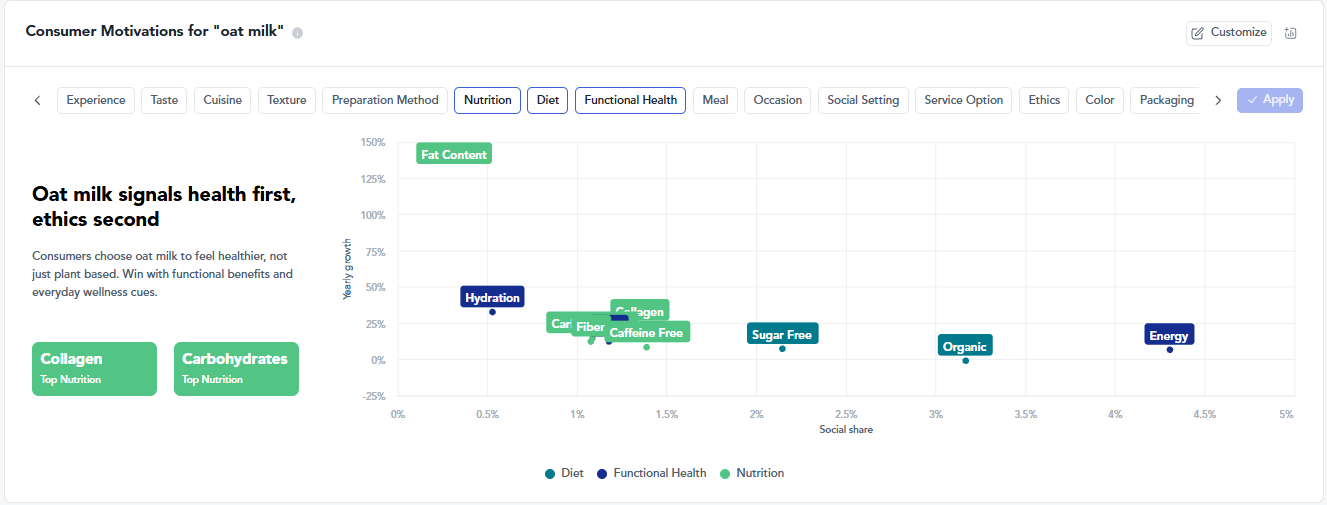
Consumers already read the labels this way. Across the Tastewise US consumer panel, protein is the top reason soy milk consumers give for their choice. Vitamins are the fastest-growing reason among them, up 26% on the previous year. Vitamin E follows at 21% growth and fiber at 13%. Among oat milk consumers, energy is the fastest-growing reason, up 15%, while protein is up 3%.
Identity claims are fading for both milks. Vegan and plant-based motivations each fell 28% among oat milk consumers. Dairy-free fell 27% among soy milk consumers. In the soy milk vs oat milk health comparison, functional nutrition is now the story that moves demand.
For soy milk vs oat milk for lactose intolerance, both are naturally lactose free, so either works as a direct swap. Allergies are the bigger divider. Soy is one of the major US food allergens, and oats are often processed near wheat, so people with celiac disease should look for certified gluten-free oat milk.
For oat milk vs soy milk for weight loss, the unsweetened labels favor soy, with 40 fewer calories and more than twice the protein per cup. Sweetened and barista versions of both add sugar and oil, so the label matters more than the base.
Taste, texture & coffee performance
Oat vs soy milk taste comes down to sweetness and body. Enzymes break oat starch into natural sugars during production, which gives oat milk its mild sweetness and creamy feel. Soy milk tastes beanier and less sweet, with a lighter body in its unsweetened form.
In hot coffee, the soy milk vs oat milk for coffee question is about stability. Soy proteins can curdle when they meet hot, acidic coffee. Barista oat milks add a little oil to hold foam and resist splitting, which is why many baristas reach for oat milk for microfoam and latte art.
US menus show where oat milk vs soy milk in coffee has landed. Starbucks lists the Iced Brown Sugar Oatmilk Shaken Espresso and the Brown Sugar Oatmilk Cortado among its oat milk drinks. It also ran the Pecan Crunch Oatmilk Latte as a limited-time item. Caribou Coffee has added a Hot Honey Oatmilk Crafted Cold Brew, and Biggby Coffee sells an Oat Milk Horchata Creme Freeze.
On Starbucks soy vs oat milk, the chain offers both, alongside almond and coconut milk. Oat milk joined its US menu in 2021. Since November 2024, Starbucks charges nothing extra for any of these swaps.
Soy milk wins its menu space in other cuisines. It anchors Chinese and Taiwanese breakfast and dessert menus, from soy milk with youtiao to matcha soy milk and Tieguanyin soy milk tea. Vietnamese restaurants serve it as sua dau nanh. In an oat milk vs soy milk taste comparison, soy is the flavor that diners in these cuisines already expect.
Environmental impact & sustainability comparison
For oat milk vs soy milk environmental impact, the Poore and Nemecek study in Science remains the most cited comparison. Per liter, soy milk produced about 0.98 kg of greenhouse gas emissions, measured as CO2 equivalent. It used about 0.66 square meters of land and 28 liters of water.
Oat milk produced about 0.9 kg of emissions per liter, using 0.76 square meters of land and 48 liters of water. Both are a fraction of dairy milk, which needs around 9 square meters of land and 628 liters of water per liter.
Consumer concern about soy and deforestation is real, but most of the world’s soy crop goes to animal feed. Oats raise a different question. They are usually grown as a single crop across large areas, so soil health depends on crop rotation.
In the soy milk vs oat milk comparison on sustainability, soy leads on water and land, while oat edges ahead on emissions. Either milk is a strong sustainability story next to dairy.
How Tastewise.io uses data-driven insights to predict plant-based trends
Tastewise is the proactive AI food and beverage intelligence system that delivers before you ask. It reads consumer social behavior, home cooking recipes and restaurant menus as one connected dataset, refreshed daily. That lets you track demand for soy milk vs oat milk as it moves, month by month.
Plant-based functional demand
Across the Tastewise US consumer panel, oat milk held nearly level among milk alternative consumers, down 0.6% on the previous year. Soy milk lost consumers faster than oat milk over the same window, down 8.5%.
Home cooking reverses the picture. Soy milk appears in nearly 3x more milk alternative recipes than oat milk, at 2.4% against 0.8%. Oat milk recipes are still rising, up 2%. Tastewise forecasts oat milk demand to keep climbing through next year, with soy milk holding steady.
The audiences differ too. Coffee lovers are the group most closely tied to oat milk, while chefs lead soy milk interest. You can build these consumer segments into your own targeting before a launch.
For product innovation teams, the signal is specific. Protein, vitamins and energy are rising as reasons to choose a plant milk. Vegan and dairy-free identity claims are losing ground.
Foodservice & specialty beverage innovation
On menus, oat milk slipped 3.6% among US restaurants that serve milk alternative beverages. Soy milk stayed flat, down 0.2%. The overall menu picture is stable, so the growth sits in specific chains.
Tim Hortons grew its share of US oat milk locations by 62%, and Biggby Coffee grew its share by 69%. Peet’s Coffee and Caribou Coffee lost share, down 37% and 27%. Distributor teams can turn these chain moves into foodservice operator pitches while the shift is still early.
Soy milk follows a different map. Panera Bread accounts for nearly 1 in 4 US restaurant locations serving soy milk (24%). Capriotti’s Sandwich Shop nearly tripled its share, up 193%, while Jamba fell 55%. Soy milk also keeps a K-12 foothold, with Silk Soymilk listed on school menus from Indiana to Washington.
Ready-to-drink formats are reaching menus as well. La Colombe’s Oatmilk Double Latte can appears on restaurant menus, and Wawa sells a Golden Mango Oat Milk drink in its convenience stores.
Real-world success: driving plant-based growth through AI analytics

Food and beverage brands use Tastewise to check a formulation against real consumer demand before it reaches the shelf. Tastewise is trusted by 80% of the world’s leading F&B brands, and its customers report 30% higher win rates.
Picture a functional beverage brand planning a new ready-to-drink coffee line. It has to choose an oat base, a soy base or a dual-protein blend before it locks the formula. Here is how the data answers that oat vs soy milk question.
First, the team checks reach. Oat milk reaches about 10x more US milk alternative consumers than soy milk, so an oat base gives the line the widest appeal.
Second, it checks the claim. Protein leads soy milk choice, and energy is the fastest-growing reason oat milk consumers give. A protein and energy pairing suits a coffee drink that already sells on caffeine.
Third, it checks texture. Oat milk’s sweetness and foam suit iced lattes and cold foam, the formats Starbucks and Caribou Coffee keep adding to menus.
The answer is an oat-forward base with added soy protein, labeled on protein and energy. The team tests it first in regions where Tim Hortons and Biggby Coffee are expanding oat milk. It then builds a retail buyer story from the same claim data for grocery sell-in.
Tastewise AI agents can watch these signals on your category and send the concept brief and buyer story when a claim starts to move. For more on turning category data into decisions, the guide to CPG insights covers the wider workflow.
The soy milk vs oat milk choice has no single winner. Oat milk leads on reach and the coffee bar. Soy milk leads on protein, home cooking and water use. Build your next plant-based launch around the claim your consumers are moving toward.
FAQs about soy milk vs oat milk
Soy milk offers more protein and fewer carbohydrates, while oat milk offers more fiber from beta-glucan. A cup of unsweetened soy milk carries about 7 g of protein, against about 3 g in a typical oat milk.
US consumers weigh it the same way. Protein is the top reason soy milk consumers give for their choice, and vitamins are the fastest-growing reason, up 26% on the previous year.
Soy milk has more than twice the protein of oat milk, and its protein is complete. Unsweetened soy milk carries about 7 g per cup, compared with about 3 g for oat milk.
Oat milk usually performs better in hot coffee because it foams well and resists curdling. Soy milk can split when it meets hot, acidic coffee.
US menus reflect this, with Starbucks accounting for more than 1 in 4 US restaurant locations that serve oat milk (27%).
Yes. Starbucks offers soy, oat, almond and coconut milk, and it has charged nothing extra for any of them since November 2024.
Soy milk uses less water and land, while oat milk produces slightly lower emissions. Per liter, soy milk needs about 28 liters of water against 48 liters for oat milk.
Both are naturally lactose free, so either works for lactose intolerance. Soy is a major allergen, and oat milk should be certified gluten free for people with celiac disease.
Lactose-free status alone is a fading reason to choose, with dairy-free motivation down 27% among US soy milk consumers.

Read more from Kelia Losa Reinoso


We’d love to learn your goals and see how Tastewise fits
We’d love to learn your goals and see how Tastewise fits
Get a personalized demo
Good taste. Wise move.
Your demo request is confirmed. We’ll reach out within one business day to schedule your walkthrough.
What happens next

See what’s driving demand, then turn it into a sell-in story for retailers and operators.
- Connect consumer panels, market trackers, and agents into one evidence view
- Get the “why” behind what’s changing, with explainable demand drivers
- Walk away with a buyer-ready narrative and next steps to activate
Trusted by


“Tastewise is my secret tool for knowing what consumers want next and why.“