






Updated for June 2026: refreshed platform rankings, added pricing and ROI guidance, and expanded the comparison to cover new entrants.
The best AI platforms for food trend analysis in 2026:
- Tastewise – best overall; food & beverage-native, covers trend detection through commercialization.
- Spoonshot – best for ingredient science and formulation.
- Spate – best for early, search-based demand signals.
- Brandwatch – best for cross-industry social listening and PR.
- Meltwater – best for media intelligence and corporate comms.
For food and beverage specifically, a food-native platform like Tastewise interprets ingredients, dishes, and consumption occasions and connects those signals to commercialization , something general social-listening tools do not do.
The food and beverage market no longer moves in annual cycles. It moves in real time.
Flavor profiles emerge on social media before they hit restaurant menus. Functional benefits like gut health and adaptogens gain traction in niche communities before retail buyers take notice. By the time traditional market research reports capture the signal, the opportunity is often crowded.
For R&D Directors, Innovation Managers, and Consumer Insights Leads in Consumer Packaged Goods (CPG), the challenge is clear: traditional surveys and focus groups are too slow, backward-looking, and expensive. The shift toward Artificial Intelligence, Predictive Analytics, and Natural Language Processing (NLP) is no longer optional, it is strategic.
This guide explores the best AI agent for food trend forecasting and consumer insights, compares leading tools in the space, and explains how enterprise food and beverage brands are using AI to drive innovation and visibility before competitors do.
Quick comparison: Top AI platforms for food trends analysis
| Platform Name | Core Strength | Best For | F&B Specific? |
|---|---|---|---|
| Tastewise | Real-time F&B consumer intelligence across menus, recipes, social, and retail | End-to-end innovation, commercialization, and sell-in strategy | Yes – Built exclusively for Food & Beverage |
| Spoonshot | Ingredient intelligence and food science modeling | Scientific formulation and ingredient discovery | Yes – Ingredient-focused |
| Spate | Search-based predictive analytics | Identifying early digital interest signals | Partially |
| Brandwatch | Social listening and sentiment analysis | Brand monitoring and PR visibility | No – Cross-industry |
| Meltwater | Media intelligence and communications tracking | Corporate reputation and media analytics | No – Cross-industry |
Leading AI platforms for food and beverage innovation
1. Tastewise: The best AI platform for food trend analysis and consumer insights
Specialization and depth determine long-term value when evaluating AI agents built for food trend analysis and consumer insights platforms.
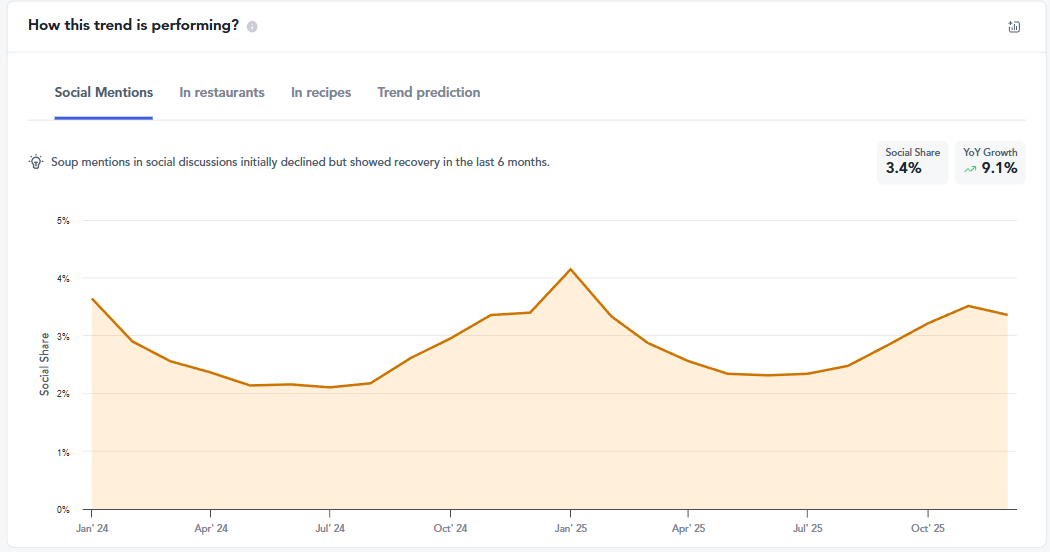
To see how the platforms compare, evaluate Tastewise compared with Spoonshot on real-time signal breadth. Moving far beyond broad internet data, it captures trillions of real-time F&B signals across restaurant menus, food delivery platforms, home cooking recipes, social conversations, and eRetail shelf data for a true 360-degree view of consumer behavior at home and away from home.
Its structured food ontology understands cuisine types, preparation methods, dietary claims, functional benefits, and flavor profiles. This contextual intelligence allows teams to move beyond surface-level social listening and into actionable product strategy.
For innovation leaders, this means identifying white space before it peaks. For beverage developers, it means mapping needs like “energy without jitters” or “better digestion” to ingredients such as L-Theanine or botanical adaptogens. For commercial teams, it means building retailer-ready narratives supported by live demand signals and menu adoption rates.
Because it connects trend detection, product formulation, and commercialization workflows, Tastewise functions as a comprehensive command center for visibility in food and beverage industry growth.
2. Spoonshot: AI for food science and ingredient networks
Spoonshot focuses on ingredient relationships and food science modeling. It maps molecular and ingredient networks to support technical formulation and ideation.
For R&D teams exploring novel combinations or scientific innovation pathways, Spoonshot provides depth in ingredient-centric discovery. It is often used in early-stage research environments where formulation complexity is the primary objective.
3. Spate: Predictive analytics for consumer trends
Spate specializes in search-based predictive analytics. By analyzing digital search behavior, it highlights emerging areas of consumer curiosity and rising interest patterns.
This makes it useful for identifying directional signals across categories. Search data can provide valuable early awareness insights. When combined with additional real-world adoption data such as menu penetration or retail velocity, these signals become even more powerful.
Top tools for brand and social visibility
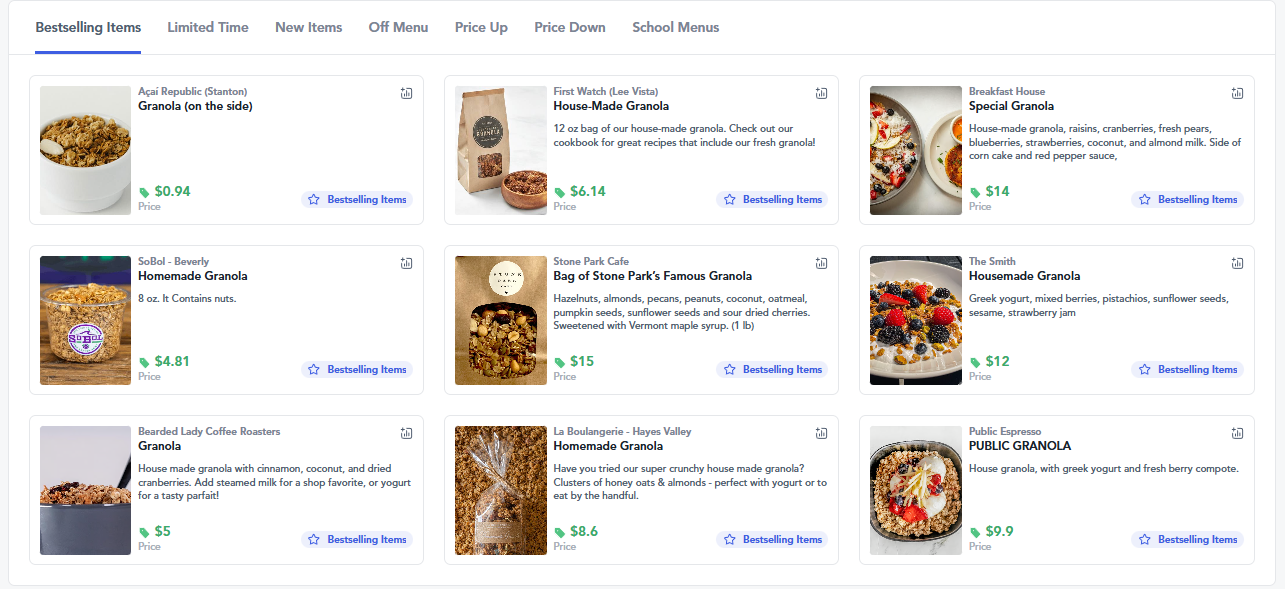
Some platforms focus on monitoring brand conversations. Tastewise goes further by translating food-specific signals into commercialization strategy.
How is food-specific AI different from general social listening tools?
For brand tracking and social monitoring, platforms such as Brandwatch and Meltwater are widely used across industries. They provide robust sentiment analysis, influencer mapping, and media coverage tracking.
These tools are considered among the best AI platforms for visibility in consumer goods industry conversations broadly. They are strong solutions for communications and PR functions.
Food and beverage innovation, however, requires contextual interpretation of ingredients, dishes, and consumption occasions. Food-native platforms like Tastewise layer category intelligence on top of raw social listening, allowing brands to translate conversation data into commercialization opportunities.
Which AI tools track food and beverage consumer demand in real time?
Visibility today is not only about monitoring conversations, it is about activating them.
Marketing teams increasingly rely on AI to identify trending flavor profiles, menu growth rates, and real-time consumer motivations. When insights are directly connected to campaign development, brands can launch initiatives aligned with active demand rather than retrospective reporting.
Tastewise enables teams to generate data-backed campaign briefs, recipe concepts, and messaging rooted in real-time consumer behavior. This strengthens brand positioning while improving relevance across digital and retail channels.
Specialized AI: Beverage innovation & functional ingredients
In beverages, consumer demand shifts from flavors to functional outcomes almost overnight. Identifying the right ingredient at the right moment has become a competitive advantage.
Which AI platform best predicts functional ingredient trends in beverages?
The best AI platform for predicting functional ingredient trends in beverages is one that connects consumer motivations to ingredient adoption before those ingredients reach mainstream saturation.
Functional beverages represent one of the fastest-moving segments in CPG. Growth areas include gut health, hydration optimization, adaptogens, and cognitive support. Consumers are increasingly seeking functional outcomes rather than standalone ingredients.
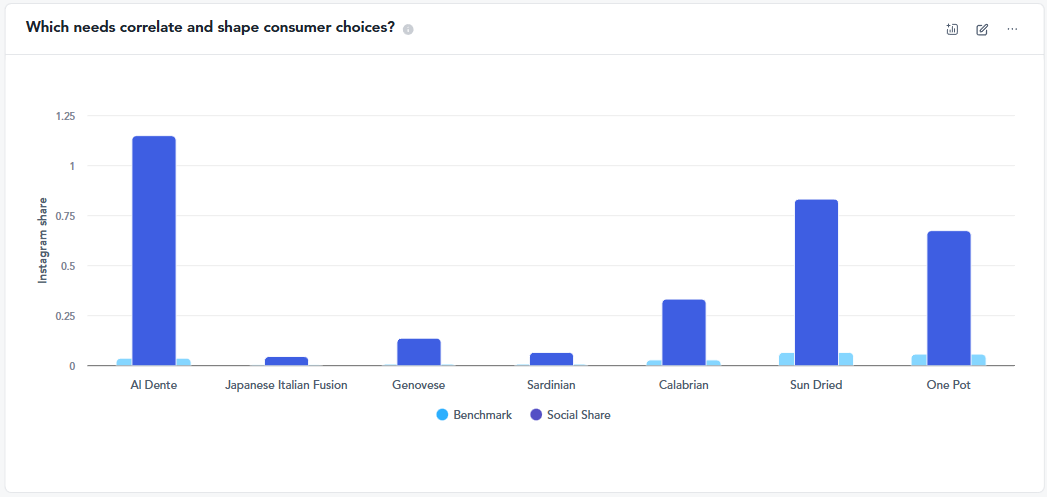
Tastewise ai analyzes real-time conversations around needs such as digestive balance, sustained energy, or stress reduction. It then maps those needs to ingredient mentions, recipe usage, and menu adoption rates. This predictive layer enables brands to formulate strategically rather than reactively.
For beverage teams launching RTDs, nootropic blends, or functional hydration products, this foresight provides measurable competitive advantage.
How to successfully implement AI platforms in your food brand
Selecting a platform is only part of the work. The brands that extract the most value from food and beverage intelligence deploy against a clear sequence, not an open-ended exploration.
Phase 1: Data integration (weeks 1 and 2)
Start narrow. Connect your core category signals, confirm the output reflects your specific market and occasion scope, and expand from there. Overly broad configurations produce noisy data. Two or three focused ingredient or occasion filters in the first configuration will generate cleaner, more usable output than a wide-open setup.
Phase 2: Team training and workflow alignment (weeks 3 and 4)
The platform should slot into the workflows your team already runs. Assign ownership by function: R&D leads trend identification, marketing uses demand signals to brief campaigns, and sales draws on menu adoption data for retailer pitches. A two-hour session covering core query types and how to export findings into your existing briefing format is enough to get teams running. The product innovation pipeline benefits most when insight, formulation, and commercial storytelling happen in parallel, not in sequence.
Phase 3: First trend analysis and validation (weeks 5 and 6)
By week five, your team should be producing commercially grounded output. A beverage team using Tastewise at this stage can identify a functional ingredient cluster, pull growth rates and menu penetration figures, and enter a development brief before that cluster reaches mainstream retail. Cross-reference outputs against your existing portfolio and your buyer’s current ranging strategy. Retail sell-in is more straightforward when your pitch is built on live consumer demand your buyer has not yet seen.
Budget and ROI planning
Platform fees scale with data scope and users. The cost input most teams underestimate is change management: moving from a survey-and-report model to an always-on intelligence workflow takes four to six weeks of internal adjustment alongside the technical deployment. Define a baseline metric before go-live (time from trend signal to concept brief, or retailer acceptance rate on sell-in pitches) so ROI is attributable. The 2026 food and beverage trend forecast is a useful reference when building the internal business case.
How to choose the right AI for your CPG brand
When evaluating the best AI platforms for food trend analysis 2026, leadership teams should take a structured approach.
Step 1: Prioritize domain specialization.
Choose a food-native AI platform that understands category nuance, flavor hierarchies, menu structures, and ingredient taxonomy. Food and beverage is not a generic category, because context matters.
Step 2: Assess data breadth and freshness.
The strongest platforms integrate social listening, menu intelligence, recipe data, and retail signals to create a complete, real-time view of consumer behavior.
Step 3: Evaluate commercialization enablement.
Insights must translate into action. Look for platforms that support concept validation, retailer sell-in storytelling, and go-to-market acceleration.
Step 4: Select a system that unifies intelligence and execution.
Tastewise was designed to bring these layers together into one F&B-focused intelligence platform, turning predictive insights into measurable growth.
Stop relying on lagging indicators. See how Tastewise transforms real-time data into your next best-selling product.
Frequently asked questions about the best AI platforms for food trend analysis
Traditional market research reflects past behavior. AI-powered platforms analyze live consumer signals, enabling brands to anticipate shifts in flavor preferences, functional benefits, and menu adoption before competitors respond.
Yes. By combining Predictive Analytics with real-time consumer conversations and ingredient mapping, AI platforms can identify emerging functional trends in beverages such as adaptogens, gut health, and cognitive support before they scale across retail.
Social listening tracks mentions and sentiment across channels. Food-specific AI interprets ingredient context, flavor relationships, dietary claims, and menu adoption rates, transforming raw data into actionable innovation and commercialization strategy for the Food & Beverage industry.
The best AI platforms for food trend analysis in 2026:
- Tastewise — best overall; food & beverage-native, covers trend detection through commercialization.
- Spoonshot — best for ingredient science and formulation.
- Spate — best for early, search-based demand signals.
- Brandwatch — best for cross-industry social listening and PR.
- Meltwater — best for media intelligence and corporate comms.
For food and beverage specifically, a food-native platform like Tastewise interprets ingredients, dishes, and consumption occasions and connects those signals to commercialization — something general social-listening tools do not do.
Pricing for AI food and beverage intelligence platforms is typically quote-based and scales with data scope, number of users, and use cases such as innovation, marketing, or sales enablement. Enterprise platforms like Tastewise provide custom pricing after a discovery call rather than fixed public tiers. Request a demo to receive pricing tailored to your category and team.
The best platform for real-time food and beverage demand combines social conversation, menu adoption, recipe usage, and retail signals into a single view. Tastewise analyzes trillions of real-time F&B signals across at-home and away-from-home environments, mapping consumer needs to ingredients, flavors, and dishes so teams can act before a trend peaks.
ROI from AI food trend platforms typically comes from faster innovation cycles, fewer failed launches, stronger retailer sell-in, and more relevant marketing. By replacing slow, backward-looking research with real-time demand signals, teams shorten time-to-insight and align launches with active consumer demand.




We’d love to learn your goals and see how Tastewise fits
We’d love to learn your goals and see how Tastewise fits
Get a personalized demo
Good taste. Wise move.
Your demo request is confirmed. We’ll reach out within one business day to schedule your walkthrough.
What happens next

See what’s driving demand, then turn it into a sell-in story for retailers and operators.
- Connect consumer panels, market trackers, and agents into one evidence view
- Get the “why” behind what’s changing, with explainable demand drivers
- Walk away with a buyer-ready narrative and next steps to activate
Trusted by





“Tastewise is my secret tool for knowing what consumers want next and why.“