





Tastewise AI is a food intelligence platform that transforms massive amounts of real-world data into actionable consumer insights. By using AI for food trend analysis, it goes beyond small surveys and delayed reports, analyzing signals from across the food ecosystem to help brands understand what people actually want, and what’s coming next.
- Tastewise AI analyzes billions of food-related data points
- Combines social, menu, retail, and consumer signals
- Uses AI models to structure and classify food data
- Detects trends based on growth and cross-source validation
- Validates insights using real-world market data
- Reduces bias through calibration and data alignment
What is Tastewise AI and how it supports food trend analysis
At its core, Tastewise connects data from multiple sources, structures it using AI, and validates it against real market behavior. The result is faster, more reliable insights that teams can use to make decisions in real time.
Traditional research methods often take weeks and rely on limited sample sizes. Tastewise AI replaces that with a system that processes millions of data points and continuously updates insights based on what consumers are saying, buying, and eating.To make these insights more accessible, TasteGPT acts as an AI interface on top of Tastewise data, helping teams quickly interpret trends and uncover opportunities without manual analysis.
How Tastewise collects data for food trend analysis
Tastewise AI starts by gathering data from a wide range of sources across the food industry. This includes social media conversations, restaurant menus, retail signals, and consumer reviews.
Each data point contains multiple layers of information, such as:
- Text (posts, descriptions, recipes)
- Metadata (location, time, engagement)
- Context (ingredients, dishes, occasions)
Before any analysis happens, the data is cleaned and standardized. This involves removing noise like spam, irrelevant content, and duplicates. Natural language processing (NLP) is then used to break down text into structured elements the system can understand.
This step is critical. Without proper cleaning and structuring, even large datasets can lead to misleading insights.
How Tastewise turns raw data into structured insights
Once the data is processed, Tastewise applies machine learning models to organize and interpret it.
One of the key techniques used is embeddings. Instead of treating words as isolated terms, the system understands their meaning and relationships. This allows it to group similar concepts together, even when they are written differently or appear in different languages.
For example, variations of the same ingredient or dish can be clustered into a single concept, making the data more consistent and easier to analyze.
At the same time, classification models are used to:
- Identify audiences (e.g. health-focused, indulgent, functional)
- Categorize ingredients and dishes
- Segment content into relevant themes
All of this is structured within a taxonomy that is continuously updated using both machine learning and expert input.
How Tastewise detects emerging food trends
Trend detection is not based on a single spike or viral moment. Instead, Tastewise AI looks for consistent patterns across time and across data sources.
A trend is identified based on:
- Growth rate (how quickly something is increasing)
- Velocity (how fast adoption is accelerating)
- Consistency (whether it appears across multiple datasets)
This approach helps separate real trends from short-term noise. For example, a sudden increase in social mentions alone is not enough. The system looks for confirmation in areas like menu adoption or retail activity.
By combining these signals, Tastewise can identify trends earlier and with more confidence.
How Tastewise validates insights using real-world data
One of the key differences in the Tastewise approach is validation.
Every insight goes through a multi-step process:
- Initial signal detection
- Cross-source validation
- Calibration using real-world data
This means that insights are not just based on what people say, but also on what they actually do.
For example, a trend may be validated by:
- Increased social conversation
- Growth in restaurant menu presence
- Movement in retail or sales data
Only when these signals align does an insight reach a high level of confidence.
How Tastewise AI turns data into insights
| Step | What happens | Why it matters |
| Data collection | Data gathered from social, menus, retail | Ensures broad market coverage |
| Data processing | AI cleans and structures data | Removes noise and inconsistencies |
| Classification | Ingredients, dishes, audiences grouped | Creates usable insights |
| Trend detection | Growth and patterns analyzed | Identifies emerging trends early |
| Validation | Cross-source confirmation | Reduces false signals |
| Calibration | Bias adjusted using real data | Improves accuracy |
Why Tastewise AI is more reliable than traditional data
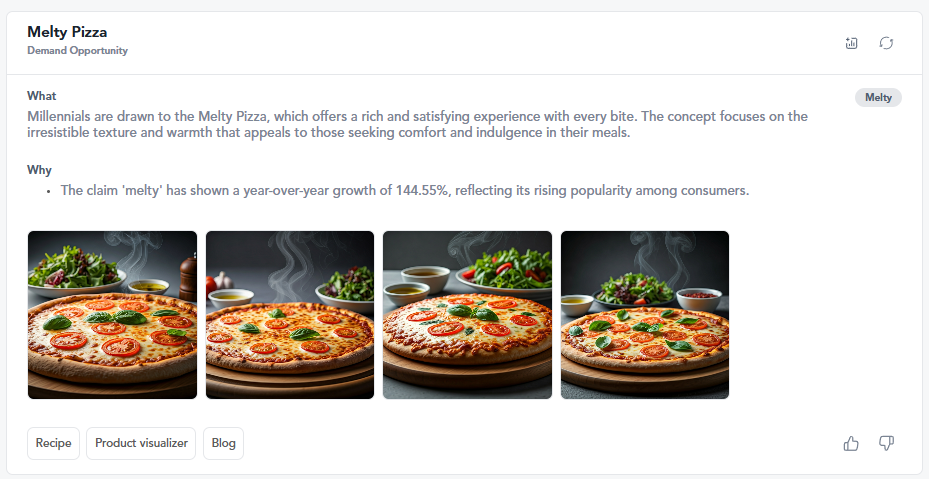
Traditional research methods rely heavily on surveys and panels. These approaches are limited by sample size, time delays, and response bias.
Tastewise AI addresses these limitations in three key ways:
Scale
Instead of hundreds of responses, the system analyzes millions of real-world data points.
Speed
Insights can be generated in hours rather than weeks, allowing teams to react faster.
Validation
Every insight is grounded in real market behavior, not just stated preferences.
In addition, calibration techniques are applied to reduce bias and ensure that the data reflects real-world patterns as closely as possible.
How brands use food trend analysis AI in real scenarios
Tastewise AI is designed to support decision-making across multiple functions.
In product innovation, teams use it to identify emerging ingredients and flavors before they become mainstream.
In marketing, it helps refine messaging by understanding what resonates with different consumer segments.
In strategy, it provides a clearer view of where demand is growing and where it is declining.
For example:
- A beverage brand can validate interest in functional ingredients before launching a new product
- A restaurant chain can track menu trends across regions
- A CPG company can identify gaps in the market based on consumer behavior
The goal is not just to provide data, but to enable faster and more confident decisions.
What’s happening under the hood of Tastewise AI
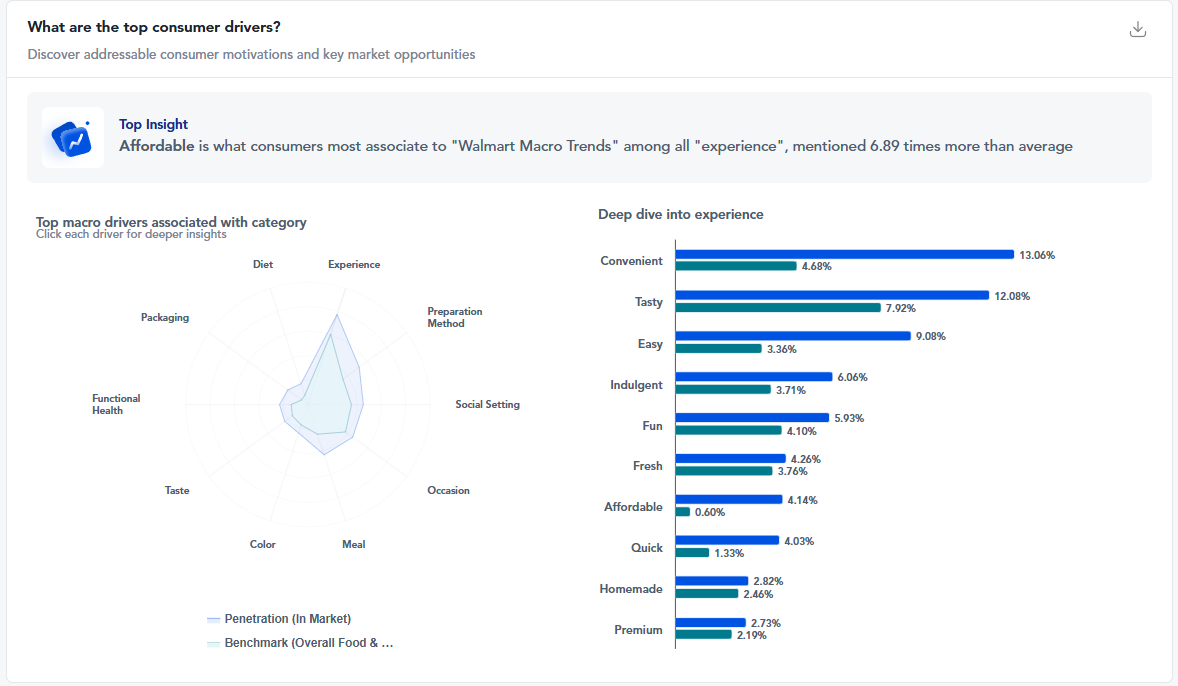
Behind the scenes, Tastewise combines several AI techniques to make this possible.
Natural language processing allows the system to understand and structure text data at scale. Embeddings help it recognize relationships between concepts, even when they are expressed differently.
Machine learning models are used to classify, cluster, and detect patterns across datasets. These models are continuously evaluated using metrics like precision and recall to ensure accuracy.
What makes the system unique is not just the models themselves, but how they are combined with real-world validation and calibration layers.
Technical implementation: AI models and architecture behind Tastewise
Tastewise runs on a layered pipeline that moves data from raw signal to validated insight. Each layer uses a specific type of model, and the layers are built to check each other, so no single source ever drives a conclusion on its own. This is what lets the platform work at scale without losing accuracy.
The data pipeline, step by step
Data enters continuously from social conversations, restaurant menus, retail signals, and consumer reviews. Before any model touches it, the pipeline cleans and standardizes it, stripping out spam, duplicates, and irrelevant content. From there the flow is consistent: ingest, clean, structure, classify, validate, then calibrate. Because the pipeline runs on an ongoing basis rather than in scheduled batches, insights update as new signals arrive instead of waiting for a fixed reporting cycle.
The models behind classification
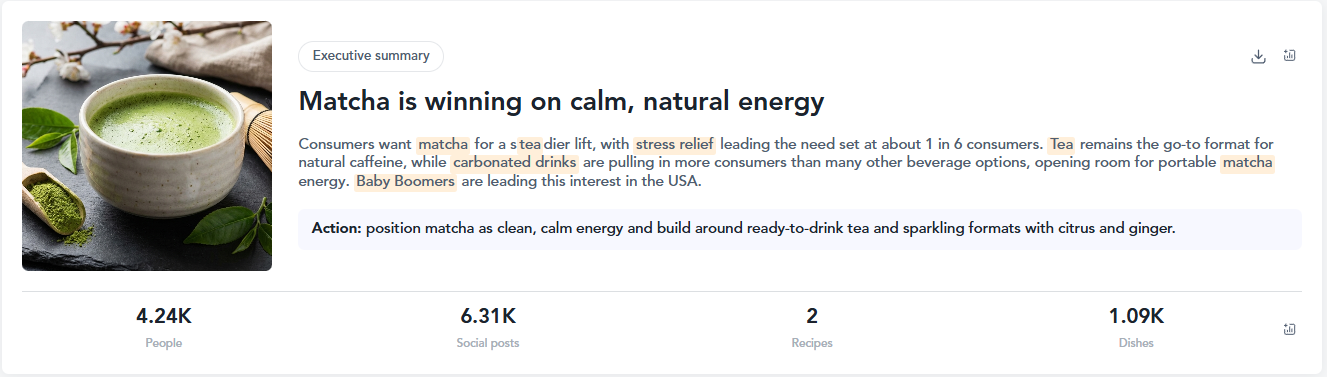
Text understanding is handled by machine learning models built to read language in context rather than match keywords. A good way to picture the problem: a single ingredient like matcha shows up in the data under hundreds of different names. The system sees it written as matcha latte, iced matcha latte, strawberry matcha, dirty matcha, matcha cloud, banana matcha, yuzu matcha, matchatini, and many more.
Two model types do most of the structuring work. Embedding models place words and phrases into a shared space based on meaning, so all of those matcha variations sit close together and get recognized as expressions of the same underlying ingredient, even when the wording differs. Classification models then sort that content, tagging the motivation behind it (matcha signals get grouped into themes the platform tracks like energy, calm, ritual, and wellness), categorizing ingredients and dishes, and grouping content into themes. Together this is the neural network classification layer that turns unstructured text into data teams can actually query.
Training and continuous evaluation
The models are not static. They are trained and retrained against a taxonomy that is maintained with both machine learning and human expert input, which keeps new ingredients, dishes, and occasions from slipping through as noise. Performance is tracked with standard measures like precision and recall so accuracy can be monitored over time rather than assumed.
Real-time data processing and scale
The advantage of this architecture is volume. On the operator side alone, the platform maps across roughly 118 million menu items, more than 880,000 restaurants, and over 26,000 chains, and that sits alongside the consumer and retail signals feeding in continuously. The granularity matters as much as the size: a single query like matcha resolves into hundreds of distinct co-occurring ingredient expressions, each tracked separately rather than lumped under one label. Scale on its own is not the point. It matters because a trend only reaches high confidence once it shows up consistently across enough independent sources, and that requires a large, continuously refreshed base to draw from.
Bringing Tastewise data into your workflow
Teams do not need to rebuild any of this to use it. Insights are available directly in the platform for day-to-day exploration, and data can be pulled into existing tools and reporting workflows through the Tastewise API, so trend signals can feed straight into the systems teams already work in.
AI trend analysis: definitions, methods, and competitive landscape
AI-powered trend analysis has its own vocabulary, and the terms are often used loosely. Here is what they mean in a food and beverage context, how the main research approaches compare, and where a platform like Tastewise sits among the tools available today.
Embeddings. A way of representing words and phrases by meaning rather than exact spelling. It is how the system knows that matcha latte, dirty matcha, and matcha cloud all belong to the same ingredient, even though they are written differently.
Cross-source validation. Confirming a signal in more than one place before trusting it. Matcha is a clear example: it appears in consumer social signals, on restaurant menus (an iced matcha latte at Starbucks, a frozen matcha latte at Dunkin, a matcha oat latte at Joe & The Juice), and on retail shelves (ceremonial and culinary-grade powders from brands like Encha and Pure Leaf). A signal that shows up across all three sources clears validation. One that only spikes in conversation does not.
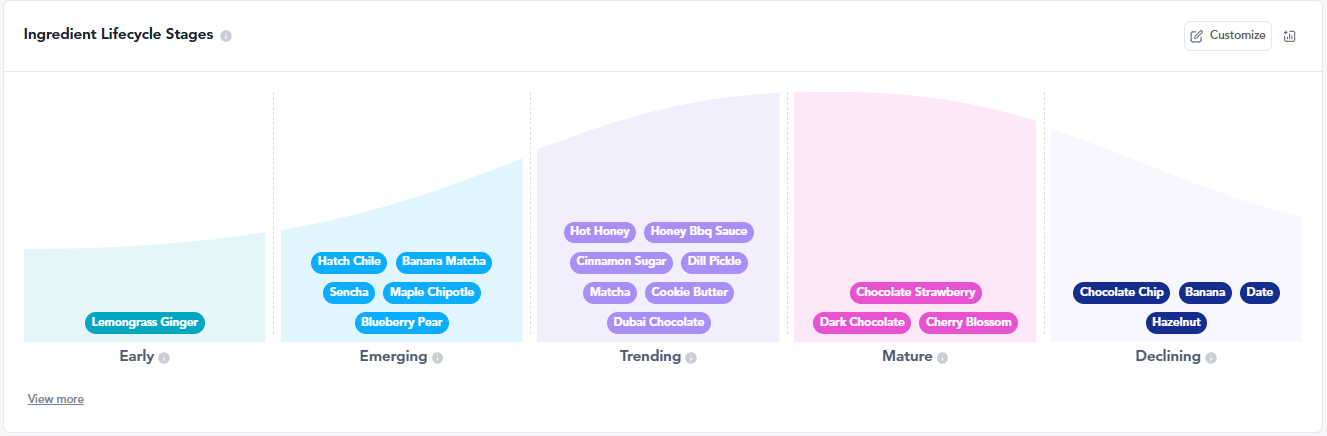
Trend velocity. How fast adoption is accelerating, not just whether something is growing. It is why the system does not treat matcha as one flat trend. It separates long-established forms like the classic matcha latte from newer offshoots such as matcha cloud and banana matcha, which it flags as emerging.
Signal calibration. Adjusting the data against real-world behavior to reduce bias, so what people actually buy and order carries more weight than what they only talk about.
Predictive modeling. Using current and historical patterns to estimate where demand is heading, so teams can act before a trend goes mainstream rather than after.
How the main research approaches compare
| Traditional research | AI-powered analysis | Hybrid approach | |
|---|---|---|---|
| Sample basis | Hundreds of survey or panel responses | Millions of real-world signals | Broad signal base plus targeted human validation |
| Time to insight | Weeks | Hours | Hours to days |
| Grounded in | Stated preferences | Observed behavior across sources | Both, with expert review |
| Bias handling | Limited by sample and response bias | Calibration against real behavior | Calibration plus human oversight |
| Best used for | Deep, specific one-off questions | Continuous, fast-moving trend tracking | High-stakes decisions needing speed and nuance |
The wider landscape of trend analysis tools
Most tools in this space fall into three groups. Social listening tools track conversation and sentiment well but read intent, not action, so they can overweight viral moments. Traditional market research platforms bring depth and rigor but move slowly and rely on smaller samples. Predictive analytics services forecast demand but are only as reliable as the data feeding them.
What sets a cross-source approach apart is that it does not depend on any single one of these. The matcha example shows why: conversation alone would tell you it is popular, but only the menu and retail presence confirms people are ordering and buying it, not just posting about it. Requiring that alignment before something counts as a trend is what filters out the false positives.
How this measures against industry standards
Reliable trend analysis is judged on a few things: how well insights are validated against real behavior, how accuracy is measured, and how effectively false signals are filtered out. Tracking precision and recall, requiring cross-source confirmation, and calibrating against sales and menu data all work toward keeping the signal-to-noise ratio high.
Start making faster decisions with Tastewise AI
Tastewise AI is built to bridge the gap between raw data and real-world decisions. By combining large-scale data analysis with validation and bias correction, it provides a more reliable approach to food trend analysis and understanding consumer behavior.
For teams in food and beverage, this means moving faster, reducing risk, and staying ahead of change with insights that reflect what is actually happening in the market.
FAQs about Tastewise AI
Tastewise AI is a food intelligence platform that analyzes large volumes of food-related data from sources like social media, menus, retail, and consumer reviews. It uses AI models to structure this data and support food trend analysis and consumer insight generation.
Tastewise AI identifies trends by analyzing patterns over time, including growth rate, acceleration, and consistency across multiple data sources. A trend is only confirmed when signals align across areas like social conversations, menu adoption, and retail activity.
Unlike traditional surveys that rely on small sample sizes, Tastewise AI uses large-scale data for food trend analysis. It validates insights across multiple sources and applies calibration techniques to reduce bias, improving overall accuracy.
Tastewise uses natural language processing and machine learning to clean and structure raw data. This includes removing irrelevant content, standardizing text, and grouping similar concepts using embeddings and classification models.
Insights go through a multi-step validation process that includes detecting signals, confirming them across datasets, and calibrating results using real-world data. This ensures insights reflect actual market behavior, not just isolated signals.


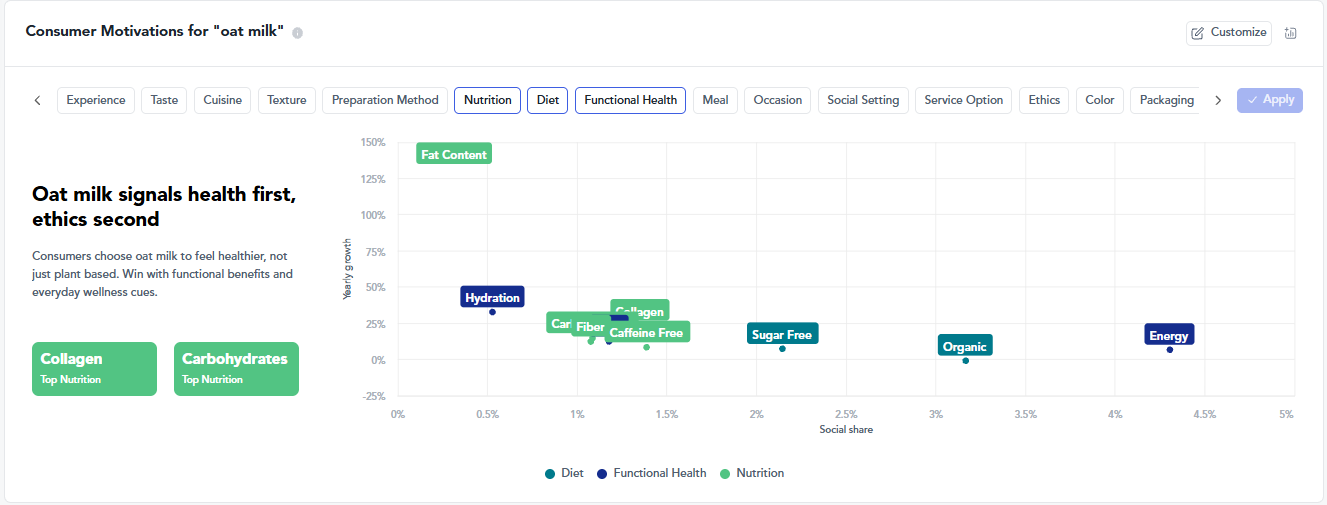

We’d love to learn your goals and see how Tastewise fits
We’d love to learn your goals and see how Tastewise fits
Get a personalized demo
Good taste. Wise move.
Your demo request is confirmed. We’ll reach out within one business day to schedule your walkthrough.
What happens next

See what’s driving demand, then turn it into a sell-in story for retailers and operators.
- Connect consumer panels, market trackers, and agents into one evidence view
- Get the “why” behind what’s changing, with explainable demand drivers
- Walk away with a buyer-ready narrative and next steps to activate
Trusted by





“Tastewise is my secret tool for knowing what consumers want next and why.“