






The frozen dessert aisle is moving faster than most retail buyers expect this summer. Shoppers are demanding formats that deliver both. Healthy ice cream alternatives sit right at that intersection, and the brands showing up with precise claims and better-for-you formulations are the ones winning distribution ahead of the summer reset window. If you work in marketing, sales, insights, or R&D at a CPG brand, the data your team needs to build that sell-in story is already there. You just need to know what to lead with.
Key takeaways
- Low calorie claims in the frozen dessert category are up 55% in the past year, and guilt free is up 66%. Shoppers want the treat without the trade-off, and your packaging and positioning need to speak that language before buyers ask you to justify placement.
- Protein holds a 31% claim share in the healthy ice cream alternatives space and has been growing steadily. It is the single most defensible health anchor your team can build around right now, because it is already embedded in consumer expectation.
- Cookie flavours are growing 79% and cocoa is up 85% in this category. Consumers are not abandoning indulgent flavours. They are pulling them into better-for-you formats. Your innovation brief should not start with what to remove. It should start with what bold flavour to feature.
- The kids signal is up 22% and snack occasions are up 19%. This is not only an adult wellness product. Healthy ice cream is becoming a family freezer staple, which changes how you write the sell-in story for retail buyers.
Healthy ice cream alternatives overview
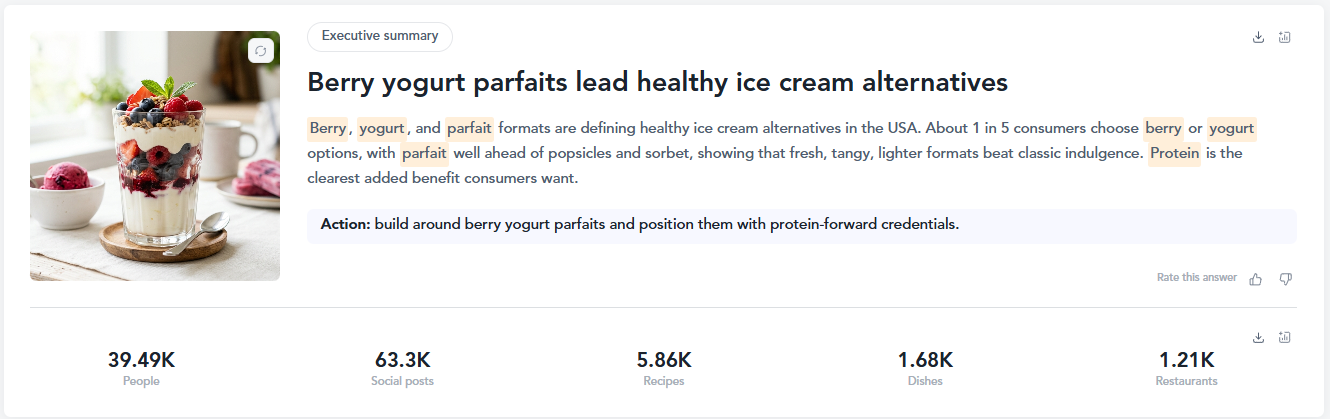
Healthy ice cream alternatives are not a niche wellness trend anymore. They represent a category-wide consumer shift driven by shoppers who have simply decided that frozen desserts should work harder for them. Whether it is blood sugar management, dairy avoidance, weight management, or just wanting to eat something sweet without a side of guilt, consumers are arriving at the freezer aisle with a specific job in mind. Formats that meet that job land in the basket. Formats that do not are sitting on the shelf past summer markdown.
Tastewise food intelligence data shows the leading health claims accelerating in this space are low calorie (up 55% in the past year), guilt free (up 66%), blood sugar management (up 72%), and refined sugar free (up 78%). These are not niche signals sitting on small bases. They are rising across a consumer panel of over 23,000 tracked shoppers in the frozen dessert category. Alongside those claims, protein has locked in as the dominant health anchor at 31% claim share, providing a launch platform your brand can credibly build on. The ingredient side tells an equally strong story: cookie flavours are up 79%, cocoa up 85%, and nut butter up 42%. The consumer wants better-for-you and bold at the same time.
The opportunity for CPG brands is specific. This summer’s reset window is not about adding one better-for-you SKU to an existing lineup. It is about walking into a buyer meeting with a clear argument that your formulation meets a documented consumer job and that your flavour story is strong enough to drive velocity, not just trial.
What is actually on shelf right now and where the gaps are
The better-for-you frozen aisle is not empty. Several brands have already staked out positions, and knowing what is there and what is missing is where your team’s sell-in argument starts.
On the dairy-free side, Ben & Jerry’s oat milk Cherry Garcia and their almond milk Peanut Butter and Cookies are the most reviewed non-dairy pints in the segment, with the Cherry Garcia pulling over 580 consumer ratings. Van Leeuwen is pushing further into flavour complexity with oat milk churros and fudge and caramel cookie formats. So Delicious is holding strong in bars with their coconut almond ice cream bar, rated consistently above 4.5. Cado is the only brand in the set using avocado as a base, with their deep dark chocolate pint at 4.7 stars across 124 reviews. That is a narrow lane but a differentiated one with no direct competitor yet.
On the low calorie and light side, N!ck’s is the clearest example of a brand owning the guilt-free brief at shelf. Their Cherry Choka-Flaka and Strawbär Swirl pints are positioned squarely at the low calorie shopper without sacrificing flavour names that feel indulgent. Breyers CarbSmart caramel swirl bars are winning the blood sugar and low carb occasion, rated at 4.7 across 83 reviews. That is the highest-rated product in that functional cluster in the data set.
The gap is obvious when you look at what is missing. Blood sugar management is up 72% as a consumer need, yet no mainstream brand has built a frozen dessert line explicitly around glycemic health. Low glycemic, FODMAP-friendly, and diabetic-friendly claims are growing fast in consumer data but almost entirely absent from branded shelf SKUs at scale. The low sugar positioning that does exist is buried in ingredient lists rather than leading on pack. That is the whitespace your innovation brief should be targeting before a private label retailer fills it first.
The 2026 frozen aisle mindset: indulgence with a job to do
The shopper reaching for a healthy ice cream alternative in 2026 is not sacrificing anything. That is the fundamental shift retailers have started to recognise, and the brands winning freezer space are the ones proving it. The guilt free claim growing at 66% in the past year is not a wellness fringe signal. It is a mainstream consumer desire to feel good about a decision they were going to make anyway. Your product needs to validate that feeling before they reach the checkout.
Premium is accelerating in parallel. Premium claims are up 14% in the frozen dessert category, and artisan is up 22%. Buyers are protecting margin by ranging products that consumers are willing to pay more for. A low calorie claim alone does not justify a premium price. A low calorie claim paired with a bold flavour story does. Think cocoa-forward, nut butter-layered, or cookie-dipped. That combination is where your product innovation brief needs to land, and it is where your sell-in narrative needs to start.
Top 5 high-growth trends in healthier ice cream alternatives
1. Low calorie + bold flavour
Consumers want fewer calories and more taste, not a compromise. Low calorie claims are up 55% in the past 12 months, and cocoa ingredient growth of 85% in the same period shows exactly which flavours they want that permission applied to. Your team’s brief: build the low calorie product around the indulgent flavour, not around the removal of it.
Buyer’s take: a low calorie SKU with a credible cocoa or nut butter flavour story gives the category manager a hero product for the better-for-you set without cannibalising the full-fat lineup.
2. Dairy free and non dairy formats
Dairy free claim share sits at 24% of all consumer discussion in this category. Not a niche. A mainstream expectation. The bases winning right now are oat milk (indexed highest on menu), coconut milk, and cashew. Pea protein base is emerging, up 23% as an ingredient signal and now appearing on 37% of menu items for plant-based frozen desserts. That is a formulation whitespace your R&D team can move on before the next reset.
Buyer’s take: retailers are actively looking for dairy-free alternatives for ice cream that bring in flexitarian and lactose-intolerant shoppers as net-new traffic to the frozen aisle.
3. Blood sugar and low sugar positioning
Blood sugar management is up 72% in the past year as a consumer need in this category. Low sugar is up 27%. The products winning this space are using monk fruit, allulose, and date-based sweeteners, all of which are climbing as ingredients in better-for-you frozen dessert formulations. This is the clearest white space for brands serving shoppers managing diabetes or metabolic health, and it maps directly to the ice cream alternatives for diabetics keyword cluster driving search volume this summer.
Buyer’s take: this is the segment where buyers are being asked most frequently to prove shelf relevance to health-focused shoppers. A well-formulated low glycemic SKU answers that question directly.
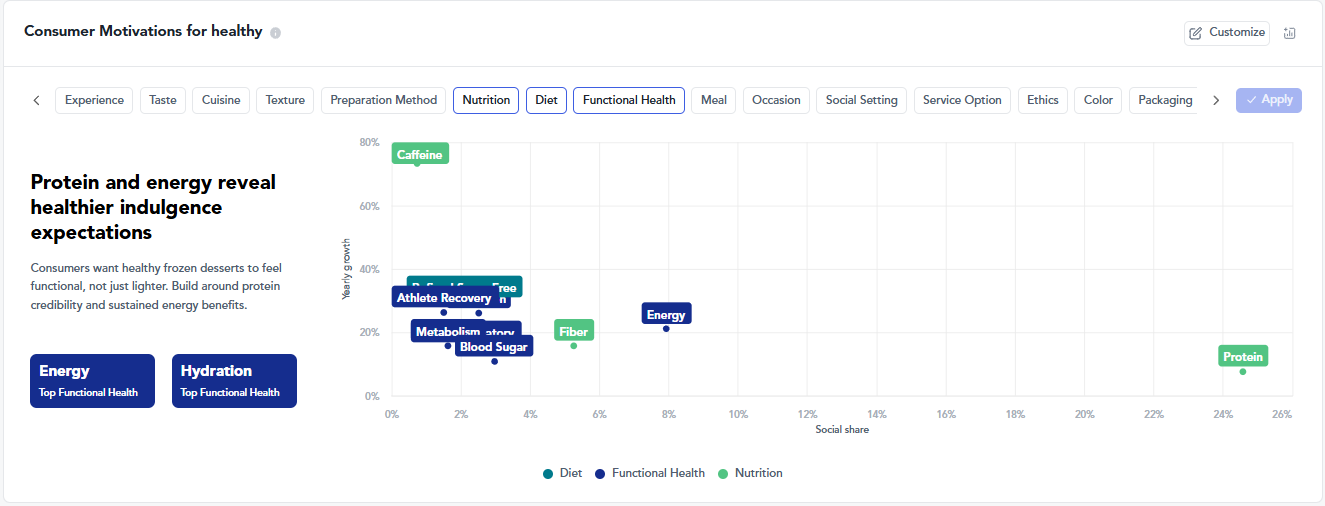
4. Protein-forward frozen desserts
Protein holds a 31% claim share in the healthy ice cream alternatives space and is up 12% in the non-dairy segment specifically. It is the health anchor consumers trust most in a frozen dessert because it transforms an indulgent product into a functional one. Greek yogurt base (up 23%), whey protein (up 62%), and pea protein are the three formulation platforms showing the strongest momentum. Athlete recovery as a consumer motivation is up 64%. Your team does not need to invent a new positioning. You need to show up in a space consumers already believe in.
Buyer’s take: protein ice cream and frozen dessert SKUs attract a high-frequency, high-basket buyer. These shoppers are not occasional treat purchasers. They are daily routine shoppers, which makes the velocity argument much easier to make.
5. Kids and family snack occasions
The kids signal is up 22% in this category, and snack occasions are up 19%. Healthy ice cream is becoming an everyday family format, not just an adult wellness product. Brands that have positioned entirely around adult health credentials are missing this half of the category. Mini format claims are up 16%, and the convenient claim is up 8%. Your retail buyer needs to see that your product can pull across two distinct shopper missions in the same aisle: the health-conscious adult and the parent looking for a better-for-you treat that kids will actually eat.
Buyer’s take: a family-positioned better-for-you frozen SKU, particularly in a mini or multipack format, justifies a double-facing in the planogram and a spot in the family-value end-cap for summer.
The product innovation platform at Tastewise is built for exactly this kind of pre-brief validation, matching formulation decisions to live consumer demand signals before development begins.
Identifying consumer whitespace for new alternatives to ice cream
The flavour whitespace in healthy ice cream alternatives is not a mystery. It is already visible in ingredient growth data. Cookie is up 79%, cocoa is up 85%, and vanilla extract is trending at its fastest growth rate in three years. These are not basic flavours. They are signals that consumers want to recognise what they are eating, trust the ingredients, and not feel like they are eating diet food.
The less obvious whitespace sits in flavour combinations that have not been formulated yet. Pandan is up 83% in the non-dairy frozen dessert space, matcha is up 27%, and dragon fruit is growing from a small base but accelerating at over 126%. These are not mainstream flavours today, but they are the flavours that will define the premium tier of dairy-free alternatives by 2027. Your innovation team has roughly two reset cycles to get there before competitors do.
Seasonal and occasion signals point to a second whitespace. Hot weather as a consumer motivation is up 105% since last year. Weekend occasions are prominent. Tropical claims are up 26%. Coconut-mango, passion fruit, and blackberry combinations are all posting double-digit ingredient growth in the non-dairy segment. These are not complex product development tasks. They are flavour extensions on existing bases that give your retail buyer a limited-time summer story with consumer evidence already attached. The summer trends report is a useful reference for category-level demand shifts running through to September.
For your CPG insights team, the question to answer before any innovation brief is finalised is whether the claim and the flavour are pulling in the same direction. The best-performing healthy ice cream alternatives in the data combine a clear functional claim, dairy free, low sugar, high protein, with a flavour profile that consumers already associate with indulgence. The products that underperform are those that lead with the restriction and follow with a flavour that feels like a consolation.
Tastewise retail sales tools give category teams the claim and flavour data to make that call confidently before a brief goes to R&D.
Creating a data-backed sell-in story for summer resets
The retail buyer sitting across from you this summer has one question: will this product move? They are not asking you to educate them on wellness trends. They are asking you to prove that a specific consumer, with a specific need, is going to pick your product off their shelf consistently enough to justify the space. Tastewise food intelligence gives your team the consumer evidence to answer that question in the meeting, not after it.
Your sell-in story should run in three acts. First, name the consumer job. Dairy-free for lactose-intolerant shoppers, low calorie for guilt-free indulgence, protein-forward for the post-workout routine. Pick the one that your formulation serves best and lead with it. Second, show the momentum. Low calorie up 55%, dairy free up 21% in consumer claim data, protein growing 12% in the non-dairy segment.
These numbers tell the buyer that the demand exists and is accelerating, not declining. Third, connect your product to the velocity story. If you have a bold flavour anchor, cocoa, nut butter, or cookie, you can show the buyer that your product is not just meeting a health need. It is doing it in a way that drives repeat purchase, because the flavour is genuinely what the consumer wants.
Your sales team should not be walking into these meetings with a sample kit and a deck of category trends. They should be walking in with an account-specific argument: here is the consumer visiting your stores, here is the job they are trying to do in your frozen aisle, here is the product that does it, and here is the data showing you this decision has already been made by the consumer before they got to your door. The CPG retail guide covers how leading brands are building this kind of buyer-ready evidence package.
Why category analytics is key to winning premium retail placement
Retailers are not placing products based on how a brand describes its own consumer. They are placing products based on whether the brand can prove category incrementality. If your healthy ice cream alternative brings in a shopper who was not already buying in the frozen dessert set, the flexitarian, the lactose-intolerant consumer, the fitness-focused millennial, you have a category growth story. That story is worth more shelf space than a product that simply competes with what is already there.
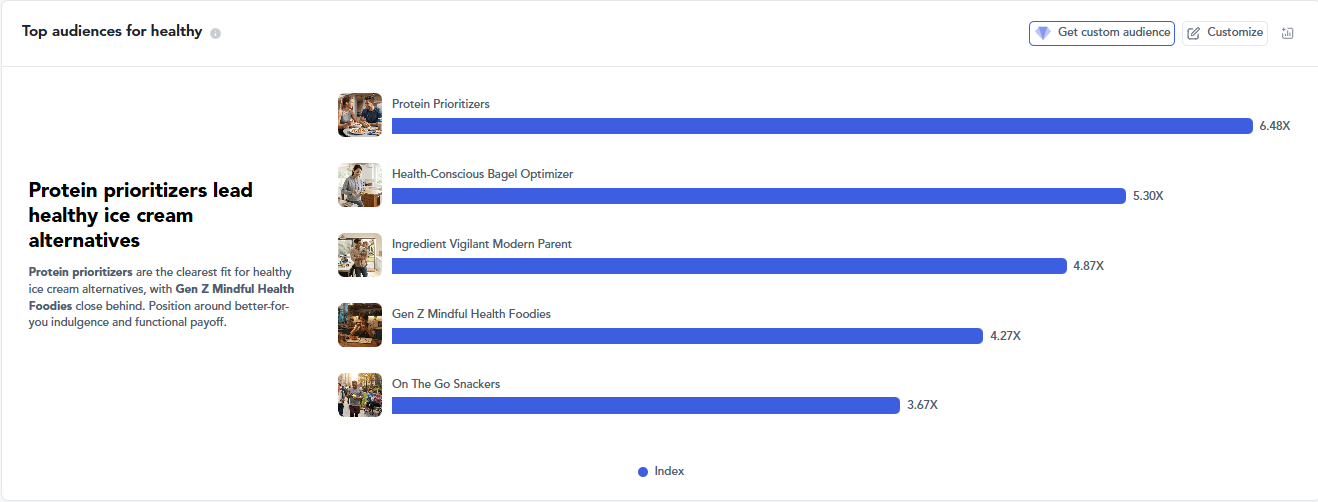
Tastewise custom audiences data shows distinct consumer segments approaching this category differently. Health-conscious shoppers index highest for protein and blood sugar claims. Younger consumers are driving the dairy-free and vegan demand. Families are the primary driver of the snack and kids signals. These are three distinct shelf missions, and a portfolio that covers all three has a strong argument for multiple facings.
Regional variation matters here too. Blood sugar and low glycemic demand is highest in the South and Midwest, where diabetes prevalence is above the national average. Dairy-free demand is concentrated on the West Coast and Northeast. Protein-forward frozen desserts are strongest in urban markets with high gym penetration. Your retail buyer in Atlanta needs a different lead claim than your buyer in Portland. The brands that win summer resets are the ones that arrive with a localised argument, not a national one.
What this means for CPG food brands in 2026
- For innovation and R&D: the best-performing healthy ice cream alternatives combine a clear functional claim with a bold, indulgent flavour. Cookie, cocoa, and nut butter are your three strongest flavour anchors right now. Do not formulate around restriction. Formulate around permission.
- For brand managers: lead with the consumer job in your packaging and your messaging. Low calorie, dairy free, high protein. Pick the job your product does best and make it the hero. Buyers need to know what shelf mission your product solves before they will range it.
- For category managers: protein and dairy free are the two claim clusters most likely to drive incremental traffic to the frozen aisle. Build your ranging argument around net-new shoppers, not share shifts within the existing category.
- For sales enablement: your sell-in deck should open with consumer data, not product specs. Low calorie up 55%, guilt free up 66%, blood sugar management up 72%. Lead with the evidence that demand already exists, then introduce the product that meets it. That sequence is far more persuasive than the reverse. The retail sales enablement guide is a practical reference for category teams building these decks at scale.
Future outlook: the 2027 frozen reset
The brands that win the 2026 summer reset will be the ones that arrive with a dynamic data argument, not a static category story. By 2027, the reset conversation will have moved from “is there consumer demand for this claim?” to “can you prove your product is the fastest-moving answer to that demand in my specific store?” The brands not yet building always-on intelligence into their category management process will be the ones scrambling to answer that question at the last minute.
Private label is already moving in this direction. Several major retailers have launched own-brand dairy-free and low calorie frozen dessert lines in the past twelve months, and they are pricing them at a 20 to 30 percent discount to branded equivalents. The branded response has to be better innovation, clearer claims, and stronger consumer evidence. Not just a better price promotion. The 2026 trend forecast maps this competitive dynamic in detail and gives your team the planning context to respond before the next reset window opens.
The opportunity is real and it is measurable. The consumer has already decided they want healthy ice cream alternatives that taste like the real thing. Your job is to show your retail buyer that you are the brand they should be betting on to meet that demand this summer and every summer after it.
FAQs about healthy ice cream alternatives
Based on consumer claim data in the frozen dessert category, the fastest-growing formats are low calorie (up 55% in the past year), dairy-free and non-dairy alternatives (up 21%), and protein-forward frozen desserts (protein claim share up 12% in the non-dairy segment specifically). Blood sugar management as a consumer motivation is up 72%, pointing to strong demand for low sugar and low glycemic options. Flavour-wise, cookie, cocoa, and nut butter are the three fastest-growing ingredient signals in better-for-you frozen dessert formulations, showing that consumers want bold flavours in their healthier options, not just clinical ones.
Start with the consumer job, not the product feature. Dairy-free claim share is 24% in the frozen dessert category. That is a mainstream expectation, not a niche request. Lead your buyer pitch with the consumer segment your product serves: flexitarians, lactose-intolerant shoppers, or vegan consumers. Show the buyer that this consumer is visiting their stores but not currently finding the right product in the frozen aisle. Then connect your formulation, oat milk, coconut milk, or cashew base, to the flavour story that will drive repeat purchase, not just first trial. Tastewise’s retail sales tools help your team build this argument with account-specific consumer data, so the conversation with the buyer is grounded in their shoppers, not generic category stats.
Protein is the strongest single claim in this space at 31% share, and it is credible across multiple consumer segments. For the low calorie and guilt-free positioning, those claims are growing fastest and are now expected, not differentiating. Your flavour story has to do the heavy lifting. If you are targeting blood sugar management or diabetic-friendly shoppers, low sugar and low glycemic are the claims with the strongest momentum right now. The most compelling shelf story combines one clear functional claim with a bold, recognisable flavour. A low calorie cocoa-nut butter sandwich bar, for example, answers the health question and the taste question at the same time and gives your buyer a product that can hold its own in a competitive summer planogram.




We’d love to learn your goals and see how Tastewise fits
We’d love to learn your goals and see how Tastewise fits
Get a personalized demo
Good taste. Wise move.
Your demo request is confirmed. We’ll reach out within one business day to schedule your walkthrough.
What happens next

See what’s driving demand, then turn it into a sell-in story for retailers and operators.
- Connect consumer panels, market trackers, and agents into one evidence view
- Get the “why” behind what’s changing, with explainable demand drivers
- Walk away with a buyer-ready narrative and next steps to activate
Trusted by





“Tastewise is my secret tool for knowing what consumers want next and why.“