






Food and beverage teams are being asked to do more with the same headcount, faster planning cycles, and higher expectations from retail buyers and operators.
Agentic AI examples are showing up across marketing, sales, and R&D as a direct response to that pressure—like seeing a trend forecasting agent in practice. These are not chatbots that answer questions.
They are AI agents that run workflows, make connections across data sources, and hand your team finished outputs rather than raw information. If you have been curious what this actually looks like in practice, and what agentic AI in the F&B industry actually is, this is the post that shows you.
Key takeaways
- Agentic AI workflows are already running in F&B marketing, retail sell-in, and innovation teams. The gap between early adopters and the rest is widening with every planning cycle.
- The most valuable AI agent examples in this category are not general-purpose tools. They are built around specific F&B jobs: building a sell-in story, mapping white space, tracking menu trends. Your team needs agents that know the category.
- Agentic AI for food and beverage is not about replacing analysts. It is about giving your best people a starting point that used to take a week, in minutes. The analyst’s job becomes editing and deciding, not digging.
- Every example in this post maps to a real pressure your team faces. The point is not to list what is technically possible. It is to show you what is already being done by teams like yours.
Agentic AI examples: what they are and why F&B teams are moving now
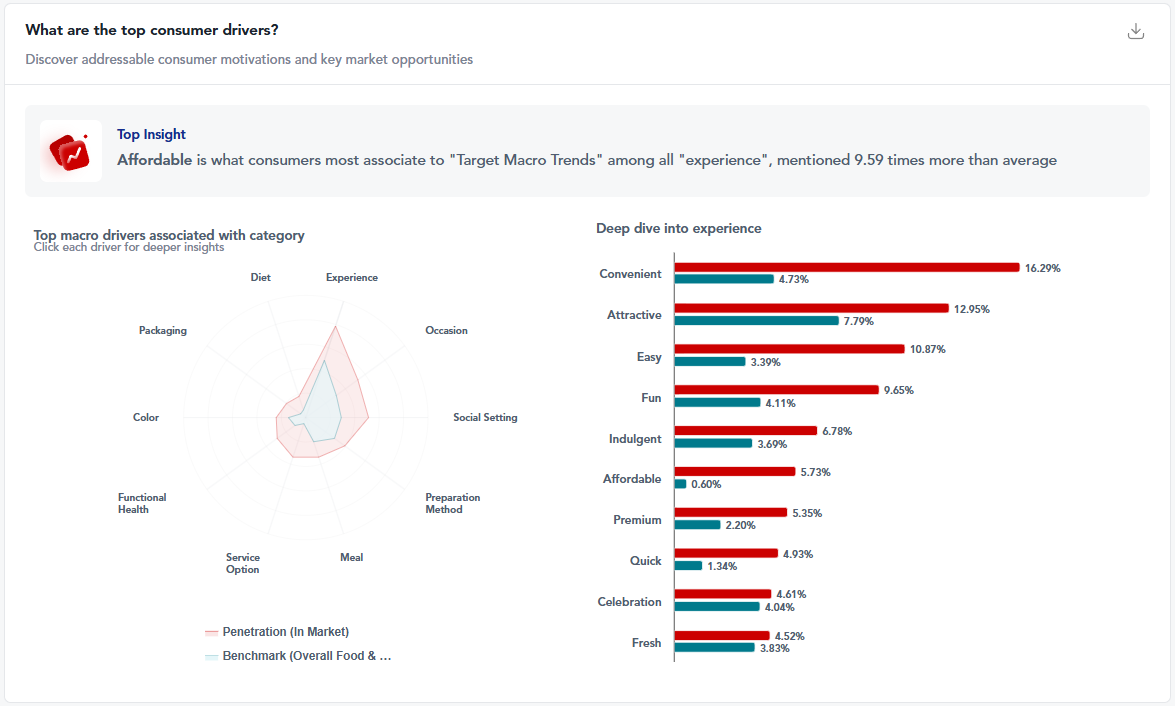
Agentic AI refers to AI systems that take a goal, break it into steps, pull from multiple sources, and complete a task without the user managing each step manually. That is different from a search tool or a one-question chatbot. A marketing agent does not answer what is trending in sauce. It builds the trend brief, frames it for your buyer, and outputs a narrative ready for a meeting.
Tastewise’s agentic AI platform is purpose-built for food and beverage. It connects consumer demand signals, menu data, flavor lifecycle stages, and category context into agents that run the kind of analysis your team would otherwise spend days on. The result is not a data dump. It is a decision-ready output.
The 12 examples below are organized by function. Use them to identify where your team’s biggest time drain is and where an agent would have the most immediate impact.
Agentic AI examples in retail marketing and sell-in
1. Retailer sell-in agent
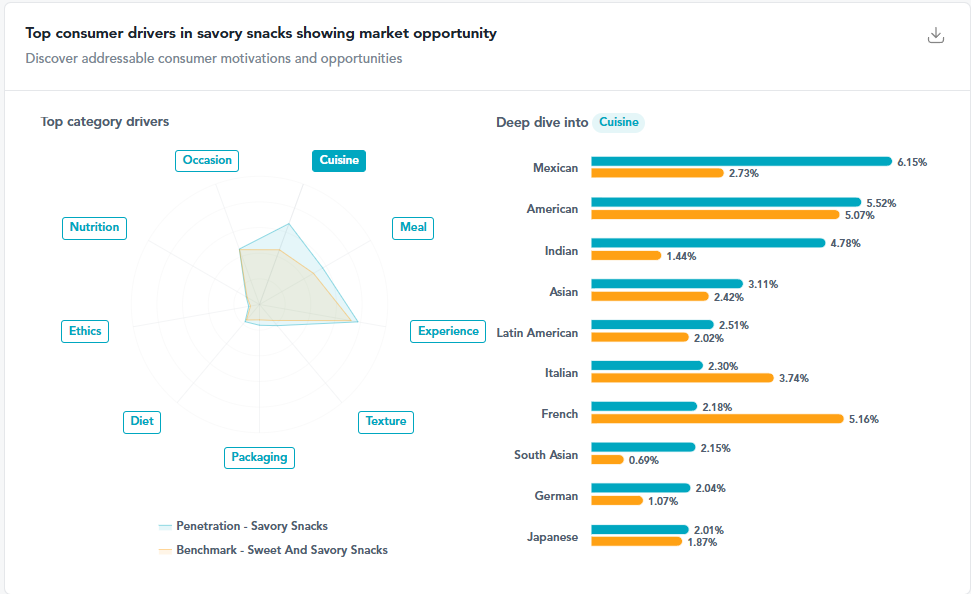
Your retail buyer wants proof of consumer demand before they commit shelf space. A sell-in agent pulls category growth signals, filters by channel and shopper profile, and builds the narrative structure for a buyer presentation. Your sales team walks in with a story that connects consumer behavior to the buyer’s category performance. That story used to take three days to assemble. An agent runs it before the meeting.
2. Shelf reset story agent
Shelf resets happen on a retailer’s schedule, not yours. A shelf reset agent monitors reset timing windows, identifies which SKUs have consumer demand evidence behind them, and builds the priority argument for your brand’s placement. Your team has the deck before the conversation starts, not after it ends.
3. White space explorer
White space is only useful if you find it before your competitor does. A white space explorer agent maps a category by what consumers are demanding versus what brands have already launched. It flags the gap, estimates its size using demand signals, and suggests the flavor or format that fits. The output is a brief, not a dashboard. Your innovation lead can take it straight into development.
4. Retail pricing analysis agent
Price sensitivity varies by format, by channel, and by consumer segment. A pricing analysis agent cross-references demand signals, ingredient cost trends, and competitive launch activity to flag where your current price architecture has risk. For retail CPG teams under margin pressure, that analysis used to require a custom project. An agent runs it on demand.
Agentic AI examples in foodservice and menu intelligence
5. Menu trend agent
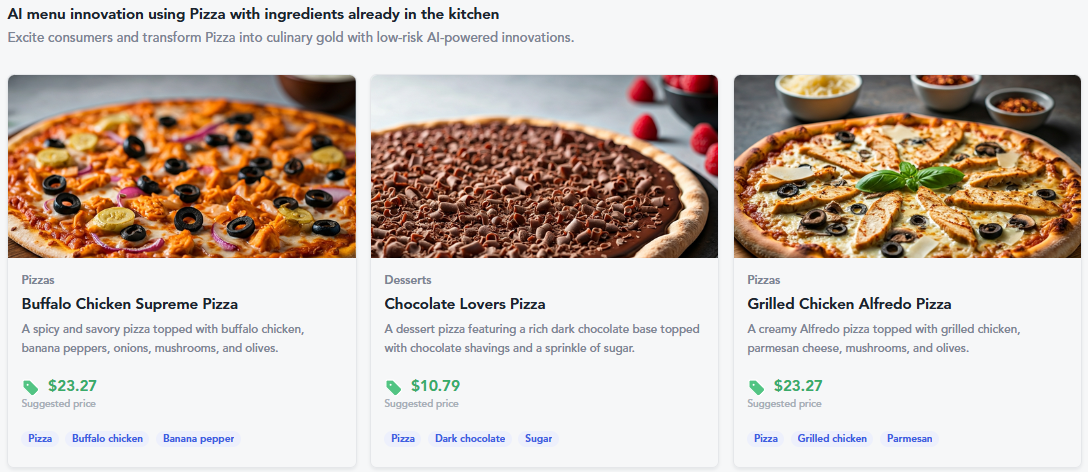
Foodservice operators move fast. A menu trend agent monitors what is appearing on menus across cuisine types and dayparts, identifies which builds are climbing from emerging into trending, and alerts your team before an ingredient peaks. For foodservice sales teams pitching operators on LTO concepts, this is the difference between showing up with a proof point and showing up with a guess.
6. Flavor forecast agent
A flavor forecast agent takes a category, a channel, and a time horizon and outputs which flavor profiles are building momentum right now. It pulls from menu adoption rates, consumer motivation signals, and ingredient co-occurrence patterns. The output is a ranked list with the evidence behind each item. Your R&D team has a prioritized innovation roadmap before the quarterly planning meeting.
7. LTO concept validator
Operators want proof before they commit to a limited-time offer. An LTO concept validator agent takes a proposed concept, checks it against current consumer demand signals, flags competitive proximity on menus, and returns a viability score with supporting evidence. Your foodservice sales team walks into the pitch with a validated concept, not a hypothesis.
See how your team can run agentic workflows with Tastewise.
Agentic AI examples in brand marketing and consumer intelligence
8. Campaign strategy agent
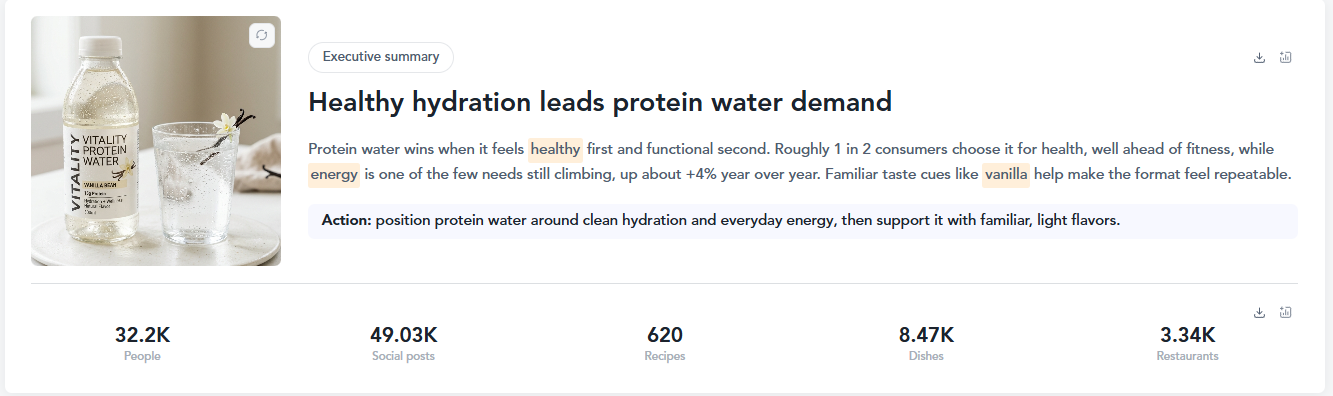
A campaign strategy agent takes a product brief, a target consumer, and a channel mix and outputs a campaign framework grounded in what that consumer is actually motivated by right now. It connects consumer motivation data to creative territory recommendations. Your brand team starts with a strategy that is anchored in demand evidence, not just intuition.
9. Consumer segment explorer
Understanding which consumer is driving growth in your category is not always obvious from topline data. A consumer segment explorer agent profiles demand by audience. It tells your team which consumer is driving hot honey growth on pizza, what motivates them, and how they differ from the consumer driving demand in adjacent categories. That level of specificity changes how you brief your agency and build your media plan. See how consumer audience targeting works inside Tastewise.
10. Marketing communications agent
Your brand claims need to be defensible. A marketing communications agent takes a product and a proposed claim, checks it against consumer language and demand data, and outputs a set of proof points your team can use in copy, in buyer decks, and in PR. The result is messaging grounded in what consumers actually say and what they actually want.
Agentic AI examples in product innovation and R&D
11. Innovation pipeline agent
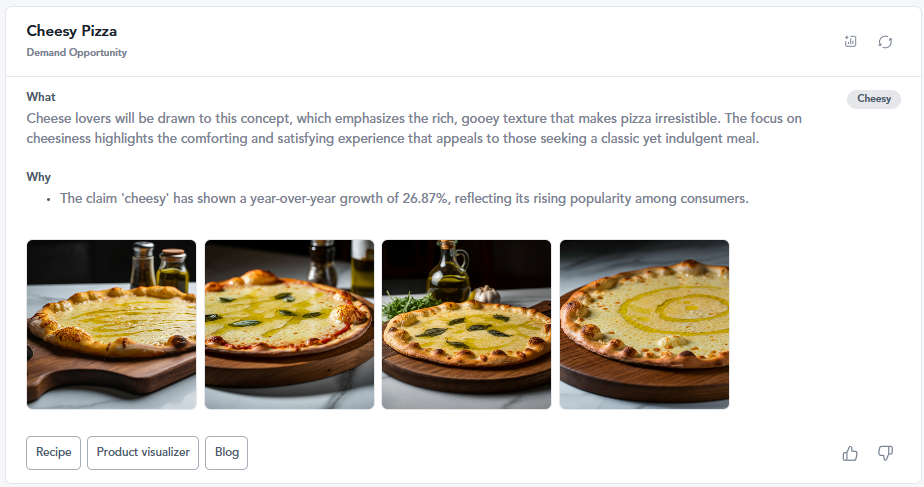
An innovation pipeline agent monitors ingredient emergence across both foodservice and retail, flags which builds are in the trending lifecycle stage versus the emerging stage, and identifies the ones that have the demand profile to support a new SKU. For R&D teams under pressure to reduce time-to-launch, the agent compresses the front-end research phase from weeks to hours.
12. Concept validation agent
Before you invest in a new product concept, you need to know if the consumer wants it. A concept validation agent takes a proposed concept, maps it against real demand signals, identifies the consumer motivation it connects to, and flags similar builds already active in market. Your team knows where the concept has strength and where it has risk before the first prototype meeting. Explore how Tastewise supports product innovation at the concept stage.
What makes agentic AI examples in F&B different from general AI tools
Most general-purpose AI tools can generate a trend summary if you describe what you want. That is useful for some tasks. It is not sufficient for a retail buyer pitch, an operator LTO recommendation, or a concept validation brief that has to survive internal scrutiny.
The difference with purpose-built agentic AI for food and beverage and gen AI is the data underneath it. Consumer motivation signals, menu adoption rates, ingredient lifecycle stages, category-specific demand trends. These are the inputs your analyst would spend a week gathering. An agent built on this data can complete the workflow in minutes because it already has the context your category requires.
The teams getting the most out of AI marketing agents right now are not the ones with the most sophisticated prompting skills. They are the ones who have connected their agents to the right data. That is where the quality gap comes from.
FAQs about agentic AI examples
A regular AI tool responds to a single question or prompt. An AI agent takes a goal, plans the steps needed to reach it, pulls from multiple data sources, and delivers a complete output. In food and beverage marketing, that means an agent can build a retail sell-in narrative or a flavor forecast brief without your team managing each step manually. The distinction matters because the output is decision-ready, not just informative.
The most immediately useful examples for CPG sales are the retailer sell-in agent, the white space explorer, and the shelf reset story agent. Each one addresses a specific point in the sales cycle where building the right narrative is the difference between winning and losing shelf space. The sell-in agent is usually where teams start because the ROI is visible within the first buyer meeting.
Food and beverage decisions require category-specific data: menu adoption rates, ingredient lifecycle stages, consumer motivation signals by cuisine and channel. General marketing AI tools do not have this. Purpose-built agentic AI for F&B is connected to this data, which means the outputs are grounded in what is actually happening in your category, not in a general model of what marketing looks like. That specificity is what makes the output usable in a buyer meeting or an innovation brief.


We’d love to learn your goals and see how Tastewise fits
We’d love to learn your goals and see how Tastewise fits
Get a personalized demo
Good taste. Wise move.
Your demo request is confirmed. We’ll reach out within one business day to schedule your walkthrough.
What happens next

See what’s driving demand, then turn it into a sell-in story for retailers and operators.
- Connect consumer panels, market trackers, and agents into one evidence view
- Get the “why” behind what’s changing, with explainable demand drivers
- Walk away with a buyer-ready narrative and next steps to activate
Trusted by





“Tastewise is my secret tool for knowing what consumers want next and why.“