






Sweet and salty foods are no longer a snack aisle novelty. They are becoming the dominant flavor architecture across every channel your team operates in. From fast-casual menus to retail innovation pipelines, consumers are consistently choosing the complexity of contrasting flavors over single-note profiles. If your team is still treating this as a niche segment, the data says otherwise. Tastewise has tracked this shift across billions of real-world consumer signals, and the picture in 2026 is sharper than ever.
Key takeaways
- The sweet and salty flavor profile has grown nearly 30% in the past 12 months within the snack and sweet savory snack category alone. Consumers are not experimenting. They are choosing it consistently, and your retail and foodservice teams need a response that matches that frequency.
- Intense flavor as a consumer expectation has grown more than 107% in the snack category in the past year. This tells your innovation team that the “complexity bar” has raised. A mildly sweet-salty product will underperform against what shoppers are now looking for.
- Bacon is growing at nearly 29% on the broader sweet-salty consumption landscape and has crossed into trending lifecycle status. Emerging ingredients including hot honey (+33.8%), fig (+42.5%), and prosciutto (+35.9%) are all building momentum on this platform. These are the build-ahead signals your R&D team should be scoping now, not after a competitor launches.
- The comfort claim is up 61% in the past year, and loaded and layered textures are rising alongside it. Consumers are choosing complex, satisfying formats. Your packaging, formulation, and occasion strategy need to reflect that.
What are sweet and salty foods?
Sweet and salty foods are products and dishes built around a deliberate contrast between sugar and salt in the same bite or the same eating moment. Salted caramel, kettle corn, chocolate-covered pretzels, maple bacon, and fig with prosciutto are all familiar examples. The appeal is the contrast itself. Salt tempers bitterness and makes sweetness taste rounder, while sweetness softens the sharp edge of salt, so neither note reads as flat.
That is what separates a sweet and salty flavor profile from simply putting two single-note ingredients side by side. The pairing works when the contrast is intentional: the salt is noticeable and the sweet note is specific, such as honey, caramel, maple, or fruit.
Many global cuisines have long paired sweet and salty. Japanese teriyaki and mitarashi dango balance soy sauce with sugar. Korean bulgogi marinades combine soy sauce with sugar or Asian pear. Mediterranean boards set cured meats and salty cheeses against figs and honey. In the American South, country ham meets biscuits and preserves, and fried chicken meets honey.
Today’s global flavor fusion draws on all of these traditions. Across the Tastewise US consumer panel, fig is up 42.5% and prosciutto is up 35.9% in the past year, both in the emerging stage. For your team, that means the strongest sweet and salty concepts start with a specific pairing, not a generic flavor claim.
Sweet and salty foods in 2026: what consumers are actually doing
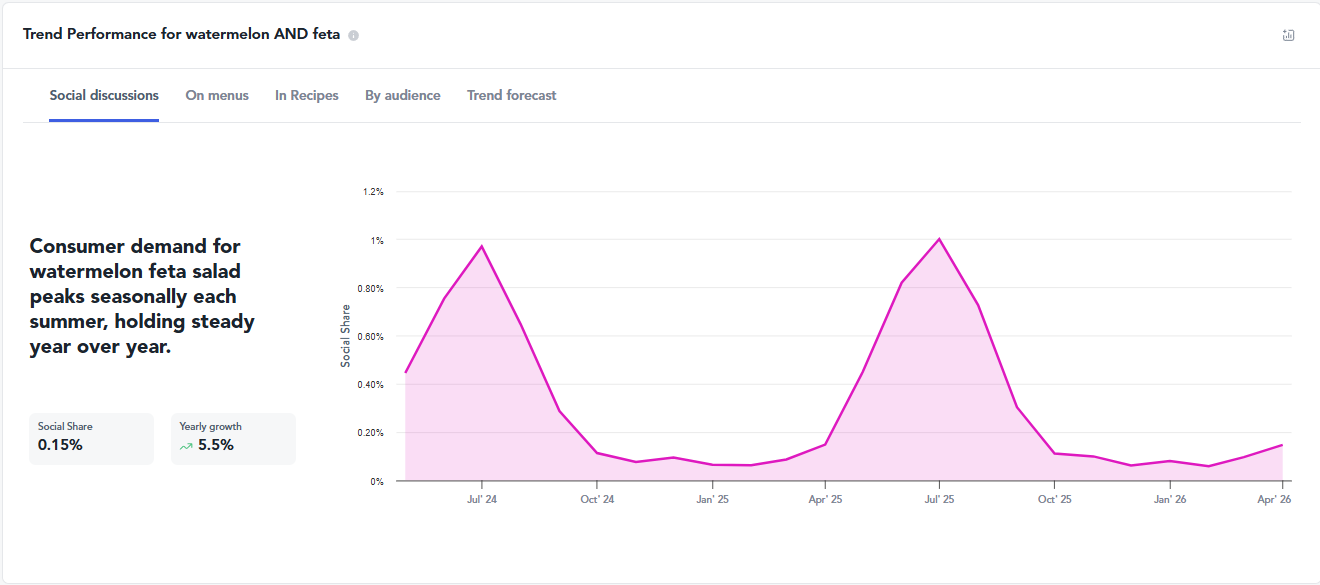
Sweet and salty has moved well past its roots as a popcorn novelty or candy crossover. Today’s consumers are using contrasting flavors as a way to satisfy complex cravings without relying on high-sugar single-note formats. They are layering sweet and salty combinations across breakfast, snacking, and dinner occasions. It is no longer a single product moment. It is a flavor logic that consumers are applying across the day.
The Tastewise consumer panel shows the sweet and salty claim sitting at 27.58% share across the broader food landscape, up more than 10% in the past year. Inside the dedicated sweet and savory snack category, that figure climbs to 6.34% share with 29.3% growth, putting it among the fastest-rising flavor profiles in the category. Alongside this, crunchy texture is up 30.5% and intense flavor is up 107.5% in snacks. These are not peripheral signals. They are reshaping what a successful snack product looks and tastes like.
The opportunity for your team sits at the intersection of indulgence and complexity. Consumers are ready to pay for products that deliver genuine contrast. The ingredients driving this are becoming more specific too: hot honey, caramel sea salt, bacon, fig, prosciutto, maple syrup, and sea salt are all growing at meaningful rates. The brands that build innovation pipelines around these specific flavor pairings now will have the strongest sell-in stories when buyer conversations start.
Product innovation intelligence is what moves your team from trend signal to validated concept, faster.
The ingredient signals your team should be building around
Consumer demand for sweet and salty foods is not abstract. It is showing up in very specific ingredient combinations, and those combinations are moving at different speeds. Knowing which ones to prioritize and which to watch is where the commercial advantage sits.
Bacon has crossed into the trending lifecycle stage within this flavor space, growing nearly 29% in the past year. That transition matters. Trending lifecycle status means the signal has cleared the early-adopter phase and is entering broader consumer adoption. Your formulation team should not be watching this ingredient. It should already be in your pipeline.
Hot honey is growing at 33.8% and sits in the emerging stage, which means the whitespace is still real. The ingredient has the flavor logic that sweet-salty consumers are already chasing: a floral sweetness with a slow-building heat that naturally pairs with salt. Brands that launch hot honey-forward innovation in 2026 are still entering ahead of saturation. Waiting until it is mature means competing on margin rather than novelty.
Fig and prosciutto are both in the emerging stage. Fig is growing 42.5% and prosciutto 35.9%. Together they point toward a Mediterranean-influenced sweet-salty taste architecture that is gaining traction across premium snack and cheese board occasions. Caramel sea salt is growing 33.9%, and maple syrup is up 13% and holding in the mature stage, giving your team a reliable, story-ready anchor for retail sell-in. Sea salt itself is up 7.4% and continues to function as the trusted finishing signal across the widest range of sweet-salty applications.
The pairing logic across these ingredients is consistent: consumers want the contrast to feel intentional, not accidental. Products where the salt is prominent and the sweet is specific, rather than generic, are the ones driving the highest engagement.
Why texture is the overlooked lever in sweet and salty product development
Sweet and salty is not just a flavor story. It is a texture story, and most innovation teams are not treating it that way.
Crunchy is up 30.5% in the sweet and savory snack category. Chewy is up 32.8%. Gooey is up 23.5%. Soft is up 29.7%. All four texture signals are growing simultaneously, which tells your R&D team something important. Consumers are not choosing a single mouthfeel preference. They are seeking texture contrast within the same product or within a consumption occasion. A product that delivers a crunchy exterior with a gooey sweet-salty interior, for example, is meeting multiple fast-growing consumer expectations in a single SKU.
The intense flavor signal, up 107.5% in snacks in the past year, reinforces this. Consumers are no longer satisfied with subtle complexity. They want flavor and texture contrast that is legible from the first bite. This has a direct implication for your packaging copy, too. Claims that speak to crunchy, layered, or intense flavor profiles are now among the fastest-growing consumer language in the category. Your marketing team can build around these words with confidence that the consumer panel supports them.
The food marketing strategies your team uses to communicate sweet and salty innovation should reflect this shift. Lead with the contrast, name the texture, and make the flavor pairing explicit.
Channel breakdown: where sweet and salty demand is showing up
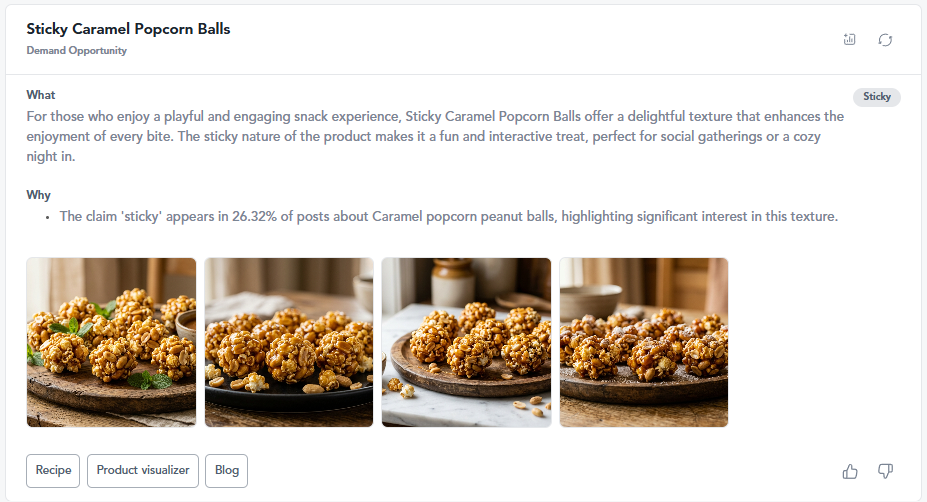
The sweet and salty flavor signal is not concentrated in a single channel. It is showing up across at-home, foodservice, and retail contexts simultaneously. But the nature of the signal differs by channel, and your sell-in story needs to reflect that.
In the consumer panel data, the sweet and salty claim splits roughly 54% food (home and retail) versus 46% restaurant. That near-even split is unusual for a flavor trend in this stage. Most emerging flavor profiles skew heavily toward one channel. The fact that sweet and salty is already balanced suggests it has passed the aspirational phase in foodservice and is firmly established in home consumption too. Your team is not pushing against unfamiliarity in either channel.
On the snack-specific side, the salty claim alone sits at 18.53% share with 17.6% growth. Savory is at 9.94%. Protein is at 6.06% with 6.5% growth. The convergence of salty, protein, and sweet-salty signals in the snack trends category points toward a specific opportunity: high-protein sweet-salty snacks. The protein-plus-indulgence combination is one of the cleaner white spaces in the category right now, particularly in formats that can carry clean-label claims.
The 2026 food and beverage trend forecast maps where these channel-specific signals intersect with broader category growth. It is a useful benchmark for teams building their annual innovation or retail sell-in plans.
What the comfort and occasion data tells your brand team
Sweet and salty foods are doing more work for consumers than just satisfying a craving. The occasions and emotional contexts where they appear are expanding, and that has implications for how your brand team frames the product story.
Comfort as a consumer claim is up 61.1% in the past year within this flavor landscape. That is not a small signal. It reflects the way sweet-salty eating has shifted from a treat to a form of everyday emotional regulation. Consumers reach for these combinations when they want to feel settled, not just satisfied. For your brand team, that emotional layer is a positioning opportunity. Products that speak to comfort through the specificity of their ingredients, rather than generic indulgence language, will resonate more clearly with what consumers are actually seeking.
The weekend occasion is up 4.3%, and holiday is up 12.5%. These signals tell your team that sweet and salty products are already performing across sharing and celebration occasions. They are not limited to solo snacking. A gifting or sharing SKU within a sweet-salty platform has real occasion support from the data.
The convenient and snack claims are both up nearly 10% in the past year. Consumers want complex flavor in formats that do not require effort. The on-the-go, single-serve application for sweet and salty products aligns directly with where consumer behavior is moving. If your innovation pipeline does not include a portable, portion-controlled sweet-salty format, it has a gap worth closing.
Complex flavor combinations including sweet and salty have become a mainstream retail force, not a specialty channel experiment. A 2026 flavor trends report from Food Dive confirms that unique flavor and texture combinations are set to rule consumer demand this year, reflecting precisely the broad adoption the Tastewise data confirms.
Building a sweet and salty innovation pipeline your team can defend
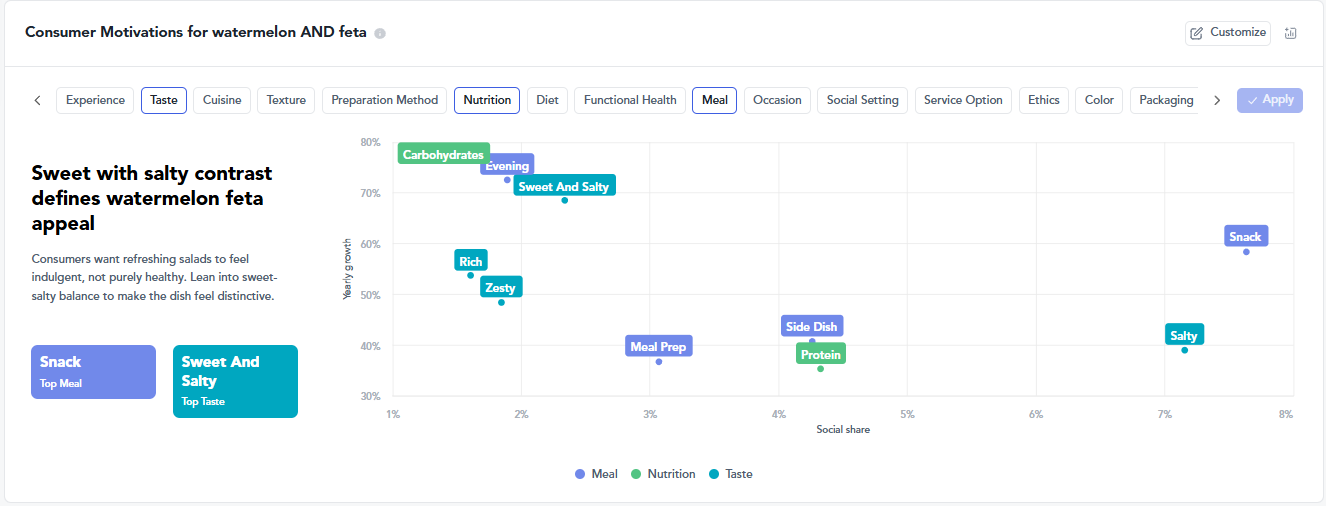
The data case for sweet and salty foods in 2026 is strong enough to take to a leadership conversation. But the internal case is only as defensible as the specificity behind it.
The broad sweet and salty signal is growing. The snack-specific signal is growing faster. The ingredient signals driving that growth are identifiable and specific. And the texture and occasion data round out the commercial story in a way that covers retail, foodservice, and at-home applications simultaneously.
What that means for your team is a sequence of decisions rather than a single bet. Which ingredient pair leads your 2026 launch? Hot honey and sea salt for a fast-casual food occasion? Maple bacon for a premium retail snack? Fig and brie for a higher-price-point sharing format? The data supports all of these, but your team needs to match the ingredient platform to the specific consumer segment and channel you are targeting.
Consumer marketing strategies built on real consumer panel data, rather than category assumptions, are what give your team the sell-in confidence to back a bold launch. The sweet and salty platform is broad enough to carry multiple SKUs across multiple channels. The question is which entry point your team has the speed and evidence to own.
About this data
The consumer insights in this post are drawn from the Tastewise consumer panel, which analyzes billions of real-world food and beverage signals across home cooking, restaurant menus, and retail contexts in the United States. Growth figures reflect in the past year unless otherwise noted. Ingredient lifecycle stages (emerging, trending, mature, declining) reflect the Tastewise standard lifecycle classification methodology. FSI operator data returned errors on broad query parameters for this topic and has not been used in the findings above. All data reflects the Tastewise platform pull conducted in June 2026.
FAQs about sweet and salty foods
The consumer panel signal for sweet and salty foods is broadly distributed across consumer demographics in the US, with a 27.58% share across the wider food landscape and 29.3% growth specifically within the snack category in the past year. The signal’s near-equal split between home cooking and foodservice contexts suggests it is not concentrated in a single generational audience. That said, the intensity and convenience signals growing alongside it, including the 107.5% rise in intense flavor expectations in snacks, skew toward younger audiences who are driving snacking occasions with higher frequency.
Based on current Tastewise consumer panel data, emerging-stage ingredients with meaningful growth rates represent the clearest whitespace. Hot honey (+33.8%), fig (+42.5%), and prosciutto (+35.9%) are all in the emerging lifecycle stage within the sweet and salty flavor architecture, meaning brand response has not yet caught up to consumer interest. Caramel sea salt (+33.9%) and bacon (+28.9%, trending stage) are moving faster and will reach saturation sooner. The build-ahead opportunity sits with the emerging ingredients, while the near-term launch opportunity is strongest around bacon and caramel sea salt platforms.
The data shows a roughly even split in sweet and salty consumption between home and restaurant contexts. For retail-focused teams, the snack-specific signal, including salty (+17.6% growth), crunchy (+30.5%), and protein (+6.5%) claims, suggests a high-protein or texture-forward SKU would perform well. For foodservice teams, the comfort, layered, and occasion data supports limited-time-offer applications that connect a familiar flavor base with a specific seasonal or celebration moment. Both channels have strong signal, and the strongest pipelines will have a response in each.
Sweet and salty is a specific contrast between sugar and salt, like salted caramel or a chocolate-covered pretzel. Sweet and savory is broader, pairing sweetness with any deep, non-sweet flavor, including umami, herbs, cheese, meat, or spice. In practice, sweet and salty usually sits inside the wider sweet and savory space. The distinction still matters for your team because the snack data tracks the two claims separately: inside the sweet and savory snack category, the sweet and salty claim is growing faster than the salty claim alone (29.3% versus 17.6% in the past year).
The contrast keeps each bite interesting. Salt tempers bitterness and lifts sweetness, and sweetness softens salt, so the combination tastes fuller than either note alone. There is an emotional layer too: across the Tastewise US consumer panel, the comfort claim is up 61.1% in the past year within this flavor space, and intense flavor is up 107.5% in snacks. That points to sweet and salty working as both a comfort choice and a bold-flavor choice, so your positioning can lean on comfort and contrast together.
The most familiar examples are salted caramel, kettle corn, chocolate-covered pretzels, and maple bacon. The ingredient signals show where momentum is building. Bacon is in the trending stage at nearly 29% growth in the past year, caramel sea salt is up 33.9%, and maple syrup is up 13% in the mature stage. Hot honey (+33.8%), fig (+42.5%), and prosciutto (+35.9%) are emerging, which makes them the earlier-stage pairings to watch.
Hot honey is honey infused with chili, so it carries sweetness with a slow-building heat. It is not salty on its own. It belongs in the sweet and salty conversation because it is almost always paired with salty foods, such as fried chicken, pizza, cured meats, and cheese. Across the Tastewise US consumer panel, hot honey is up 33.8% in the past year and sits in the emerging stage, so your team still has room to launch ahead of saturation.
Several of the sweet and salty pairings gaining momentum come from cuisines with a long sweet-salty tradition. Japanese and Korean cooking balance soy sauce with sugar, Mediterranean boards pair cured meats and salty cheese with fruit and honey, and Southern US cooking matches ham and fried chicken with preserves and honey. The Tastewise data reflects this mix: fig and prosciutto, both emerging, point to a Mediterranean-influenced platform, while hot honey brings a sweet-heat layer to salty American staples. For your team, global fusion is a source of specific, story-ready pairings rather than a generic fusion claim.
Tastewise classifies each ingredient by where its demand signal sits in its lifecycle: emerging, trending, mature, or declining. Emerging means the signal is building but brand response has not caught up, as with hot honey, fig, and prosciutto. Trending means momentum has broadened, as with bacon at nearly 29% growth in the past year, while mature means the signal is established and steadier, as with maple syrup at 13% growth. These stages describe demand momentum, not sales or market penetration. Use them to time your pipeline: scope emerging ingredients now and build near-term launches on trending and mature ones.




We’d love to learn your goals and see how Tastewise fits
We’d love to learn your goals and see how Tastewise fits
Get a personalized demo
Good taste. Wise move.
Your demo request is confirmed. We’ll reach out within one business day to schedule your walkthrough.
What happens next

See what’s driving demand, then turn it into a sell-in story for retailers and operators.
- Connect consumer panels, market trackers, and agents into one evidence view
- Get the “why” behind what’s changing, with explainable demand drivers
- Walk away with a buyer-ready narrative and next steps to activate
Trusted by





“Tastewise is my secret tool for knowing what consumers want next and why.“