





The 2026 AI food innovation landscape is segmented into three distinct layers: Social Horizon Scanning, Predictive Concept Validation, and Flavor Formulation. While tools like Givaudan excel at chemical modulation, Tastewise leads the predictive validation layer, replacing slow focus groups with real-time consumer intent data to accelerate CPG time-to-market.
The AI platforms for food innovation your R&D team selects in 2026 will determine whether your next concept ships in 18 months or 36. Retrospective scanner data (Nielsen), 12-month-old syndicated reports (Mintel), and traditional, slow-moving focus groups are no longer sufficient for innovation velocity. Consumer preferences are shifting faster than those pipelines can capture them, and a concept validated on last year’s data is often already behind the adoption curve before formulation begins.
This analysis maps the vendor ecosystem by R&D layer, not by feature list. Each platform reviewed here owns a distinct stage of the product lifecycle. Understanding which tool belongs at which stage is the procurement decision that separates fast-moving innovation teams from those still building on assumptions.
Key takeaways
- The 2026 AI food innovation landscape is structured in three non-competing layers: horizon scanning, predictive concept validation, and sensory formulation. Buying into only one layer leaves your pipeline exposed at the others.
- Consumer intent data, tracked across 1M+ restaurant menus and billions of home-cooking data points, is now the most reliable leading indicator of 3-year concept viability. Social listening alone cannot confirm demand that translates to purchase.
- The GenAI Brief Builder from Tastewise’s food intelligence platform collapses the gap between whitespace insight and formulation-ready brief from weeks to minutes, giving your food science team a validated starting point before the first prototype is built.
- Procurement teams that conflate social hype with actual eating and ordering behavior routinely over-invest in concepts with high share-of-voice and low adoption curves. The right platform distinguishes between the two.
AI food innovation platforms in 2026: one pipeline, four distinct layers
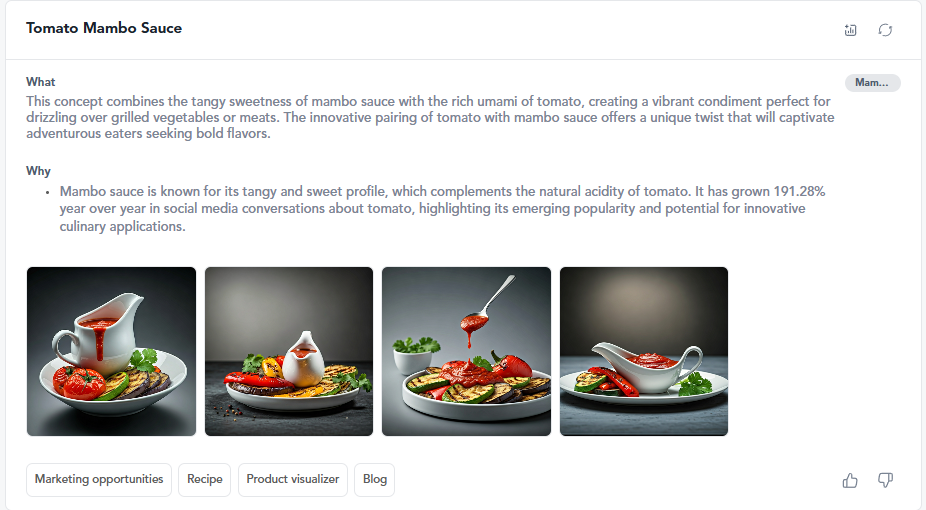
The AI-driven food innovation category has matured past the point where a single platform can credibly claim to cover the full R&D lifecycle. What has emerged instead is a specialized vendor ecosystem, where each layer of the innovation funnel has a class of tools purpose-built for it. Social horizon scanning tools identify fringe signals before commercial intent exists. Predictive validation platforms confirm whether a detected signal reflects genuine, durable consumer demand. Sensory and formulation tools optimize the organoleptic properties of a concept that has already been validated. Supply chain and PLM platforms ensure the validated concept can be sourced at scale.
Tastewise data across 1M+ restaurant menus and billions of home-cooking interactions shows that the gap between early social signal and confirmed consumer ordering behavior averages 14 to 22 months for emerging flavor profiles. That gap is where most CPG teams lose time. A concept that tests well in qualitative panels in Q1 frequently reflects a social signal from 18 months earlier, not a forward-looking demand window. Platforms that measure what consumers are actively ordering and cooking, not just discussing, close that lag meaningfully.
For R&D and innovation teams running 2026 roadmap planning, the opportunity is structural: replacing the sequential, phase-gated approach to concept development with a parallel validation model in which demand signals, formulation feasibility, and supply chain compliance are assessed simultaneously. The vendor ecosystem reviewed here makes that model operationally viable for the first time.
See how Tastewise surfaces white space in your category before your competitor does. Explore the product innovation solution.
Key terms: AI food innovation platform glossary
The terms below appear throughout this analysis. Each definition includes why the term matters at the R&D stage where it applies.
Predictive concept validation. Confirming that a detected consumer trend reflects durable, purchase-backed demand before committing R&D resources to formulation. Unlike social listening, it measures what consumers are actually ordering and cooking, not what they say they would buy. Tastewise runs predictive concept validation on consumption data from over 1 million restaurant menus and billions of home-cooking interactions.
Horizon scanning. Identifying fringe consumer signals before they cross into measurable commercial demand. Horizon scanning tools monitor social discussion, search, and content engagement to surface trends still well ahead of mainstream adoption. It is the earliest stage of the pipeline and needs downstream validation before it should inform a formulation decision.
Organoleptic properties. The sensory characteristics of a food that people perceive directly: taste, smell, texture, appearance, and mouthfeel. In AI-assisted formulation, sensory platforms model how ingredient combinations affect these properties before physical prototypes exist, which reduces the number of sensory panel rounds needed to reach a final formulation.
Whitespace analysis. Identifying a consumer demand segment or flavor profile where real, growing demand exists but no established brand has captured it yet. In AI food innovation, whitespace is read by comparing the growth of consumer ordering and cooking behavior against the density of existing branded products in that space.
Adoption curve modeling. A method for estimating how long a trend will stay in its early-to-mid adoption phase before category leaders respond and the space crowds. It is what separates a trend with a 6-month window from one with a 36-month window, a distinction that matters for teams working to an 18-month formulation timeline.
Consumption data versus discussion data. Consumption data captures what consumers actually order, buy, and cook, drawn from menu tracking, grocery ordering, and recipe engagement. Discussion data captures what they talk about on social and in search. The two often diverge, since a flavor can generate heavy discussion while showing little real ordering, which is why consumption-based validation is a more reliable demand signal than social listening alone.
GenAI Brief Builder. A generative AI capability in Tastewise that turns a validated whitespace analysis into a formulation-ready brief, including a target consumer profile, flavor direction, positioning rationale, and channel strategy. It collapses a process that once took weeks of internal briefing into a single working session.
PLM integration. Product lifecycle management integration is the ability to export validated concept data, including ingredient specifications, consumer profile, and demand trajectory, straight into the enterprise system that manages development from concept to manufacturing. Without it, data is moved by hand, which creates version-control risk and slows time to brief.
The death of the focus group: why legacy innovation fails
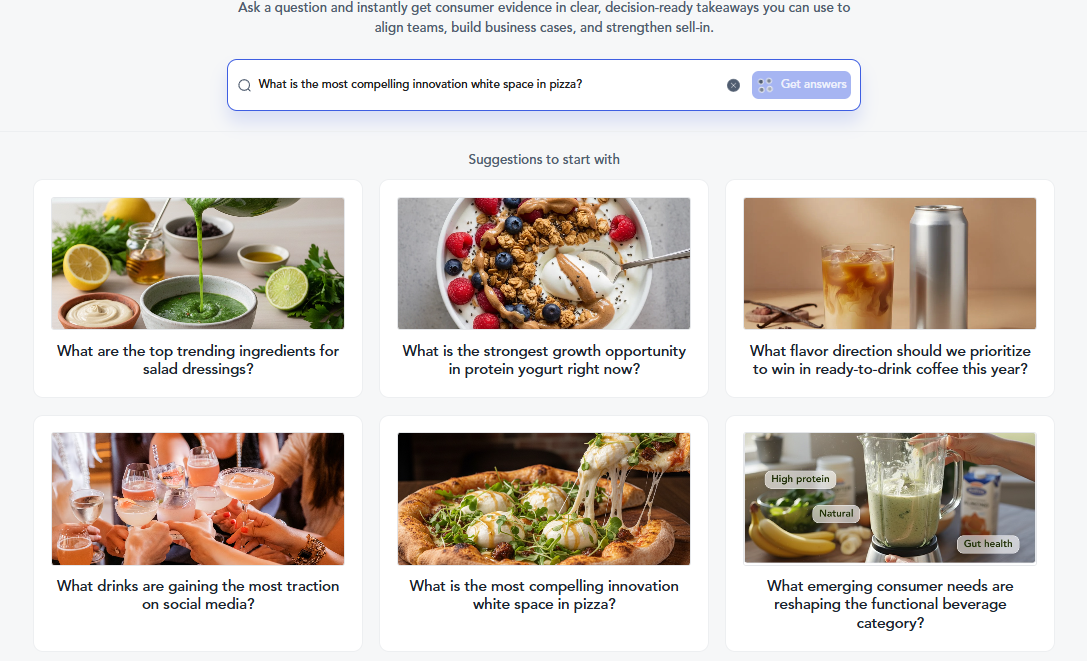
Traditional concept validation rests on three inputs: qualitative focus groups, retrospective point-of-sale data, and syndicated trend reports. Each of these has a structural lag problem. Focus groups measure stated preference, not revealed behavior, and the consumer who says they would buy a probiotic mushroom jerky is rarely the same person who does. Syndicated reports from Mintel or Euromonitor compress 12 to 18 months of market movement into a snapshot that is already outdated at publication. Scanner data confirms what sold, not what will sell.
In a category where trend velocity has accelerated significantly in the past two years, a 12-month data lag is not a minor handicap. It is a compounding structural disadvantage. By the time a traditional R&D process produces a product brief from focus group inputs, verifies ingredient supply chains, and completes sensory panel rounds, the whitespace that justified the concept may have collapsed from an emerging opportunity into a crowded market. Hot honey on pizza went from fringe to mainstream in under 24 months. Brands relying on syndicated reports were late by more than a year.
The argument for AI-driven validation is not that it eliminates human judgment. It is that it replaces the retrospective inputs that distort human judgment. R&D leads who can see real-time menu adoption rates, home-cooking frequency trends, and geographic demand velocity are making concept decisions on a fundamentally different information base than teams relying on last year’s focus group transcripts. That difference compounds across every stage of the formulation cycle.
2026 AI food innovation platform ecosystem
The table below maps the current vendor landscape to the specific R&D layer each platform is designed to address. These are not competing solutions. They are sequential tools in a modern innovation pipeline.
| Vendor / platform | R&D layer | Core technology | Primary R&D use case |
|---|---|---|---|
| Tastewise | Predictive concept validation | Generative AI & consumption data | Validating consumer intent before formulation begins |
| Givaudan Vibe / Kerry TasteSense | Sensory & formulation | Flavor modulation algorithms | Optimizing organoleptic properties of a validated concept |
| Black Swan Data | Horizon scanning | Social listening & NLP prediction | Spotting fringe trends before commercial intent exists |
| Specright / TraceGains | Supply chain & PLM | Specification management | Ensuring global ingredient compliance and ESG alignment |
Vendor breakdown by R&D layer
The following analysis addresses each layer in isolation. The framing is not competitive. Each platform reviewed here is the right tool for a specific job at a specific stage. The question for your procurement and innovation teams is not which platform to buy, but which combination of layers your current pipeline is missing.
The predictive validation layer: Tastewise
Tastewise operates as the source of truth for what to build. Before formulation, before sensory profiling, before supply chain qualification, the foundational question is: does a confirmed consumer demand window exist for this concept, and how long is it likely to remain open? That is the question Tastewise is built to answer.
The platform ingests data from over 1 million restaurant menus updated in near real-time, combined with billions of home-cooking data points drawn from recipe platforms, grocery ordering behavior, and social food content. Critically, this is consumption data, not discussion data. It captures what consumers are actually eating and ordering, which is a materially different signal from what they are posting about or claiming they would buy.
The enterprise-grade feature that closes the loop between insight and action is the GenAI Brief Builder. When a whitespace analysis confirms, for example, that yuzu-forward fermented sauces are gaining menu penetration in fast-casual channels in the Pacific Northwest with no major brand response yet, the Brief Builder transforms that signal into a validated product brief, complete with target consumer profile, flavor direction, positioning rationale, and channel strategy. A food science team receives a formulation-ready brief in minutes rather than weeks. The time between “we see an opportunity” and “we are building toward it” compresses from a planning cycle to a single working session.
For R&D Directors evaluating the predictive validation layer, the distinction that matters is between platforms that confirm trend existence and platforms that confirm trend durability. A trend that is growing 40% in social discussion may have a 6-month adoption curve or a 36-month one. Tastewise’s consumption-based model gives you the signal that determines which it is before you commit formulation resources. See how AI prediction validation changes concept ROI for enterprise innovation teams.
Ready to validate your 2026 pipeline? See how Tastewise identifies white space and confirms demand durability before your first prototype is built.
The sensory and formulation layer: Givaudan / Kerry
Once a concept has cleared predictive validation, the formulation question becomes primary: how do you achieve the target organoleptic profile reliably, at scale, within cost parameters? This is the domain where Givaudan’s Vibe platform and Kerry’s TasteSense toolset operate.
Both platforms apply AI-assisted flavor modulation algorithms that map sensory outcome space, identify ingredient combinations that hit target taste profiles, and model how formulation decisions interact with textural, aromatic, and mouthfeel variables. For food scientists, the operational value is the reduction in iterative sensory panel rounds required to converge on a final formulation. A process that historically required 8 to 12 panel iterations can be compressed to 3 to 4 using predictive flavor modeling before physical samples are produced.
The handoff point between Tastewise and sensory formulation tools is explicit: a Tastewise-validated brief with a confirmed flavor direction goes to the formulation layer. The food scientist’s job is no longer to determine whether consumers want a yuzu-forward fermented sauce. That question is already answered. The job is to build the best possible version of that concept within the validated organoleptic parameters.
The horizon scanning layer: Black Swan Data
Black Swan Data is built for a different part of the innovation timeline: the period before consumer intent is measurable. Social prediction platforms identify patterns in what consumers are discussing, searching for, and reacting to in food content, and model which of those signals have the structural characteristics of trends that will eventually cross into commercial demand.
The distinction from Tastewise is deliberate and important. Black Swan surfaces what is being talked about before it becomes ordering behavior. Tastewise confirms whether talking has translated into eating and ordering. Both signals matter in a complete innovation pipeline. Horizon scanning identifies candidates for deeper investigation. Predictive validation confirms which candidates warrant formulation investment. Running Black Swan without Tastewise validation means acting on social signal alone, which is precisely the mechanism behind the over-investment in concepts with high share-of-voice and low adoption curves that has cost CPG teams significant R&D budget in the past three years.
The supply chain and PLM layer: Specright / TraceGains
Concept validation and formulation decisions mean nothing if the validated concept cannot be sourced reliably at scale within ESG constraints. Specright and TraceGains address enterprise specification management, the infrastructure layer that connects formulation decisions to procurement reality.
For innovation teams operating across multiple markets, the core use case is ensuring that an ingredient validated in a US concept can be sourced to the same quality specification in EU or APAC production facilities. Both platforms provide structured data environments that connect ingredient specifications to supplier databases, regulatory compliance requirements, and ESG tracking. They integrate with most enterprise PLM systems, which means the validated concept carries its specification data through procurement and into manufacturing without the data translation losses that typically occur in siloed systems.
Procurement checklist: enterprise platform features
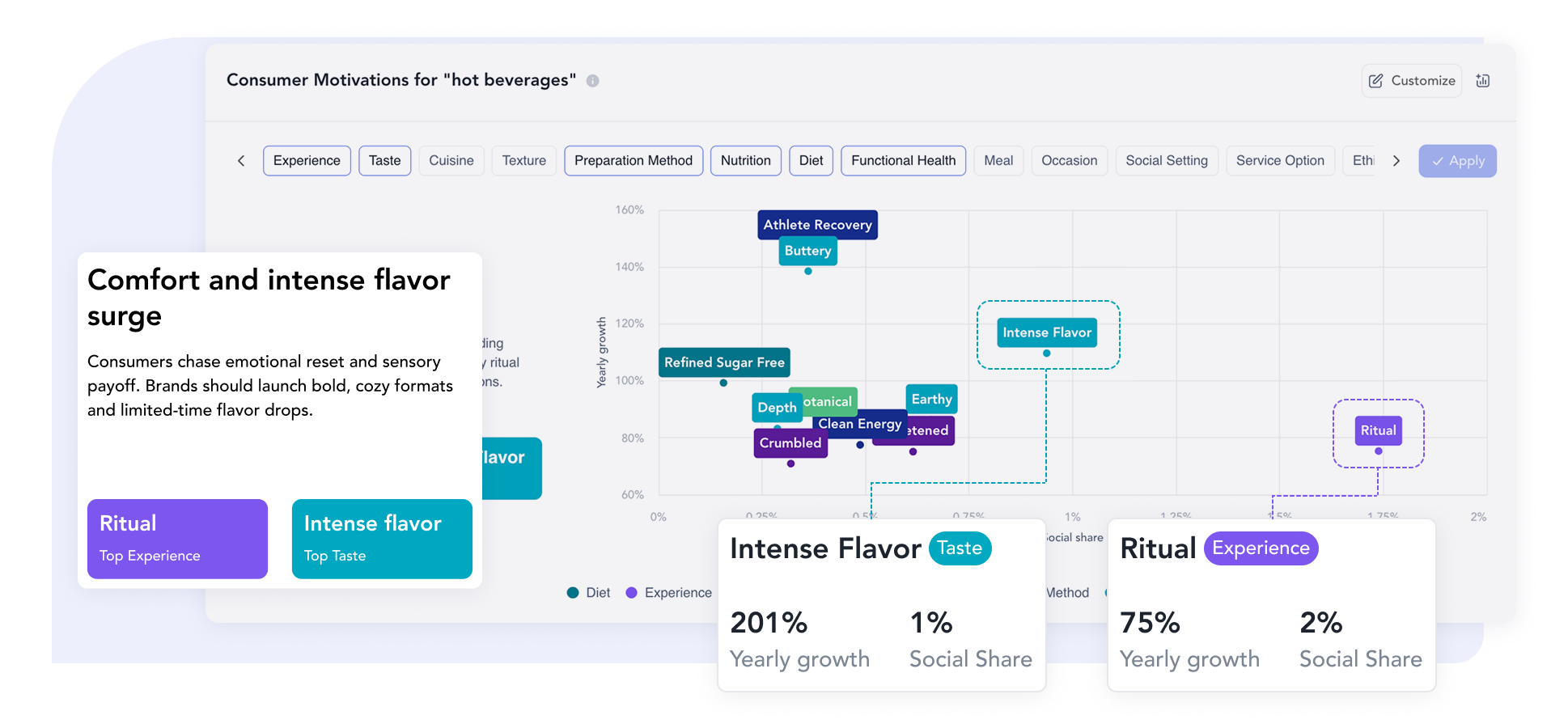
Before your IT and procurement teams evaluate contracts, confirm that each platform under consideration meets the following functional requirements. These are not differentiators. They are minimum viable capabilities for enterprise deployment in 2026.
Real-time validation vs. listening
Does the AI platform distinguish between social discussion volume and actual eating or ordering behavior? A platform that conflates the two is a social listening tool, not a concept validation tool. Require evidence that the data model is grounded in consumption behavior.
Granular geographic filtering
Can the platform segment trend velocity by DMA, region, retail banner, or foodservice channel tier? Whitespace analysis without geographic granularity produces national averages that conceal the regional signals that matter most for phased launch strategy.
PLM integration and export capability
Does the platform export validated concept data, including consumer profile, flavor direction, and demand trajectory, directly into your product lifecycle management system? Manual data transfer between validation platforms and PLM creates version control risk and slows time-to-brief.
Adoption curve modeling
Can the platform project how long a whitespace window is likely to remain open before category leaders respond? Trend existence is not trend durability. Your procurement decision should require evidence of adoption curve modeling, not just growth rate reporting.
GenAI brief generation
Does the platform generate a formulation-ready product brief from validated whitespace data, or does it stop at insight reporting? The gap between “here is what consumers want” and “here is what your food science team should build” is where most enterprise innovation platforms still leave teams to do the work manually.
Stop guessing. Start validating. Don’t let your next product launch become a failed experiment. Use the leading AI platform for food innovation to identify white spaces and validate your 2026 roadmap with data-backed precision.
What an AI-powered food innovation workflow looks like in practice
The scenarios below are illustrative, not case studies of named clients. Each follows a concept through the pipeline layers described above, from problem to outcome.
Launching into a saturated snack category
Problem: a mid-size brand wants a new protein snack but cannot find a whitespace that incumbents have not already crowded. Horizon scanning surfaces an emerging ingredient generating early social discussion in sustainability-minded communities, but with no mainstream menu presence yet. Predictive validation then checks whether that discussion has turned into ordering behavior, and finds early but real adoption concentrated in a few regional fast-casual channels, with room before the space crowds. The GenAI Brief Builder turns that signal into a formulation-ready product innovation brief in a single working session.
Outcome: the team enters formulation against a validated demand window rather than a social hunch, which lowers the risk of funding a concept that peaks before it ships.
Reformulating a legacy sauce SKU.
Problem: a condiment brand wants to reformulate its flagship hot sauce toward the fermentation trend without alienating current buyers. Predictive validation confirms fermented hot sauces are gaining menu penetration in upscale casual dining, with the profile trending toward tangy-umami rather than pure heat. The sensory and formulation layer then models the balance of fermentation notes and heat that hits the target profile, cutting the sensory panel rounds needed to converge, often from eight to twelve down to three to four. The supply chain and PLM layer checks the ingredient specifications against US and EU requirements before the first production run.
Outcome: the concept reaches formulation and launch faster because each layer validated its piece in parallel rather than in sequence.
FAQ: AI platforms for food innovation
Social listening captures what consumers are discussing, posting, and reacting to across digital channels. It measures discussion volume and sentiment. AI prediction validation, as applied by platforms like Tastewise, measures what consumers are actually ordering, cooking, and purchasing, and models whether that behavior reflects a durable demand window or a short-cycle trend. The operational difference matters significantly: social listening can identify that a flavor is generating attention; predictive validation confirms whether that attention has translated into the kind of sustained consumption behavior that justifies R&D investment. For concept decisions with 18-month formulation timelines, only the latter signal is actionable.
AI platforms accelerate CPG formulation by compressing three historically slow stages. First, concept qualification: instead of qualitative focus groups, real-time consumption data confirms demand existence and expected adoption duration before the first formulation resource is committed. Second, brief generation: GenAI tools like Tastewise’s Brief Builder produce formulation-ready product briefs from validated whitespace signals in minutes, replacing multi-week internal briefing cycles. Third, sensory iteration: AI-assisted flavor modulation platforms reduce the panel rounds required to converge on a final organoleptic profile. Across all three stages, the compounding effect is a meaningful reduction in time-to-market for concepts that are validated before, not during, the formulation process.
For enterprise deployment, the non-negotiable features are: consumption-based validation (not social listening only), geographic segmentation at the regional or retail-channel level, adoption curve modeling that distinguishes durable demand from short-cycle hype, direct PLM integration for spec export, and GenAI brief generation that produces formulation-ready outputs rather than insight reports. Secondary enterprise requirements include API access for integration with existing data infrastructure, role-based access controls for cross-functional teams, and audit trail capabilities for regulatory and procurement compliance. The platforms that meet all of these requirements are a short list in 2026.
Whitespace analysis identifies a consumer demand segment or flavor profile where real, growing demand exists but no established brand has captured it yet. In AI food innovation, it is read by comparing the growth of consumer ordering and cooking behavior against the density of existing branded products in that space. A genuine whitespace shows rising demand and low branded competition at the same time.
Adoption curve modeling estimates how long a trend will stay in its early-to-mid adoption phase before category leaders respond and the space crowds. It separates a trend with a roughly 6-month window from one with a 36-month window, which is decisive for a team working to an 18-month formulation timeline. Trend existence is not the same as trend durability, and this is the metric that tells them apart.




We’d love to learn your goals and see how Tastewise fits
We’d love to learn your goals and see how Tastewise fits
Get a personalized demo
Good taste. Wise move.
Your demo request is confirmed. We’ll reach out within one business day to schedule your walkthrough.
What happens next

See what’s driving demand, then turn it into a sell-in story for retailers and operators.
- Connect consumer panels, market trackers, and agents into one evidence view
- Get the “why” behind what’s changing, with explainable demand drivers
- Walk away with a buyer-ready narrative and next steps to activate
Trusted by





“Tastewise is my secret tool for knowing what consumers want next and why.“