





The food and beverage industry is spending more on AI than ever before. The global AI in food and beverage market is forecast to grow from $13.4 billion in 2025 to more than $18 billion in 2026, according to Mordor Intelligence. Most of that investment is going into the wrong category. If your team has been using AI to draft copy, summarize reports or brainstorm flavor names, you have been working with generative AI. That is useful. It is also only half the picture. Understanding what an agentic AI is in the first place, and the difference between agentic AI vs generative AI is now one of the most practical decisions a food and beverage brand can make.
Key takeaways
- Consumer demand for wellness-linked claims is up sharply in the past 12 months, with signals like gut health up 86%, anti-inflammatory up 171%, and metabolism up 192% in Tastewise data. Generative AI can write about these trends. Agentic AI can track them continuously, flag when a signal crosses a threshold and brief your team before a competitor acts.
- Consumer interest in “convenient” food and beverage experiences is up 39% since last year, while “easy” is up 43%. These are not content trends. They are product positioning signals. Agentic workflows can take a signal like this and build a full retail brief around it, ready for a buyer meeting, without your team pulling data manually.
- “Comfort” as a consumer motivation is up 86% and “wellness” is up 90% in the past year. Two signals moving in the same direction at scale create a portfolio opportunity. Agentic AI identifies the intersection and connects it to white space on the shelf. Generative AI waits to be asked.
- The category of AI your team uses determines whether you get a useful draft or a finished decision. One writes content. The other executes strategy.
What these two types of AI actually do

Generative AI is the category most people encountered first. It responds to prompts. You ask it a question or give it a brief, and it produces text, images or structured content. Tools like ChatGPT work this way. They draw on broad training data to produce outputs that feel human and often save time. For F&B teams, that might mean a campaign headline, a product description, or a summary of a competitor press release.
The limitation is that generative AI is reactive. It does not go looking for anything. It does not monitor your category for you. It does not know what happened in the market yesterday or what your retail buyer is seeing in their sell-through data. It knows what it was trained on, and it responds to what you type. Every insight it produces requires a human to frame the question first.
Agentic AI is different in a specific and commercially important way. Rather than responding to a prompt, agentic AI executes tasks autonomously across multiple steps. It can monitor a data environment, identify a signal when it appears, reason about what that signal means given a set of business rules, and take an action, such as producing a brief, updating a dashboard or flagging a category shift, without waiting to be asked. There are many examples of agentic AI and what it can do in the F&B industry.
The distinction is not about sophistication. It is about direction of flow. Generative AI is pull. Agentic AI is push.
Why the gap matters for food and beverage brands specifically
The pace of consumer change in food and beverage is faster than most annual planning cycles. Tastewise data across both retail and foodservice shows consumer motivations shifting at speed. Wellness is up 90% in the past year. Gut health is up 86%. Anti-inflammatory is up 171%. Metabolism is up 192%. These are not slow-moving cultural shifts. They are signals that move through your category before most innovation teams have finished writing the brief.
A generative AI tool can describe these trends clearly if you paste in the data and ask the right questions. But someone still has to find the data, paste it in, frame the question and interpret the answer. That is a process with multiple human gates. Each gate introduces lag.
An agentic AI workflow closes those gates. It monitors the signals continuously, reasons about which ones cross the threshold your team has defined as material, and delivers a brief to the right person at the right time. It does not wait for a quarterly review. It acts when the market acts.
That is the commercial case. The teams that understand agentic AI vs generative AI are not just using AI better. They are compressing the time between signal and decision.
What the data shows about where consumers are moving right now
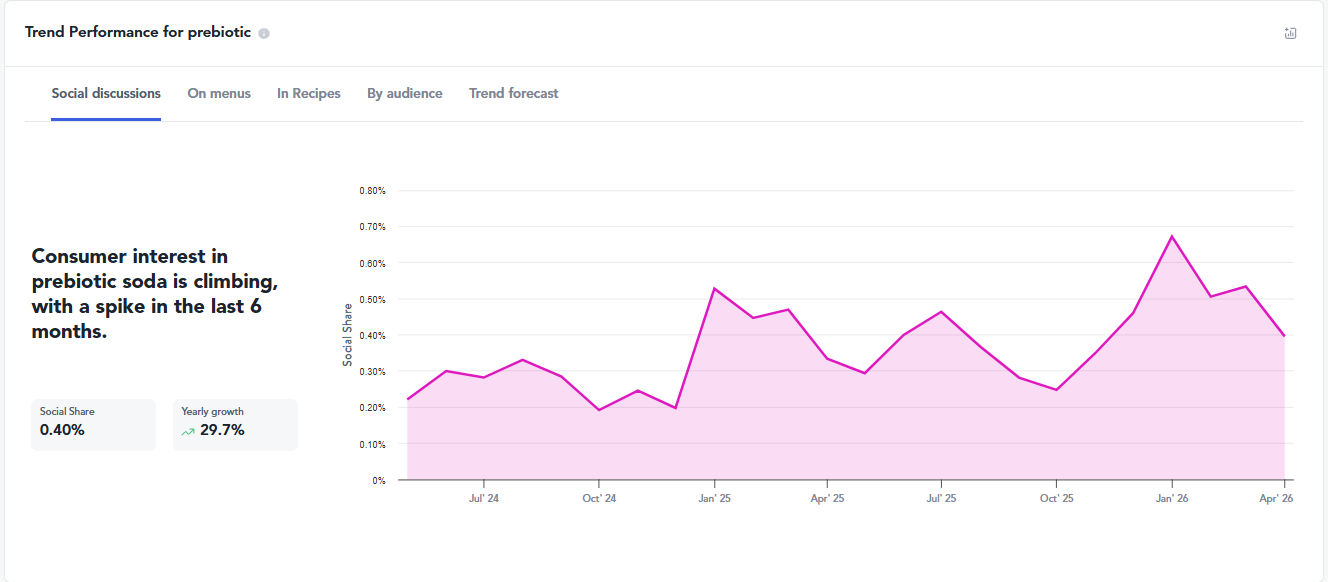
When you see TasteGPT in use, the Tastewise data makes the urgency concrete. Across the full US food and beverage landscape, the fastest-growing consumer experience signals are not novelty-driven. Comfort is up 86% in the past 12 months. Wellness is up 90%. Gut health is up 86%. Metabolism is up 192%. These four signals are moving together, and they are moving in both the food and beverage channels simultaneously.
“Convenient” as a consumer need is up 39% since last year, with 68% of that signal coming from at-home food consumption. “Easy” is up 43%, with 77% from the food channel. Together they describe a consumer who wants functional, feel-good products that fit into a real daily routine. That combination is not a niche audience. It is the mainstream.
The insight your brand can use here is the gap between what consumers are already choosing and what brands have built around it. Matcha is up 50% and in the trending lifecycle stage. Pistachio is up 26% and emerging. Yogurt is up 47% and emerging. These are not early signals anymore. They are category-level shifts that your product innovation and marketing teams should already be responding to. See which signals are material in the 2026 trend forecast for your specific category.
A generative AI tool can summarize this list beautifully. An agentic workflow can monitor which of these signals is accelerating in your specific retail channel, cross-reference it against your current portfolio, and flag the gap before your buyer asks why you do not have an answer.
Tastewise agentic AI workflows run end-to-end F&B intelligence for teams that cannot afford to wait.
The workflow comparison: what each type of AI actually produces
The clearest way to understand the agentic AI vs generative AI difference is to run the same task through both and look at what comes out.
Take retailer pitch creation. A generative AI tool, given the right prompt and data, can produce a well-written narrative about why a hot honey SKU makes sense for a specific retail buyer. It will be clear, structured and on-brand. It will also require a skilled human to source the data, write the prompt, review the output and update it for each buyer conversation.
An agentic workflow handles the full sequence. It identifies the white space in the retailer’s current assortment, pulls the consumer demand data relevant to their shopper profile, formats it into a buyer-ready narrative and flags when a competing brand has moved on the same opportunity. Your sales team arrives at the meeting with a brief that was built for that specific buyer, at that specific moment, without a manual research step in the middle.
The same logic applies to launch planning. Generative AI produces a launch plan when asked. Agentic AI monitors the signals, identifies the timing window, cross-references it against production lead times and drafts the plan before the window closes. For menu innovation, the pattern is identical. Generative AI describes what is trending. Agentic AI tells you which specific dish is emerging in your cuisine, at what price tier, with which consumer motivation driving it, and what your competitor has not built yet.
These are not hypothetical workflows. They are what AI food intelligence platforms built on agentic principles are already delivering for teams that have made the shift.
The practical question for your team
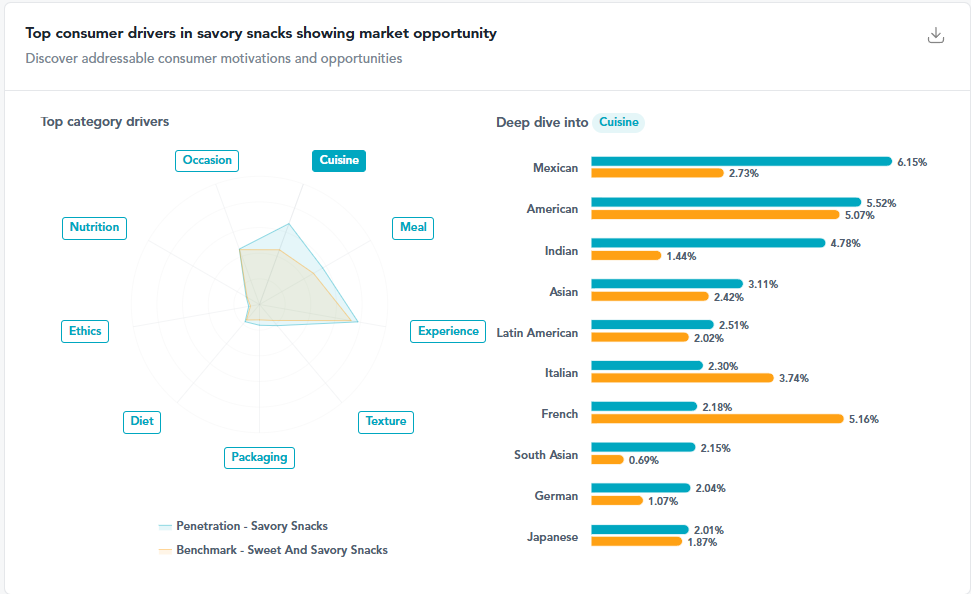
Most F&B teams are not choosing between generative and agentic AI as a philosophical exercise. They are asking a practical question: which category of AI investment actually closes the gap between the insight and the decision?
The answer depends on what your bottleneck is. If your team spends most of its time producing content, generative AI delivers a meaningful efficiency gain. If your team spends most of its time finding, interpreting and briefing on market signals before anyone can act on them, generative AI does not touch that problem. Agentic AI does.
Tastewise is built on the agentic side of this distinction. The platform does not wait for your team to ask. It monitors your category, surfaces the signals that matter for your specific portfolio and channel, and delivers the evidence in a format your team can use in the next buyer meeting or briefing call. The difference between getting that insight this week versus next quarter is often the difference between owning a trend and following one. See how product innovation teams use Tastewise to move first.
Want to see how fast your team can move from signal to decision?
FAQs about Agentic AI vs Generative AI
Generative AI responds to prompts and produces content such as text, copy or summaries when a human asks. Agentic AI executes multi-step tasks autonomously, monitoring data environments, reasoning about findings and taking action without waiting for a prompt. In food and beverage, generative AI helps teams write faster. Agentic AI helps teams decide faster.
Food and beverage trends move faster than most planning cycles. Consumer motivations like wellness, gut health and convenience are shifting significantly in the current period. Agentic AI monitors those signals continuously and delivers a brief when a threshold is crossed. Generative AI only helps once a human has already found the signal and knows what question to ask.
Yes, and many leading brands do. Generative AI handles content production, copywriting and ideation. Agentic AI handles market monitoring, signal detection, brief creation and retailer pitch preparation. The two work well together when each is applied to the job it is actually built for.


We’d love to learn your goals and see how Tastewise fits
We’d love to learn your goals and see how Tastewise fits
Get a personalized demo
Good taste. Wise move.
Your demo request is confirmed. We’ll reach out within one business day to schedule your walkthrough.
What happens next

See what’s driving demand, then turn it into a sell-in story for retailers and operators.
- Connect consumer panels, market trackers, and agents into one evidence view
- Get the “why” behind what’s changing, with explainable demand drivers
- Walk away with a buyer-ready narrative and next steps to activate
Trusted by




“Tastewise is my secret tool for knowing what consumers want next and why.“