







Australia’s restaurant and foodservice landscape is changing faster at the dish level than most operators and food developers are tracking. If your menu planning still relies on annual surveys or lagged sales reports, the signals your competitors are already acting on are invisible to you. The Tastewise consumer intelligence platform tracks dish-level momentum across Australia’s foodservice market in real time, and in 2026, several patterns are sharp enough to build strategy around. Australia menu trends right now reward operators who move at the speed of consumer behavior, not the speed of product development cycles.
Key takeaways
- Smash burgers are growing 28.9% in the past year and carry a 1.2 menu share score, the highest category benchmark. Restaurants that have not yet formatted a smash variant are leaving a proven format on the table at a moment when consumer appetite is still building.
- Hot honey is up 56% in the past 12 months on Australian menus, shifting from a niche condiment to a cross-daypart flavoring that is appearing equally at lunch and dinner service. Your innovation team has a short window before this becomes a standard expectation rather than a point of difference.
- Comfort as a consumer motivation has grown 81.1% since last year, the fastest-rising need state in the broad food category. Operators and brands who can name “comfort” as a functional benefit, rather than a vague descriptor, will resonate at a structural level with where Australian diners are heading emotionally.
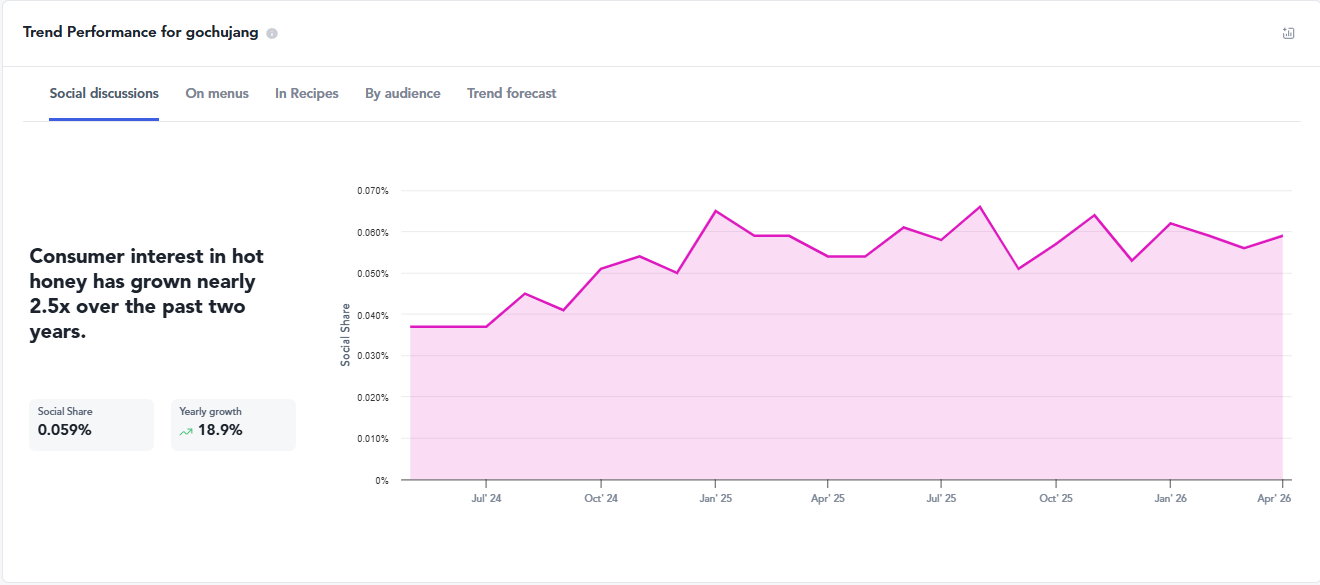
- Dishes entering the Australian market via Southeast Asian and Middle Eastern cuisines are gaining meaningful operator presence. Gochujang (up 18.5%), shawarma (up 28.2%), and laksa (up 20.3%) are all trending. These are not fringe signals. They are diner-driven formats arriving at scale.
What Australia menu trends look like in 2026
Australian diners are not just choosing differently. They are choosing more deliberately, and they are choosing with a vocabulary that has expanded. Cuisines that were once specialty-only, Korean, Middle Eastern, Filipino, now sit comfortably alongside Anglo-Australian defaults in the same daypart and the same price tier. The appetite for flavor diversity is not a Millennial or Gen Z phenomenon in isolation. It is a structural characteristic of the Australian food consumer in 2026.
The Tastewise Australian consumer panel, across more than 218,000 consumers and nearly 1.06 million behavioral signals in the past year, shows this clearly. Dish volume across the categories tracked in this analysis grew 16.3% in the past 12 months, with restaurant menu representation up 4.8%. That gap between dish growth and menu growth is the key commercial read: consumer demand is outpacing operator response. The whitespace is real.
The opportunity for food and beverage brands, and for foodservice operators, sits in that gap. Formats consumers are already choosing, smash burgers, hot honey glazes, broth-led dishes, and Korean-inflected preparations, are growing faster than the menus that serve them. For innovation teams tracking product innovation opportunities, this is the entry point.
The daypart story Australia menu trends are writing
Breakfast and brunch have a signal worth paying close attention to. Brunch carries a 7.0% consumer share in Australia, one of the highest of any occasion context in the dataset. But its growth tells a more complicated story: brunch as a claim has declined 6.7% in the past 12 months, even as formats associated with it, eggs, toast, grilled proteins, remain strong. This is not a brunch retreat. It is a reframing. Consumers are moving away from the occasion label while staying attached to the food behaviors brunch represents.
What is growing in the morning daypart is specificity. Grilled formats are up 7.1%. Matcha has grown 39.2% across Australian consumer signals. Cold brew is up 34.9%. These are morning-specific ingredients and preparations that consumers are naming, not just consuming passively. For operators and food developers working in the foodservice sales enablement space, the morning daypart in Australia is an underserved premium tier, not a commoditized daypart.
The dinner occasion is also shifting. Steak is up 9.1% in the past year, suggesting a return to premium proteins that tracks with the broader comfort motivation surge. Braised beef is trending at 18.2% growth. Peppercorn preparations are up 27.7%. Taken together, this dinner signal is not about experimentation. It is about reassurance in format, elevated in execution.
The core finding: three dish-level trends driving 2026 menus in Australia
Smash burgers and the new standard for beef formats
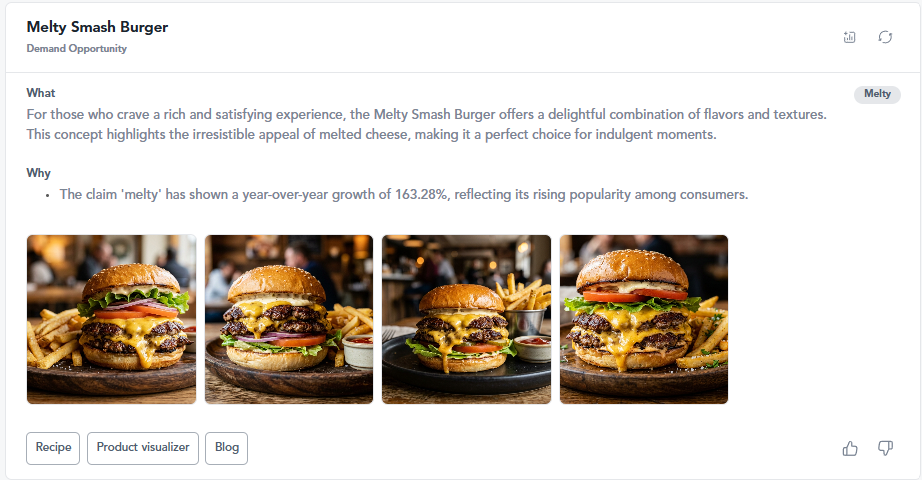
The smash burger has moved from a format experiment to a format expectation in Australian foodservice. Tastewise data shows smash burger growing 28.9% in the past 12 months with a 1.2 menu share index, the highest possible benchmark in the platform’s lifecycle scoring. That score means smash burger has achieved broad operator presence alongside strong consumer demand. It is no longer emerging. It is the baseline.
The strategic implication is not whether to add a smash burger. It is how to differentiate within a format that consumers have already adopted as default. Hot honey as a topping, a combination the data tracks with a 1.0 menu share and 56% growth, is one signal. Gochujang as a sauce, trending at 18.5% growth and increasing operator uptake, is another. Operators who treat smash burger as a commodity format are already behind. Those who use the format as a platform for flavor innovation have a clear runway.
Your team’s product brief for beef formats should be built around what comes with the smash, not the smash itself. The 2026 food and beverage trend forecast has the broader beef and protein signal for Australian operators.
Hot honey as a cross-category lever
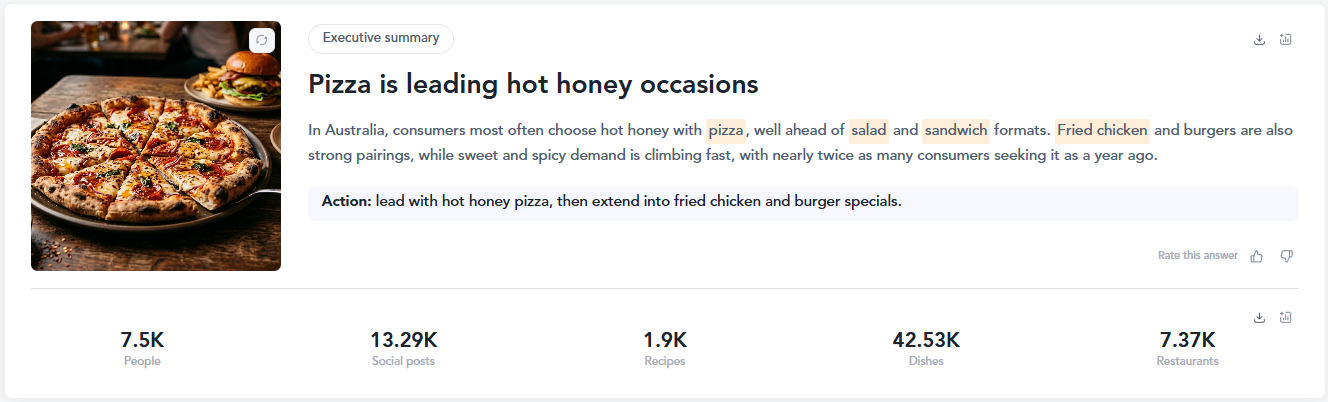
Hot honey in Australia is not a pizza topping anymore. It is a cross-category ingredient with 56% growth in the past 12 months, operator-indexed menu share of 1.0, and growing presence across chicken, beef, and dessert applications. Its consumer profile is broad: hot honey appears equally in lunch and dinner contexts, and its motivational overlap with comfort (up 81.1%) and satisfying (up 12.1%) makes it an ingredient that does emotional work as much as flavor work.
The whitespace within hot honey is application breadth. Most current Australian menu appearances are limited to chicken and burger contexts. Dessert applications, where hot honey intersects with the tiramisu signal (up 15.1%) and the broader sweet-plus-spicy trend, are underdeveloped. This is a short-term window. When an ingredient with 56% growth is already appearing on 1 in every 100 Australian menus tracked in the dataset, the window from early differentiation to saturation is typically 18 to 24 months.
For food developers and innovation managers, hot honey is a proving-ground ingredient right now. It tests a team’s ability to translate a trending signal into a menu format that still carries brand personality.
Global cuisine formats reaching mainstream operator scale
The combination of laksa (up 20.3%), shawarma (up 28.2%), gochujang (up 18.5%), and ulam (up 67.2%, the fastest-growing item in the dataset from a Filipino origin) tells a single story: Australian menus are not borrowing from global cuisines as decoration. They are adopting formats wholesale.
This is the materially different signal from a decade ago, when global ingredients might appear in a fusion context. Today, the operator data shows these formats appearing in full preparation contexts. Chicken yakisoba at an izakaya-style restaurant. Mansaf at a Lebanese casual dining venue. Beef bulgogi burgers at Korean-Australian fast casual. The menu architecture is global, not the garnish. Fine Food Australia’s 2026 foodservice industry analysis identifies ingredient-led menu concepts as one of the defining shifts for Australian hospitality operators this year, a read that aligns with what the dish-level data shows.
For brands and foodservice operators using consumer marketing strategy to reach multicultural Australian households, this matters structurally. The consumer base choosing these formats is not niche. The Tastewise panel shows 13.87% of Australian consumers in this dataset choosing Asian-inflected formats, second only to the “tasty” and “fresh” motivations in overall share. Southeast Asian as a cuisine signal sits at 5.3% share. Middle Eastern has reached 3.38% with 4.2% growth. These are mainstream positioning signals, not specialty ones.
Get the full menu trends picture.
What Australia menu trends mean for your planning cycle
The aggregate read from the Tastewise Australian data is this: the market is moving faster than most planning cycles can track, but in a predictable direction. Consumers are choosing comfort, choosing global formats with confidence, and choosing quality markers (premium up 21.1%, satisfying up 12.1%) that signal they are willing to pay for specificity.
For innovation teams and menu developers, three practical reads emerge. The smash burger is your baseline: the question is what you layer on top of it. Hot honey is your near-term flavoring play: it has 12 to 18 months of differentiation value left before it becomes table-stakes. And global formats, particularly Korean, Middle Eastern, and Southeast Asian, are not innovation bets. They are operational readiness questions. The consumers are already there. The menus are catching up.
The food intelligence platform your team uses for this kind of real-time tracking determines how far ahead of the menu curve you can operate. Quarterly platform pulls will not give you the lead time these signals require.
Want to how Australian menu data maps to your innovation pipeline?




We’d love to learn your goals and see how Tastewise fits
We’d love to learn your goals and see how Tastewise fits
Get a personalized demo
Good taste. Wise move.
Your demo request is confirmed. We’ll reach out within one business day to schedule your walkthrough.
What happens next

See what’s driving demand, then turn it into a sell-in story for retailers and operators.
- Connect consumer panels, market trackers, and agents into one evidence view
- Get the “why” behind what’s changing, with explainable demand drivers
- Walk away with a buyer-ready narrative and next steps to activate
Trusted by





“Tastewise is my secret tool for knowing what consumers want next and why.“