







Your category is getting harder to launch into. Large manufacturers are chasing better-for-you formats at speed, shoppers have not come back at the rates executives forecast, and the window between a flavor surfacing and a competitor shipping it keeps narrowing. AI-powered feedback tools for product validation exist because that window closed faster than quarterly research cycles can move. The question your team faces is not whether to use them. It is which signals you trust when a concept is still cheap to change.
Key takeaways
- Beef bouillon buzz is 20.15% higher than last year across the Tastewise US consumer panel, while it appears on only 0.06% of tomato-related menu items. Velocity that high against menu presence that low is the shape of an unclaimed concept, so test it before a competitor does.
- The claim “healthy” carries the largest share of tomato-related consumer language at 9.67%, and that share fell 23.4% in the past year. Generic wellness positioning is losing ground, so move your concept language toward the specific benefits that are gaining.
- Provolone sits on 16.65% of tomato-related menu items but moved only 2.67% since last year. High presence with flat movement means a crowded execution, so treat it as a cost of entry rather than a differentiator.
- Melty, at 0.68% share, grew 49.1% in the past 12 months, and intense flavor grew 40%. Texture and flavor-intensity language is where the momentum sits, so brief your sensory team against those attributes.
Why food concepts fail after they test well
Product-market fit in food is a moving target because taste moves. A concept that scored well in a focus group eighteen months ago was validated against a version of the consumer who has since changed what they order, what they cook and which claims they respond to. Founders and R&D leads feel this as a timing problem rather than a research problem. The formulation was fine. The moment had passed.
What the data shows is that the two signals teams most often collapse into one are actually independent. Across the Tastewise US consumer panel, bone broth buzz grew 18.7% since last year while sitting on 0.05% of tomato-related menu items, which looks identical to beef bouillon at first glance. The difference is lifecycle stage. Bone broth reads as mature, meaning the growth is arriving late. Beef bouillon reads as trending, meaning the growth is arriving early. Same velocity, opposite decisions.
That gap is the opportunity. If your team can separate a signal that is early from a signal that is merely loud, you can commit development budget to concepts with runway and kill the ones that are peaking. That decision costs nothing at the concept stage and a great deal after a production run. The product innovation workflow is built for exactly that sequence.
What is product-market fit in the food industry and why is it crucial?
Product-market fit in the food industry happens when a product’s flavor profile, ingredient list and nutritional claims line up with active, growing consumer demand across foodservice, retail and home consumption. Reaching it means sustained velocity and repeat purchase rather than short-lived trial curiosity.
The cost of misreading market demand
Surface-level fads and durable need states produce the same early signal and very different two-year outcomes. Consider the difference between two claims in the same category. Nutritious language fell 47.2% in the past year and weight management fell 34.5%, while high fiber grew 32.5% and blood sugar grew 10.7%. A concept validated against the word “healthy” would have read as a shrinking bet. The same concept validated against fiber and blood sugar reads as a growing one. The formulation never changed. Only the language your team tested did.
This is why the reformulation race described in Food Dive’s account of the 2026 growth battle rewards precision. Kellanova put protein into Pop-Tarts and built supply chain capacity to get it out quickly. Speed of that kind only pays when the claim underneath it is the one still gaining ground. Your team’s job at concept stage is to find out which one that is.
Deciding which AI tools to use for product-market fit
Traditional concept testing runs on cycles measured in weeks and reports refreshed quarterly. Teams evaluating which AI tools to use for product-market fit now weigh two things instead: how fast the tool ingests real consumption behavior, and whether its taxonomy actually understands food. A general-purpose model can summarize a category. It cannot tell you that provolone is crowded and beef bouillon is not, because that distinction lives in menu and recipe structure rather than in text. Comparison of the vendor landscape by R&D layer sits in our guide to AI platforms for food innovation.
How AI-powered feedback tools for product validation simplify market validation
Validation gets simpler when the feedback comes from what people actually order, cook and buy rather than from what they tell a moderator they would buy. Self-reported intent is filtered through memory and social desirability. Consumption behavior is not. Tastewise reads restaurant menus, delivery platforms and home cooking recipes alongside consumer conversation and eRetail shelf data. Because those sources sit in one connected picture, a claim, a flavor and a format can be scored against each other in the same session.
Real-time demand against static surveys
The practical difference is where the waiting happens. A quarterly research cadence means your concept queue waits for the report, and the report describes a consumer who existed when fieldwork closed. Live signal inverts that. You bring a question, you get a scored answer, and you spend your development time on the shortlist instead of on the screening. Our breakdown of CPG innovation walks through how that reordering changes the stage-gate process.
Scoring a concept before it reaches a bench
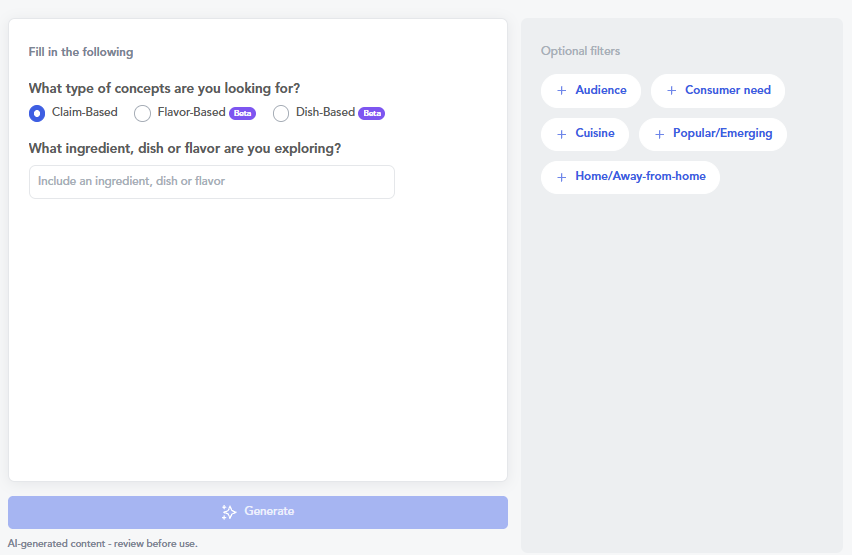
Here is the sequence in practice. A team exploring tomato-adjacent formats sets the concept type to claim-based, flavor-based or dish-based, then adds the ingredient they are working with. Optional filters narrow it further by audience, consumer need and cuisine. Two more decide popularity stage and whether the occasion is at home or away from home.
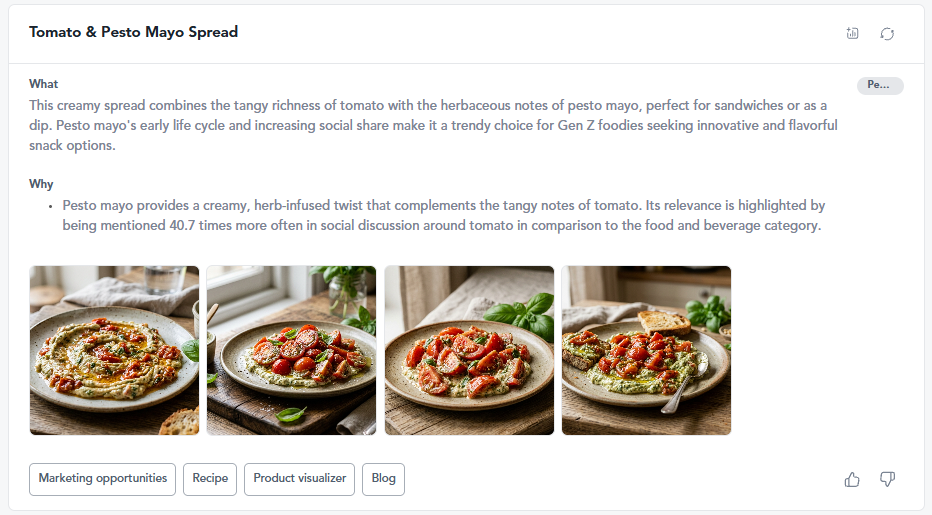
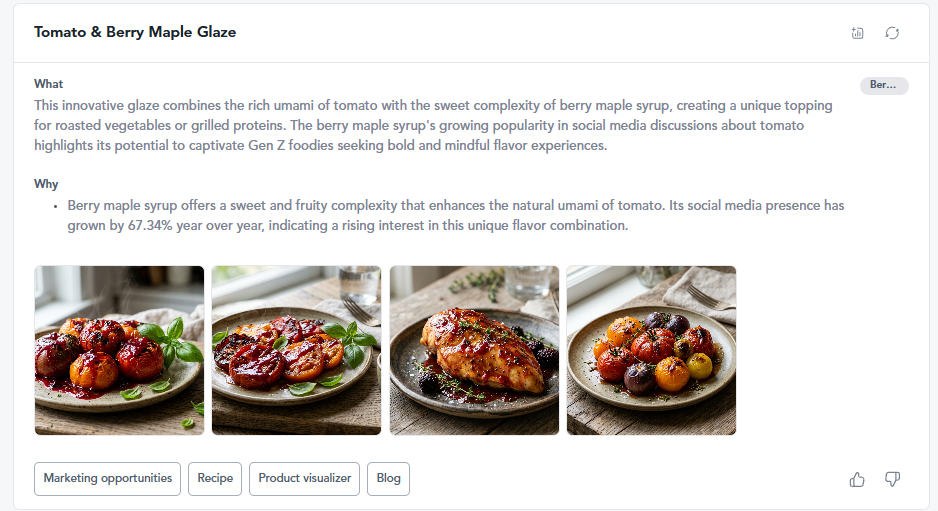
The output comes back as scored concepts with the reasoning attached. Tomato and pesto mayo returns with pesto mayo flagged at an early lifecycle stage and indexing 40.7 times higher in tomato-related conversation than it does across the wider food and beverage category. That index is the useful number. It says the pairing is specific to tomato rather than generally popular, which is what makes it defensible on a shelf. Tomato and berry maple glaze returns with berry maple syrup buzz up 67.34% on last year, positioned for roasted vegetables and grilled proteins.
Neither concept has been to a kitchen yet. That is the point. Your team now has two scored directions, a lifecycle read on each and a reason to prefer one, before anyone has costed a formulation.
How Tastewise connects consumer demand data with R&D decisions
Three layers of the data do different work at the concept stage. Read together, they tell you what to build, when to launch it and how to describe it.
Reading claims and consumer preference analysis
Claim language is where positioning is won, and it moves independently of the product. Across the Tastewise US consumer panel, tomato-related claim language shows generic wellness terms losing share while specific functional and sensory terms gain. Fitness fell 24.8% and wellness fell 17.8%. Meanwhile energy grew 46.4%, balanced grew 37.3% and gut health grew 6.4%. Protein, at 5.53% share, has gone flat at a decline of 0.7%, which matters if protein is the headline on your pack.
Texture tells a parallel story. Silky grew 118.7% in the past 12 months from a 0.39% base, depth grew 51%, melty grew 49.1% and buttery grew 24.8%. These are small shares and fast movement, so treat them as directional rather than as evidence of scale. For a sensory brief, that is enough. It tells your R&D team which mouthfeel to formulate toward and which words to put on the front of pack.
Flavor lifecycle analysis and launch timing
Lifecycle stage is the signal that stops your team from launching into a peak. The platform tracks a flavor or functional ingredient from emerging through trending, mature and saturated, which changes what a growth number means. Hot honey now appears on 4.42% of tomato-related menu items and is still up 6.65% on last year at a trending stage, so there is headroom left in a flavor most teams assume is finished. Bone broth grew 18.7% at a mature stage, so the same velocity signals a closing window. One of those is a launch. The other is a pass.
Uncovering whitespace opportunities
Whitespace shows up where velocity and menu presence disagree. Beef bouillon grew 20.15% and reaches 0.06% of tomato-related menu items. Beef broth grew 17.1% at 0.08%. Smoked paprika grew 6.2% at 0.11%. Each of those is a savory depth cue with real momentum and almost no execution against it, which is a formulation brief rather than a trend report. Pair one with a rising functional claim such as high fiber and you have a concept nobody currently owns. The same pattern applied across categories sits in the 2026 trend forecast.
A validation checklist for your next food concept
Run a concept through these questions before it consumes development budget.
- What is the menu or shelf presence today, expressed as a share rather than a count?
- What is the growth rate over the past year, and is it accelerating against its own prior period?
- What lifecycle stage does the flavor sit in, and does the growth arrive early or late?
- Does the ingredient index specifically against your base, or is it generally popular everywhere?
- Which claim is gaining in your category, and which claim is your pack currently leading with?
- Which texture attributes are rising, and has your sensory brief been written against them?
- Which audience carries the signal, and does that audience match your distribution?
- Does the occasion sit at home or away from home, and does your format suit it?
- What is the competing execution, and is it crowded or open?
- What would have to be true in the data for your team to kill this concept?
Teams that answer these before formulation spend less on prototypes that were never going to travel. Broader category context for those questions sits in our overview of AI in the food industry and in the comparison of food trend analysis platforms.
Your next concept deserves live evidence.
Frequently asked questions about AI-powered feedback tools for product validation
They are systems that score a product concept against live consumer behavior rather than against survey responses, using signals such as menu presence, recipe usage, retail shelf data and consumer conversation. In practice that means a concept can be tested against real demand before a formulation is costed, as with beef bouillon showing 20.15% growth against 0.06% menu presence.
Choose tools by two criteria: how quickly they ingest real consumption behavior, and whether their taxonomy is built for food rather than adapted from general text. A food-native taxonomy is what lets a platform separate a crowded execution such as provolone at 16.65% menu presence from an open one such as beef broth at 0.08%.
It separates velocity from lifecycle stage, which is the distinction most concept decisions get wrong. Bone broth and beef bouillon show similar growth of 18.7% and 20.15%, but one is mature and one is trending, so the same number supports a pass in one case and a launch in the other.
It changes what research is for rather than removing it. Live signal narrows a long concept list to a defensible shortlist, then panel work and sensory testing validate the survivors, which is a better use of a research budget than screening ideas that the data already ruled out.





We’d love to learn your goals and see how Tastewise fits
We’d love to learn your goals and see how Tastewise fits
Get a personalized demo
Good taste. Wise move.
Your demo request is confirmed. We’ll reach out within one business day to schedule your walkthrough.
What happens next

See what’s driving demand, then turn it into a sell-in story for retailers and operators.
- Connect consumer panels, market trackers, and agents into one evidence view
- Get the “why” behind what’s changing, with explainable demand drivers
- Walk away with a buyer-ready narrative and next steps to activate
Trusted by





“Tastewise is my secret tool for knowing what consumers want next and why.“