





The market is moving faster than anyone anticipated it would, and it’s thanks to AI. What I find inspiring is the response, because the brand leaders I meet are not waiting for the picture to settle before they commit. They are actually making the calls this moment demands of them with incomplete information and moving anyway.
In my conversations across the industry this year, one thing comes up more than anything else. Consumer demand is now moving faster than most food companies can respond to it, and AI agents for food innovation are what the industry is counting on to close that gap. In most companies they have not closed it yet.
Three years ago most of this industry was experimenting with chatbots. A team could connect their internal data to a large language model, ask it questions, and and receive fluent answers that nobody can act on. A year or two later the project is still a proof of concept and the budget has moved on. This has now happened at one large food company after another, which is why a lot of the industry is more wary of AI agents today than it was before.
MIT recently put a number on it. 95% of AI proofs of concept fail. I am not surprised, because the failures are almost never about the model. Projects stall because of where consumer demand signals sit inside a food company and who is allowed to see them, and because of what an agent is fed once someone has built it.
I made this argument at IFT FIRST this year to a room of food developers, and it holds for anyone who owns a piece of the innovation pipeline. Both problems are fixable, and the fix is not another software subscription or another data source, but more about rethinking how teams work, so that every function reads the same consumer signal at the same time, and giving the agents food intelligence deep enough to act on it. That is a reorganization, which is why it tends to get deferred into a three-year roadmap when most of it is available now.
The silo trap: why consumer insights fail to drive food R&D
Food companies stall for several reasons, and the one I keep running into is that consumer demand signals sit with one function, so marketing and insights own the view of the consumer, and R&D and supply chain get a filtered version of it weeks later, when the behavior that justified the decision has already changed.
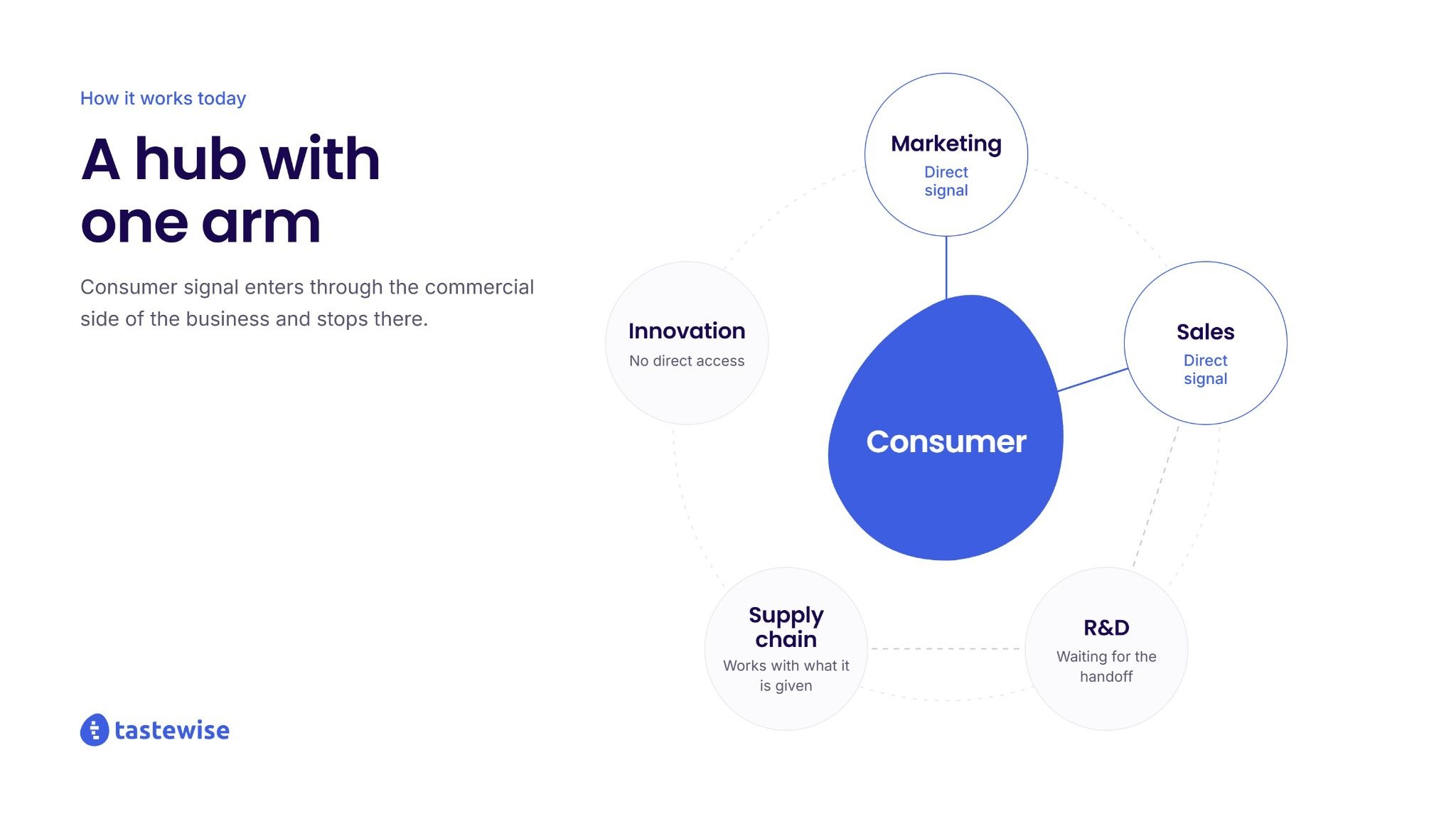
The structure looks like a hub with one arm. Consumer signal enters through the commercial side of the business and stops there. Then we see R&D waiting for the handoff, innovation has no direct access at all, and supply chain works with what it is given.
You can see the cost in the questions a team cannot answer quickly, and they are not difficult questions: what mothers in Chicago are eating for breakfast this month, which diets are rising with Gen Z and Generation Alpha, which claim is pulling shoppers toward a competitor right now. In most companies each one takes weeks, because you need three teams and a meeting to answer it, and by the time those three teams have met the answer has changed again.
Brands used to be able to live with that delay, because a product development cycle ran six to nine months and everyone was working to the same clock. It is much harder now that a flavor can peak and fade inside one quarter, and restaurants can respond to the same shift without repackaging anything or renegotiating shelf space, so packaged brands are competing against a channel that moves faster than they do. That pace is what product innovation teams are now expected to match with the same handoffs they have always used.
From passive chatbots to active AI agents
The analogy I keep coming back to is that deploying agents without consumer intelligence and a real food taxonomy is like hiring a warehouse worker to run your innovation pipeline. They can move the boxes without knowing what is inside them, why it matters, or who might want to buy it.
A generic model has read the internet, which is a different thing from watching what happens on menus, in recipes, in retail baskets and in social conversation about food. It will treat the same ingredient as the same ingredient whether you are putting it in a beverage or a bar.
The data underneath is the other half of it. Enterprises spent years hoarding data and most of them ended up with data fatigue and no way to put any of it together and act on it. Feed a model material that has not been tested or checked and is not statistically significant, and you get hallucinations, which is why so many of the companies we work with will not let their teams use generic models for day-to-day decisions.
What an agent actually needs is a domain taxonomy, so that it treats a dish, an ingredient, a claim and an occasion as different objects with different rules, running on live consumption data so its answers reflect this month rather than last year. Taxonomy is the part people underestimate. It is the middleware everything else runs on, and it is where most of the agentic failures I have seen trace back to.
Agentic AI across the F&B innovation lifecycle
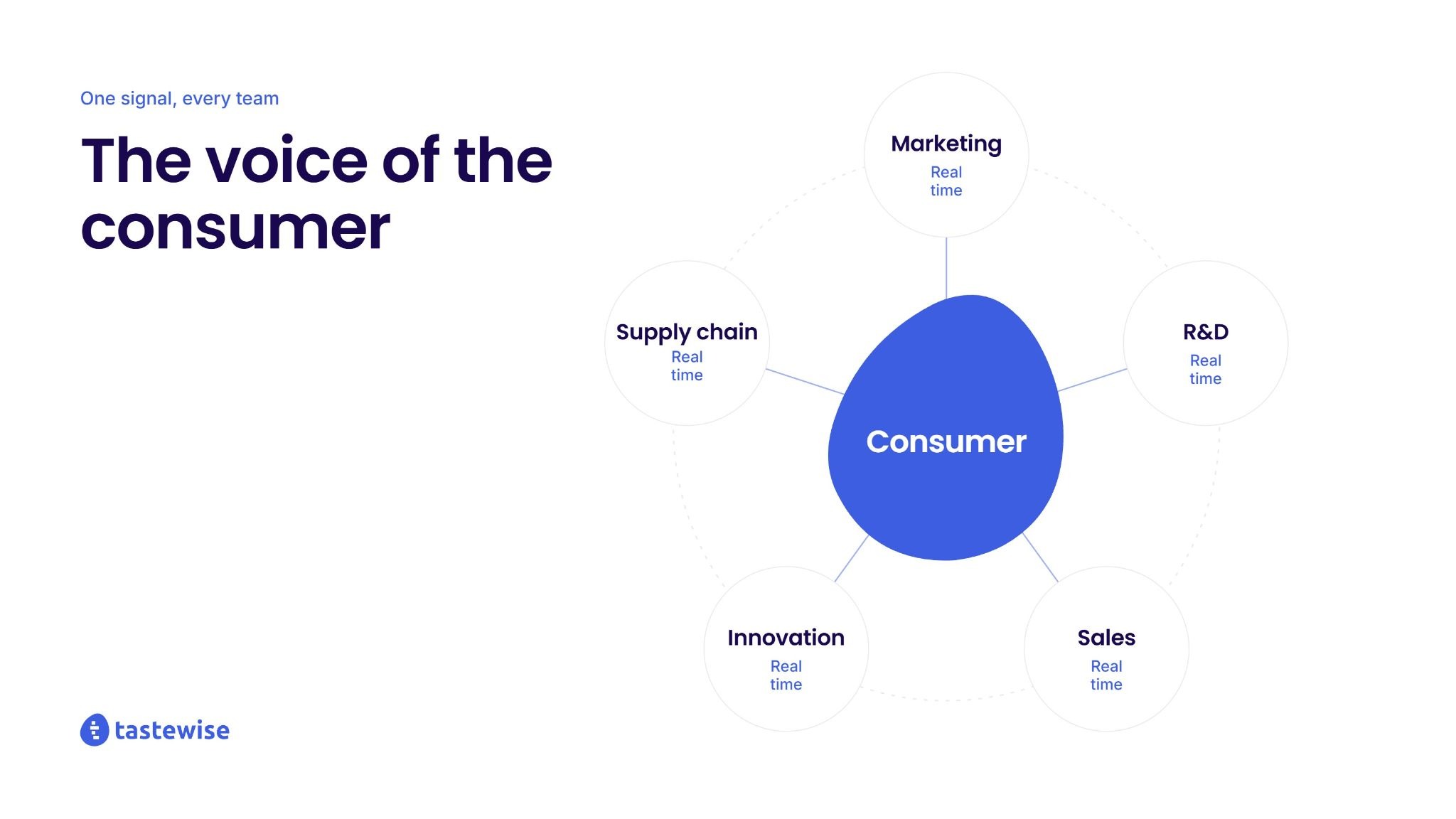
The useful mental model is not one assistant but a set of agents around every account and category you care about. And each one is watching its own slice of real consumption. In turn, all of them are feeding the same picture. What changes is who gets the signal and when, because every function is now reading from the same source at the same time, in the format that function actually works in.
For marketing and insights that means catching a shift while it is still small and knowing how fast it is moving. For R&D and culinary it means the signal arrives as something you can formulate against, which is how Newly Weds Foods answers more than 350 client projects a year in days rather than weeks. For commercial teams it means checking an idea can be sourced and then turning it into a story that a buyer will sit through, which is how Butterball grew menu presence 20% moving into national chains.
Kerry is the clearest illustration. They ran a taste chart for fourteen years on an annual cycle and moved it to on demand, which is the same intelligence released from the calendar it was trapped in. Post Consumer Brands took three months off the Cinnamon Pebbles relaunch the same way. Neither of them bought a chatbot, they changed the order in which their organization learns things.
The test I would apply to any agent is whether someone can take its output into a meeting without rebuilding it first. If a person has to redo the work before it is usable you have added a step rather than removed one. And humans stay in the loop on the decisions that matter, which is why every customer we sign runs a data review, a privacy review and a generative AI committee review.
If someone in your organization is presenting a three-year AI roadmap, challenge them on what you can gain this quarter, because roles and responsibilities have to change and a long plan is often a way of deferring that. Marketing organizations will be close to fully agentic within a decade. Supply chain, manufacturing and food science will move more slowly, because the physical world sets the pace. There is very little we cannot solve now, so the question worth asking is which problems are worth solving, and that judgment stays with your people.
Frequently asked questions about AI agents for food innovation
They are systems that watch real consumption signals continuously and turn them into work that R&D, marketing and commercial teams can use. What separates them from a chatbot is that they run on a schedule instead of waiting to be asked, and they are built on a food-specific taxonomy rather than general knowledge.
A generic model has no food domain structure and no live consumption data behind it, so it will treat the same ingredient the same way whether it goes into a beverage or a bar. Systems built for this industry treat dishes, ingredients, claims and occasions as separate objects with their own rules, and they refresh against current menu, recipe, retail and social activity.
MIT put the failure rate for AI proofs of concept at 95%, and in food the reasons are consistent. There is usually no domain taxonomy underneath, the data feeding the system is stale or has never been checked for significance, and the output stops at an answer in a chat window instead of becoming something a person can act on.
It needs a taxonomy that understands food, live data rather than a database refreshing quarterly, and enough context about your business that the output maps to your accounts and your consumer segments. The practical test is whether someone can take what it produces into a meeting without rebuilding it first.
Start wherever the consumer signal is already blocked, which in most companies is the handoff from insights to R&D. Kerry is the clearest example, moving a taste chart that had run annually for fourteen years onto an on-demand footing, which changed what every function downstream of it could see.
No. Humans stay in the loop on the decisions that matter, with data, privacy and generative AI committee reviews around them. Agents compress the time it takes to see something happening. Deciding which problems are worth solving stays with your people.



We’d love to learn your goals and see how Tastewise fits
We’d love to learn your goals and see how Tastewise fits
Get a personalized demo
Good taste. Wise move.
Your demo request is confirmed. We’ll reach out within one business day to schedule your walkthrough.
What happens next

See what’s driving demand, then turn it into a sell-in story for retailers and operators.
- Connect consumer panels, market trackers, and agents into one evidence view
- Get the “why” behind what’s changing, with explainable demand drivers
- Walk away with a buyer-ready narrative and next steps to activate
Trusted by


“Tastewise is my secret tool for knowing what consumers want next and why.“