






Consumer demand for environmentally responsible, ethically produced food has moved from the margins to the mainstream, and your product development brief needs to reflect that. Brands that treat sustainability as a box to tick are losing ground to those that build it into the product from day one. Sustainable food trends are where CPGs should be looking.
Key takeaways
- Plant-based is declining, not growing. Menu presence is down 14% and social conversation has fallen 32%. Brands still leading with plant-based as their primary sustainability claim are investing in a shrinking signal. Your team needs a more specific story.
- Upcycled ingredients are the breakout opportunity right now. Menu growth is up 39% and the category is still early stage. Brands that move now have a genuine first-mover window before the space consolidates around a handful of dominant players.
- Alternative proteins are becoming operational, not aspirational. Social buzz is down 40% but menu adoption is up 16%. Operators are quietly integrating these proteins without the fanfare. Your product brief should reflect where the category actually is, not where the headlines were two years ago.
- Ethical claims and sustainable seafood are where consumer attention is concentrating. Ethical motivation indexes at 65.7 on social. Oyster is up 12.3%, crab up 30% and mussel up 24% in the past year. The sustainability signal in seafood is accelerating faster than most product teams have planned for.
What is happening in sustainable food right now
Sustainable food means food produced in a way that minimizes environmental impact while supporting social and economic benefits. That includes reducing greenhouse gas emissions, conserving natural resources and upholding fair labor practices. For your team, it means sourcing, formulation and packaging decisions that a growing segment of consumers is actively scrutinizing before they buy.
The data tells a more nuanced story than the headlines suggest. Plant-based, long positioned as the flagship sustainability signal, is in decline: down 14% on menus and 32% socially. The real growth is happening in upcycled ingredients (up 39% on menus), sustainable seafood and alternative proteins quietly moving into mainstream operations. Zero-waste production is becoming a retailer requirement in some categories, not just a differentiator. To understand how food waste reduction is shifting consumer expectations at shelf, see how zero-waste food trends are changing what brands need to build.
The opportunity for your team is structural, not cosmetic. Sustainability in food is professionalizing: moving from consumer-facing marketing to supply chain innovation. The brands that build this into the product brief from the start, rather than layering it on at the end, are winning on price premium, loyalty, and retailer placement simultaneously.
Sustainable food trends shaping product development
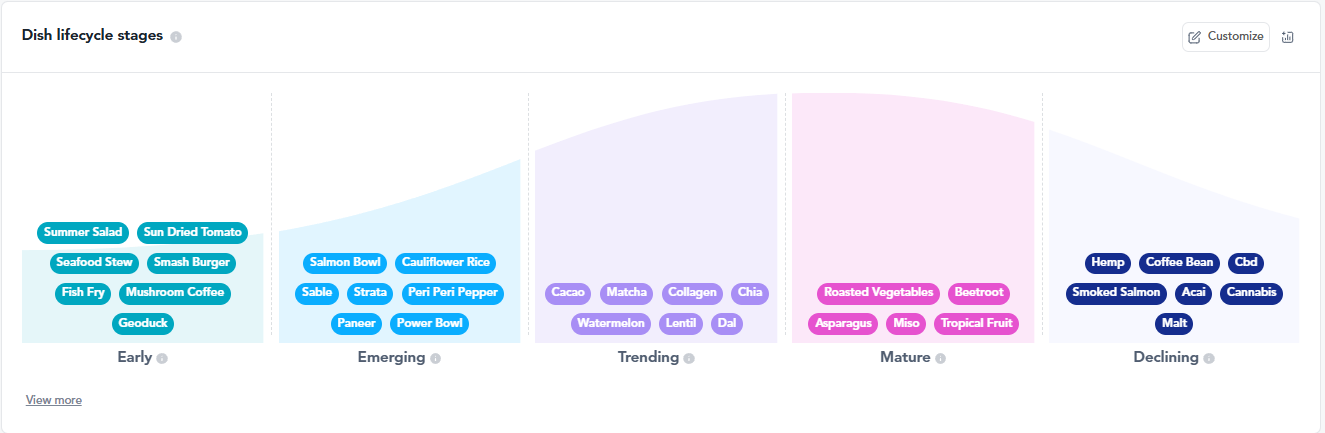
The trends below are not equal in stage, cost or consumer readiness. Use the comparison table in the next section to map them against your category and timeline before committing.
Regenerative agriculture
Regenerative agriculture is a holistic farming approach that improves soil health and promotes biodiversity through crop rotation and minimal tillage. It sequesters carbon while reducing the environmental costs of conventional farming. For your product team, it translates into a sourcing story with measurable environmental credentials and growing consumer recognition.
Locally sourced ingredients
Demand for locally sourced ingredients is rising as consumers become more conscious of transport emissions and community impact. This trend also reduces supply chain complexity and supports small-scale farmers. Retailers are increasingly asking for local sourcing documentation as part of their own sustainability reporting.
Food waste reduction
Precision agriculture, smart packaging and food tracking systems are making waste reduction achievable at commercial scale. For your team, waste reduction is one of the fastest routes to simultaneous cost savings and sustainability credibility. To see how the most forward-thinking brands are applying this, explore how zero-waste food trends are changing what brands need to build.
Farm-to-table practices
Farm-to-table sourcing connects production directly to the consumer through local, seasonal ingredients and transparent supply chains. It reduces transport emissions, supports local economies and delivers higher nutrient density. In foodservice, it has become a premium positioning driver. In retail, it is moving into the mainstream brief.
Organic and non-GMO
Organic and non-GMO products continue to grow as consumers seek food free from synthetic pesticides and chemicals. Organic farming practices are more environmentally friendly and promote biodiversity. For your product brief, organic certification adds both a consumer trust signal and a regulatory compliance layer that protects against future restrictions.
Plant-based diets
Plant-based is now a category in its own right, but the headline trend data has shifted. Menu presence is down 14% and social conversation has fallen 32%, signalling that the category has normalised. The differentiation premium has eroded. Brands that continue to lead with plant-based as their primary sustainability claim are investing in a declining signal. The opportunity now is in specificity: which plant-based ingredients, which occasions and which consumer motivations are still growing within the broader category.
Cultivated meat
Cultivated meat grows animal cells in controlled environments, eliminating the need for traditional livestock farming. It addresses greenhouse gas emissions and ethical concerns at the same time. Commercial scale is still several years away for most markets, but the brands building supply chain relationships and consumer familiarity now will have a structural advantage at launch.
Sustainable seafood
Sustainable seafood is one of the clearest growth signals in the category right now. Oyster is up 12.3%, crab up 30% and mussel up 24% in the past year. These are not niche movements. They represent a broad shift toward bivalves and certified sustainable fish as the consumer-credible protein choice. Overfishing and irresponsible fishing practices have damaged marine ecosystems globally, and consumers are paying attention in a way they were not five years ago. For branded seafood manufacturers and B2B suppliers, certification is moving from differentiator to entry requirement faster than most teams have planned for.
Diverse and ancient grains
Quinoa, amaranth, millet and teff offer nutritional benefits and flavour profiles that standard grains cannot match. Growing interest in these ingredients also promotes crop diversity and supports small-scale farmers. For your R&D team, they represent a dual win: genuine nutrition differentiation and an authentic sustainability story in one ingredient.
Ethical and humane practices
Consumer scrutiny of animal welfare is increasing and is increasingly backed by retailer audit requirements. Food and beverage companies that invest in transparent sourcing and humane treatment policies are building a compliance lead as regulations tighten across markets.
See how Tastewise surfaces white space in your sustainability category.
Sustainable food approaches: definitions and comparisons
Not every sustainability approach is right for every brand or category. Use this framework to map the key approaches against your team’s specific context before committing to a product or sourcing brief.
How the main approaches compare
| Approach | Environmental Impact | Cost to Implement | Consumer Appeal | Best For |
|---|---|---|---|---|
| Regenerative agriculture | Very high: improves soil carbon, biodiversity | High upfront, lower long-term input costs | Growing: resonates with climate-aware shoppers | Grain, dairy, beef supply chains |
| Organic farming | High: eliminates synthetic inputs, supports biodiversity | Moderate: certification and yield trade-offs | Strong: premium buyer segment, well understood | Fresh produce, packaged staples |
| Precision agriculture | Moderate: reduces fertiliser and water overuse | High: sensor and drone tech investment | Low direct appeal, high efficiency gains | Large-scale commodity producers |
| Farm-to-table sourcing | Moderate: cuts transport emissions | Variable: depends on supplier proximity | High: local resonates across income groups | Foodservice, fresh and chilled categories |
| Plant-based formulation | High: significantly lower land and water use vs meat | Moderate: R&D-intensive, ingredients improving | Very high and growing fast | Protein, dairy alternatives, snacks |
| Cultivated meat | Potentially very high: no land or slaughter | Very high: still pre-commercial scale | Moderate: early adopter segment only | Premium protein, long-term pipeline plays |
What the Tastewise data shows: the sustainability signals your team should be tracking
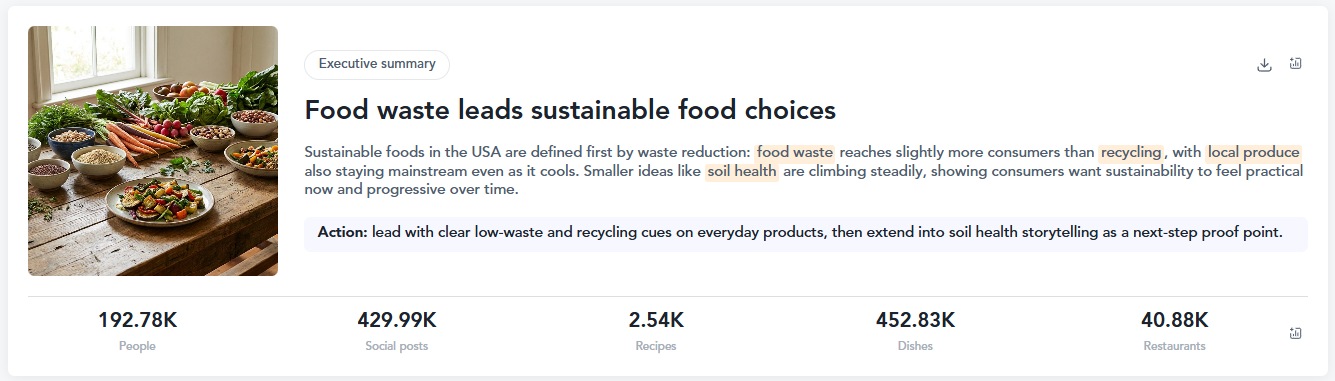
The sustainability conversation in food has matured. It is no longer about whether consumers care. It is about which signals are growing, which are plateauing and where the white space still exists. Additionally, sourcing decisions made at the start of your product brief carry more weight than any claim you add at the end. Here is what the data shows.
The sustainability conversation has matured beyond plant-based. Menu presence for plant-based is down 14% and social conversation has fallen 32%, signalling a category that has normalised. The real growth is happening elsewhere: upcycled ingredients are up 39% on menus and still in early stage, meaning your team has a genuine first-mover window before the space consolidates. Alternative proteins tell a quieter story: social buzz is down 40% but menu adoption is up 16%. Operators are integrating them without the fanfare. The trend has moved from marketing story to operational reality.
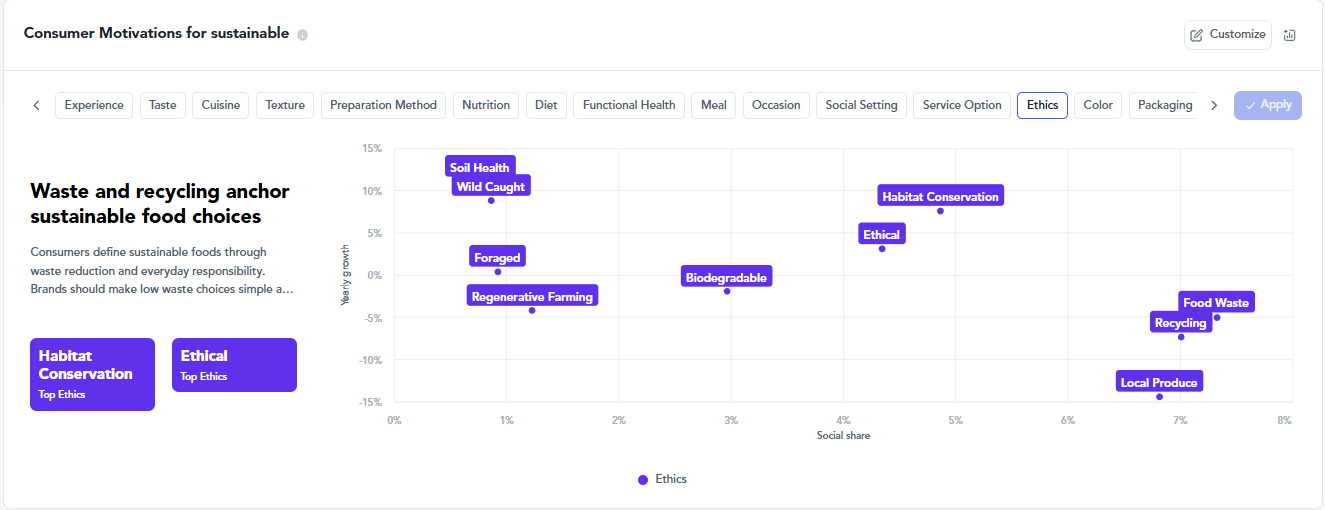
Consumer motivations are shifting in the same direction. Ethical claims index at 65.7 on social and are still growing. Climate change as a direct purchase driver has fallen 23.2% in the past year. Convenience is up 20.2%, protein up 27.6%, energy up 37.8%. Consumers are not abandoning sustainability values. They are applying them inside a framework that also demands speed, satiety and function. Sustainability claims land hardest when they are paired with a functional benefit, not positioned as a stand-alone virtue.
The ingredient and dish data points in one direction: sustainable seafood is accelerating fast. Crab is up 30%, mussel up 24%, oyster up 12.3%. At ingredient level, kelp is up 19.7% and seaweed up 14%, both in early-growth stage with strong first-mover potential. Palm oil is declining and under retailer scrutiny. Reformulating away from it is a stronger story than any certification claim.
The viral content signal reinforces this: the highest-performing sustainable food posts lead with taste and creativity, not environmental virtue. Sustainability wins on social when it is the supporting story, not the headline.
See the full sustainability signal data for your category on Tastewise.
Real-world applications: how companies implement sustainable food trends
Scenario 1: Plant-based startup switches to compostable packaging
Challenge High repeat purchase churn. Consumers wanted the packaging to match the product’s values.
Solution Lifecycle assessment identified packaging as the highest-impact touchpoint. Switched to compostable moulded fibre across core SKUs.
Results Waste down 60%. $200K annual cost savings. Repeat intent scores up 15%.
Scenario 2: CPG brand moves to regenerative sourcing on a core grain product
Challenge Margin pressure from private label and declining relevance with under-35 shoppers.
Solution Food intelligence data confirmed regenerative was growing with their target demographic. Partnered with two certified regional farms and rebuilt the brand story around traceable regenerative oats.
Results Held shelf position through a competitive range review. Brand perception up 22 points among 25 to 34 year-olds.
Scenario 3: Novel protein startup narrows its retail launch to one format
Challenge Developing across three formats simultaneously with no clear signal on which to prioritise.
Solution Demand data showed ready-to-eat meals indexed highest for their demographic across lunch and post-workout occasions. Launched that format only.
Results Secured national retailer shelf placement on first submission. Year two expansion funded by first-year revenue.
The protein category is where sustainable innovation is moving fastest right now. See what the novel protein trends data shows your team should be watching.
See how Tastewise helps your team validate concepts against real consumer demand before launch.
How sustainable sourcing connects to carbon footprint reduction
The relationship between sourcing decisions and carbon outcomes is more direct than most product teams realise. Transportation distance typically accounts for 15 to 30% of a product’s total carbon footprint. Packaging materials contribute 10 to 25%. Production and farming methods carry the largest share at 40 to 60%, which is why regenerative agriculture and plant-based formulation deliver the highest environmental impact per product change.
For your team, this means the highest-leverage sustainability actions are usually upstream in the brief, not downstream in distribution. Changing a farming practice or a protein source has more impact than optimising a delivery route.
How sustainability applies differently across categories
| Category | Highest-impact sustainability action | Consumer expectation level | Regulatory pressure |
|---|---|---|---|
| Beverages | Packaging material switch and water use reduction | Very high: consumers read labels and scrutinise claims | High and increasing in EU and UK |
| Packaged foods | Ingredient sourcing (organic, regenerative, local) | High: ingredient transparency is a purchase driver | Moderate: labelling requirements tightening |
| Fresh produce | Farm-to-table and waste reduction at distribution | Moderate: freshness and provenance matter most | Low currently but rising in agriculture regulation |
| Proteins (animal) | Ethical sourcing certification and humane standards | High and increasing across all demographics | High: welfare regulations expanding globally |
| Novel proteins | Formulation sustainability and packaging | High: core audience is sustainability-motivated | Low currently: category still being defined |
Sustainable vs conventional food production: the key differences
Conventional food production optimises for yield, shelf life and cost. Sustainable production optimises for long-term resource viability, consumer trust and regulatory resilience. The two are not mutually exclusive. Most successful transitions start with sourcing changes that improve both cost performance and sustainability credentials simultaneously.
The key practical differences for your product brief are in timeline and measurement. Conventional decisions can be made and reversed in a single product cycle. Sustainable sourcing decisions often involve supplier relationships, certification processes and consumer communication that take 12 to 24 months to build correctly. Plan accordingly.
The business case for sustainable product development
Sustainable product development is not just a response to consumer pressure. It creates measurable competitive advantages across four dimensions.
- Consumer loyalty: Brands that align with consumer values on sustainability consistently see higher satisfaction scores and repeat purchase rates. Loyalty built around shared values is more durable than loyalty built around price.
- Brand reputation: Demonstrable commitment to sustainable practices builds perception capital with both consumers and trade buyers. A positive sustainability reputation opens doors to retailer programmes and partnership conversations that are closed to brands without it.
- Cost savings: Waste reduction, efficient sourcing and simplified packaging often deliver direct cost savings. These are not just sustainability wins. They are operational improvements with a financial return your CFO will understand.
- Regulatory compliance: Sustainability regulations are tightening across the EU, UK and increasingly in North America. Brands that invest ahead of mandates avoid the cost and operational disruption of reactive compliance.
What the future of food sustainability looks like for product teams
The next five years will accelerate several trends that are already in motion. Your team needs to be building for them now, not reacting when they arrive.
Innovative farming techniques including precision agriculture and drone-assisted monitoring will reduce input waste and improve yield predictability. For sourcing teams, this means more reliable and more documentable supply chains.
Alternative protein sources will continue to narrow the cost and taste gap with conventional animal products. The brands that have already built consumer familiarity with plant-based and novel proteins will have a pricing and loyalty advantage as these options scale.
Circular economy models will move from voluntary to expected in several categories. Brands that have already built recycling and repurposing into their supply chains will be ahead of retailer and regulatory requirements.
Consumer education will become a competitive advantage. The brands that are clearest about what their sustainability claims mean and how they are measured will build more durable trust than those relying on generic labelling.
FAQs about sustainable food trends
The most effective implementations start upstream: sourcing, formulation and packaging decisions made early in the brief carry more impact than distribution or marketing changes. Companies that have moved fastest typically follow a lifecycle assessment, identify their one or two highest-impact touchpoints, pilot a change on a single SKU and build the cost and brand case before rolling out. See the real-world scenarios above for specific examples and step-by-step breakdowns.
Organic farming eliminates synthetic inputs and supports biodiversity. Regenerative agriculture goes further: it actively improves soil health, sequesters carbon and restores ecosystem function. Both carry consumer trust, but regenerative is earlier in consumer awareness and therefore carries more differentiation potential right now. For sourcing teams, regenerative certification is typically more demanding and more expensive, but the brand equity return is higher in categories where the audience is already tracking the distinction.
Start with a lifecycle assessment of your top SKU. Identify your highest-impact touchpoints: usually ingredient sourcing, packaging and energy use in that order. Make one change at a time and measure both the environmental and commercial impact. Use consumer demand data to validate that your target audience is tracking the specific sustainability signal you are investing in. Not every consumer segment prioritises the same thing. Building the right story for the right buyer is as important as making the change.
The evidence points in one direction: brands that switch to compostable or recyclable packaging see a short-term cost increase and a medium-term cost reduction as material costs fall and supply chain efficiency improves. Consumer preference scores for repeat intent typically rise 10 to 20% following a visible packaging sustainability change, particularly in plant-based and health-positioned categories where the audience expects alignment between product values and packaging choices.





We’d love to learn your goals and see how Tastewise fits
We’d love to learn your goals and see how Tastewise fits
Get a personalized demo
Good taste. Wise move.
Your demo request is confirmed. We’ll reach out within one business day to schedule your walkthrough.
What happens next

See what’s driving demand, then turn it into a sell-in story for retailers and operators.
- Connect consumer panels, market trackers, and agents into one evidence view
- Get the “why” behind what’s changing, with explainable demand drivers
- Walk away with a buyer-ready narrative and next steps to activate
Trusted by





“Tastewise is my secret tool for knowing what consumers want next and why.“