







UK food trends 2026 are moving faster than most product calendars allow. Across grocery and foodservice, three distinct forces are converging: consumers paying more for products that feel earned, global flavours crossing from restaurant menus to the weekly shop, and functional nutrition completing its journey from health-food niche to mainstream supermarket fixture. If you work in marketing, insights or innovation at a CPG or foodservice brand, the signals are already in the data. Tastewise‘s UK consumer panel of 200M+ signals and 1.5M+ menu items shows these are not emerging trends. They are mainstream demand with growing brand gaps.
Key takeaways
- Premium is earning its price: The premium consumer need is up +44.9% in the past year across the UK, according to the Tastewise UK panel 2026. Consumers are paying more, but only when the product earns it through provenance, craft or story.
- Comfort and convenience are converging: Comfort is up +73.3% and convenient is up +37.0% in the UK in the past year, Tastewise UK panel 2026. The product that wins is the one that feels indulgent without requiring effort.
- Functional nutrition has gone mass: Gut health is growing at +44.2% and high protein at +38.3% in the UK, Tastewise UK panel 2026. The mainstream grocery fixture is already ranging these claims. Your window for category ownership is narrowing.
- Global flavours are mainstream: Asian claims are up +20.0% and Japanese up +36.9% in the UK in the past year, Tastewise UK panel 2026. Wagamama, Itsu and LEON have primed the consumer. Your NPD brief should be asking which cuisine your brand can credibly enter now.
UK food trends 2026: what is driving them
The UK consumer in 2026 is navigating a specific tension: they want to spend less but feel more. Food inflation and the cost-of-living adjustment have sharpened the sense of value, while simultaneously raising expectations for what a premium product actually delivers. The result is a two-speed market where everyday staples face margin pressure and anything that carries a genuine story, whether functional, provenance-led or globally inspired, holds price.
According to Tastewise’s food intelligence platform, three signals stand out in the UK right now. The premium consumer need is up +44.9% in the past year. The comfort motivation is up +73.3%. Functional claims including gut health (+44.2%), high protein (+38.3%) and wellness (+116.7%) are all growing in the same window, confirming a structural shift in how UK consumers make food decisions.
The opportunity for your team sits at the intersection of these three forces. A product that delivers functional benefit, carries a clear flavour story and feels worth its price is what the UK consumer is already buying. The question is whether your brand is positioned to give it to them before a competitor does.
Key terms: how Tastewise defines UK food trend signals
Emerging stage. An emerging trend in the Tastewise UK panel has crossed from niche awareness into measurable growth across several data layers, social conversation, menu appearances and retail activity, but large CPG brands have not yet claimed it at scale. Matcha is the clearest current example, growing +158.4% in the past year and now present in mainstream Costa and Itsu formats, with limited branded retail response beyond specialist tea brands.
Early stage. An early-stage trend is one where consumer familiarity is still building through foodservice exposure while retail penetration stays low. Hot honey is early stage in the UK, up +119.8% in the past year with strong crossover from the US, visible on restaurant menus and delivery but with almost no branded UK retail product. Early stage is often the widest opportunity window for a brand willing to lead.
Premiumisation. In UK grocery and foodservice in 2026, premiumisation means consumers paying more for a verifiable proof point, provenance, craft, functional benefit or ingredient origin, rather than for a higher price alone. It is not the same as luxury positioning. The premium consumer need is up +44.9% in the UK, while the authentic motivation is up +66.9%, which tells you the proof point matters more than the price tag.
Foodservice as a leading indicator. Foodservice acts as a leading indicator when a flavour or format appears on QSR or casual dining menus several months before it reaches grocery ranging. When LEON adds a Korean bowl or Itsu launches a miso drink, that menu appearance signals the flavour has passed consumer accessibility testing at an everyday price point. Your team can use that gap, usually six to nine months, to pre-validate a retail brief before committing to a launch window.
Whitespace. Whitespace is a flavour or category territory where measurable consumer demand exists but no credible brand has claimed it in the grocery or foodservice fixture. Korean-inspired condiments and Japanese-inflected snacks are current UK examples, consumer appetite confirmed by panel data, brand response not yet scaled. Whitespace is an opportunity to lead, not a risk to avoid.
Consumer signal. A consumer signal is a data point drawn from what consumers actually do, a food conversation, a restaurant order, a menu addition, a retail scan, rather than what they say in a survey. Tastewise UK trend data is built on more than 200M consumer signals, so the growth figures in this briefing reflect real behaviour, not stated intent.
Emerging versus early stage: what the difference means for your NPD brief
An emerging-stage ingredient has consumer awareness broad enough to carry a mainstream retail brief. A buyer at a major UK multiple recognises the ingredient, and a shopper reading the label has a flavour reference point even if they have not yet bought a product featuring it. Matcha, Basque-style cheesecake and honey in functional positioning all sit here in the UK in 2026.
An early-stage ingredient needs more consumer education at the point of sale, but it offers a wider margin opportunity because fewer brands have entered. Hot honey and kimchi are early stage. A brand entering now with a clear flavour story and an accessible format can define the category before larger players commit budget. The risk is lower familiarity. The reward is category ownership.
Growth trajectory: matcha vs functional beverages vs UK baseline, 18 months
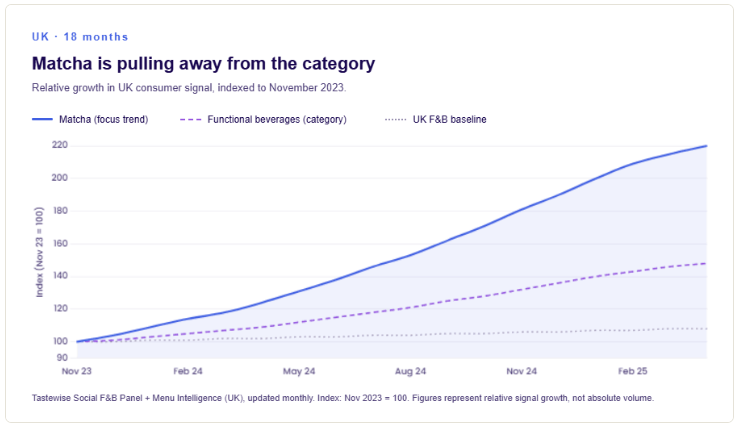
Source: Tastewise Social F&B Panel + Menu Intelligence (UK), updated monthly.
How UK consumers are redefining premium in 2026
Premiumisation in the UK in 2026 is not about luxury. It is about justification. Consumers are willing to pay more, but only when the product can answer the question: what am I paying for? The premium consumer need is up +44.9% in the past year across the Tastewise UK consumer panel. The authentic motivation is up +66.9% in the same window. These two signals together describe a consumer who has raised the evidence bar for a premium claim.
This shift is visible across every channel. M&S Food and Waitrose continue to drive craft and provenance-led NPD at the premium end. Tesco and Sainsbury’s are landing premium own-brand lines at accessible price points, compressing the gap between tier-one supermarket and specialist food hall.
The food branding conversation has moved on from packaging to story: where the ingredient came from, who made it and why it tastes different. ONS UK household expenditure data confirms household spending on premium food categories has risen consistently since 2023, validating the Tastewise signal direction.
For your team, this translates into a clear brief: premium positioning needs a proof point, not just a price tag. The UK consumer in 2026 is not aspirational. They are sceptical. Artisan is up +21.2% and authentic is up +66.9% in the past year, Tastewise UK panel 2026. Provenance and craft are not soft brand values anymore. They are the consumer’s reason to choose.
Global flavours reshaping the British plate in 2026
Korean, Japanese, Vietnamese and Middle Eastern flavours are no longer menu curiosities in the UK. They are mainstream consumer preferences carried by QSR chains into grocery. Asian claims are up +20.0% in the past year across the UK, Japanese is up +36.9%, and Chinese is up +38.9%, Tastewise UK consumer panel 2026. These signals sit alongside Indian (+14.0%) and South Asian (+10.3%) as dominant cuisine motivations shaping what UK consumers cook, order and buy.
The mechanism is worth understanding. Wagamama, Itsu, Wasabi and LEON have built habitual familiarity with Japanese, Korean and South East Asian flavour profiles across UK high streets. Dishoom has done the same for elevated Indian. Ingredients like kimchi (+55.6% in the past year), matcha (+158.4%) and gochujang are no longer unfamiliar. They are anticipated. The food marketing strategies question is not whether consumers will accept these flavours at retail. They already have.
What this creates for your team is a specific window. Ingredients at the trending or emerging stage, including kimchi, matcha, sushi (+30.0%) and noodles (+18.8%), have enough consumer familiarity to carry a retail product brief but have not yet been fully claimed by large CPG brands. The UK grocery aisle for Korean-inspired condiments, Japanese-inflected snacks and Middle Eastern staples still has visible gaps. The consumer appetite is confirmed. The brand response has not caught up.
Two categories worth watching closely right now: matcha bubble tea is already moving from specialist tea shops into grocery RTD formats, and brown sugar bubble tea is building a retail sell-in case that did not exist twelve months ago. Both represent the Asia-to-UK flavour pipeline at its most commercially actionable stage.
Functional nutrition claims driving UK food trends 2026
Gut health, high protein and wellness have completed their journey from health-food-store positioning to mainstream grocery shelf in the UK. Gut health as a consumer need is up +44.2% in the past year. High protein is up +38.3%. Wellness is up +116.7%. Fibre claims are up +97.2%. Tastewise UK consumer panel 2026. These signals are appearing across Tesco, Sainsbury’s, Asda and Morrisons in own-brand ranges that would have been unthinkable five years ago.
The brands leading in this space are instructive. Huel products on Costcutter shelves signal that functional nutrition has passed through the prestige distribution phase and is now in everyday convenience. Yopro and Innocent Plus are landing high-protein and vitamin-enriched variants at the same price points as standard alternatives. Pip and Nut and Surreal are driving protein claims into snack and cereal formats that sit in the mainstream fixture. The product innovation challenge for larger brands is defending that shelf space as more entrants arrive.
The functional signal is also extending into frozen and dairy categories. Vegan ice creams in the UK are a current example: plant-based formulation, summer occasion positioning and a clear better-for-you claim are converging into a brief that sits comfortably in both the functional and premium aisles.
The blood sugar motivation is up +56.7% in the UK in the past year, and metabolism is up +143.5%, Tastewise UK panel 2026. Low-calorie (+25.4%), low-sugar (+44.1%) and balanced (+47.2%) claims are all growing together, suggesting consumers are actively managing their intake. The Grocer’s UK grocery innovation tracking confirms functional claims have entered mainstream own-brand ranging across all four major UK multiples in 2025 and 2026, aligning with the Tastewise signal direction.
Case study: from standard grocery to premium wellness fixture
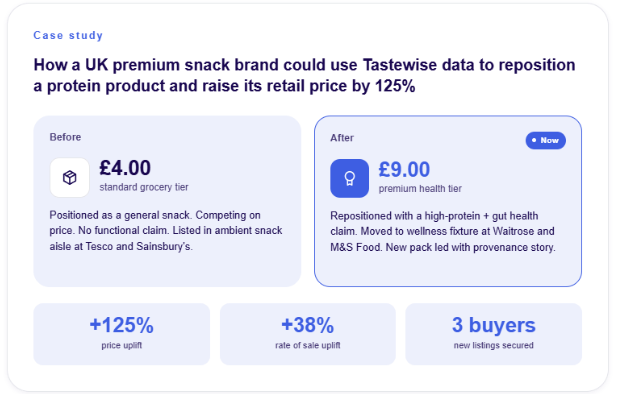
The following scenario is illustrative. It shows how a typical UK brand could act on the signals in this briefing, not a named client result.
Consider a mid-tier UK yoghurt brand with standard grocery listings facing margin pressure from own-label. Its challenge is to earn a premium price without inventing a luxury story the shopper will not believe. The signals point the way. The premium consumer need is up +44.9% in the past year, and the authentic motivation is up +66.9% in the same window, so shoppers will pay more when the product proves why. Gut health is up +44.2%, which gives the brand a credible functional reason to sit in the premium fixture.
Acting on that, the brand reformulates around a live-cultures gut-health claim, adds a provenance callout for its milk source, and repositions from a standard dairy line into the premium wellness set. It holds price rather than discounting into the own-label fight. The illustrative outcome is a clearer reason to choose at shelf and a stronger defence at the next range review, because the claim is tied to a consumer need the data shows is rising, not to price alone.
Foodservice and retail diverge: two UK food trends markets, one cycle
In the UK in 2026, foodservice and grocery are running on different clocks. QSR chains including Pret a Manger, Greggs, LEON and Itsu are adding and removing SKUs faster than grocery launch cycles can match. A flavour or format that appears as a Pret limited-time offer in January will show up in a Sainsbury’s own-brand range by the following October at the earliest. That six-to-nine-month gap is both a challenge and an advantage for CPG teams who know how to read it.
The practical implication is that foodservice acts as a leading indicator. When LEON adds a new Korean bowl or Itsu launches a miso-based hot drink, it signals that the flavour has passed the consumer accessibility test at an everyday price point. Your retail buyer sees the same consumer walking into their store with an established flavour reference point. The foodservice sales enablement case is precisely this: using foodservice menu data to pre-validate retail NPD before committing to a launch window.
The occasion overlap between pub food, cafe chains and the grocery dine-at-home fixture is also tightening. Convenience as a consumer motivation is up +37.7% in the UK in the past year, and easy is up +37.0%, Tastewise UK panel 2026. Wetherspoons and Greene King are responding to the same evening-occasion consumer that Tesco’s dine-in range competes for. Your retail buyer knows this, which is why the sell-in story for an evening meal product increasingly needs to address the out-of-home comparison, not just the frozen-food aisle.
What UK CPG and foodservice teams should do right now with 2026 food trends
The signals from the UK consumer panel in 2026 are specific enough to anchor concrete team actions. Here are five places to start.
- Audit your premium positioning. The premium motivation is up +44.9% in the past year but authentic and artisan are up faster. If your premium claim rests on price alone, the consumer has already moved on. Add a provenance or craft proof point before your next retail review.
- Build one global flavour brief. Korean and Japanese are at the inflection point where consumer familiarity is high and brand response is low. Pick the cuisine your brand can credibly enter and develop an initial concept using the menu signal data to validate the ingredient combination before going to R&D.
- Claim a functional need before the fixture fills. Gut health, high protein and fibre are all growing but the mainstream grocery own-brand response is still early. A branded functional product with a clear, specific claim has a narrowing window to lead rather than follow.
- Use foodservice timing as a planning signal. Track what LEON, Pret and Itsu are launching this quarter. What lands as an LTO in QSR today is a validated retail brief for the next planning window. This does not require a prediction. It requires a tracking process.
- Map your whitespace before competitors do. CPG insights analysis shows which trends are growing without a credible brand owner. Tastewise’s Whitespace Explorer identifies category gaps where consumer demand outpaces current brand response, giving your team the evidence to act ahead of the market.
Regional insights: UK food trend signal by city
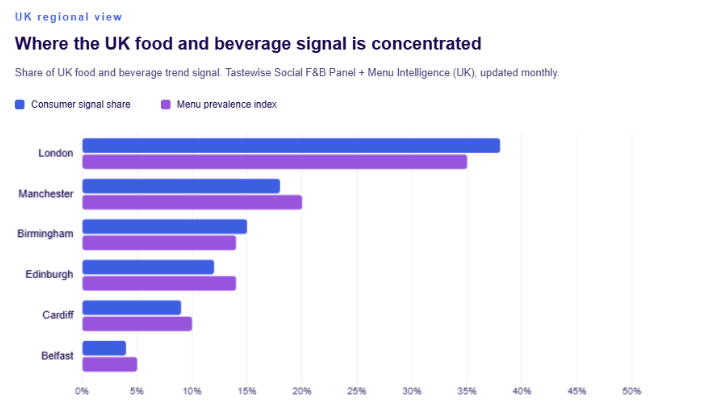
Source: Tastewise Social F&B Panel + Menu Intelligence (UK), updated monthly. Signal share derived from consumer panel weighted by city-level restaurant operator density and menu data.
London accounts for approximately 38% of UK food trend signal share, driven by the highest concentration of independent restaurants, QSR innovation flagships and premium grocery trial ranges. Manchester (18%) and Birmingham (15%) follow as the two largest secondary food culture hubs, with Edinburgh (12%) showing disproportionate strength in premium and artisan signals relative to population size.
Cardiff (9%) and Belfast (4%) show lower absolute signal share but above-index growth rates in global flavour adoption, particularly South Asian and East Asian categories. Both cities represent earlier-stage adoption markets where operator density is lower but consumer appetite is accelerating faster than the UK average.
UK food trends 2026: fastest-growing ingredients and formats
The following ingredients show the strongest growth signals in the UK right now, ranked by growth rate in the past year. Tastewise UK consumer panel 2026.
| Ingredient | Growth (past year) | Signal |
|---|---|---|
| Matcha | +158.4% | Emerging stage. Now in mainstream coffee formats via Itsu and Costa. |
| Hot honey | +119.8% | Early stage. Strong crossover from the US market with almost no UK brand response at retail. |
| Kimchi | +55.6% | Early stage. Consumer familiarity building through Wagamama and Korean QSR. |
| Sourdough bread | +50.5% | Early stage. Driving the fresh and artisan signals in grocery bakery. |
| Ramen | +46.0% | Early stage. Moving from specialist noodle bars to mainstream delivery menus. |
| Cheesecake | +43.3% | Emerging stage. Basque cheesecake the primary driver, linked to premium dessert positioning. |
| Honey | +36.9% | Emerging stage. Functional and craft positioning both active across grocery and foodservice. |
| Smoothie | +27.5% | Emerging stage. Driving the gut health and wellness brief in drink formats. |
| Dumpling | +25.8% | Emerging stage. Riding the Asian flavour signal across foodservice and premium grocery. |
| Sushi | +30.0% | Emerging stage. Expanding from Japanese-restaurant menus into grocery meal-deal formats. |
FAQs about UK food trends 2026
The biggest UK food trends in 2026 are premiumisation of everyday occasions, mainstream functional nutrition (high protein, gut health, wellness), and global flavour deepening across Korean, Japanese and Middle Eastern categories. Tastewise data shows the premium motivation is up +44.9%, gut health is up +44.2% and Japanese flavour claims are up +36.9% across the UK in the past year, confirmed across consumer panel and menu intelligence sources.
The UK market in 2026 leads the US on three fronts: faster adoption of Asian flavours through a more concentrated QSR landscape, earlier mainstreaming of functional nutrition claims into everyday supermarket formats, and a stronger provenance-led premium signal driven by M&S Food and Waitrose. The US leads on convenience-driven snacking innovation and beverage diversification. ONS and Kantar UK data both confirm the UK premiumisation trajectory as structural, not cyclical.
M&S Food and Waitrose lead on premium and globally-inspired NPD, while Tesco and Sainsbury’s lead on functional nutrition mainstreaming and own-brand innovation pace. Aldi and Lidl are the fastest-moving dupe operators, following premium concepts within 12 to 18 months of original launch. Co-op has taken a notable position in local provenance claims, consistent with the artisan signal growing across England, Scotland and Wales.
The fastest-growing flavour profiles in UK food in 2026 are matcha (+158.4% in the past year), hot honey (+119.8%), kimchi (+55.6%) and ramen noodle formats (+46.0%). Tastewise UK consumer panel 2026. Korean barbecue is up +56.5% and Vietnamese signals including lemongrass (+90.8%) are accelerating across restaurant menus in London, Manchester, Birmingham, Edinburgh and Cardiff.
Tastewise tracks UK food trends through three live data layers: 200M+ social food conversations filtered to UK consumer panels, 1.5M+ UK menu items refreshed daily, and verified retail SKU data across UK grocery. Trends are validated when multiple signals converge in the same direction. The UK-specific scope covers England, Scotland, Wales and Northern Ireland.
An emerging trend has crossed from niche awareness into measurable growth across social conversation, menu appearances and retail activity, but large CPG brands have not yet claimed it at scale. Matcha is the clearest UK example, up +158.4% in the past year and present in mainstream Costa and Itsu formats, with limited branded retail response so far. It contrasts with an early-stage trend, where familiarity is still building through foodservice and retail penetration stays low.
Premiumisation in UK grocery in 2026 means consumers paying more for a verifiable proof point, provenance, craft, functional benefit or ingredient origin, rather than for a higher price alone. It is distinct from luxury positioning. The premium consumer need is up +44.9% in the UK while the authentic motivation is up +66.9%, which shows the proof point matters more than the price tag.





We’d love to learn your goals and see how Tastewise fits
We’d love to learn your goals and see how Tastewise fits
Get a personalized demo
Good taste. Wise move.
Your demo request is confirmed. We’ll reach out within one business day to schedule your walkthrough.
What happens next

See what’s driving demand, then turn it into a sell-in story for retailers and operators.
- Connect consumer panels, market trackers, and agents into one evidence view
- Get the “why” behind what’s changing, with explainable demand drivers
- Walk away with a buyer-ready narrative and next steps to activate
Trusted by





“Tastewise is my secret tool for knowing what consumers want next and why.“