







Matcha bubble tea is having a moment in the UK, and the timing could not be better for beverage brands approaching summer shelf resets. Consumer interest in the format has grown +56.6% year-over-year across more than 11,400 consumer data points, it now appears on menus across 447 UK restaurants and 30 national chains, and the premium signal is accelerating. As UK summer drink trends continue to shift toward functional indulgence, your team has a narrow window to build the sell-in story before the category gets crowded.
Key takeaways
- Matcha consumer reach in the UK is up +56.6% year-over-year and the “premium” claim in the format has grown +61.2%. The audience is growing and trading up.
- The biggest flavour whitespace sits in ube, pistachio, and peach, all showing strong consumer pull with near-zero current menu penetration.
- 30 UK chains now carry matcha bubble tea across 447 restaurants. RTD shelf velocity at grocery typically follows within 12 to 18 months of mainstream chain adoption.
- The matcha boba consumer is not substituting existing spend. Weekend, summer, and social occasion signals are all growing, making this a net-new basket-building SKU.
- Generic national pitches lose deals in regional UK retail. Geo-specific consumer data matched to a buyer’s store cluster is what separates a listing decision from a polite pass.
Winning the 2026 beverage reset with premium indulgence
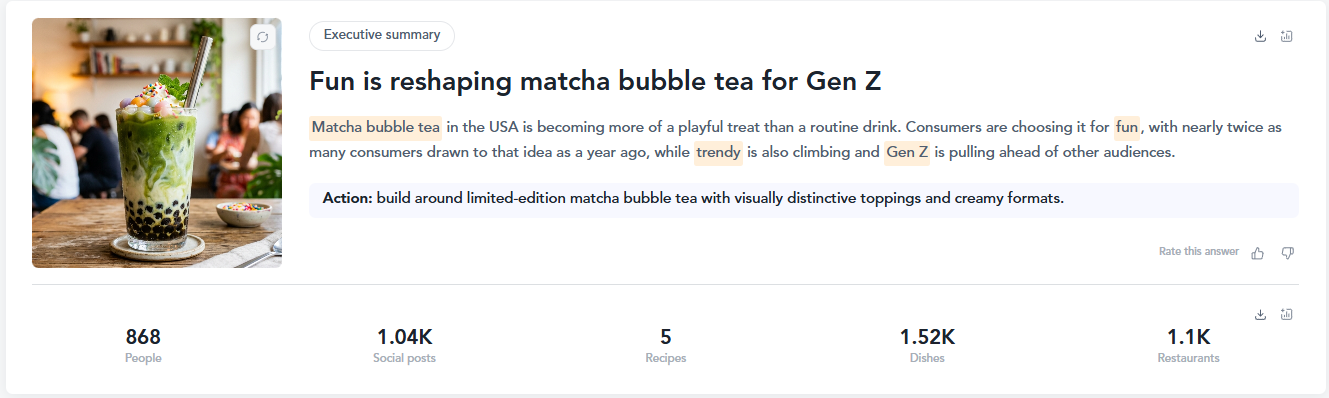
UK supermarket category managers are focused on right-sizing portfolios and finding incremental distribution, not cannibalising existing soft drink sales. Matcha bubble tea offers exactly that: demonstrable consumer pull, a premium price tier that lifts average basket spend, and a format identity distinct enough not to overlap with existing carbonated or juice ranges.
Across the Tastewise UK consumer panel, matcha consumer reach has grown +56.6% year-over-year. The “premium” claim within the matcha bubble tea format has grown +61.2% year-over-year. That combination tells a clear story for a buyer: the audience is growing and it is trading up, not down. For a broader read on what is driving this shift, the 2026 beverage trends report sets the wider category context.
Matcha boba is not cannibalising existing RTD tea sales. It is bringing a new occasion to the aisle: the afternoon treat-with-purpose, where the consumer wants something that feels both indulgent and intentional.
Matcha bubble tea’s rise is part of a broader shift in what UK consumers expect from a summer drink: something that earns its place in the basket rather than just filling it. The data behind that shift is all in one place.
Want to see which beverage formats are gaining ground this season and what the consumer signals say about where the category is heading next?
Finding untapped whitespace in premium matcha bubble tea blends
The opportunity inside matcha bubble tea is not uniform. There is a clear current core in milk-based formats with tapioca pearls and brown sugar, and a fast-moving periphery where the genuinely incremental flavour combinations live. The full picture of where matcha trends are heading in 2026 points to accelerating demand well beyond the classic milk tea format.
Brands using Tastewise analytics to map underserved flavour pairings find the strongest whitespace in ingredients with high consumer pull and near-zero menu penetration:
- Ube: +354% year-over-year among Gen Z matcha consumers in the UK, with near-zero current menu share.
- Pistachio: +64.4% year-over-year in the bubble tea innovation set, 0.6% menu share.
- Peach: +61.1% year-over-year, 0% current menu share in the matcha bubble tea format.
- Jasmine tea: +187.5% year-over-year in the bubble tea ingredient context.
- Oolong: +123.4% year-over-year, strong tea-on-tea layering signal.
The Tastewise whitespace index flags Mooboo Bubble Tea, PAYA Cuisine, and You Me Sushi as the leading UK operators where new matcha variants could achieve fast velocity based on existing consumer demand and current menu gaps.
How to craft an unshakeable buyer story for RTD tea lines
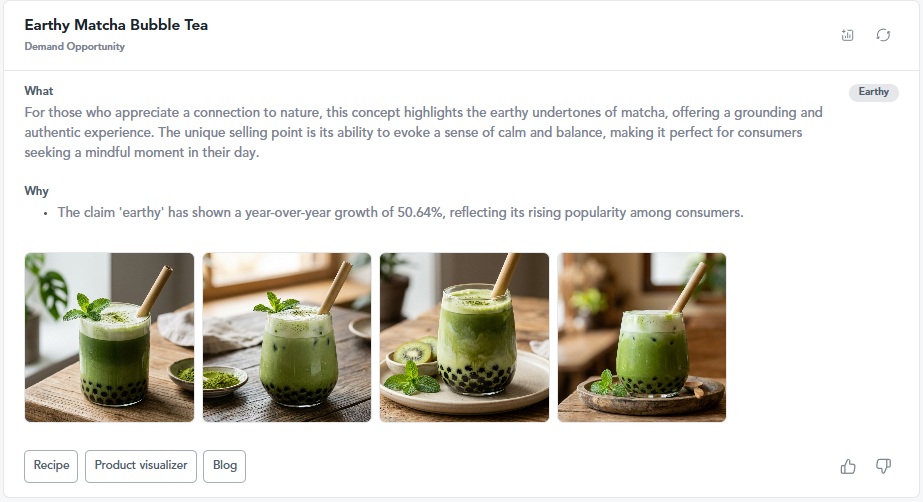
The strongest retail sell-in stories for RTD matcha bubble tea do not lead with flavour. They lead with the consumer signal, translate that signal into a velocity forecast, and close with a shelf placement recommendation the buyer can defend internally.
About 1 in 2 matcha bubble tea consumers in the UK panel are engaging in a summer moment context. About 1 in 7 attach the “fresh” claim to their experience, a signal that grew +108% year-over-year. The broader summer food trends picture confirms that refreshing, functional formats are what consumers are actively seeking this season.
Operator data provides the velocity proof. Matcha bubble tea has migrated from specialist boba shops into mainstream UK chains: Starbucks, GAIL’s, Caffe Nero, Black Sheep Coffee, Tim Hortons, and Tsujiri are all carrying matcha variants at prices ranging from around £4.30 to £7.70. When a format reaches national QSR and cafe chains, RTD shelf velocity at grocery typically accelerates within 12 to 18 months. That migration is already underway.
Sales teams can combine this chain-level operator data with consumer year-over-year velocity and the premium claim trajectory to present buyers with a three-sided proof: consumer demand is real and growing, operators are already commercialising it at scale, and the RTD channel is the logical next distribution point.
Leveraging category analytics to secure endcap and fridge placement
Endcap and fridge-door placement decisions come down to one question: does this SKU bring a net-new shopper to the beverage section, or does it simply relocate spend from an existing brand?
Matcha bubble tea has a defensible answer. The core consumer skews toward Gen Z and Millennial shoppers who treat matcha boba as a distinct occasion, not a replacement for a regular soft drink. The “weekend” occasion is growing +19.3% year-over-year and the “friends” social context is up +23% year-over-year. These are basket-building moments, not substitution moments. This pattern is consistent with broader healthy food trends data showing that Gen Z consumers are adding premium functional drinks to their basket rather than swapping them in.
With “creamy” growing +17.9% and “smooth” up +79.6% in consumer preference data, and premium price points clustering at £5 to £8 in the operator channel, this format belongs in the premium fridge door alongside cold-brew and functional waters, not in a promotional multipack position.
Micro-market targeting and managing regional vs national velocity
UK retail buyers manage highly specific store clusters, and the matcha bubble tea consumer is not uniformly distributed across UK geographies. A formulation that shows strong acceleration in urban London hubs requires a completely different strategy in other regions.
The Tastewise operator data makes this visible. The density of matcha bubble tea operators in Shoreditch, Mayfair, and South Bank signals a consumer base that has already normalised the format. Regional cities show a different picture: operators are present but sparser, and Gen Z reach, while growing, is earlier in its adoption curve outside urban hubs. The Tastewise platform lets sales teams isolate demand by city, region, and retail banner footprint so each pitch reflects the buyer’s actual store cluster.
Using geo-specific consumer filters in Tastewise, sales teams can present London-focused buyers with London-benchmarked data while presenting Northern or Scottish regional buyers with tailored velocity data that reflects their actual store footprint. This protects sales teams from the most damaging outcome in a category review: a generic national pitch that a buyer flags as irrelevant to their cluster.
What this means for CPG brands in 2026

Innovation and R&D
Avoid developing flavour profiles in a vacuum. Use real-time macro signals to validate concept pipelines and ensure formulations align with summer craving windows. Pistachio, peach, and ube all show strong consumer pull with near-zero menu penetration. The Q3 2025 food and beverage trends report shows that functional indulgence is the dominant summer demand signal: formats that feel both rewarding and purposeful are winning across every beverage category.
Category managers
Defend shelf footprint by using basket-building insights that show how a premium SKU increases total basket penetration and spend per trip in the beverage section. The “weekend” and “friends” occasion data gives you a quantitative argument, not an anecdotal one.
Sales enablement
Replace static presentation decks. Walk into your next category review with a Retail Sell-In Kit and a Consumer Demand Map rather than a basic product sample kit. Tastewise’s Retail Sell-In Kit surfaces live consumer pull, operator velocity, and geo-specific demand in a format buyers can act on immediately.
Looking ahead to 2027 shelf resets with predictive data
The pace of UK beverage shelf resets is accelerating. Leading grocery retailers are running mid-cycle reviews tied to real-time POS data. For brands without live data infrastructure, buyers know more about shelf performance than the brands supplying it.
Tastewise’s predictive modelling points toward three shifts that will reshape how premium RTD is ranged by 2027:
- Hyper-personalised retail tiers. The same RTD variant may be ranged in 400 urban stores while a different flavour runs in 200 suburban stores. Brands need SKU-level consumer data to navigate this.
- Always-on data as a baseline. Ube grew +354% year-over-year among UK Gen Z matcha consumers in a single year. Brands unable to monitor emerging ingredients in near-real-time will mis-time their innovation pipeline.
- Functional matcha premiumisation. The “stress relief” claim grew +36.9% year-over-year and “ritual” grew +90.5%. This aligns with the wider functional beverage trend toward layering health positioning onto indulgent formats.
FAQs about Matcha Boba tea
Tastewise data is sourced from consumer behaviour signals and modelled into a statistically significant, F&B-specific representation of the UK consumer population. The platform’s ingredient lifecycle staging has been validated across multiple UK beverage category resets.
Yes. Tastewise’s geo-specific consumer filters let you isolate matcha bubble tea consumer demand by UK city, region, and retail banner footprint. Data is normalised against local consumer universes, so comparisons across different market sizes are proportionate and defensible when presenting to buyers who know their store clusters well.
Ube (+354% year-over-year among Gen Z, near-zero menu penetration), pistachio (+64.4%), and peach (+61.1% with 0% current menu share) represent the clearest combination of high consumer pull and low current availability. For a detailed flavour-by-flavour breakdown, the matcha trends report covers the full landscape of emerging pairings across the UK and global markets.
The Tastewise data shows structural growth rather than a single-period spike. Matcha consumer posts in the UK grew +30.8% year-over-year in the bubble tea context, across more than 11,400 consumer data points. Distribution across 447 UK restaurants and 30 chains indicates the format has moved beyond niche early-adopter status into early mainstream.
Mid-cycle resets are won or lost on in-period performance data. Tastewise’s always-on consumer panel tracks weekly shifts in matcha bubble tea consumer reach, flavour claim velocity, and occasion context, giving brand teams an early signal before the buyer’s own POS review catches up. Request a demo to see how brand teams use it ahead of category reviews.





We’d love to learn your goals and see how Tastewise fits
We’d love to learn your goals and see how Tastewise fits
Get a personalized demo
Good taste. Wise move.
Your demo request is confirmed. We’ll reach out within one business day to schedule your walkthrough.
What happens next

See what’s driving demand, then turn it into a sell-in story for retailers and operators.
- Connect consumer panels, market trackers, and agents into one evidence view
- Get the “why” behind what’s changing, with explainable demand drivers
- Walk away with a buyer-ready narrative and next steps to activate
Trusted by





“Tastewise is my secret tool for knowing what consumers want next and why.“