





Zero-waste food trends 2026 are being driven by waste-to-value systems. Zero-waste food trends in 2026 are not constrained by demand. They are constrained by execution. Interest in upcycled certification is accelerating, but menu penetration remains low, indicating that while awareness and intent are established, operational integration is still in early stages. At the same time, the scale of economic impact tied to food waste mitigation is forcing both retailers and manufacturers to treat waste-to-value as a margin and supply chain decision, not a sustainability initiative.
The implication is structural. Brands that approach zero-waste through ESG messaging alone will struggle to convert demand into distribution. The opportunity sits in building circular supply chain systems that transform industrial leftovers into functional, scalable inputs.
Zero-waste food trends 2026: what is actually scaling
As of 2026, the zero-waste food system has shifted from packaging reduction to upcycled functionalism, where industrial leftovers such as spent grain and cacao pulp are repurposed into high-value functional ingredients.
B2B redistribution of industrial surplus is scaling through digital secondary markets, enabling consistent sourcing within the circular economy. At the same time, ingredient innovation is consolidating around formats that deliver both functionality and compliance. Fruit pit flour is emerging as a high-probability CPG input due to its clean label positioning and compatibility with existing bakery systems. Regulatory pressure is accelerating this shift, with the EU Green Claims Directive forcing brands to substantiate sustainable ingredient sourcing strategies through verifiable data and traceability.
Tastewise predictive analytics indicates that root-to-stem integration will expand in QSR by Q4 2026, particularly in formats where trim and byproducts can be incorporated without increasing operational complexity. This signals that foodservice will continue to act as the validation layer before retail scale.
Earlier zero-waste strategies focused on sustainable packaging, but current data shows the shift is happening at the ingredient level, where waste-to-value inputs deliver both functional and commercial advantages.
Key terms in zero-waste food innovation: what they mean and why they matter
Upcycled ingredients. Upcycled ingredients are food inputs made from byproducts or surplus that would otherwise be discarded in production. In 2026 they are moving from cost-saving substitutes toward premium, functional inputs, and Tastewise Social F&B panel data shows consumer sentiment for upcycled carries a 15% price premium over organic in the snack category. Spent brewery grain milled into high-fiber flour and fruit pulp used as a natural colorant are common examples.
Waste-to-value systems. Waste-to-value systems are operational frameworks that turn production byproducts into commercially viable ingredients, products, or revenue streams. Unlike waste reduction aimed at disposal, they treat surplus as a supply chain input with measurable return. In 2026 manufacturers and retailers are adopting them as margin and supply chain decisions, not sustainability initiatives.
Circular food economy. The circular food economy is a model where byproducts, surplus, and agricultural waste are continuously cycled back into the food supply as new inputs, rather than exiting the chain as waste. It spans B2B redistribution platforms, bio-refinery models, and upcycled sourcing. It contrasts with a linear system, where waste simply leaves the chain entirely.
Root-to-stem integration. Root-to-stem integration is the practice of using the whole plant, including roots, stems, peels, and leaves that are usually trimmed away, in preparation or ingredient sourcing. In foodservice it lowers trim waste and input costs. Tastewise predictive analytics indicates root-to-stem integration will expand in QSR formats by Q4 2026.
Scope 3 emissions. Scope 3 emissions are the indirect greenhouse gas emissions across a company’s value chain, including upstream sourcing and ingredient transport, rather than its own operations. In zero-waste strategy, Scope 3 is pushing brands to audit sourcing decisions, not just manufacturing. Consumer interest is already moving upstream, with soil health up 105% and urban farming up 57% in the panel.
Bio-refinery model. The bio-refinery model uses a single raw input, such as a fruit, grain, or byproduct, to extract several outputs at maximum yield with minimal waste at each stage. In food, it lets manufacturers derive ingredients, functional additives, and even energy inputs from one sourcing stream, lowering per-unit cost and improving sustainability metrics.
EU Green Claims Directive. The EU Green Claims Directive is a regulation requiring brands operating in the European Union to back environmental claims, including circularity and waste-reduction messaging, with verified, traceable data. For zero-waste brands it means sourcing must be auditable and marketing claims must rest on documented supply chain evidence, not general sustainability positioning.
Zero-waste adoption is shifting from awareness to embedded behavior
According to the Social F&B panel, consumer interest in food waste has declined over the past two years. This decline does not indicate reduced demand. It reflects a transition from awareness-driven engagement to behavior-driven execution.
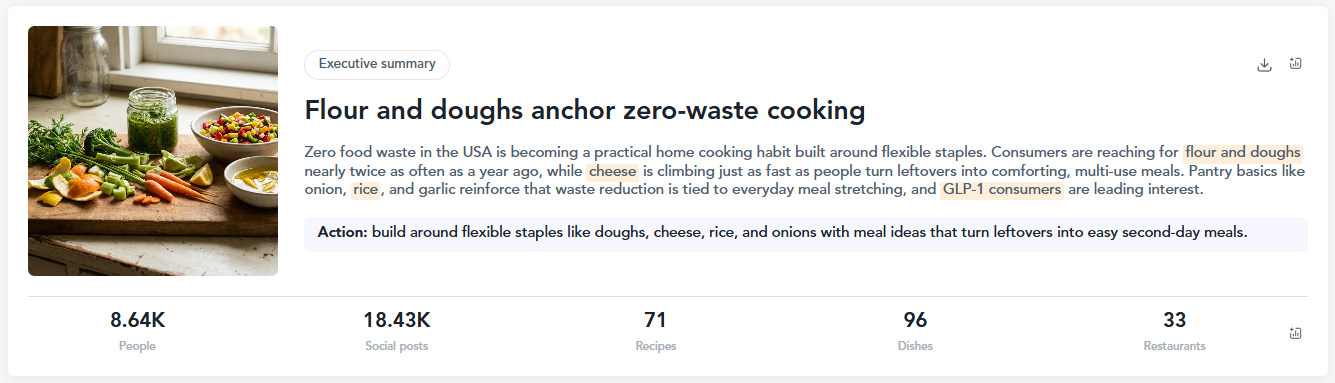
The Home cooking panel shows that zero-waste behavior is now embedded in everyday meal construction. Flour and dough usage in zero-waste contexts has nearly doubled year-over-year, while cheese is rising at a comparable rate as a binding ingredient that enables reuse across meals. Pantry staples such as onion, rice, and garlic continue to over-index, reinforcing that consumers are solving waste reduction through familiarity and repeat usage.
This creates a clear execution filter for zero-waste food trends in 2026. Products that require behavioral change or rely on sustainability messaging will underperform relative to those that integrate into existing cooking systems. The winning approach is to design products that enable automatic waste reduction through repeat usage, rather than requiring active consumer intent.
Pantry-led formats are outperforming fresh in zero-waste systems
Category data reinforces the shift toward controlled, repeatable consumption. According to the Home cooking panel, tea has grown by 15% and seasonings by 4% within zero-waste contexts, while fruits have declined by 10% and vegetables by 1%. This divergence is driven by waste risk. Fresh ingredients introduce variability and spoilage, while pantry-based formats enable portion control and extended usage across multiple meals.
This is where many upcycled food innovation strategies fail. Introducing a sustainable ingredient without solving for usage frequency results in low repeat purchase, even when initial trial is strong. Zero-waste food trends in 2026 are consolidating around formats that reduce friction, extend shelf life, and support multi-use applications.
For R&D teams, this means prioritizing powders, flours, concentrates, and modular ingredients that integrate into existing meal systems. For commercial teams, it means aligning product narratives with usage behavior rather than sustainability positioning alone.
The leftover revolution: scalable waste-to-value models
| Industrial Surplus Type | Repurposing Opportunity | Business Value (ROI) |
| Fruit Pulp & Peels | Natural flavors / Natural colorants | High (Clean Label appeal) |
| Brewery Spent Grain | High-protein / Fiber-rich flours | Medium (Functional snacking) |
| Restaurant Surplus | B2B Redistribution Platforms | Immediate (Waste tax reduction) |
Industrial leftovers are transitioning into standardized inputs within the circular food economy. Fruit pulp and peels are being integrated into natural additive systems, replacing synthetic colorants and flavoring agents while supporting clean label claims. Spent grain is scaling within fiber-forward and protein-enhanced formulations, aligning with demand driven by GLP-1 consumption patterns and functional nutrition. Restaurant surplus represents the most immediate opportunity, where redistribution platforms reduce disposal costs and contribute directly to margin recovery.
The role of the bio-refinery model is expanding in this context, enabling higher yield extraction from single raw inputs and supporting scalable waste-to-value food data systems. As regulatory frameworks tighten, particularly under the EU Green Claims Directive, the ability to trace and verify these inputs will become a prerequisite for retail acceptance.
Foodservice is determining which zero-waste formats reach retail scale

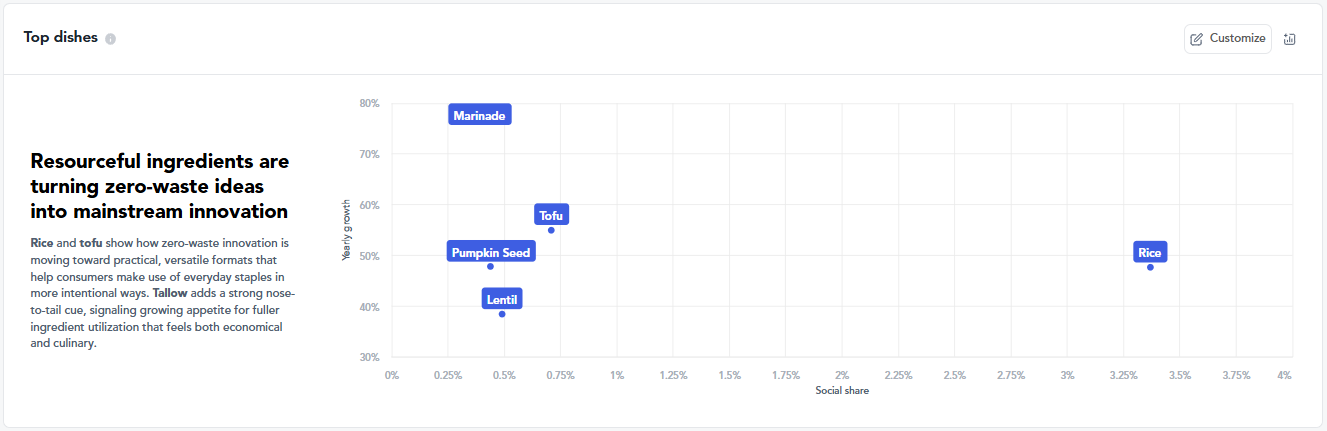
Foodservice data shows that rice, tofu, and tallow are leading indicators of zero-waste adoption. These ingredients succeed because they deliver operational efficiency alongside full-input utilization. Rice functions as a base across multiple dayparts, tofu provides a flexible protein format, and tallow signals increased adoption of nose-to-tail consumption.
This pattern establishes a clear pipeline within the circular economy. Limited-time offers validate demand, independent operators refine execution, and only then do products transition into retail. Brands that bypass this sequence risk launching products that generate awareness but fail to sustain velocity.
For sales and category teams, this reinforces the need to build buyer-ready narratives grounded in Foodservice validation, not just consumer sentiment.
Consumer motivation is shifting toward sourcing and Scope 3 emission mitigation
According to the Social F&B panel, consumer interest is increasing in upstream factors such as soil health (+105%), urban farming (+57%), and animal rights (+43%). This indicates that zero-waste is being reframed within the broader context of the circular economy and sustainable ingredient sourcing strategies.
Waste reduction is no longer evaluated at the point of disposal. It is evaluated at the point of origin. This has direct implications for ESG compliance, where Scope 3 emissions and supply chain traceability are becoming central to product validation.
Brands operating within the zero-waste food system must align ingredient sourcing with these expectations. Claims must be verifiable, supply chains must be auditable, and sustainability narratives must connect directly to measurable impact.
Proprietary data: upcycled ingredients are commanding price premiums
According to the Social F&B panel, consumer sentiment for “upcycled” carries a 15% price premium over organic in the snack category. This indicates a shift in perceived value, where upcycled food innovation is no longer positioned as a cost-saving measure but as a premium attribute when supported by functionality and traceability.
This pricing dynamic changes how products should be built and sold. Waste-to-value inputs should be framed as performance-enhancing ingredients within a circular supply chain, not as secondary or alternative options.
Zero-waste behavior is no longer driven by intent; it is being embedded into everyday meal construction through formats that extend ingredient usage. The growth in dough-based cooking, the decline in high-spoilage inputs, and the rise in sourcing-driven motivations indicate that brands need to build around flexible systems and traceable inputs rather than standalone sustainable products.
Zero-waste food innovation in practice: illustrative use cases
The scenarios below are illustrative, not case studies of named clients. Each shows how a team could act on the signals in this briefing, following a problem, strategy, and outcome structure.
Fruit pit flour moving into retail bakery.
- Problem: a mid-size CPG brand making stone fruit products generates steady peach and apricot pit waste with no scalable use, creating both cost and ESG reporting pressure.
- Strategy: it works with a bio-refinery processor to mill dehydrated pits into a clean-label flour that drops into existing bakery formulations with no equipment change, carrying a traceable origin story that fits EU Green Claims Directive verification.
- Outcome: the flour goes into snack and cracker SKUs with an upcycled claim, the kind of claim the panel shows can carry a premium over organic in snack, and it enters through foodservice validation before any national grocery push.
Root-to-stem integration in a QSR chain.
- Problem: a regional QSR chain discards a large share of vegetable inputs as trim each week, which drives up food cost and leaves a gap against corporate ESG targets.
- Strategy: it pilots root-to-stem integration across a subset of sites, folding trim such as carrot tops, beet greens, and onion skins into existing sauces, stocks, and seasoning blends, designed to add no labor steps or equipment.
- Outcome: the pilot lowers vegetable waste and weekly food cost at the test sites, and the chain scales it network-wide ahead of Q4 2026, in line with the root-to-stem QSR expansion Tastewise predictive analytics projects. A foodservice sell-in story follows from the validated pilot.
Spent grain redistribution through a digital secondary market.
- Problem: a craft brewery generates a steady volume of spent grain each week with no consistent B2B buyer, turning a usable byproduct into a disposal cost.
- Strategy: it lists the surplus on a digital secondary market for industrial food byproducts, reaching buyers such as a functional snack maker sourcing high-protein flour and a direct-to-consumer baking brand featuring spent grain as a traceable upcycled ingredient.
- Outcome: the brewery converts a disposal cost into a recurring revenue line, and the snack maker secures a lower-cost protein input with a supply chain story that fits verified upcycled demand. This is the product innovation pipeline the circular economy is built on.
The commercial decision for zero-waste food trends 2026
The zero-waste opportunity is no longer about whether to participate in the circular economy. It is about how effectively brands can integrate waste-to-value inputs into scalable product systems.
Products that deliver functional performance, align with existing consumption behavior, and meet ESG compliance requirements will secure distribution. Products that rely on sustainability messaging without operational integration will not.
Frequently asked questions about zero-waste food trends 2026
The leading trend is upcycled functional ingredients, where industrial leftovers are repurposed into high-performance inputs such as fiber-rich flours and natural additives within the circular food economy.
It introduces new sourcing models and margin structures. Brands can reduce input costs, improve ESG compliance, and create premium positioning through verified waste-to-value systems.
Spent grain, fruit pulp derivatives, cacao byproducts, and emerging inputs such as fruit pit flour are leading due to their functional benefits and scalability.
Dedicated predictive analytics identify scalable surplus streams, validate demand across Social F&B panel, Home cooking panel, and Foodservice data, and generate buyer-ready narratives that accelerate internal alignment and external sell-in.
Upcycled ingredients are food inputs made from byproducts or surplus that would otherwise be discarded in production. In 2026 they are shifting from cost-saving substitutes toward premium, functional inputs. Tastewise Social F&B panel data shows consumer sentiment for upcycled carries a 15% price premium over organic in the snack category, which is why brands increasingly position them as performance ingredients rather than alternatives.
The circular food economy is a model where food byproducts, surplus, and agricultural waste are continuously cycled back into the food supply as new inputs, instead of leaving the chain as waste. It spans B2B redistribution platforms, bio-refinery models, and upcycled ingredient sourcing. It contrasts with a linear system, where waste simply exits the supply chain.




We’d love to learn your goals and see how Tastewise fits
We’d love to learn your goals and see how Tastewise fits
Get a personalized demo
Good taste. Wise move.
Your demo request is confirmed. We’ll reach out within one business day to schedule your walkthrough.
What happens next

See what’s driving demand, then turn it into a sell-in story for retailers and operators.
- Connect consumer panels, market trackers, and agents into one evidence view
- Get the “why” behind what’s changing, with explainable demand drivers
- Walk away with a buyer-ready narrative and next steps to activate
Trusted by





“Tastewise is my secret tool for knowing what consumers want next and why.“