






Plant-based was the first scaled wave of novel protein trends. It set the expectation that consumers were ready to move beyond traditional animal protein, creating a clear entry point for alternatives. That’s why the recent decline in plant-based demand matters. It’s not just a slowdown in one category, it’s a signal that the original model for introducing new proteins is no longer working.
At the same time, interest in sustainably made protein is holding steady rather than declining alongside it. Taken together, this points to a shift in how consumers evaluate new protein sources. The issue is not demand for alternatives, but how those alternatives are positioned. Plant-based succeeded by focusing on substitution and identity, replacing meat and aligning with a value system.
What is emerging now instead is a more pragmatic decision framework, where consumers prioritize familiarity, functionality, and clear environmental value over labels. For CPG teams, the opportunity remains, but growth now depends on embedding novel proteins into everyday formats rather than asking consumers to adopt entirely new ones.
- Plant-based demand is declining, while sustainably made protein is stabilizing, signaling a positioning shift rather than a drop in consumer interest
- Adoption of novel proteins is driven by familiar formats like milk, coffee, and chicken, not by entirely new product concepts
- Low menu penetration paired with steady growth and rising prices indicates early-stage scale potential with strong premium positioning
- Sustainability drives interest, but only when translated into tangible benefits like food waste reduction and functional nutrition
- The winning strategy is to embed novel proteins into existing high-frequency products to reduce risk and accelerate consumer adoption
Consumer perceptions: the shift from “vegan” to “sustainable”
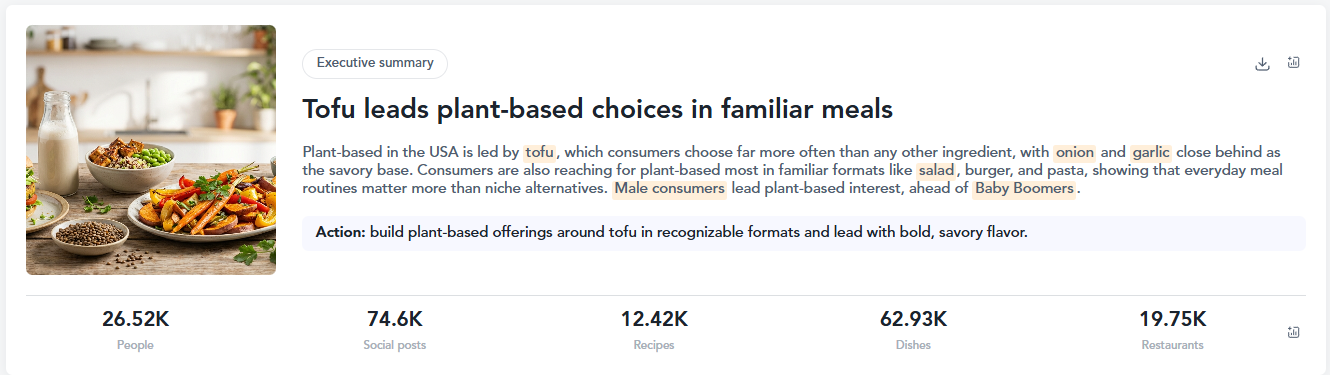
The slowdown in plant-based demand is not a rejection of alternative proteins.It’s a rejection of how the category has been framed. Plant-based products were built on identity-led positioning, where “vegan” or “meat-free” acted as the primary reason to buy. That framing reached its ceiling. The data now shows demand softening, even as consumers continue to engage with protein innovation in other forms.
What replaces that framing is not a new label, but a different set of decision criteria. Sustainability remains a strong driver, but only when it is grounded in something tangible and easy to understand. In cultivated meat, sustainability accounts for 76% of consumer motivation, clearly outpacing other factors like nutrition or novelty. Precision fermentation follows a similar pattern, where sustainability and protein benefits work together rather than independently. At the same time, broader “sustainably made” positioning is becoming more specific, with food waste emerging as the most meaningful and actionable claim for consumers.
This changes how products need to be built and sold. Consumers are not responding to abstract environmental promises or ideological cues. They are responding to products that translate sustainability into something practical, like reduced waste, everyday usability, and clear nutritional function. The purchase decision is no longer “is this plant-based?” but “does this product fit into my routine while delivering on sustainability and performance?”
The market signal: low penetration, high momentum
Foodservice data reinforces that this is an early-stage category, but not an uncertain one. Fermented and mycelium-based proteins currently account for just 2.3% of menu penetration, yet they are growing at a steady pace, with overall menu presence up 10.2% year over year and menu item expansion increasing by 14.17%. This combination of low penetration and consistent growth is a classic indicator of a category moving from experimentation into early commercialization.
At the same time, pricing dynamics suggest that these products are not competing on cost. Mycelium-based proteins have seen price increases of more than 37% year over year, signaling that operators and consumers are willing to assign premium value when the proposition is clear. What is notable is where this growth is happening. Adoption is not concentrated in fine dining, where premium ingredients typically emerge, but in scalable formats such as quick-service and fast casual, which together account for the majority of market share. That distribution shifts the strategic question from “is this premium enough?” to “can this scale operationally across high-volume formats?”
What’s actually driving adoption across protein types
Across mycelium, precision fermentation, and cultivated meat, the same pattern emerges: adoption is anchored in familiarity. Mycelium is most strongly associated with mushroom, with roughly half of consumers using that as their primary reference point. Precision fermentation enters through milk and coffee, two of the most routine consumption formats in daily life.
Cultivated meat is understood through chicken, with approximately one in three consumers linking the category to that format. Even within broader sustainable protein, demand centers on familiar, functional staples such as Greek yogurt and cottage cheese.
This is not a minor detail. It defines the adoption pathway. Consumers are not embracing novel proteins because they are new. They are accepting them when they are embedded into products they already recognize and consume regularly. The implication is that innovation should not be framed as introducing something entirely new, but as upgrading what already exists.
This is reinforced by where growth is happening on menus. Mycelium is expanding into broths, sausages, and even chocolate, while fermented formats are seeing rapid growth in categories like kebab, roast beef, and milkshakes. These are not traditional plant-based replacements. They are familiar, often indulgent formats that reduce the perceived risk of trial. The role of the novel protein is not to define the product, but to enhance it.
The novel protein matrix: where to focus
| Protein Type | Example | Consumer Awareness | High-Growth Application |
| Animal-Free Bioidentical | Precision fermentation dairy | Emerging | Coffee and milk-based formats |
| Biomass / Fermented | Fermented microbial proteins | Low | Sauces, sides, global dishes |
| Fungi Protein | Mycelium / Mycoprotein | Moderate | Broths, sausages, beverages |
| Cultivated Meat | Chicken-led formats | Emerging | Familiar meat dishes |
The table is not a segmentation exercise. It is a prioritization tool. Each protein type is at a different stage of consumer understanding, but all of them follow the same rule: growth happens fastest when the application is clear, familiar, and easy to integrate into existing consumption habits.
Strategic decisions for CPG innovators
The data does not support launching entirely new product concepts built around novel proteins. It supports integrating these ingredients into formats that already have established demand. Precision fermentation should continue to scale through dairy-adjacent products like milk and coffee, where consumers already understand both the use case and the value.
Mycelium performs best when positioned within comfort foods or functional formats such as broths and hybrid meat products, where it enhances rather than replaces. Cultivated meat should remain anchored in familiar proteins like chicken, where the barrier to trial is lowest.
At the same time, the claim strategy needs to evolve. Sustainability on its own is too broad to drive conversion. The most effective positioning combines sustainability with functional benefits, such as protein content, energy, or metabolic support, and ties those benefits to everyday use cases. Consumers are not looking for abstract environmental impact. They are looking for products that justify their place in a routine.
Finally, scalability needs to be considered early. The fact that most adoption is happening in quick-service and fast casual environments indicates that simplicity and repeatability are critical. Products that require complex preparation, unfamiliar formats, or unclear messaging will struggle to move beyond niche adoption, regardless of their underlying innovation.
Turn insight into product decisions

Traditional surveys show what consumers say; they don’t show what actually drives adoption or wins shelf space. Tastewise turns real-time signals from social, foodservice, and home consumption into explainable, repeatable evidence teams can use to validate novel protein concepts, align internally, and build buyer-ready narratives that convert. If the challenge is proving that a sustainably made protein will work in market, this is where that conviction gets built.
FAQs about novel protein trends
Novel sustainable proteins are ingredients produced using methods such as precision fermentation, mycelium cultivation, or cellular agriculture. These approaches focus on improving how protein is made, often reducing environmental impact, rather than simply replacing animal products with plant-based alternatives.
Consumer attitudes are evolving from curiosity to cautious adoption. Interest is strongest when products are tied to sustainability and functional benefits, but actual adoption depends on familiarity. Formats that resemble everyday foods such as milk, coffee, or chicken are more likely to succeed than entirely new or unfamiliar concepts.
CPG brands should integrate novel proteins into existing, high-frequency consumption formats. Success comes from embedding these ingredients into familiar products, supported by clear claims around protein content, energy, and sustainability, rather than launching entirely new or niche product categories.
The future of sustainable proteins will be defined by gradual integration into mainstream food categories. Growth will come from products that combine scalability, familiarity, and clear functional value, rather than from disruptive replacements that require consumers to change established habits.




We’d love to learn your goals and see how Tastewise fits
We’d love to learn your goals and see how Tastewise fits
Get a personalized demo
Good taste. Wise move.
Your demo request is confirmed. We’ll reach out within one business day to schedule your walkthrough.
What happens next

See what’s driving demand, then turn it into a sell-in story for retailers and operators.
- Connect consumer panels, market trackers, and agents into one evidence view
- Get the “why” behind what’s changing, with explainable demand drivers
- Walk away with a buyer-ready narrative and next steps to activate
Trusted by





“Tastewise is my secret tool for knowing what consumers want next and why.“