





Germany’s approach to summer eating is shifting fast. Consumers are moving toward lighter, more flavorful plates, and summer salads are at the center of that movement. The data is clear: fresh, Mediterranean-influenced formats are outpacing legacy categories, and ingredient signals like cherry tomatoes, burrata, and fresh herbs are reaching new consumers at pace. If your team works in retail or foodservice and needs to know which summer salads to prioritize for the season ahead, this is the picture the data is drawing.
Key takeaways
- Cherry tomatoes are growing at +120% in the past year within Germany’s salad category, reaching new consumers faster than almost any other salad ingredient. Your team has a narrow window to build product stories around this signal before the shelf fills up.
- Fresh herbs are up +88.8% in the past 12 months as a salad ingredient in Germany. Consumers are choosing freshness as a signal of quality, not just flavour. Herb-forward dressings and finishing garnishes are an underdeveloped whitespace in packaged salads.
- Mediterranean motivations like “fresh” (+15.1%) and “practical” (+11.9%) are both accelerating, telling your team that German consumers want Mediterranean inspiration without the preparation effort. That is the brief for ready-to-eat and kit formats.
- Creamy and crunchy textures are two of the fastest-growing consumer needs in this category, at +36.7% and +34.9% respectively. Products that deliver textural contrast in a salad context are well ahead of where most product ranges sit today.
Summer salads in Germany: what is driving the shift
German consumers are not simply eating more salad. They are eating differently. The move is toward salads that feel complete, flavourful, and effortless to assemble, a format that sits between a side dish and a full meal. The “girl dinner” moment is a niche but fast-rising signal (+64.7% in the past 12 months), pointing to a broader consumer behaviour where one beautiful, ingredient-led salad replaces a multi-component meal entirely. That is a new product occasion that most brands have not yet built for.
Across the Tastewise consumer panel for Germany, the Mediterranean influence is the single strongest directional signal in summer salads. “Fresh” and “Mediterranean” are both growing at above 15% as consumer motivations in this category. Panzanella has a social index of 253.9, meaning it is disproportionately prominent among engaged food consumers in Germany. Caprese sits at 36.2. These are not niche dishes. They are proof that Italian-influenced summer formats have found a permanent home in the German summer eating calendar.
The opportunity for your team is not to recreate Italian tradition. It is to build around the flavor logic those dishes carry: ripe tomatoes, quality cheese, fresh herbs, and acid. That combination travels well into packaged, ready-to-eat, and meal-kit formats. The summer food trends report covers the full seasonal demand picture and is worth reviewing before your next category review.
Top 5 high-growth trends for summer salads in Germany
1. Cherry tomatoes
Cherry tomatoes are growing at +120% in the past year as a salad ingredient in Germany, making them the single fastest-rising ingredient in this category dataset. Consumers are gravitating toward sweeter, more intensely flavoured tomato varieties that hold their structure in a dressed salad. Your buyer’s take: this ingredient justifies premium positioning. Cherry tomatoes on a retail ready-to-eat salad signal freshness at a glance.
2. Fresh herbs
Fresh herbs have grown +88.8% in the past 12 months as a feature of summer salads. Basil alone is up +28.5%. This is not just a flavour signal. Fresh herbs are a visual quality cue. Consumers who choose herb-forward salads are signalling that they want the product to look as good as it tastes. Your buyer’s take: herbs-as-garnish are an easy and high-impact differentiation play for both packaged retail and foodservice plating.
3. Shrimp (Garnele)
Shrimp is the fastest-growing dish format within the summer salad context in Germany at +82.85%. It also holds a social index of 8.3 within this category, meaning it over-indexes among active food consumers. Protein is a growing motivation for German salad consumers (+3.5%), and shrimp delivers that alongside a premium perception. Your buyer’s take: a chilled shrimp and grain summer salad SKU sits directly in the gap between what German consumers want and what most shelves currently offer. The protein signal in German summer salads is part of a broader shift in how German consumers think about nutrients. According to FoodNavigator, 56% of German consumers now pay attention to protein quality, considering factors like digestibility and amino acid profile. That is a consumer who is reading a salad SKU with more scrutiny than before. A shrimp and grain format answers that scrutiny directly.
4. Peach
Peach is growing at +62% in the past year as a summer salad ingredient in Germany. The sweet motivation in this category is up +11.1%, and peach sits at the intersection of fruit, sweetness, and seasonal relevance. The 2026 food and beverage trend forecast flags fruit-forward savoury formats as one of the most underdeveloped categories in European retail. Your buyer’s take: a peach, burrata, and basil salad format is both differentiated and consumer-ready.
5. Burrata
Burrata is growing at +24.1% and holds a social index of 47.2, making it one of the most disproportionately chosen premium cheese ingredients in German summer salad contexts. It directly addresses the creamy texture motivation (+36.7%). Your buyer’s take: burrata-led summer salads carry a premium price point that most retail ranges have not yet captured. The signal is strong enough to justify a dedicated SKU.
Finding untapped whitespace in premium summer salad formats
The intersection of premium cheese, seasonal fruit, and fresh herbs is where Germany’s summer salad whitespace sits right now. Burrata (social index 47.2, +24.1% growth), peach (+62%), and basil (+28.5%) have reached consumers independently. No one has yet combined them into a retail-ready format with the prominence they deserve. That is a product brief your R&D team can act on immediately.
Plant-centric summer salads also carry significant untapped potential. Vegan feta has a social index of 160.6 in the German salad dataset, the single most disproportionate ingredient signal in the entire dataset. It reaches a smaller base today, but its over-representation among engaged food consumers means it is moving fast through the early adoption phase. Edamame (social index 29.5), tofu, and tahini all sit in the same cluster. Together they point toward a Mediterranean-influenced vegan summer salad that has strong appeal among food-forward consumers and has not yet hit mainstream distribution.
For green summer salads, the signal is more nuanced. The “grün” (green) motivation carries a social index of 5.2 in this category, meaning green salad formats are already broadly present. The growth opportunity is in layering green formats with high-signal ingredients: cucumber (+0%), zucchini (+0% but socialIndex 13.8), and herbs. The Tastewise product innovation solution maps this intersection directly for R&D teams working on concept validation.
Proving category uplift with consumer demand data
German consumers who are reaching for premium summer salads are not switching from a lower-tier product. They are arriving in the category from adjacent occasions. The “practical” motivation is growing at +11.9% in this category, and “easy” is up +13.1%. Together they describe a consumer who is replacing a more complex meal-preparation routine with a single, high-quality salad. That is net-new category volume, not brand switching.
For your category management team, this is the sell-in story that stands up in a buyer meeting. A premium ready-to-eat summer salad featuring burrata, cherry tomatoes, and fresh basil is not competing with a bagged mixed leaves SKU. It is competing with a deli purchase, a restaurant meal, or a home-assembled dish. The category reference point is different, and so is the price ceiling.
The filling/sättigend motivation is growing at +37.5% among German salad consumers. That is your signal that meal-salad formats, bowls, and grain-based summer salads with protein are not a trend hypothesis. They are an already-expressed consumer preference with no dominant brand answer yet on the shelf.
A retail sell-in strategy built on these signals gives your sales team a proof deck that connects directly to the consumer behaviour the buyer needs to demonstrate to their category director.
Micro-market targeting and regional summer salad demand
Germany’s food culture is regionally differentiated. Urban centres like Berlin, Hamburg, and Munich skew toward food-forward consumer profiles, which is where Panzanella’s outsized social index (253.9) is most concentrated. Southern territories maintain stronger traditional preferences. A one-size brief for a summer salad range will not perform evenly across a national German retailer’s store estate.
The Greek motivation in Germany’s summer salad category is growing at +7.6%, with a social index of 7.1, meaning Greek-influenced formats over-index among active food consumers. That signal is likely strongest in urban and coastal markets. A Halloumi-based summer salad, for instance, has a social index of 45.9 in this dataset. It has significant reach among engaged consumers and has not yet been translated into mainstream packaged retail.
Your sales team can use geo-specific consumer signals from the Tastewise platform to customise retailer presentations by region and banner tier. A national presentation built on German average data leaves value on the table. A regional presentation built on city-level signals shows the buyer you have done the work their own analytics team rarely has the bandwidth to do. The CPG retail guide covers this approach in the context of broader CPG sell-in strategy.
What this means for CPG brands and foodservice operators in 2026
For innovation and R&D teams
The ingredient brief for summer 2026 is already written in the data. Cherry tomatoes, burrata, fresh herbs, peach, and shrimp are the five highest-velocity signals in Germany’s summer salad category right now. A premium ready-to-eat salad built around even two of these has differentiation built in before it reaches a packaging brief.
For category managers
The creamy and crunchy texture motivations growing at +36.7% and +34.9% are your category growth argument. A summer salad that delivers textural contrast is not a novelty. It is meeting a stated consumer preference that most ranges have not yet addressed. That is the argument you take to the buyer.
For sales teams
Walk into the meeting with specific ingredient-level consumer signals scoped to the buyer’s region. Panzanella’s social index, cherry tomato growth, and the Mediterranean motivation trend are three data points that tell a coherent story about where Germany’s summer salad shopper is heading. That story lands better than a sample kit.
For marketing teams
The “practical” and “easy” motivations growing in this category tell you that the consumer’s primary anxiety is effort, not taste. Summer salad campaign messaging that leads with ease of preparation and the quality payoff will outperform messaging that leads with health credentials alone.
Preparing for 2026 and beyond: what comes next
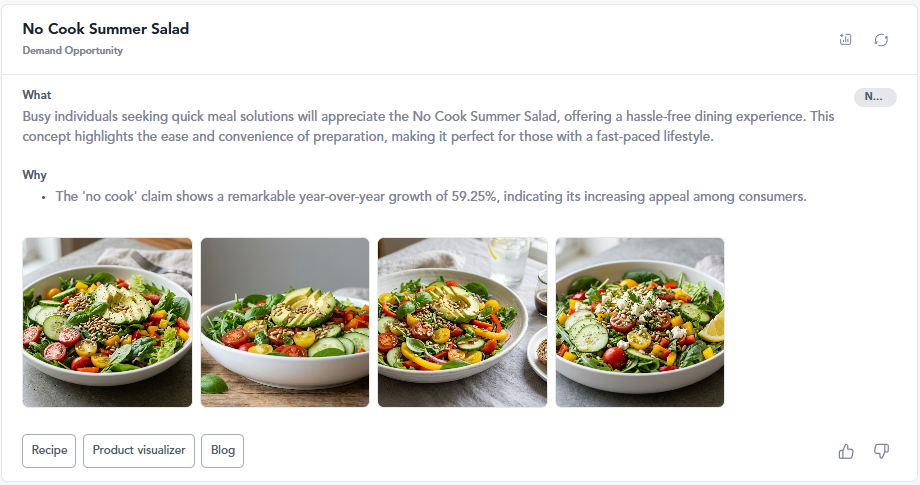
The summer salad category in Germany is still in early-stage commercial development. Almost every ingredient and dish signal in the Tastewise dataset sits in the early lifecycle stage. That means the category is building momentum but has not yet been commercially claimed by a dominant brand or format. The window to lead is open.
The signals pointing toward 2027 are already visible. “Girl dinner” as a consumer motivation is growing at +64.7% from a niche base. It describes a consumption occasion, not just a dish: one curated, ingredient-forward plate that replaces a meal and photographs beautifully. That format has shaped entire retail categories in the US and UK. In Germany, it is still nascent. Brands that build for that occasion now, with premium ingredient combinations and deliberate presentation, will own the category moment before the mainstream follows. The summer food trends insights blog maps how these seasonal signals typically move from early consumer adoption into mainstream commercial opportunity.
Hyper-seasonal and locality-specific salad formats will also become more prominent as German retailers increase their frequency of shelf resets. Always-on consumer intelligence, like the kind the Tastewise platform provides, means your team does not have to wait for an annual planning cycle to spot these movements. The data is available now. The brief can start today.
FAQs about summer salad trends in Germany
Cherry tomatoes are the fastest-growing ingredient in Germany’s summer salad category, up +120% in the past 12 months. Fresh herbs are close behind at +88.8%, followed by shrimp at +82.85%, lime at +72.3%, and peach at +62%. These five ingredients together point toward a Mediterranean and protein-forward direction that has strong momentum and limited brand ownership at retail.
The consumer motivation data shows “fresh” growing at +15.1% and “Mediterranean” at +15% in Germany’s summer salad category. Dishes like Panzanella and Caprese have very high social index scores (253.9 and 36.2 respectively), meaning they over-index among Germany’s most engaged food consumers. The appeal is flavour density combined with ease. Consumers want salads that feel chef-inspired without requiring chef-level preparation. That is the brief Mediterranean formats answer better than most alternatives.
The strongest retail sell-in stories in this category start with ingredient-level consumer signals scoped to the buyer’s specific region or banner. Cherry tomato growth at +120%, burrata’s social index of 47.2, and the creamy texture motivation growing at +36.7% are three data points that connect consumer behaviour directly to category opportunity. When you walk in with regional data rather than national averages, you are showing the buyer their specific shopper, not a generic German consumer. That conversation changes how the meeting ends.

We’d love to learn your goals and see how Tastewise fits
We’d love to learn your goals and see how Tastewise fits
Get a personalized demo
Good taste. Wise move.
Your demo request is confirmed. We’ll reach out within one business day to schedule your walkthrough.
What happens next

See what’s driving demand, then turn it into a sell-in story for retailers and operators.
- Connect consumer panels, market trackers, and agents into one evidence view
- Get the “why” behind what’s changing, with explainable demand drivers
- Walk away with a buyer-ready narrative and next steps to activate
Trusted by





“Tastewise is my secret tool for knowing what consumers want next and why.“