





The UK premium drinks aisle is undergoing a quiet but decisive reset this summer. Mango bubble tea has moved beyond a niche café format and into a category that retail buyers are watching closely, as dish volumes in the bubble tea and boba space across UK operators have grown 10.4% in the past year. Consumer demand is accelerating even as some of the broader bubble tea signals consolidate. Beverage brands that can translate this momentum into a shelf-ready proposition will find an audience that is already waiting. Tastewise data shows the consumer story is clear. What most brands have not yet done is package it into a pitch that lands.
Key takeaways
- Dish volumes for bubble tea and boba across UK operators are up 10.4% in the past year, while mango is the fastest-growing fruit ingredient in the mango bubble tea space at +12.7% growth, with a 6.31% consumer share. Your innovation team should treat mango as the anchor flavour, not an extension.
- Brown sugar bubble tea retains a 5.70% menu share but consumer growth has stalled at +2.9%. The format has mainstream reach but lacks momentum. Mango fills the gap with flavour energy that brown sugar no longer provides.
- The refreshing claim leads mango bubble tea consumer motivations at 25.95% share and is still growing at +4.2%. Convenience is up 43.9%. Your retail brief should lead with everyday refreshment, not occasion-based indulgence.
- Matcha is the rising modifier in the broader bubble tea space, up 56.3% and entering the emerging lifecycle stage. A mango-matcha crossover SKU sits at the intersection of the two strongest growth signals in the category. That is a brief your R&D team can run tomorrow.
Mango bubble tea and what is driving it in the UK right now
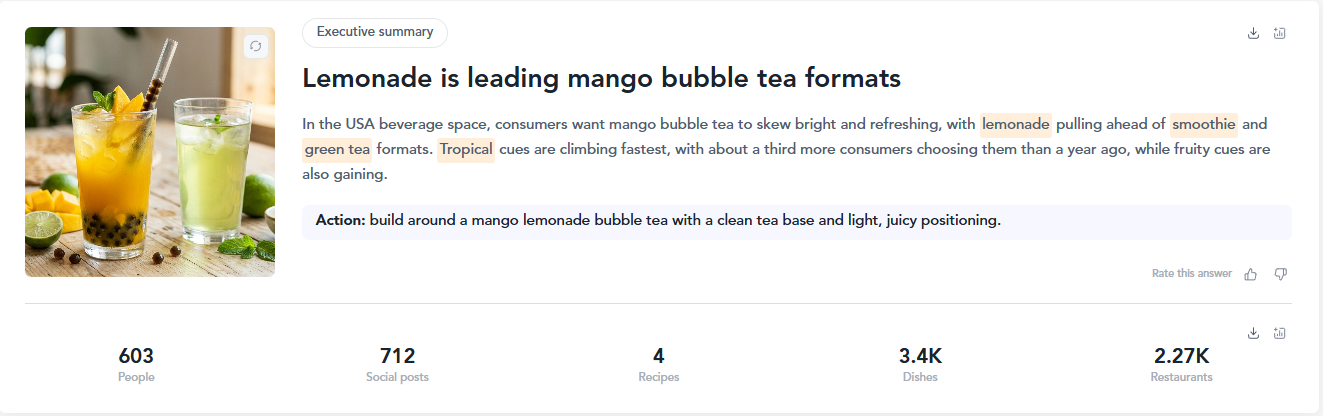
Consumers are not looking for a novelty drink. They are looking for a refreshing, tropical-led beverage that feels slightly elevated without requiring effort. Mango bubble tea satisfies that brief exactly. It is fruity, familiar enough to reduce risk, and visually distinctive enough to perform on shelf and on a food delivery thumbnail. The consumer who orders it on a Tuesday afternoon via Uber Eats and the shopper who picks up an RTD from the chilled aisle are often the same person. This is not a foodservice-only play.
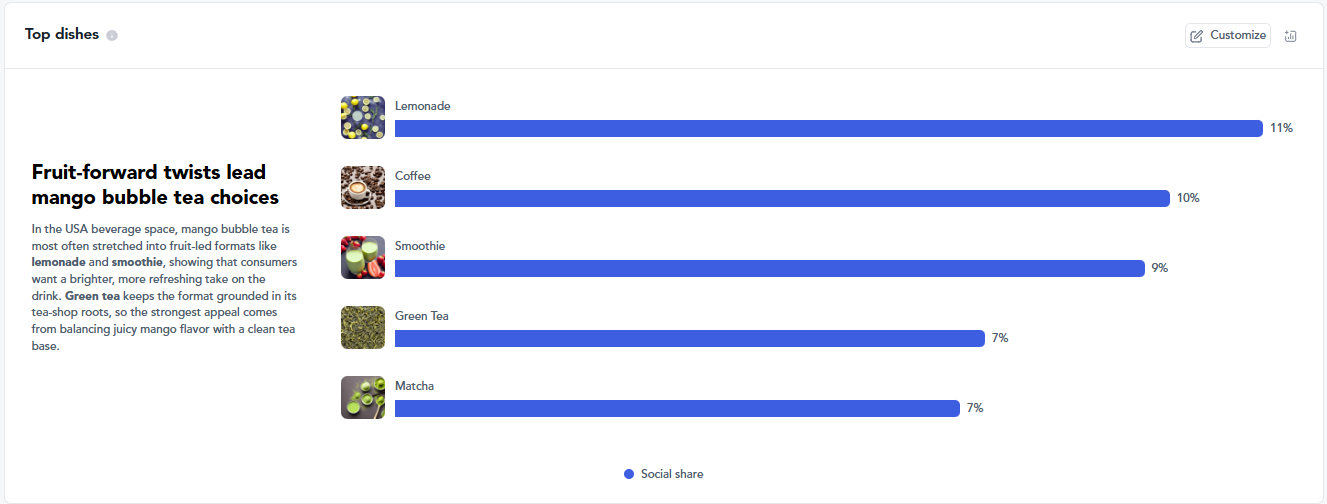
Tastewise data for the UK bubble tea and boba category shows mango at 6.31% consumer share, up 12.7% in the past 12 months, making it the standout fruit signal in the category. Refreshing leads consumer motivations at 25.95% share. Sweet is growing at +30.7%. Convenient has climbed 43.9%, signalling that the consumption moment is shifting from a special-occasion experience to a repeatable everyday choice. On the operator side, mango appears across 6,566 menu items in the UK, with mango passion fruit sitting at 8.50% menu share among the top operator combinations. The format is proven. The consumer is ready.
For beverage brands, this creates a very specific window. The broad bubble tea category is beginning to mature in some formats, but mango-led builds are still in the early lifecycle stage with room to grow before the segment is crowded. The opportunity is to move into that space now with a proposition built around real consumer evidence, before a retailer’s own-label offer fills the gap. The summer food trends 2026 report outlines where this sits within the broader seasonal drinks landscape.
Extracting value from indulgence in the 2026 beverage reset
UK retail buyers and grocery category managers are under pressure to prove incremental distribution, not simply swap one SKU for another. A new bubble tea line has to demonstrate that it will attract net-new basket spend and bring in a consumer who is not already buying from the existing assortment. That is the question your sales team will face in the room, and the answer has to be in the data before you walk in.
Mango bubble tea answers that question directly. The indulgent claim sits at 11.45% consumer share in the mango bubble tea space, up +4.0%. But the more important signal is the convenient motivation, up 43.9%. A drink positioned as a Tuesday afternoon treat rather than a weekend indulgence is not cannibalising the premium soft drink lines. It is opening a new consumption occasion entirely. Buyers want to see that story in your pitch, not just a flavour brief.
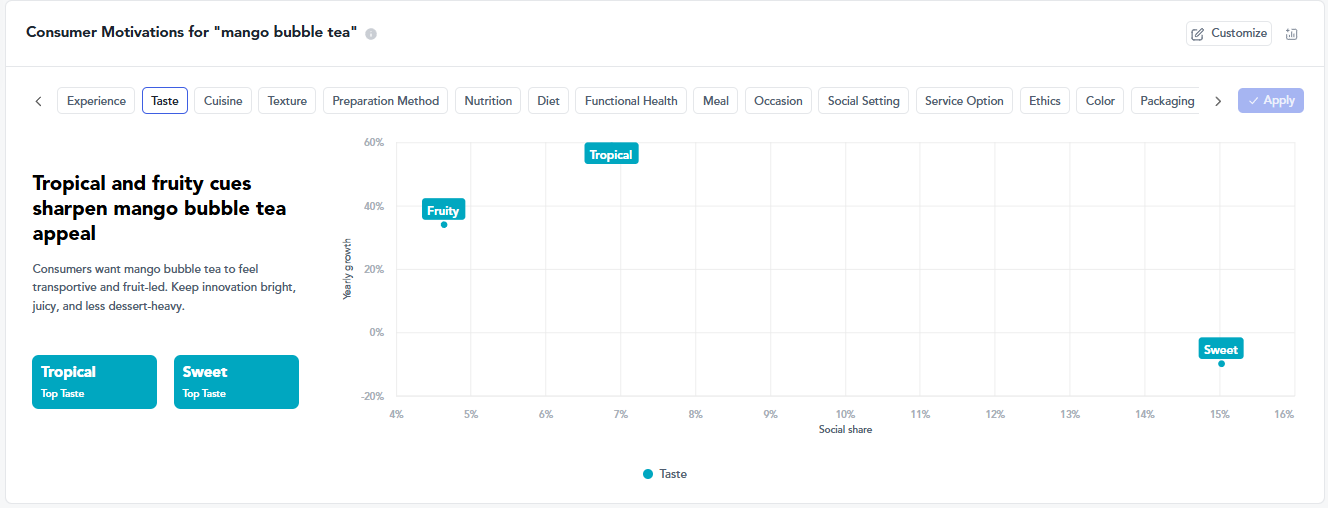
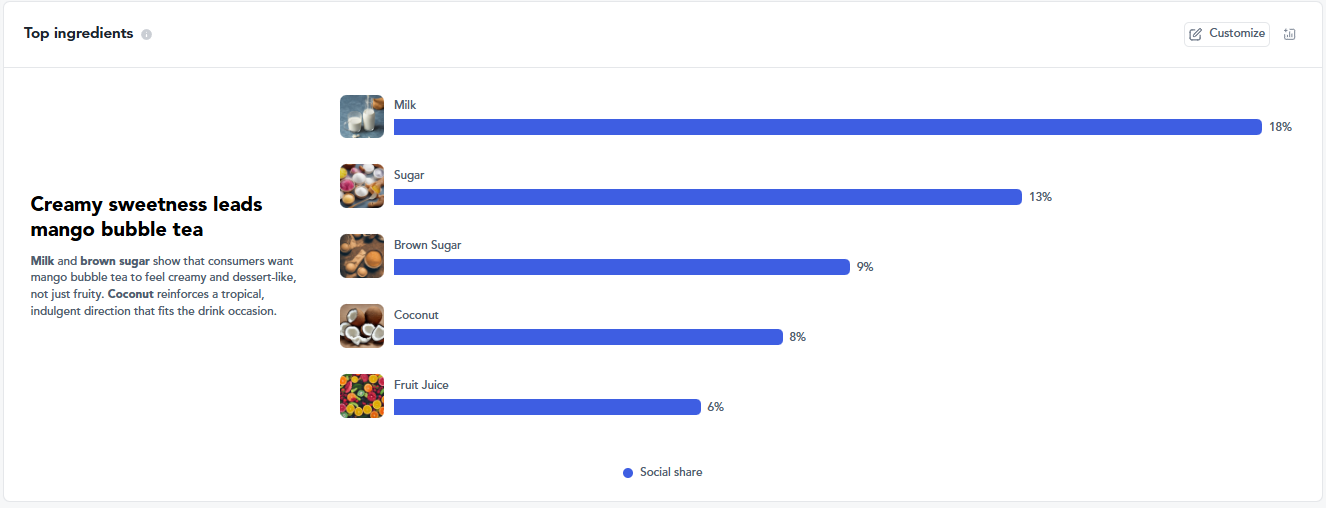
The dessert signal is growing at +55.9% in the mango bubble tea space, and fruity is up +20.6%. These two growing together tell you that the consumer is treating this as a permissible treat that doubles as a flavour experience. That is a different shelf position from a standard juice or flavoured water, and it supports a premium price point without alienating the everyday shopper. Your category story should frame mango bubble tea as incremental to the chilled drinks aisle, not adjacent to it.
Uncovering consumer whitespace for clean-label mango bubble tea
The whitespace in mango bubble tea is not about finding an underserved flavour. Mango is already the lead signal. The whitespace is about format and label. The real fruit claim is growing at +32.8% in this space. Natural is at +10.6%. Sugar free is up +14.2%. Consumers are drawn to the category for its flavour, but they want to feel that what they are drinking is honest about its ingredients. That is the clean-label gap that most current formats are not filling.
The matcha and bubble tea crossover is the most instructive signal in the data. Matcha as an ingredient in the broader bubble tea category is up 56.3% and has crossed into the emerging lifecycle stage. In the mango bubble tea space specifically, matcha sits at 12.21% consumer share with +52.4% growth. A mango-matcha RTD positions itself at the intersection of tropical refreshment and functional credibility. That is a proposition that earns premium shelf space and gives your sales team a clean differentiation story against standard boba formats.
Jelly as a topping modifier is up 55.9% in the mango bubble tea space, and fruit jelly is up 117.2%. This points to texture-led innovation as a specific whitespace. A mango bubble tea with fruit jelly rather than tapioca pearls signals a cleaner, lighter format that speaks to the same refreshing and natural motivations but removes the tapioca association for consumers who find it off-putting. That is an RTD brief that your innovation team can validate quickly against the consumer signal, without guessing.
How to craft an unshakeable buyer story for mango bubble tea
The buyer does not want to know that mango bubble tea is trending. They want to know why this specific SKU will perform in their specific store. Your pitch has to move from category signal to shelf story in under three minutes, and every step has to be backed by evidence that holds up when they push back.
Start with the consumer motivation, not the product. Refreshing at 25.95% share and growing. Sweet up 30.7%. Convenient up 43.9%. These three together describe a consumer who is choosing mango bubble tea on regular shopping missions, not just impulse occasions. That is a velocity story, not a novelty story, and it is the difference between a 12-week trial listing and a permanent range slot.
Then move to the format proof. Mango passion fruit at 8.50% menu share in UK operators. Brown sugar bubble tea at 5.70% menu share, still significant, but growing at only +2.9% compared to mango’s +12.7%. That comparison shows the buyer that the category is in transition and that mango is where the growth is going. Your SKU is not chasing a trend. It is arriving at the right moment in a proven format cycle. The Tastewise food and beverage trend forecast provides the category context your team needs to make that case with evidence behind it.
Using category analytics to prove the brand deserves premium placement
Premium placement is earned, not negotiated. Retail buyers at major UK grocery chains are managing tight footprint decisions and they allocate premium shelf space to brands that can demonstrate, with data, that their SKU will drive category value rather than simply redistribute it. The consumer motivations signal in mango bubble tea makes this case clearly.
The premium claim in the mango bubble tea space is up 47.6%. Artisan is up 69.4%. Limited edition is up 56.5%. These signals together suggest that the consumer who is buying mango bubble tea is actively choosing a product they feel is a step above the standard soft drink. They are willing to pay for that positioning. For a brand pitching a chilled RTD at a premium price point, this is exactly the evidence that converts a buyer’s caution into a listing.
The kids motivation is up 75.7% in this space, which also matters for shelf strategy. A product that appeals across age groups within a single household removes the one-occasion-per-trip limitation and increases the probability of a repeat purchase. That is a basket-building argument your category manager can take to the range review. Position mango bubble tea not as a single-consumer play but as the household refreshment upgrade that earns space in the cart every week.
Regional relevance and localized demand for mango bubble tea
The UK is not one market. A bubble tea brand that performs in urban London will not automatically replicate that performance in the North West or Scotland without understanding where the consumer base differs. UK operator data shows that mango bubble tea is currently concentrated in delivery-platform restaurant operators in London, Birmingham, and other urban centres with high South and East Asian community density. That is a strong foundation but it is not where retail growth will come from.
The summer claim sits at 16.56% share in mango bubble tea motivations. Hot weather is up 19.5%. Outdoor dining is up 7.4%. These signals point to a summer seasonal window that maps differently across UK regions. A brand targeting national retail distribution needs to understand that the warm-weather consumption trigger arrives earlier and lasts longer in the South, while the convenience and everyday motivations carry more weight in regions with shorter summer windows.
Regional flavour variation is also worth considering in your innovation brief. The mango lychee combination appears at 4.70% menu share among UK operators. Mango passion fruit is at 13.70%. These sub-formats perform differently across regions depending on the demographic profile of the consumer base. A range architecture that includes both a mainstream mango passion fruit and a more adventurous mango lychee option gives your retail sales team the flexibility to tailor the pitch to account-specific opportunities rather than relying on a generic national range story.
Micro-market targeting for British beverage trends across regional and national footprints
UK supermarket buyers manage highly specific store clusters and regional assortments. A range that performs in a south-east London Sainsbury’s will require a different validation story for a Tesco in Leeds or a Waitrose in Edinburgh. The risk for beverage brands is pitching a national story when the demand signal is geographically concentrated, and having the buyer push back with their own store-level data.
Account-specific validation means going into the pitch with geo-filtered consumer data that maps the demand signal to the buyer’s specific store universe. The convenience motivation up 43.9% is nationally consistent but the tropical and fruity claims are stronger in urban multicultural markets. Knowing which signals carry weight in which region allows your sales team to build a different opening narrative for each account without changing the core product. That is the difference between a pitch that gets a trial listing in five stores and one that secures a national rollout from day one.
The operator data across the UK shows 5,473 restaurants currently carrying bubble tea or boba formats, with mango-led variants heavily concentrated in delivery platforms. That operator footprint is a signal of where the consumer is already engaged with the format. Retail brands that target grocery stores in proximity to high-density bubble tea operator locations are pitching to a consumer who already knows the category and is primed to convert to a retail format. That is a geo-insight worth building into your channel strategy before you walk into the first buyer meeting. The retail sales strategy page shows how leading brands are building that kind of account-specific evidence.
What this means for beverage brands in 2026
The data resolves to a set of clear jobs to be done, depending on where your team sits.
- For innovation and R&D: Mango is the anchor flavour, matcha is the fastest-growing modifier, and fruit jelly is the emerging topping format. Your next mango bubble tea brief does not need to start from scratch. The consumer signals point to a mango-matcha RTD with a fruit jelly inclusion as the whitespace that most current formats are not filling.
- For category managers: Defend your shelf footprint by showing the buyer that mango bubble tea increases total basket value rather than switching volume from adjacent lines. The convenience signal up 43.9% is your argument that this is an additive purchase, not a substitution.
- For marketing managers: The refreshing and summer claims are growing in parallel. Your campaign window is May to August. A mango bubble tea launch brief built around everyday summer refreshment, with real fruit credentials, reaches a consumer who is already in the mindset. That brief should be ready now.
- For sales teams: Lead with the category transition story. Brown sugar bubble tea at +2.9% versus mango at +12.7% gives you a before-and-after narrative that every buyer will understand. The category is moving and your brand is positioned to lead that move.
Looking ahead to 2027 shelf resets with predictive data
The next shelf reset cycle will not wait for brands that are still relying on historical sales data. UK grocery buyers are already moving toward more frequent, data-informed range reviews, and private-label teams are watching the same consumer signals that brand teams are. The brands that defend their listings in 2027 will be the ones that are running always-on consumer intelligence now, not pulling a quarterly data report and reacting to it.
The signals in mango bubble tea that are currently in the early lifecycle stage, matcha, fruit jelly, mango lychee, will reach peak consumer visibility within 12 to 18 months. By the time those signals show up in retail sales data, the listing window for new entrants will have narrowed significantly. The brands that will hold premium space through the 2027 reset are those that are building their range strategy on forward-looking consumer signals rather than trailing indicators.
The agentic AI intelligence layer that powers always-on category monitoring is what separates a brand that reacts to the shelf reset from one that shapes it. If your team is still waiting for the quarterly data cycle to inform your next innovation brief, the 2027 window is already closing. The consumer is not waiting. Your range strategy should not be either.
FAQs about mango bubble tea
Mango sits at the intersection of the strongest consumer motivations in the UK premium drinks category: refreshing, sweet, and convenient. Tastewise data shows the mango ingredient in the bubble tea space growing at +12.7% in the past 12 months, ahead of most other fruit variants. The passion fruit and lychee pairings that amplify mango are also growing, which means the flavour system has room to extend across a range rather than sitting as a single SKU. The combination of familiar tropical appeal and a strong operator precedent, with mango passion fruit at 13.70% menu share among UK operators, means that retail brands are entering a category the UK consumer already understands.
Retail shelf resets are won before the meeting, not in it. Brands that arrive with geo-specific consumer demand signals, a clear category transition story, and a flavour pipeline mapped to the emerging lifecycle stage have a materially stronger listing case than brands relying on trailing sales performance. The mango bubble tea whitespace data shows that consumer demand is ahead of brand response. Brands that act on that gap now, with format-level evidence for the buyer and an account-specific pitch for each retail banner, are positioned to earn and hold premium space through both reset cycles. Consumer marketing strategy built on always-on intelligence is how leading F&B brands are doing this today.
The UK bubble tea market report by Fortune Business Insights values the UK bubble tea market at USD 68.17 million in 2024 and projects it to reach USD 118.95 million by 2032, a compound annual growth rate of 7.21%. That structural market growth sits directly underneath the Tastewise real-time signal, which shows UK operator dish volumes up 10.4% in the past 12 months and mango growing at +12.7% within the category. The market-level trajectory and the consumer-level signal are pointing in the same direction. Brands that move now on mango bubble tea are entering a category with both structural tailwind and live consumer demand behind it.



We’d love to learn your goals and see how Tastewise fits
We’d love to learn your goals and see how Tastewise fits
Get a personalized demo
Good taste. Wise move.
Your demo request is confirmed. We’ll reach out within one business day to schedule your walkthrough.
What happens next

See what’s driving demand, then turn it into a sell-in story for retailers and operators.
- Connect consumer panels, market trackers, and agents into one evidence view
- Get the “why” behind what’s changing, with explainable demand drivers
- Walk away with a buyer-ready narrative and next steps to activate
Trusted by





“Tastewise is my secret tool for knowing what consumers want next and why.“