





Food product innovation has never been harder to time. Consumer preferences move in weeks, shelves are more crowded than ever, and the reports most teams rely on describe demand that has already peaked. If you plan your next launch from quarterly sales data, you are reading yesterday’s market. The teams pulling ahead have changed where they look. They track live consumer demand as it forms, then move before the trend becomes obvious to everyone else.
Key takeaways
- Most new food product launches do not survive their first two years. Build on live demand signals rather than internal opinion and you improve the odds before you commit R&D budget.
- Leading indicators, like home cooking behaviour and new menu additions, move months ahead of sales data. Watching them gives your team a head start that competitors reading sales reports will not have.
- Real results back this up. Givaudan reached a 10× faster pitch turnaround and Mademoiselle Desserts saw a 145% post-launch sales increase after grounding decisions in real demand.
- A real-time consumer intelligence dashboard connects panels, menus, and retail data in one view. Your team spends its time deciding, not assembling the evidence.
What is happening in food product innovation right now
Food product innovation is shifting from gut feel to demand evidence. Buyers, boards, and category reviews now expect proof that consumers actually want a concept before it reaches a shelf or a menu. That pressure is real, because new food product launches mostly disappear within two years. The cost of guessing wrong keeps climbing.
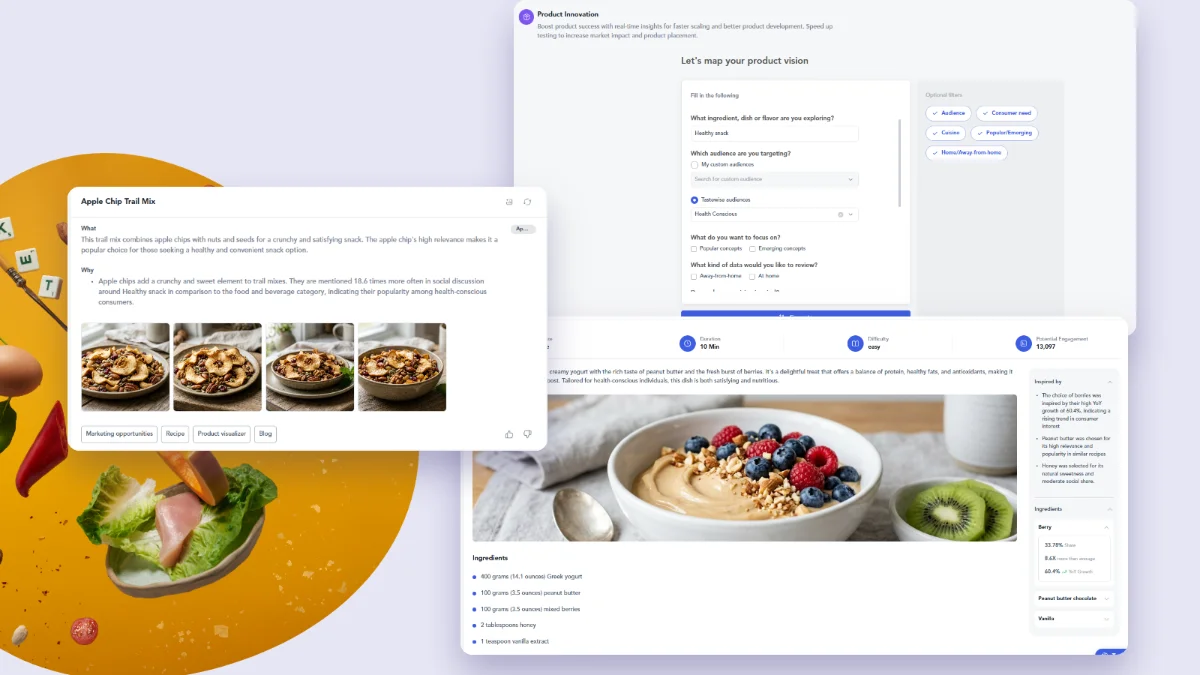
The evidence teams need is already forming in consumer behaviour. As the agentic intelligence system for food and beverage, the Tastewise platform reads live signals across consumer panels, foodservice menus, retail performance, and home cooking. It classifies where demand sits on the trend lifecycle, from emerging to fading, so you can tell a building opportunity from a saturating one. This is what people mean when they search for real-time consumer intelligence dashboards.
The opportunity is timing. When you can see a flavour, format, or occasion gaining momentum before it surfaces in sales data, your team can move into it while there is still whitespace to own. That head start is the difference between leading a category shift and reacting to one. It turns product innovation from a bet into a defensible decision.
How AI-powered trend prediction drives food product innovation
AI-powered trend prediction is the process of identifying where consumer demand is heading before it becomes obvious in sales data. It works by reading leading behavioural signals across channels at the same time. When multiple signals align around one flavour, format, or occasion, the system flags it as an accelerating trend you can act on with confidence.
From signals to predictions
Tastewise reads real-time market signals rather than delayed surveys, across millions of data points including digital menu additions, retail velocity, social signals, and home cooking recipes. The AI finds patterns that tend to precede mainstream adoption. That means you see what is building momentum long before it shows up at the point of sale.
Leading vs lagging indicators
Traditional market reports rely on lagging indicators, the historical sales data that reflects what shoppers bought months ago. A real-time approach is built on leading indicators instead, like early menu appearances and rising consumer interest. Focusing on leading indicators gives your team a multi-month head start on emerging trend detection.
The prediction model
The forecasting engine cross-references demand signals across channels together. When an ingredient appears in home cooking conversations, gains traction on independent menus, and starts taking retail space at the same time, the system surfaces it with directional confidence. You get a read on where the market is going, not just a snapshot of where it has been.
Trend lifecycle analysis
Tastewise sorts trends into clear stages through trend lifecycle analysis: emerging, accelerating, plateauing, and fading. This helps your team time market entry accurately. Launching into an accelerating trend rather than a saturating one changes the commercial return, so the stage matters as much as the trend itself.
The human expertise layer
The models are reinforced by more than 300,000 hours of human food and beverage expertise. Specialists validate the AI outputs so predictions stay grounded in real culinary context and commercial feasibility. You get direction that is checked by people who know the category, not pattern-matching alone.
Who offers real-time consumer intelligence dashboards?

Tastewise is the real-time consumer intelligence dashboard built specifically for food and beverage. Many broad market intelligence platforms report on categories after the fact. A food-first system is designed to read demand as it forms and translate it into a decision.
When you evaluate food and beverage market intelligence dashboard tools, three questions separate the real options. First, does it ingest live signals, or does it lean on periodic surveys and historical sales. Second, how deep is its menu and foodservice coverage, since operators often move before retail does. Third, can it classify a trend by lifecycle stage, so you know whether demand is building or fading. Tastewise is built around all three, powered by agentic AI that connects the signals for you.
Key terms in AI-powered food trend prediction
What is a real-time consumer intelligence dashboard?
A real-time consumer intelligence dashboard is a software platform that pulls live behavioural signals, including foodservice menu additions, retail velocity, home cooking activity, and social content, into a single view that updates continuously. Unlike traditional research tools that deliver periodic reports, it reflects demand as it forms. For food and beverage teams, that means decisions grounded in what consumers are doing now, not what they did last quarter.
What is AI-powered trend prediction?
AI-powered trend prediction uses machine learning to spot patterns in consumer behaviour that precede mainstream adoption. The model cross-references several data streams at once, menus, retail, social signals, and home recipes, and surfaces trends gaining momentum before they reach sales reports. The result is a directional forecast that gives product teams a head start measured in months rather than weeks.
What is trend lifecycle analysis?
Trend lifecycle analysis classifies a food or beverage trend into one of four stages: emerging, accelerating, plateauing, or fading. Knowing the stage is as important as knowing the trend. A team launching into an accelerating trend faces less competition and more upside than one launching into a saturating one. Lifecycle analysis turns a trend signal into a timing decision.
What are leading indicators in food trend forecasting?
Leading indicators are signals that historically precede mainstream adoption. In food and beverage they include early appearances of an ingredient on independent menus, spikes in home cooking activity around a flavour, and rising consumer conversation. These signals tend to move several months ahead of retail sales data, which is the head start teams that watch them gain.
What are lagging indicators, and why do they limit traditional research?
Lagging indicators reflect what has already happened, mainly historical sales, periodic panels, and syndicated retail reports. Most traditional market research is built on them. By the time a trend shows up in sales data, the early-mover window has usually closed, so teams relying on lagging indicators are making forward-looking decisions on backward-looking evidence.
What is the difference between emerging and accelerating trends?
An emerging trend shows early signals in one or two channels while adoption is still limited. An accelerating trend shows alignment across several channels at once, menus, retail, and home cooking, with adoption growing quickly. The difference is commercial: emerging trends carry higher risk and higher potential reward, while accelerating trends offer more confidence inside a narrowing window of whitespace.
How teams use real-time consumer intelligence dashboards for food product innovation
The scenarios below are illustrative examples of how a team like yours might work. The named customer results, from Givaudan, Tree House Foods, and Mademoiselle Desserts, are real and verified. The surrounding team situations are hypothetical.
What is driving category growth right now?
Best for: category directors, insights leads, brand strategists
Say your core snack portfolio is losing share and nobody can agree why. A real-time consumer intelligence dashboard shows which occasions, claims, and ingredients are pulling demand across panels, menus, and retail at once. You walk into the category review with a clear read on what is real versus noise. Working from real demand evidence, Tree House Foods opened 25% more sales opportunities, as the Tree House Foods story shows.
Where is the whitespace opportunity?
Best for: R&D leads, innovation managers, flavour developers
Imagine your team wants to move on functional hydration before the shelf fills up. The dashboard cross-references home recipe behaviour and beverage menus to show where consumer demand is building but supply is still thin. That gives you a defensible direction to develop against, rather than a hunch. You act while the space is still open, not once every rival has arrived.
What should you launch next?
Best for: innovation teams, product managers, CPG brand leads
Picture a room full of strong opinions and no external proof. Validating each concept against real consumer behaviour shows which flavours are accelerating, which are taking menu share, and which are already saturated. Decisions get faster because the direction is grounded in demand, not internal consensus. Mademoiselle Desserts saw a 145% post-launch sales increase after grounding a launch this way, detailed in the Mademoiselle Desserts story.
Which products deserve shelf or menu placement?
Best for: trade marketing managers, category planners, brokers
Suppose you need to convince a regional buyer that a new line earns eye-level space. Localised demand signals let you show where consumer interest is outpacing what is currently on shelf in that market. The pitch stops being about opinion and starts being about evidence the buyer can trust. That is the case that moves a review from maybe to yes.
How do you build a sell-in story that lands?
Best for: sales directors, retail account managers, commercial leads
Enterprise buyers want forward-looking proof, not another historical panel. A dashboard turns live signals into a clear narrative about why a SKU will drive incremental demand. Your team builds retailer-ready stories in hours instead of days. Givaudan reached a 10× faster pitch turnaround working this way, shown in Givaudan’s results.
See where demand is heading next

Your planning window is open now. The teams that read live demand first are the ones who own the next launch.
FAQs about product innovation for F&B
It reads leading consumer signals across menus, retail, home cooking, and social behaviour at the same time, then flags where demand is accelerating before it shows up in sales data. The 2026 trend forecast is one example of that analysis applied across markets.
Traditional research is periodic and backward-looking, so it tells you what already happened. A real-time consumer intelligence dashboard reads live behaviour, so it tells you what is building now and lets your team act while the opportunity is still open.
It watches leading indicators, like a flavour appearing in home recipes and on independent menus before any major chain adopts it. When those early signals align across channels, the system surfaces the trend as emerging, giving your team a head start on it.
A comprehensive platform ingests foodservice menus from both independent and chain operators, retail point-of-sale velocity, home cooking and recipe activity, consumer panel surveys, and social content. The breadth matters because trends often emerge in one channel, usually independent foodservice, before they migrate to retail. A platform reading only one channel will consistently lag one that cross-references all of them at once.
Accuracy depends on the breadth and quality of the underlying data and the sophistication of the model. Platforms reinforced with domain expertise, such as those validated by food and beverage specialists, outperform pure pattern-matching because culinary context filters out signals that look statistically significant but are commercially irrelevant. Real outcomes, like Mademoiselle Desserts’ 145% post-launch sales increase and Givaudan’s 10x faster pitch turnaround, reflect the value of well-calibrated predictions.
Most teams reach useful insight within their first session, since live trend data is available as soon as they log in. Meaningful outcomes, such as validating a concept, building a retailer pitch, or identifying whitespace, usually emerge within the first few weeks. That is far faster than traditional research cycles, which can take months to produce a usable report.
The platform serves several functions. R&D and innovation teams validate concepts and find whitespace. Category directors and insights leads see what is driving or eroding portfolio performance. Sales and trade marketing teams build forward-looking retailer sell-in stories. Brand strategists align campaigns with rising occasions and claims. The common thread is any team making a decision that should be grounded in current consumer demand.
Social listening monitors conversation volume and sentiment, which is one signal among many. AI-powered trend prediction for food and beverage reads social alongside foodservice menu data, retail velocity, and home cooking behaviour, then applies a forecasting model to find where signals converge. That multi-channel approach reduces false positives, trends that look like they are building online but have no traction in purchasing.
It works best as a complement to traditional research, not a replacement. Focus groups and quantitative panels give depth on attitudes and motivations. A real-time dashboard gives breadth and speed, showing what consumers are actually doing across millions of data points in near real time. Used together, they give teams both the what and the why behind shifting demand.




We’d love to learn your goals and see how Tastewise fits
We’d love to learn your goals and see how Tastewise fits
Get a personalized demo
Good taste. Wise move.
Your demo request is confirmed. We’ll reach out within one business day to schedule your walkthrough.
What happens next

See what’s driving demand, then turn it into a sell-in story for retailers and operators.
- Connect consumer panels, market trackers, and agents into one evidence view
- Get the “why” behind what’s changing, with explainable demand drivers
- Walk away with a buyer-ready narrative and next steps to activate
Trusted by




“Tastewise is my secret tool for knowing what consumers want next and why.“