
Business
Extending Cold Weather Demand with Winter Solstice Food


Winter solstice food is what people eat to mark the longest night of the year. In 2026, the solstice lands on Monday, December 21, at 3:50 p.m. Eastern in the US. The dishes that mark it are warm and shared, from dumplings and sticky rice balls to porridge and spiced drinks.
Those cravings outlast the holidays. Across the Tastewise US consumer panel from December 2025 to February 2026, soup reached nearly 1 in 3 consumers who engaged with winter comfort food (34%).
Key takeaways
- Dongzhi, the Chinese winter solstice festival, falls on December 22 in China in 2026, with dumplings in the north and tangyuan in the south.
- About 1 in 3 US consumers who engaged with winter comfort food last season described it as cozy (33%).
- Cozy-framed comfort food reached new consumers 2x faster than holiday-framed comfort food, at 117% growth against 58%.
- Latte (+68%) and chai (+51%) were the fastest-growing winter drinks, while mulled wine fell 22%.
- Dumplings appear on nearly 1 in 7 US restaurant menus (14%), and that menu share climbed every month from December to February.
- Nearly 3 in 5 dumpling products on US shelves carry a frozen claim (61%), and only about 1 in 8 sit in the soup aisle (12%).
Winter solstice food traditions around the world
Traditional winter solstice food is warm, round or made to share. Families share dumplings, rice balls, porridge and fruit to welcome back longer days. Winter solstice celebrations from Beijing to Tehran center on a family meal.
Dongzhi and winter solstice Chinese food
Dongzhi is the Chinese winter solstice festival, held between December 21 and 23. Northern families eat jiaozi dumplings, tied to an old saying that dumplings keep your ears from freezing. Southern families roll tangyuan, glutinous rice balls served in sweet or savory soup. Some northern homes add mutton soup or mutton hot pot to keep out the cold.
Yalda, Dongji, Toji and Yule
Iran marks Yalda night with pomegranates, watermelon and nuts. Korea celebrates Dongji with patjuk, a red bean porridge. In Japan, Toji means kabocha squash and a hot yuzu bath. Scandinavian Yule, now folded into Christmas, brings rice porridge and spiced breads.
US consumers already know this winter solstice food. Nearly 1 in 2 US consumers who engaged with dumplings last winter framed them as Chinese food (49%). Soup came up for nearly 1 in 4 of them (27%). That gives your brand a cultural reason to feature dumplings and soup before Christmas.
Cold-weather flavors consumers reach for
Winter solstice food and drink leans on soup, broth, slow cooking and hot drinks. Among US consumers who engaged with winter comfort food last season, broth came up for nearly 1 in 8 (12%).
The soup mix is shifting. Butternut squash soup grew 109% and bisque grew 101%, while seafood stew rose 55% and chowder rose 24%. Tomato soup and chicken noodle soup each fell 31%.
Need claims are moving even faster. Slow cooked (+255%), nourishing (+237%) and warming (+207%) all outpaced cozy (+117%).
Hot drinks follow the same pattern. Latte grew 68%, chai 51%, coffee 32% and hot chocolate 14%. Mulled wine fell 22% and herbal tea fell 47%. Peppermint, the flavor of candy cane treats, grew 68%. Gingerbread rose 49%, pear 56% and cranberry 31%, while nutmeg dropped 52%.
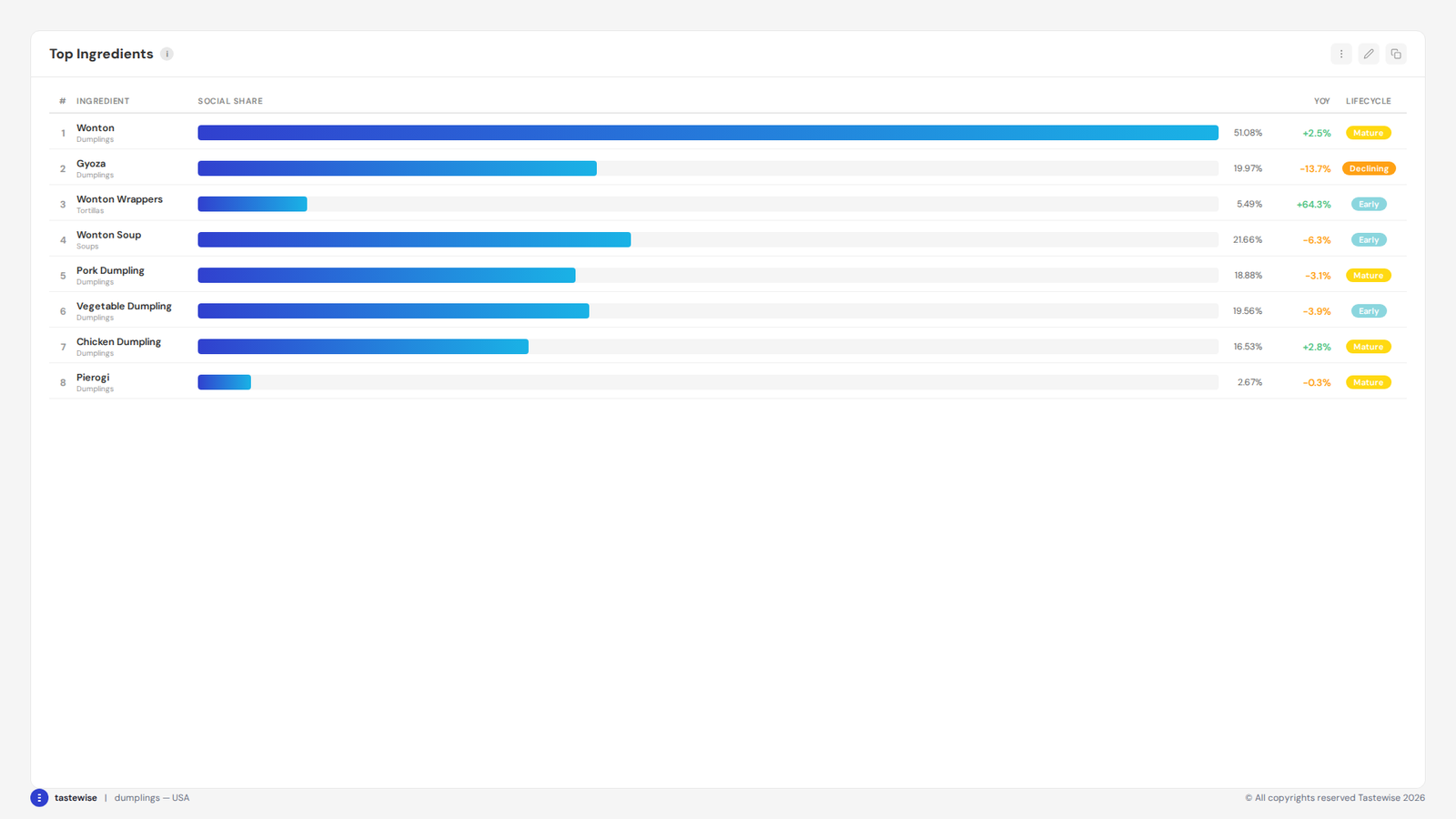
Dumplings pick up new flavor too. Among consumers who engaged with dumplings, white pepper grew 76%, chili crisp 65% and sesame oil 43%. Wonton wrappers rose 64% as more people fold dumplings at home.
Winter solstice food ideas for menus and shelves

Strong winter solstice food ideas include dumpling soup, tangyuan in ginger broth and lamb hot pot. Red bean porridge, kabocha dishes and pomegranate desserts work too.
Menu ideas for foodservice
Dumplings appear on nearly 1 in 7 US restaurant menus (14%), and that share rose every month from December to February. Casual dining and midscale restaurants over-index on them. Din Tai Fung sells kurobuta pork xiao long bao at $17.50. The Night Market offers taro and black sesame tangyuan soup at $8.75, and Mekong Palace a Hong Kong lamb stew hot pot at $36.99.
For foodservice operators, run a dumpling soup LTO on December 21 and 22. Add a tangyuan dessert in ginger broth, and keep both through Lunar New Year.
Shelf ideas for retail
Tastewise tracks 350 dumpling products from 141 brands on US shelves, at an average price of $7.51. Bibigo leads with 27 products, and its frozen Mini Wontons hold a 4.7 rating across more than 8,600 reviews.
Nearly 3 in 5 of these products carry a frozen claim (61%), and 2 in 5 sit in appetizers and snacks (40%). Only about 1 in 8 sit in soup, broth and stock (12%). That gap is your opening: a dumpling and broth bundle for solstice soup night gives your retail sell-in a seasonal story buyers can merchandise.
Extending seasonal demand from December into February
Brands extend winter demand after the holidays by framing products around cold weather and comfort, which last until spring.
The data backs the shift. Among US consumers who engaged with winter comfort food last season, cozy framing grew 117% and cold-weather framing grew 91%. Holiday framing grew 58% and Christmas framing 36%. Cozy reached new consumers 2x faster than holiday.
Dumplings show how one dish can carry the whole season. Consumer engagement with dumplings climbed steadily from December through February, linking Dongzhi on December 22 to Lunar New Year on February 6, 2027. Plan both moments together with your Chinese New Year menus.
Three moves help your team hold demand through February:
- Swap holiday cues for winter cues on packs, menus and ads in late December, and lead with cozy, warming and slow cooked.
- Keep soup, dumpling and hot drink LTOs live through February, and rotate flavors such as chai, peppermint and pear to stay fresh.
- Brief your product innovation team on soup-ready dumpling formats and broth pairings for next winter.
Tastewise, the proactive AI food and beverage intelligence system that delivers before you ask, tracks these signals across consumers, menus and shelves. Your brand campaigns can follow the cravings that outlast the holidays. Winter solstice food is the bridge from the last holiday party to the first spring menu.
FAQs about winter solstice food
People eat warm, shared dishes such as dumplings and tangyuan in China, patjuk in Korea and pomegranates in Iran. Dumplings already appear on nearly 1 in 7 US restaurant menus (14%).
Dongzhi is the Chinese winter solstice festival, which falls on December 22 in China in 2026. Families eat dumplings in the north and tangyuan in the south. Nearly 1 in 2 US consumers who engage with dumplings frame them as Chinese food (49%).
Frame products around winter comfort, which lasts into February, and keep seasonal LTOs live past December. Cozy-framed comfort food reached new US consumers 2x faster than holiday-framed comfort food last season.
Chai, lattes and hot chocolate pair well with solstice dishes. Among US consumers engaging with winter comfort food last season, latte grew 68% and chai grew 51%.
Sources cited in this article
- Winter solstice celebrations npr.org
Cite this article
Reinoso, K. L. (2026). Extending Cold Weather Demand with Winter Solstice Food. Tastewise. https://tastewise.io/blog/winter-solstice-food