
Business
Launching Festive Menus Around Chinese New Year Food Trends


Chinese New Year food carries a wish for the year ahead. Dumplings stand for wealth, long noodles for long life and a whole fish for surplus. Lunar New Year 2027 falls on Saturday, February 6, and opens the Year of the Fire Goat. The festival runs 15 days, closing with the Lantern Festival on February 20.
For operators, that window is short and demand climbs fast. This guide covers what US consumers eat for the holiday, which lucky foods and desserts are gaining ground, and when to launch a festive menu. Every figure comes from Tastewise US consumer, menu and shelf data from October 2025 to October 2026.
Key takeaways
- Dumplings are the most-reached Chinese New Year food, reaching nearly 1 in 6 US consumers who engage with Lunar New Year food (16%).
- Lychee, glutinous rice and edible flowers are in the trending stage, with reach up 34%, 41% and 52% on last year.
- About 1 in 20 of these consumers now frame the holiday as festive (5.7%), 76% more than last year.
- Consumer interest starts climbing in December, while menu items for the holiday peak in February and March.
- The average Lunar New Year menu item reached $40.14 in February 2026, about 24% above December.
- Fast casual holds 2 in 5 locations serving Lunar New Year items (40%), and QSR share grew 33% on last year.
Chinese New Year food trends for 2027
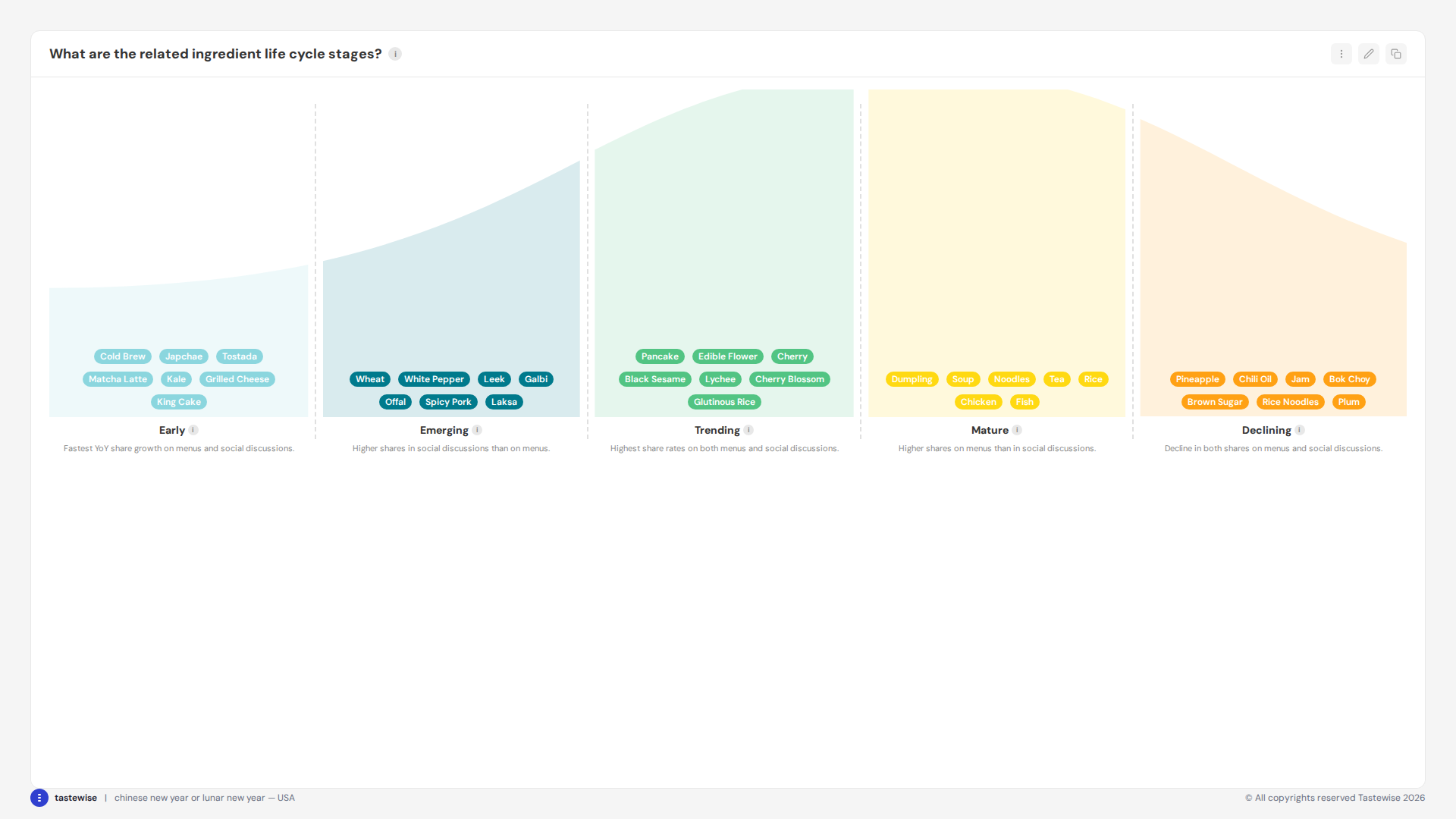
The most popular Chinese New Year food in the US is the reunion dinner core: dumplings, soup, noodles, rice and whole fish. Across the Tastewise US consumer panel, dumplings reach nearly 1 in 6 US consumers who engage with Lunar New Year food (16%). Soup reaches nearly 1 in 7 of the same group (14%), and noodles reach nearly 1 in 8 (13%).
These staples are mature and steady, so they anchor a menu while the growth sits one step out. The Chinese New Year food ideas with momentum for 2027 are fruit, texture and color. Lychee reaches 1.35% of this group, 34% more than last year. Glutinous rice reaches 0.98% and grew 41%, and black sesame reaches 1.64% and grew 6%.
Floral and visual cues are moving fastest. Edible flowers reach 2.9% of this group, 52% more than last year, and cherry blossom more than tripled its reach from a small base. Duck is the protein to watch. Roast duck reach grew 56%, and Peking duck now reaches 1.5% of this group, up 7%.
Consumers also frame the holiday around shared eating. Nearly 1 in 3 US consumers who engage with Lunar New Year food link it to celebration (31%), and nearly 1 in 6 link it to family (16%). Togetherness reaches 1.7% of this group but grew 38%, and gold color cues grew 47%.
Traditional Chinese New Year food and its symbolism
Traditional Chinese New Year food is chosen for what its name, shape or color promises. Chinese New Year food symbolism leans on wordplay, so one dish can carry a wish for wealth, luck or a long life. Here are the lucky Chinese New Year foods US consumers reach for.
- Dumplings (jiaozi): shaped like silver ingots, they stand for wealth. Chicken dumplings reach 0.48% of this group, 16% more than last year.
- Whole fish: the word for fish sounds like the word for surplus, so the fish is served whole. Fish reaches nearly 1 in 10 US consumers who engage with Lunar New Year food (11%).
- Longevity noodles: long, uncut noodles stand for a long life.
- Nian gao: the name sounds like a higher year, a wish for growth. Peony Seafood Restaurant lists pan-fried nian gao at $8.75.
- Spring rolls: shaped like gold bars, they stand for wealth. Reach is 2.6% of this group but fell 19%, which leaves room for a refreshed format.
- Mandarins and kumquats: their gold color and names suggest good fortune. Mandarins reach 2.75% of this group, and kumquat reach grew 12%.
- Yusheng: the prosperity toss salad is lifted high for abundance. It reaches 1.85% of this group and grew 9%.
The menu takeaway is simple: print the meaning next to the dish. A plate listed as wealth dumplings, or a whole steamed fish for surplus, gives guests a story to share at the table.
Chinese New Year food traditions in the US

Chinese New Year food traditions in the US center on the reunion dinner on New Year’s Eve. Visits and shared meals follow up to the Lantern Festival. In 2027 that window also holds Valentine’s Day on February 14.
US celebrations draw on several Lunar New Year cultures. Across the Tastewise US consumer panel, about 1 in 20 US consumers who engage with Lunar New Year food link it to Vietnamese food (5.6%). A similar share link it to Korean food (5.0%), 13% more than last year.
The Valentine’s Day overlap is worth planning for. Consumers who connect Lunar New Year food with Valentine’s Day reach 2.1% of this group, 58% more than last year. Convenience is rising too. Nearly 1 in 10 of this group pair the holiday with convenient food (9.4%), up 19%, and delivery grew 19%.
Lunar New Year menu items cluster in California, New York, Massachusetts, Texas and Illinois. Cafes, bakeries and Chinese restaurants carry the most, while Malaysian, Cantonese and Vietnamese restaurants over-index. The holiday closes a run of winter food moments, from winter solstice food in December to New Year’s Day food in January.
Chinese New Year desserts
The desserts eaten at Chinese New Year are built on glutinous rice, red bean, sesame and citrus. Tangyuan (sweet rice balls) and nian gao stand for reunion and rising fortune. Pineapple tarts, sesame balls and candied fruit stand for luck. Sweet taste is part of the holiday for nearly 1 in 8 US consumers who engage with Lunar New Year food (12%).
Across the Tastewise US consumer panel, the dessert ingredients gaining reach are textural and bakery led. Red bean reach grew 31%, egg tarts grew 16% and mochi grew 8%. Tanghulu, candied fruit on a stick, grew 45% from a small base (0.47%). Cake reaches 1 in 10 of this group (10%) and grew 7%, while pineapple fell 19%.
LimeRed Teahouse listed a Lunar New Year red bean mochi cookie at $3.50 and a pineapple mochi cookie at $3.55. Ladurée sold a Lunar New Year macaron box at $66, and Baked by Melissa sold a $41 pack of red luck cupcakes.
For a Chinese New Year food dessert menu, pair one growing ingredient with one symbolic one. Think black sesame tangyuan in osmanthus syrup or a kumquat tart. Check the wider dessert trends before you lock flavors, and finish in red and gold.
Launching a festive Lunar New Year menu

Consumer demand builds before most menus move. Across the Tastewise US consumer panel, the share of consumers engaging with Lunar New Year food was 2.5 times its November level by December 2025. It reached 6 times that level in January and peaked in February. Menu items for the holiday peaked in February and stayed high through March.
For a holiday on February 6, 2027, that means launching in mid-January and running through the Lantern Festival on February 20. P.F. Chang’s ran its 2026 Lunar New Year menu from January 28 to February 24, about three weeks ahead of the holiday, with Long Life Noodles at the center. Put both dates on your LTO calendar now.
Guests pay more for the occasion. The average Lunar New Year menu item rose from $32.43 in December 2025 to $40.14 in February 2026. Across the full year, average prices rose 12%. Shareable formats carry that premium best, as Lady M’s Year of the Snake gift set at $96.80 shows.
Fast casual holds 2 in 5 locations serving Lunar New Year items (40%). QSR holds about 1 in 10 (9.7%), and its share grew 33% on last year. Operators that join the holiday also go deeper, with menu items per operator up 18%.
Retail is wide open. Only 11 products on US e-commerce shelves carry a Lunar New Year label, mostly gift baskets, spirits and fortune cookies, with no new launches in the period. For CPG teams, that gap is a clear product innovation opening. Suppliers can take the same data into operator pitches before menus lock.
A five-step plan for your 2027 launch:
- Lead with dumplings and long noodles, and print their meaning on the menu.
- Add one trending ingredient, such as lychee, black sesame or roast duck.
- Build a shareable reunion set priced as one item for the table.
- Launch in mid-January and run the LTO through February 20.
- Bridge Valentine’s Day with a red and gold dessert.
Chinese New Year food in 2027 rewards operators who plan early. The holiday falls on February 6, demand builds from late December and guests pay a premium for shared, symbolic dishes. Build your menu around meaning and launch before consumers go looking.
FAQs about Chinese New Year food
Families eat dumplings, whole fish, long noodles, nian gao and citrus fruit. In the US, dumplings reach nearly 1 in 6 consumers who engage with Lunar New Year food (16%), the most of any food.
Dumplings and spring rolls stand for wealth, fish for surplus, noodles for long life and mandarins for good fortune. Yusheng, the prosperity toss salad, reaches 1.85% of US consumers who engage with Lunar New Year food and grew 9% on last year.
Tangyuan, nian gao, sesame balls, egg tarts and pineapple tarts are the classics. Among US consumers who engage with Lunar New Year food, red bean reach grew 31% and egg tarts grew 16% on last year.
Launch in mid-January for a holiday on February 6, 2027. US consumer interest was already 2.5 times its November level by December 2025 and peaked in February, so a mid-January launch meets the ramp.
Sources cited in this article
- Lunar New Year menu patch.com
Cite this article
Reinoso, K. L. (2026). Launching Festive Menus Around Chinese New Year Food Trends. Tastewise. https://tastewise.io/blog/chinese-new-year-food-trends