






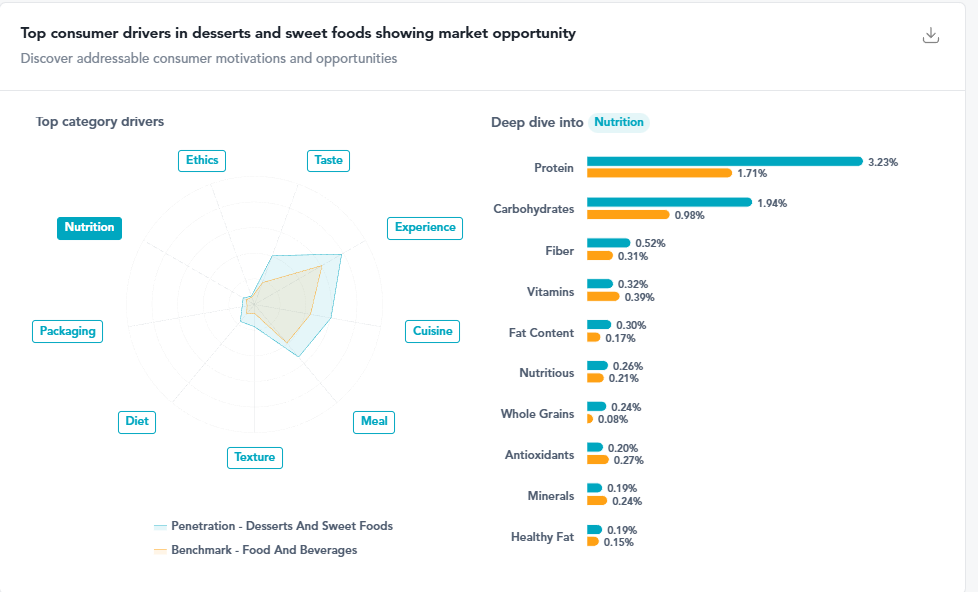
Dessert trends are driven by taste-first decision-making and experience-led consumption. Tastewise Category Dashboard data shows desserts over-index on taste and experience compared to the broader food and beverage benchmark, while nutrition, ethics, and diet cues remain secondary. This positions indulgent desserts as a category where consumers prioritise sensory payoff over functional value.
Dessert trend overview
- Social conversations about desserts have increased by 17.9% year-over-year, reaching a 2.5% social share across food-related discussions (Tastewise Category Dashboard).
- Desserts remain widely distributed across foodservice and retail, supported by more than 550,000 dishes and 149,000 restaurants in the Tastewise database.
- The top consumer needs driving dessert consumption today are tasty (30%), sweet (24%), and indulgent (20%), reinforcing taste-led decision-making over convenience or health.
- Dessert demand is concentrated around mature formats and flavors, with cake (35% social share), chocolate (24%), cookies (16%), and ice cream (14%) dominating consumption and discussion.
Market performance of indulgent desserts
Desserts account for 2.5% social share with 17.9% year-over-year growth in social discussions over the past 24 months. Growth is steady rather than explosive, reflecting a mature but resilient category. The volume behind this performance is substantial, supported by more than 1.9 million posts, 186,000 recipes, and 550,000 dishes tracked in the Tastewise database.
This pattern indicates that indulgent desserts are not emerging from obscurity. Demand is being reinforced through repeated consumption, frequent posting, and consistent menu presence rather than novelty spikes.
Consumer needs shaping dessert indulgence
Tastewise consumer needs analysis shows indulgence is structurally tied to taste satisfaction rather than convenience or health positioning.
Protein is the most prominent nutrition driver in desserts, which is notable given the category’s indulgent positioning. What is interesting is how clearly protein outpaces other nutrition cues, reaching 3.23% penetration compared to carbohydrates at 1.94% and fiber at 0.52%. This suggests consumers are using protein as a justification layer within indulgent desserts, engaging with nutrition selectively rather than seeking broadly “healthy” formulations.
“Tasty” accounts for 30% of consumer need mentions, and “indulgent” at 20%. These needs alone define the core of the dessert indulgence food trend. “Baked” (16%) and “homemade” (11%) suggest that indulgence is often associated with familiar preparation methods rather than restaurant-only experiences.
Convenience appears lower at 9%, indicating that indulgent desserts are rarely chosen for speed. Consumers allocate time and attention to these items, reinforcing desserts as intentional consumption occasions.
Dessert dishes sustaining indulgence demand
Dish lifecycle data shows that the highest-volume desserts are not emerging products.
Mature dishes include cake, chocolate, cookies, ice cream, cheesecake, pudding, caramel, and brownies. Cake alone captures 35% social share, followed by chocolate at 24% and cookies at 16%. Ice cream holds 14%, supported by frequent retail and menu appearances.
Declining desserts such as cupcakes, donuts, and Oreo-based desserts show reduced novelty value, despite brand recognition. This suggests that indulgence demand is consolidating around fewer, more flexible dessert formats rather than fragmented SKUs.
Growth appears within recognisable structures. Kataifi (+245% YoY) and knafeh (+107% YoY) gain traction by applying global formats to indulgent bases. Sourdough cookies (+120%) extend indulgence through texture rather than flavour disruption.
These patterns reinforce that experimentation succeeds when anchored to established dessert expectations.
Flavor preferences defining indulgent desserts
Flavor data confirms that the dessert indulgence food trend is led by classic combinations.
Chocolate ice cream, peanut butter cups, mint chocolate chip, and caramel apple show strong presence across menus, retail products, and recipes. Chocolate remains the anchor flavor across dishes and ingredients, appearing in 24% of ingredient mentions.
Caramel apple demonstrates seasonal elasticity rather than limited-time behaviour. Its strength in recipes and retail indicates repeated demand tied to occasion-based indulgence rather than novelty cycles.
Fruity and sour notes remain marginal. Fruity taste drivers sit at 0.38% penetration, reinforcing that indulgence in desserts is defined by richness and sweetness rather than freshness cues.
Ingredient trends supporting indulgence
Ingredient lifecycle data shows indulgence stability supported by mature ingredients.
Chocolate, sugar, vanilla, strawberry, banana, and berries dominate ingredient usage. These ingredients enable scalability across both retail and foodservice without reformulation risk.
Emerging indulgent ingredients include strawberry matcha (+108% YoY), allulose (+77%), and chocolate pistachio (+73%). These ingredients add contrast or reduced-sugar positioning while maintaining indulgent flavour profiles.
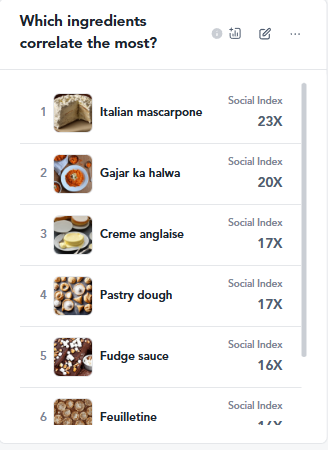
Correlation analysis shows strong alignment between indulgent sauces and bases, including fudge sauce (16X), crème anglaise (17X), and mascarpone (23X). This supports layered dessert formats rather than single-flavour builds.
Dessert formats and consumption moments
Consumption moment analysis shows indulgence driven by visual and experiential cues.
High-performing social posts centre on melting chocolate, hot-cold contrast, sculptural desserts, and plated presentation. Posts featuring gelato cones with chocolate filling, blooming apple tea served with cheesecake, and decorative chocolate work generate millions of likes, indicating strong engagement with visual payoff.
Recipe data supports this behaviour. Frozen yogurt clusters, chocolate pizza, and no-bake desserts combine indulgence with shareability. These formats balance effort with reward, reinforcing desserts as planned consumption moments rather than impulse snacks.
Foodservice vs retail in the dessert indulgence food trend
Foodservice data shows indulgent desserts priced between $3 and $12, often positioned as add-ons or limited-time offers. Apple pie poppers, frosted lemonades, and ice cream-based beverages demonstrate that indulgence performs well in portable, format-driven executions.
Retail products mirror this structure through multipacks, frozen desserts, and coated formats. The overlap between menu and retail usage indicates strong cross-channel transferability within the dessert indulgence food trend.
How Tastewise tracks dessert indulgence
Tastewise tracks the dessert indulgence food trend through the Category Dashboard, dish and ingredient lifecycle analysis, menu data, and consumption moments. This allows teams to monitor when indulgence demand is consolidating, where flavour fatigue appears, and which formats support scalable growth across retail and foodservice.
The data shows indulgence is not driven by experimentation volume. It is sustained through repetition, familiarity, and sensory certainty.




We’d love to learn your goals and see how Tastewise fits
We’d love to learn your goals and see how Tastewise fits
Get a personalized demo
Good taste. Wise move.
Your demo request is confirmed. We’ll reach out within one business day to schedule your walkthrough.
What happens next

See what’s driving demand, then turn it into a sell-in story for retailers and operators.
- Connect consumer panels, market trackers, and agents into one evidence view
- Get the “why” behind what’s changing, with explainable demand drivers
- Walk away with a buyer-ready narrative and next steps to activate
Trusted by





“Tastewise is my secret tool for knowing what consumers want next and why.“