





Ice cream trends 2026 show a category that keeps its place through indulgence rather than reinvention. Engagement is concentrating on specific formats, flavors, and consumption moments, while broad everyday usage softens. This guide covers the latest ice cream trends across consumer needs, dishes, flavors, menus, and social behavior.
Key takeaways
- Indulgence anchors ice cream demand in 2026, and health-oriented needs still sit outside the top 10 consumer drivers.
- Gelato, sundaes, and soft serve are in the trending stage. Chocolate, vanilla, and caramel desserts form the mature base.
- Flavor growth is layered and cafe-inspired, led by Greek honey (up 147%), cold foam (up 69%), and banana matcha (up 46%) since last year.
- Soft texture is up 21% on last year, which favors soft serve, gelato, and swirled builds.
- Better-for-you claims are a small but fast-growing niche, with the better-for-you claim up 94% within health-positioned ice cream.
- Summer climbs from about 2% of ice cream eating moments in winter to 17% in July, so seasonal LTOs need to be on shelf by May.
Ice cream market performance and growth signals

Overall interest in ice cream has softened over the past 24 months, while engagement concentrates on defined products and experiences. Menu data supports this pattern, with consistent pricing and placement across QSR and dessert-focused chains.
This points to fewer casual mentions and stronger engagement around defined products and experiences. Menu data supports this pattern, with consistent pricing and placement across QSR and dessert-focused chains.
The ice cream food trend is stabilizing around formats that justify purchase through indulgence, familiarity, or visual appeal rather than novelty alone.
Ice cream consumer needs shaping demand
Ice cream demand is anchored in sensory payoff and cultural familiarity, not experimentation or functional benefits. The strongest consumer needs tied to ice cream consumption are sweet (13%), indulgent (13%), and tasty (12%) confirming that consumers approach the category as a reward-driven snack rather than a meal or wellness product.
The prominence of Italian (15%) and American (13%) points to trust in established dessert traditions. Consumers are gravitating toward formats and flavor profiles that feel proven and recognizable, which helps explain the sustained performance of gelato, sundaes, and chocolate-led desserts.
Needs such as fun (7%) and attractive (7%) appear consistently in social and recipe behavior, indicating that visual impact plays a supporting role in driving engagement and sharing. These needs amplify performance when layered onto familiar flavors, rather than replacing them.
Notably, health-oriented needs are absent from the top drivers. This limits the upside for better-for-you positioning within ice cream and suggests that reduced sugar, plant-based, or functional claims are unlikely to drive mainstream demand without a clear indulgence-first payoff.
Ice cream dishes by lifecycle stage
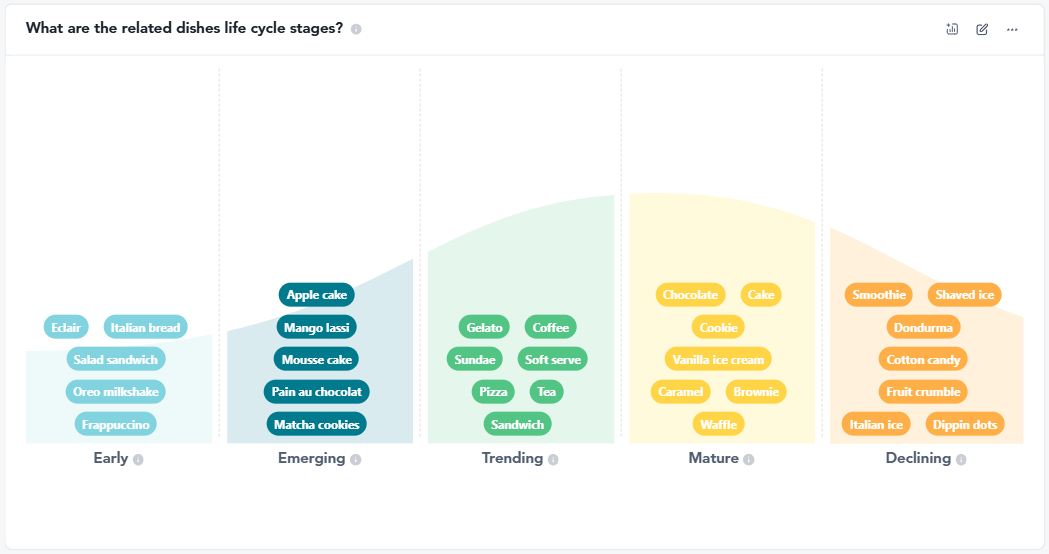
Ice cream growth is being driven by adjacent dessert formats rather than new frozen bases. Emerging dishes lean toward bakery and beverage-led desserts, suggesting consumers are extending ice cream occasions instead of replacing core formats.
Gelato, sundaes, and soft serve sit squarely in the trending stage, indicating that demand is shifting toward perceived quality and customization rather than experimentation with unfamiliar concepts.
The mature stage is dominated by chocolate-, vanilla-, and caramel-led desserts, reinforcing that flavor preference remains stable and that most innovation is occurring through format, layering, and presentation.
Declining items are novelty-driven frozen desserts such as shaved ice and cotton candy, which offer limited customization and lower indulgence value, making them less competitive in the current ice cream landscape.
Most popular ice cream dishes today
By social share, the leading dishes are:
- Gelato (12%)
- Chocolate-based desserts (12%)
- Cake (11%)
- Cookie desserts (8.3%)
- Coffee-linked desserts (8%)
High correlation scores (51X) between vanilla ice cream, gelato, sundae, soft serve, banana split, and affogato indicate that consumers view these formats as interchangeable indulgence options rather than distinct occasions.
Fast-growing ice cream and dessert flavors
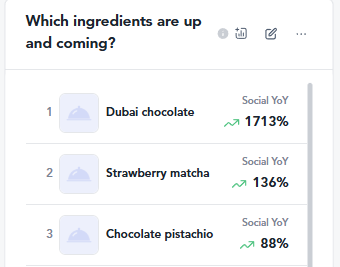
The fastest-growing ingredients in ice cream are globally influenced and layered rather than single-note. Dubai chocolate leads growth by a wide margin, up 1,713% on last year. Strawberry matcha follows, up 136% since last year, and chocolate pistachio is up 88% in the past year.
This pattern shows the ice cream food trend expanding through ingredient-led complexity and regional flavor cues, rather than through new base formats or standalone scoops.
Ice cream formats driving menu usage
Menu data shows consistent pricing and format usage across major chains:
- Sundaes and soft serve dominate QSR menus
- Gelato appears more frequently in premium and specialty concepts
- Customisable formats (mix-ins, toppings, cones) outperform fixed SKUs
The ice cream food trend on menus is defined by flexibility and recognisable flavor bases rather than limited-time experimentation.
Ice cream consumption moments and social behavior
High-indulgence visuals drive on-the-plate social performance more than novelty does. The top Instagram posts generate 2.0M to 2.4M likes and consistently feature chocolate-forward gelato cones, filled cones, and stacked builds. These formats over-index on visible richness and portion perception, so visual density tracks closely with engagement.
The top Instagram posts generate 2.0–2.4M likes and consistently feature chocolate-forward gelato cones, filled cones, and stacked builds. These formats over-index on visible richness and portion perception, indicating that visual density directly correlates with engagement.
In-the-kitchen behavior shows lower overall volume but clearer intent. Recipe saves range from 3 to 1,830, with demand concentrated around sorbet, no-churn ice cream, and lighter adaptations. This suggests home usage is exploratory and functional, while indulgent ice cream consumption remains primarily out-of-home or social-led.
Menu data shows tight pricing compression across major chains, with ice cream items clustered between $2.69 and $6.99. This narrow price band reinforces ice cream’s role as a low-friction add-on rather than a destination item. Premium perception is created through format and toppings, not price escalation.
TikTok drives reach for ice cream more than purchase. Ice cream videos reach 3M to 13.8M views, with performance tied to emotional context, brand familiarity, and hacks rather than product differentiation. TikTok positions ice cream as a comfort cue and social signal. Pricing stays invisible in short-form video, which builds awareness without anchoring price.
Analyzing key ice cream consumer trends shaping product innovation
Ice cream consumer trends show a category where indulgence leads and health-conscious eating grows at the edges. Across the Tastewise US consumer panel over the past 12 months, sweet and indulgent each sit behind nearly 1 in 7 ice cream eating moments (13%). Celebration is rising too, up 13% on last year.
Health-oriented needs sit outside the top 10, yet functional and clean-label claims are growing quickly within health-positioned ice cream. The better-for-you claim is up 94% in that niche, while no artificial flavors (up 122%) and net carbs (up 89%) are also climbing. For your portfolio, the opportunity sits in permissible indulgence that still delivers the full dessert payoff.
Flavor and textural preferences
Texture is where ice cream consumer trends move fastest. Soft texture is tied to about 1 in 14 ice cream eating moments (7%) and is up 21% on last year. That favors soft serve, gelato, and swirled builds.
Flavor growth comes from layered pairings with botanical and cafe cues. Greek honey (up 147%) and almond slivers (up 194%) are emerging. Cold foam is trending, up 69%, while banana matcha (up 46%) is still early. These work as ripples, mix-ins, and toppings that add texture to a familiar base.
If you are developing high-protein or low-sugar formulations, build in that multi-textured payoff. A reduced-sugar vanilla base with a Greek honey ripple and toasted almond crunch is one example. It pairs a global ingredient mashup with the indulgence consumers still expect, which keeps product innovation grounded in demand.
CPG positioning
For dairy brands, seasonal timing decides whether an LTO sells through. Summer goes from about 2% of ice cream eating moments in winter to 17% in July, with the steepest climb between April and June. A summer flavor needs to be on shelf by May to meet that peak, and an LTO calendar helps you plan launches against these windows.
Real-time consumer analytics let you validate a seasonal LTO before you commit a production run. Weekend occasions (9%) and celebration give you a second lane outside summer, such as party multipacks of novelties. Within the broader ice cream trends 2026 landscape, these signals help you decide which flavors earn a permanent SKU and which stay as LTOs. They also guide retail sell-in and shelf placement for maximum velocity.
How brands use Tastewise to track the ice cream food trend

Tastewise enables brands to:
- Track dish and ingredient lifecycle stages across retail and foodservice
- Compare social velocity with menu adoption rates
- Identify emerging flavors such as pistachio-chocolate or kataifi before menu saturation
- Monitor consumer needs linked to indulgence, familiarity, and visual appeal
This approach allows teams to act on demand signals rather than surface-level trend spikes while staying aligned with how the ice cream food trend is actually consumed.
FAQs about ice cream trends
It is driven by indulgent, familiar flavors paired with premium or globally influenced formats rather than everyday novelty.
Gelato currently leads by social share and is perceived as more premium, while traditional ice cream formats maintain volume.
Dubai chocolate, pistachio-based desserts, and Middle Eastern-inspired flavors show the highest growth rates.
Sundaes, soft serve, and gelato formats perform best due to customization and familiarity.
Engagement centers on visual builds, emotional moments, and recognizable flavors rather than experimental concepts.
Tastewise combines social data, menu data, and lifecycle analysis to monitor demand across channels in near real time.
Ice cream brands should combine real-time consumer data, menu intelligence, and AI-driven consumer analytics with their own retail POS data. Consumer and menu data show which flavors people are adopting and how fast. POS data then confirms what is already selling on your shelf. Tracking these signals together lets you spot a high-velocity flavor, such as Greek honey or banana matcha, while it is still early and before it reaches peak market adoption.


We’d love to learn your goals and see how Tastewise fits
We’d love to learn your goals and see how Tastewise fits
Get a personalized demo
Good taste. Wise move.
Your demo request is confirmed. We’ll reach out within one business day to schedule your walkthrough.
What happens next

See what’s driving demand, then turn it into a sell-in story for retailers and operators.
- Connect consumer panels, market trackers, and agents into one evidence view
- Get the “why” behind what’s changing, with explainable demand drivers
- Walk away with a buyer-ready narrative and next steps to activate
Trusted by





“Tastewise is my secret tool for knowing what consumers want next and why.“