






Spinach is one of the few crops where the ingredient cost and the menu price have moved in opposite directions this year. Wholesale cartons out of California carried a mostly $21.45 to $24.75 range in the first week of September 2026, above the $9 to $14 quotes coming out of the state’s central district through mid-summer. The average US restaurant item containing spinach still sells for $14.32, almost exactly what it sold for a year ago. Reading the spinach price trend properly means separating those two numbers, because procurement, manufacturing and menu teams are each exposed to a different one.
The spinach popsicles new food trend deserves a direct answer too, since novelty formats get blamed for demand spikes. Across the Tastewise US consumer panel, spinach popsicles register no measurable consumer, menu or recipe signal in the 24 months to July 2026. Frozen and blended spinach formats do carry a real premium, and that part of the story holds up.
Key takeaways
- Spinach appears on nearly 3 in 10 US restaurant menus (28.6%), and that presence slipped about 2% over the past year.
- Menu depth moved the other way. Operators who carry spinach now average eight items containing it, up roughly 8%, and the total count of spinach menu items reached 1.94 million, up 17.9%.
- The average US menu item containing spinach sells for $14.32, down 0.5% over the past year, so operators have absorbed input cost instead of repricing.
- USDA quoted Central Coast California bunched cartons at mostly $21.45 to $24.75 on 4 September 2026, above the roughly $9 to $14 quoted for central district California in June and July (National FOB Review).
- Retail fresh vegetable prices ran 6.3% above July 2025, and USDA forecasts fresh vegetables up 5.9% across 2026 (Food Price Outlook).
- Spinach popsicles show no measurable signal in 24 months of US data. Blended spinach drinks at juice bars sell for $15.90 to $18.90, which is where premium format demand actually sits.
Current spinach price trend and market summary
Four separate price systems get called the spinach price trend, and mixing them is how cost models go wrong. Shipping point quotes are farm-gate sales by first handlers, freight excluded. Terminal market quotes are the delivered price in a specific city. Retail prices are what a shopper pays for a washed pack. Menu prices are what a diner pays for a finished dish that happens to contain spinach.
The table below sets the current reading for each, using USDA quotes from early September 2026 and Tastewise menu data through July 2026.
| Region or segment | Current average price | Annual price change | Key cost driver |
|---|---|---|---|
| Shipping point, Central Coast California | Bunched cartons of 24 at $20.45 to $27.75, mostly $21.45 to $24.75 | No annual figure published. Directionally above the mid-summer central district quotes of roughly $9 to $14 | Field supply and a wide quality spread |
| Los Angeles terminal market | California flat bunched 24s at $16.00 to $18.00. Fair appearance at $13.00 to $14.00 | No annual figure published | Short-haul freight and cooling |
| New York terminal market | California flat bunched 24s at $38.00 to $40.00. Film bag packs at $18.00 to $20.00 | No annual figure published | Cross-country cold chain |
| Chicago terminal market | Baby type, 12 bags of 10 oz, at $19.50. Bunched 24s at $18.00 to $19.00 | No annual figure published | Washed pack conversion and packaging |
| US retail, fresh vegetables | Index based, so no single unit price | Up 6.3% against July 2025, with 2026 forecast at up 5.9% | Grocery pass-through and margin |
| US restaurant menus, items containing spinach | $14.32 per menu item | Down 0.5% | Menu engineering absorbing input cost |
One caution on the last row. The $14.32 figure is the average price of a whole menu item that contains spinach, not the price of the spinach in it. It tells you what operators are charging for spinach-carrying dishes, and it is the cleanest available proxy for whether input cost is reaching the guest.
For seasonal planning against the same price systems, our 2027 food trends work maps where demand is forming before contracts get signed.
Key drivers behind the spinach price shift
Three cost layers explain most of the movement. They act on different timescales, which is why a single headline carton price tells you very little about next quarter.
Field supply and growing conditions
The quality spread is the most useful signal in the USDA quotes. Los Angeles carried standard California flat bunched 24s at $16.00 to $18.00 in mid-August, with a fair appearance line at $13.00 to $14.00 for the same commodity. A gap that wide inside one market means condition, not scarcity, is setting the price you actually pay.
USDA market comments through the summer noted harvest curtailed due to market conditions, and the September report still flags a wide range in price, quality and condition out of Central Coast California. For procurement, that reads as a specification problem rather than a supply shortage. Tightening your acceptance spec costs more per carton than the headline suggests.
Freight, cold chain and pack format
The same California crop was quoted at $16.00 to $18.00 delivered in Los Angeles and $38.00 to $40.00 delivered in New York for the equivalent bunched carton. Distance and cold chain account for the difference, not the field. Film bag packs narrow it, running $15.00 to $16.00 in Los Angeles against $18.00 to $20.00 in New York.
Pack format changes the maths again. Chicago quoted baby type in twelve 10 oz bags at $19.50 while bunched 24s in the same market sat at $18.00 to $19.00. You are paying for wash, cut and bag conversion, which is a manufacturing cost sitting inside a produce line item.
Demand shifts and new spinach formats
Menu presence fell while menu depth rose, and that combination is the commercial story. Fewer US operators list spinach than a year ago, and the ones who keep it now build eight items around it on average. Demand is consolidating onto kitchens that use spinach across the daypart rather than as a single side.
The launches carrying that consolidation are named and priced. Starbucks lists a Spinach, Feta & Egg White Wrap at $5.89. The Cheesecake Factory added Sautéed Spinach at $7.95, having carried it at $7.50, and its Spinach, Mushroom, Bacon and Cheese Omelette moved to $20.50 from $19.95. Papa John’s runs a 16 inch Spinach Alfredo at $35.00, IHOP a Spinach & Mushroom Omelette at $13.00, and Panera a Spinach & Bacon Soufflé at $8.29. Convenience follows the same pattern, with Wawa’s Egg White Burrito at $6.09 and an Amy’s Kitchen Tofu Wrap Spinach at $3.49.
On the spinach popsicles new food trend specifically, the data does not support treating it as a demand driver. There is no measurable consumer, menu or recipe signal for it across the 24 months to July 2026. What the popsicle idea gestures at, a cold blended format that hides the leaf, is already commercially proven in beverages. Qwench Juice Bar prices a Spinach Greens Blend at $15.90 and a large at $18.90, against $2.89 for a side of grilled spinach at Cantina Louie. The format premium is real, the frozen novelty is not.
Early dish signals are worth a watchlist rather than a launch. Tetrazzini is up 133% among US consumers, ghormeh sabzi 36% and strata 12%, though each sits below 0.1% reach, so treat them as emerging rather than established. Our foodservice trends work tracks whether signals at that size convert onto menus.
Retail versus wholesale price breakdown
The spread between bulk and shelf is where most of the cost sits, and it is larger than the crop move. A bunched carton of 24 at $22.00 works out near $0.92 a bunch before freight. Earthbound Farm Big Leaf Spinach sells at $5.99 on the retail shelf. Wash, pack, shrink, distribution and retail margin fill that gap, which is why a shipping point rally rarely shows up at the register in the same quarter.
Certification adds a further layer that USDA quotes let you size directly. In the same September report, organic bunched kale out of south and central California ran $16.00 to $20.00 while the conventional Central Coast line sat at $12.45 to $16.95. Leafy green organic premiums of that shape carry across to spinach programs, and they compound with the pack conversion cost rather than replacing it.
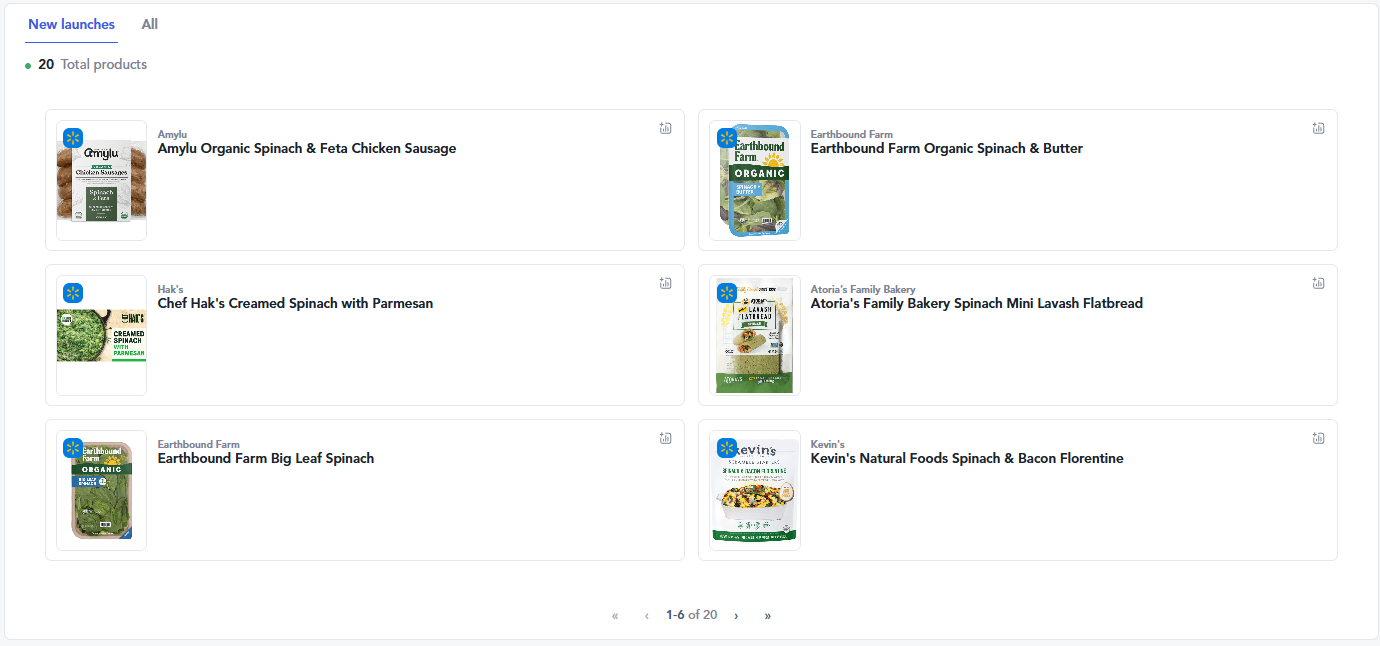
Processing choice moves the unit economics more than sourcing does. Prepared spinach SKUs price well above the bagged leaf, with Kevin’s Natural Foods Spinach & Bacon Florentine at $10.99 and Toufayan Savory Spinach Wraps at $3.29. Organic and prepared lines including Amylu Organic Spinach & Feta Chicken Sausage, Earthbound Farm Organic Spinach & Butter and Chef Hak’s Creamed Spinach with Parmesan all sit in that higher band. For retail sell-in, the pack claim is doing more pricing work than the commodity.
At the other end, non-commercial channels show the frozen and bulk economics. Spinach appears at a zero menu price on school programs including Papillion-La Vista High School in Nebraska and Millbrook High School in Virginia, where it enters as a bulk or frozen input rather than a priced item.
The margin context matters for anyone selling in. Restaurant prices ran 3.4% above last year while grocery prices ran 2.7% higher, and yet spinach menu items held flat. Operators are carrying the input cost themselves, which changes the conversation foodservice operators want to have about specification and yield.
What to do with the spinach price trend
Five moves follow from the data above, in the order they pay back.
- Quote film bag packs, not bunched cartons, on any cross-country lane. The New York bunched premium ran more than double Los Angeles, while the film bag gap stayed close to $3.00 a carton.
- Write the acceptance spec before the price. A fair appearance line at $13.00 to $14.00 against $16.00 to $18.00 in the same market means your spec choice is worth more than your negotiation.
- Test blended spinach beverages in the $15.00 to $19.00 band rather than frozen novelty formats. The juice bar price points are already proven and the popsicle signal is absent.
- Build limited time offers on comfort formats that already carry spinach, such as tetrazzini, strata and saag, where the growth is visible and the technique is familiar to the kitchen.
- Move the premium onto the pack for retail programs. Organic and prepared claims are carrying the price, which is a product innovation decision more than a sourcing one.
If you need these cuts against your own categories, regions or chains, request your own data pull.
Frequently asked questions about the spinach price trend
Wholesale spinach is trading above its mid-summer level while restaurant menu prices have stayed flat. USDA quoted Central Coast California bunched cartons at mostly $21.45 to $24.75 in early September 2026, and the average US menu item containing spinach held at $14.32, down 0.5% over the past year.
The divergence matters because the two numbers describe different exposures. Buyers are paying more for the raw crop while kitchens have chosen not to reprice the dishes built on it.
Quality spread and logistics are doing more of the work than crop volume. USDA reports flag a wide range in price, quality and condition, and the delivered price gap between Los Angeles and New York reached more than $20.00 a carton for the same commodity.
Retail follows a separate path. Fresh vegetable prices at retail ran 6.3% above July 2025 and are forecast up 5.9% across 2026, which reflects grocery pass-through as much as field cost.
Shipping point cartons of 24 bunches were quoted at $20.45 to $27.75 out of Central Coast California in early September 2026, mostly $21.45 to $24.75. Delivered terminal prices ranged from $16.00 to $18.00 in Los Angeles to $38.00 to $40.00 in New York.
Pack format shifts the figure again. Chicago quoted baby type in twelve 10 oz bags at $19.50 against $18.00 to $19.00 for bunched 24s in the same market.
No. Spinach popsicles show no measurable consumer, menu or recipe signal in US data across the 24 months to July 2026. Treating them as a demand driver for raw spinach processing is not supported.
Cold blended spinach formats are a different case. Juice bar blends priced at $15.90 to $18.90 show that consumers will pay a premium for spinach they drink rather than chew.
A bunched carton at $22.00 works out near $0.92 a bunch before freight, while a retail pack such as Earthbound Farm Big Leaf Spinach sells at $5.99. Wash, pack, shrink, distribution and retail margin account for the difference.
Certification and preparation widen it further. Organic leafy green lines and prepared spinach SKUs both price well above the conventional bagged leaf.
Operators have absorbed the increase so far. Spinach presence on US menus fell about 2% over the past year to 28.6%, while operators who kept it raised depth to eight items each, and the average item price held at $14.32.
That points to consolidation rather than retreat. Kitchens that use spinach across several dishes can spread yield and waste costs in a way single-side users cannot.




We’d love to learn your goals and see how Tastewise fits
We’d love to learn your goals and see how Tastewise fits
Get a personalized demo
Good taste. Wise move.
Your demo request is confirmed. We’ll reach out within one business day to schedule your walkthrough.
What happens next

See what’s driving demand, then turn it into a sell-in story for retailers and operators.
- Connect consumer panels, market trackers, and agents into one evidence view
- Get the “why” behind what’s changing, with explainable demand drivers
- Walk away with a buyer-ready narrative and next steps to activate
Trusted by





“Tastewise is my secret tool for knowing what consumers want next and why.“