






Food and beverage brands lose the most money on a new trend food ingredient when they launch on a social spike that never reaches menus. By the time the product ships, the buzz has faded and operators have moved on.
The odds are steep before timing even enters the picture. An Oregon State University review of new product research puts the commonly cited failure rate for new food products at 70% to 85%. One grocery study it cites found the top 20 US food companies failed 24% of the time, against 88% for the bottom 20,000. The study tied that gap to the research and strategic marketing behind each launch.
Tastewise tracks every ingredient across social posts, restaurant menus and recipes, so your product innovation team can see which signals are holding. This guide follows three functional ingredients with real staying power: matcha, L-theanine and moringa. It closes with what to do with each in 2027.
Key takeaways
- Menu growth is the clearest sign an ingredient is staying, and all three examples here are climbing faster on menus than on social.
- L-theanine’s US menu presence grew 36% in the past year, with the sharpest rise in mid-2026.
- Matcha is still climbing on US menus, up 13.6% in the past year, while social interest cools from its 2025 peak.
- Moringa is growing quietly, up 9.4% on menus, with seasonings and tea as its leading formats.
- Goji berries show the opposite pattern, spiking on social each January and falling back by spring.
What makes a new trend food ingredient commercially viable?
A new trend food ingredient is a functional or flavor-focused component growing across consumer social posts, restaurant menus and home cooking recipes. F&B brands validate it by checking whether that growth reflects a lasting change in behavior or a short viral spike.
Three checks separate a lasting ingredient from a spike. It should be growing on menus, where operators commit real money. Its social signal should hold up across the whole year. And it should fit a format and a need your consumers already have. The Tastewise forecast of food trends 2027 applies the same tests across every major category.
Legacy ingredient tracking vs. real-time demand signals
Static market research reports what happened last year. A real-time view tracks the same ingredient every month, so you can see whether interest is building or repeating a seasonal peak.
The goji berries trendy ingredient food trend shows why this matters. Across the Tastewise US consumer panel, goji’s social share climbed in early 2025 and again in early 2026, then fell back within two months both times. Its yearly social growth is a modest 4.2%. A report written at either peak would have overstated the trend.
The same check applies to the CBD oil food trend ingredient story, or to any ingredient that arrives with a burst of attention. Read the full monthly line before you trust the headline growth number. Teams choosing a tool for this can start with our review of AI platforms for food trend analysis.
Predicting lifecycle velocity
Lifecycle velocity is how fast an ingredient moves from early interest to everyday use. The most reliable read comes from comparing surfaces. When menus grow faster than social, operators are adopting the ingredient ahead of the buzz, and that is what staying power looks like.
All three examples follow that pattern over the past year. Matcha’s menu presence grew 13.6% against 4.5% on social. L-theanine grew 36% on menus against 5% on social. Moringa grew 9.4% on menus against 1.1% on social.
Goji berries run the other way, with attention arriving in short social bursts. Windows also close faster when younger consumers drive a trend, a pattern covered in our analysis of Gen Z food trends.
How real-time consumer data drives ingredient innovation

Most food behavior is unstructured. It sits in recipe posts, menu descriptions, photos and reviews. Tastewise’s AI sorts it into ingredients, dishes, formats and consumer needs, so your team can query it before writing a formulation brief. For a new trend food ingredient, that shows which format consumers already choose and which benefits pull them in.
De-risking formulation
Start from the format consumers already pick. In US tea drinks, roughly 1 in 2 matcha consumers choose matcha latte, well ahead of iced matcha latte. That makes the latte the safest base for a matcha food trend ingredient launch.
Consumers are also stretching matcha into lighter and coffee-led formats such as matcha cloud and dirty matcha. Strawberry matcha points to a more approachable fruit direction for teams that want a second flavor.
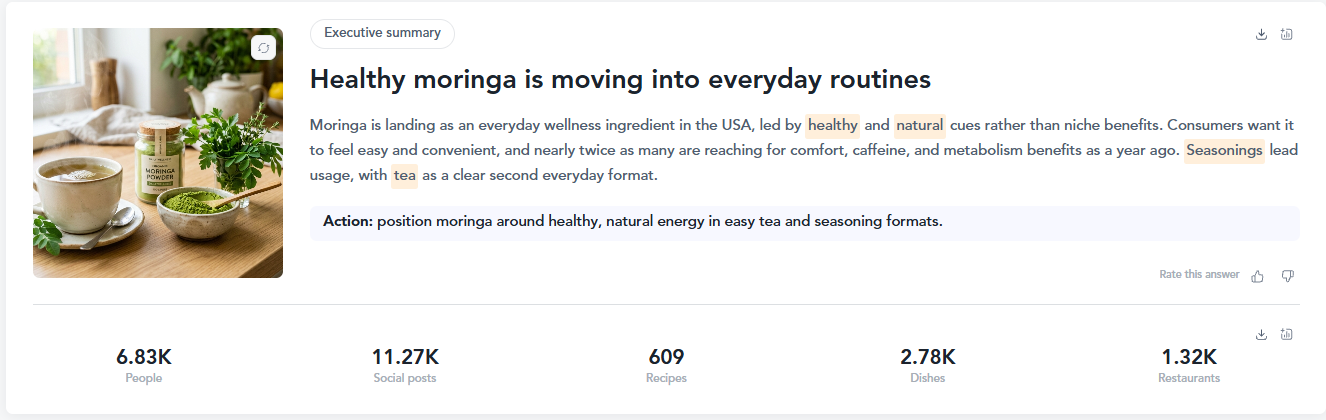
Moringa points somewhere else. Seasonings lead its usage, with tea as a clear second everyday format. A moringa launch carries less risk as a seasoning blend or a tea than as a novel drink that needs explaining.
Practical case scenario
Consider a functional beverage brand choosing its 2027 launch. The team has two candidates: a goji berry wellness drink and a calm-focus drink built around L-theanine.
- Compare the menu lines. L-theanine’s menu presence grew 36% in the past year, with the steepest rise in mid-2026. Operators are adding it now.
- Check the shape of the social signal. Goji’s social share spikes each January and falls back by spring, so the goji berries food trend ingredient reads as seasonal. L-theanine’s social share grew 5% across the year and climbed through mid-2026.
- Pick the audience. Dads lead L-theanine interest, ahead of male consumers and comfort food lovers. That gives the media plan a starting target.
- Choose a format consumers already use. L-theanine occurs naturally in tea leaves, so a matcha latte base gives the drink a familiar starting point.
- Make the call. The brand leads with L-theanine and saves goji for a January limited edition, timed to its yearly social peak.
The team reaches that decision before paying for bench samples or a co-packer run.
How category leaders scale trend-led products

Scaling a new trend food ingredient means making three decisions from the same data: the need you lead with, the format you launch in and the channel you start from. When your ad, pack and retail pitch carry the same evidence, consumer marketing and sales work from one story.
How to position your product around real consumer needs
Any matcha food trend ingredient article written two years ago would have told you to lead with a generic health message. The current data asks for more precision, and each ingredient answers it differently.
Moringa is landing as an everyday wellness ingredient, led by healthy and natural cues. Nearly twice as many consumers now reach for its comfort, caffeine and metabolism benefits as a year ago. Position it around healthy, natural energy in formats people use daily.
For L-theanine, the audience is clearer than the claim. Dads lead interest, so build your first campaign around the consumer segments they sit in.
Reaching consumers across digital ads and store shelves
Each ingredient calls for a different 2027 move across ads, menus and shelves.
For matcha, build the core product around matcha latte, then extend into strawberry and coffee-forward versions. Menus are still climbing, so make that menu growth the proof point in your retail buyer story.
For L-theanine, launch where adoption is moving fastest. Restaurants are adding it at the steepest rate of the three, so a foodservice pilot or a coffee shop partnership tests demand before a national retail push. Point digital ads at dads from day one.
For moringa, go wide in easy formats. Launch a seasoning blend or an everyday tea priced for repeat purchase, and lead the pack with healthy, natural energy.
Every new trend food ingredient has a window, and menus show you whether it is still open. For matcha, L-theanine and moringa it is, which makes 2027 the year to commit. Brands that track all three surfaces monthly, with AI agents flagging changes, can launch while demand is still rising.
FAQs about new trend food ingredient
A new trend food ingredient is a flavor or functional component growing across social posts, restaurant menus and home recipes. The strongest ones grow fastest on menus, where operators commit real money.
Compare its menu growth with its social growth. Matcha’s US menu presence kept climbing in the past year while its social interest cooled from a mid-2025 peak, a sign operators are committed beyond the buzz.
Yes, on menus. Matcha’s US menu presence grew 13.6% in the past year, while its social growth slowed to 4.5%. Matcha latte remains the anchor format, with strawberry and coffee-led versions extending it.
Goji berries are seasonal more than trending. Their US social share spikes each January and falls back by spring, with yearly social growth of 4.2%.
Of the three examples in this guide, L-theanine is growing fastest, with menu presence up 36% in the past year. Dads lead consumer interest in it.
Seasoning blends and everyday teas, its two leading formats in the US. Lead with healthy, natural energy, since nearly twice as many consumers reach for its comfort, caffeine and metabolism benefits as a year ago.

Read more from Kelia Losa Reinoso


We’d love to learn your goals and see how Tastewise fits
We’d love to learn your goals and see how Tastewise fits
Get a personalized demo
Good taste. Wise move.
Your demo request is confirmed. We’ll reach out within one business day to schedule your walkthrough.
What happens next

See what’s driving demand, then turn it into a sell-in story for retailers and operators.
- Connect consumer panels, market trackers, and agents into one evidence view
- Get the “why” behind what’s changing, with explainable demand drivers
- Walk away with a buyer-ready narrative and next steps to activate
Trusted by





“Tastewise is my secret tool for knowing what consumers want next and why.“