







Rice is the primary staple for more than half the world’s population, according to the USDA Economic Research Service. At that scale, brown rice vs white rice is a commercial question as much as a nutritional one. US consumers want complex carbohydrates that keep blood sugar steady and deliver more fiber per bite. Restaurant menus and grocery shelves are moving with them. This guide compares the two grains on milling, fiber, calories and glycemic index. It then shows where each one sits on US menus and shelves in 2026, using Tastewise data.
Key takeaways
- Brown rice and white rice come from the same grain. Milling strips the bran and germ from white rice, and most of the fiber goes with them.
- Harvard Health Publishing rates white rice as a high glycemic food at 73 and brown rice as a medium glycemic food at 68.
- Calories are close. A cup of cooked medium-grain brown rice has 218 calories, and the same cup of white rice has 242.
- White rice appears on nearly twice as many US restaurant menus as brown rice, but brown rice is gaining menu share about 15 times faster.
- Among US consumers who choose brown rice, nearly 3 in 10 (29%) do so for health. High protein is the only motivation that grew over the past year, up 13%.
- Power bowls are rising fastest among the top brown rice dishes Tastewise tracks, up 43% over the past year among the dishes US consumers pair with brown rice.
What is the difference between brown rice and white rice?
Brown rice vs white rice comes down to processing, since both start as the same Oryza sativa grain. Brown rice is an unrefined whole grain that keeps its fiber-rich bran and nutrient-dense germ, while white rice is milled and polished down to the starchy endosperm.
That one processing step drives every other difference in this comparison. Fiber, minerals, B vitamins, glycemic response and cook time all trace back to the bran and germ. White rice cooks faster, which helps explain why it remains the default base in most kitchens.
Fiber content, caloric density & carbohydrate profiles
Fiber is where the brown rice vs white rice nutrition gap is widest. The bran layer holds most of the grain’s fiber, so milling removes it. According to Harvard Health Publishing, brown rice delivers more fiber, magnesium, potassium and iron than white rice. It also carries more of vitamins B1, B3, B6 and B9.
Calories are much closer. Brown rice calories vs white rice depend on the grain length you compare. Harvard Health Publishing lists a cup of cooked medium-grain brown rice at 218 calories and a cup of cooked medium-grain white rice at 242 calories.
Carbs in brown rice vs white rice are similar too, because both grains are mostly starch. The difference is what comes with that starch. Brown rice pairs its carbohydrate with fiber and minerals, and that changes how quickly the body absorbs it.
For product developers, the white rice vs brown rice nutrition comparison rarely turns on calories. It turns on fiber density, mineral content and the whole grain claim a pack can carry.
Glycemic response, weight loss & functional health benefits
The glycemic index ranks foods from 0 to 100 by how much they raise blood sugar. Harvard Health Publishing places white rice in the high range at 73 and brown rice in the medium range at 68. That gap in the brown rice vs white rice glycemic index comes from the bran. Fiber slows how quickly the starch is digested, so glucose reaches the blood more gradually.
The long-term evidence points the same way. A Harvard School of Public Health study of nearly 200,000 US adults linked five or more weekly servings of white rice with a higher risk of type 2 diabetes. The researchers estimated that swapping 50 grams of white rice a day for brown rice would lower that risk by 16%, according to the 2010 study findings.
On brown rice vs white rice for weight loss, the evidence is softer. A cup of each has a similar calorie count, so neither grain drives weight loss on its own. Harvard Health Publishing links fiber-rich whole grains, including brown rice, with weight management. Fiber adds fullness for the same calories, which makes portions easier to manage.
The health benefits of brown rice vs white rice also have limits. Harvard Health Publishing notes that white rice is easier to digest. That can suit people managing a digestive flare-up who need to limit fiber for a while.
Fast-casual menu applications, grain varieties & culinary performance
Chipotle is the clearest US benchmark for chipotle brown rice vs white rice. Tastewise data shows Chipotle serves brown rice in more fast-casual locations than any other chain Tastewise tracks, ahead of Panera Bread and Qdoba.
Chipotle’s published US nutrition facts list both rices at 210 calories per 4-ounce serving. The cilantro-lime brown rice carries 2 grams of fiber against 1 gram for the white rice. It has 36 grams of carbs against 40 grams. It also has 190 milligrams of sodium against 350 milligrams. Brown rice is slightly higher in fat, at 6 grams against 4 grams. So the chipotle white vs brown rice nutrition choice is mostly about fiber and sodium.
Brown vs white basmati rice follows the same logic. Brown basmati keeps its bran, so it brings the fiber and mineral advantages of other brown rice. It also keeps the long, separate grain that makes basmati popular in prepared meals.
On US menus, brown basmati is a niche ingredient that is growing. Tastewise data shows its menu share up 5.8% over the past year. Dishes featuring brown basmati average $16.40, about $2.40 more than the average brown rice dish at $13.97.
For prepared CPG meals, cook time and texture matter as much as nutrition. Brown rice takes longer to cook and has a chewier bite. Product teams building ready-to-heat cups and frozen bowls need to plan for both.
How Tastewise.io uses data-driven insights to predict grain trends
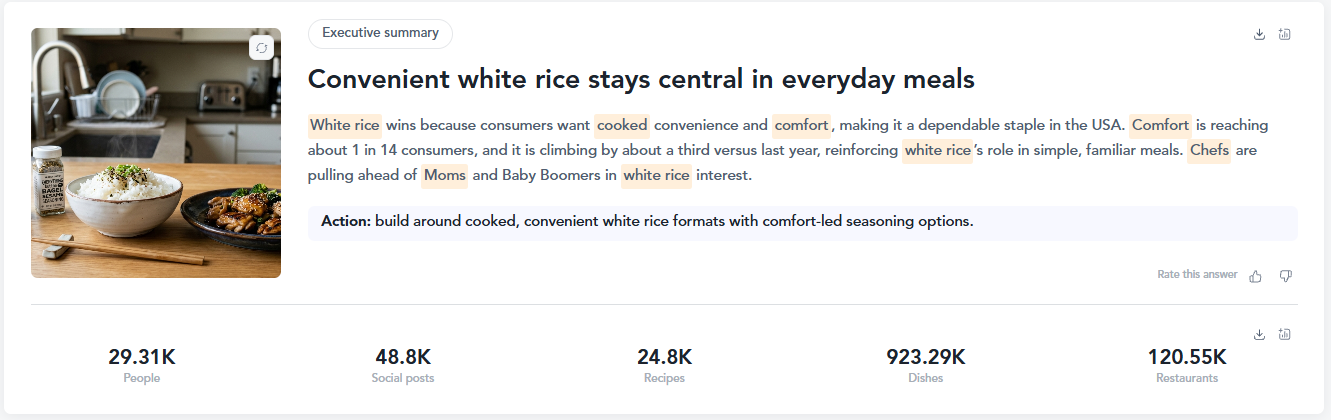
Tastewise reads consumer social signals, home recipes and restaurant menus as one connected dataset, refreshed daily. That lets your team track demand for brown rice vs white rice month by month, well ahead of a quarterly report.
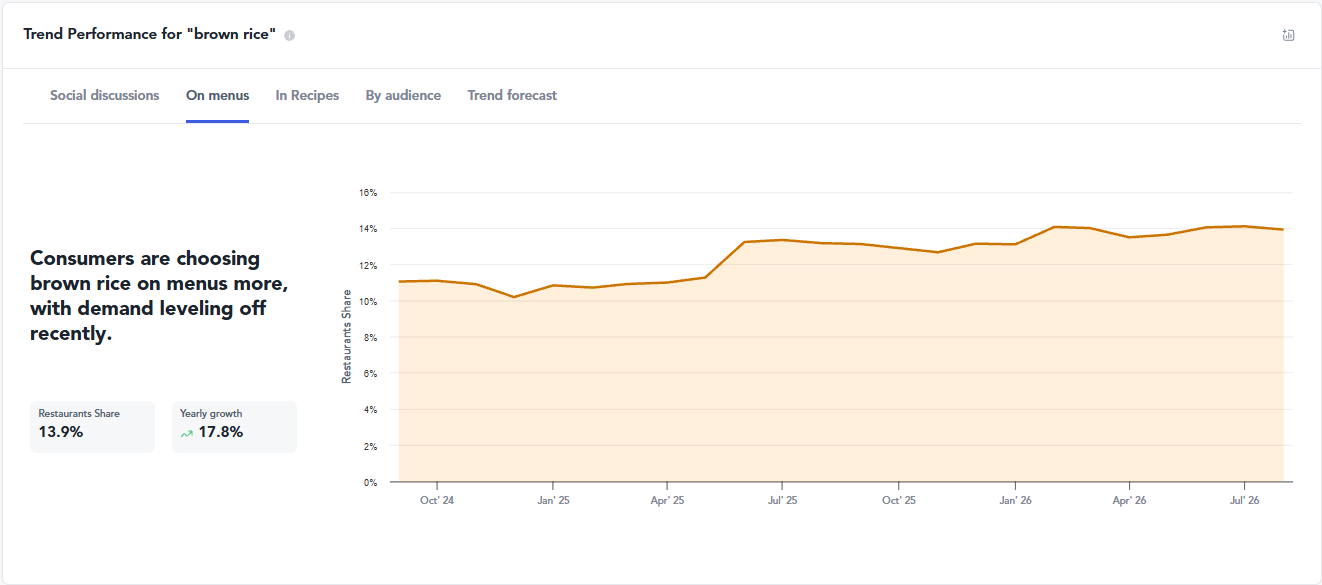
Across Tastewise menu data, white rice appears on nearly twice as many US restaurant menus as brown rice. Brown rice is closing that gap. Its menu share grew 16.6% over the past year, while white rice grew 1.1%. That puts brown rice about 15 times faster at reaching new menus.
Brown rice dishes also average $13.97 on US menus, about $1.15 less than white rice dishes at $15.12. That price point suggests brown rice is moving into everyday bowls as well as premium health concepts.
Low-GI & fiber-dense grain demand
Across the Tastewise US consumer panel, health is the main reason people choose brown rice. Among US consumers who choose brown rice, nearly 3 in 10 (29%) cite health. Nearly 1 in 4 (24%) cite protein, and nearly 1 in 10 (11%) cite fiber.
The motivation that is growing is high protein, up 13% over the past year. General health fell 17% in the same period, and whole grains fell 24%. Brown rice consumers increasingly treat the grain as one part of a protein-forward meal.
That shift matters for packaged frozen meals and meal kits. A brown rice base paired with a named protein answers both the health motivation and the protein motivation. For product innovation teams, the front-of-pack story is the pairing, with fiber and steady energy as supporting claims.
Foodservice & fast-casual bowl innovation
Tastewise menu data shows brown rice moving between cuisines. Mexican restaurants’ share of US brown rice locations grew 165% over the past year, and cafes grew 145%. Chinese, Japanese and Thai restaurants each lost about a fifth of their share.
In fast casual, Chipotle, Panera Bread and Qdoba serve brown rice in the most locations. CAVA and Sweetgreen follow, bringing it into Mediterranean and salad bowls. Teriyaki Madness carries it for Asian-fusion bowls.
The format behind this is the bowl. Among the dishes US consumers pair with brown rice, power bowls grew 43% and rice bowls grew 17% over the past year. Stir fry fell 10% in the same period. Grilled chicken and roasted vegetables remain the most common companions.
For suppliers, these shifts shape foodservice sell-in pitches. A Mexican fast-casual operator and a Thai operator are moving in opposite directions on brown rice. Tastewise data on menu planning helps match the pitch to the operator.
Real-world success: driving functional grain growth through AI analytics
CPG manufacturers and restaurant chains use Tastewise to test grain blends, choose health claims and build the buyer story before launch. Tastewise customers report 30% higher win rates and retailer-ready narratives 10x faster.
Take a packaged food brand planning a pre-cooked grain cup line. The team has to decide whether to lead with brown rice, white rice or a blend. It also has to choose the claim that goes on the front of pack.
The menu data settles the first question. White rice holds the larger base, so a white rice cup protects core volume. Brown rice carries the momentum, so it earns the lead launch slot.
The consumer data settles the claim. High protein is the only brown rice motivation that grew over the past year. A brown rice cup built for protein bowls, such as a cilantro-lime cup sized for grilled chicken or black beans, speaks to that shift. Generic health language is losing ground with the same consumers.
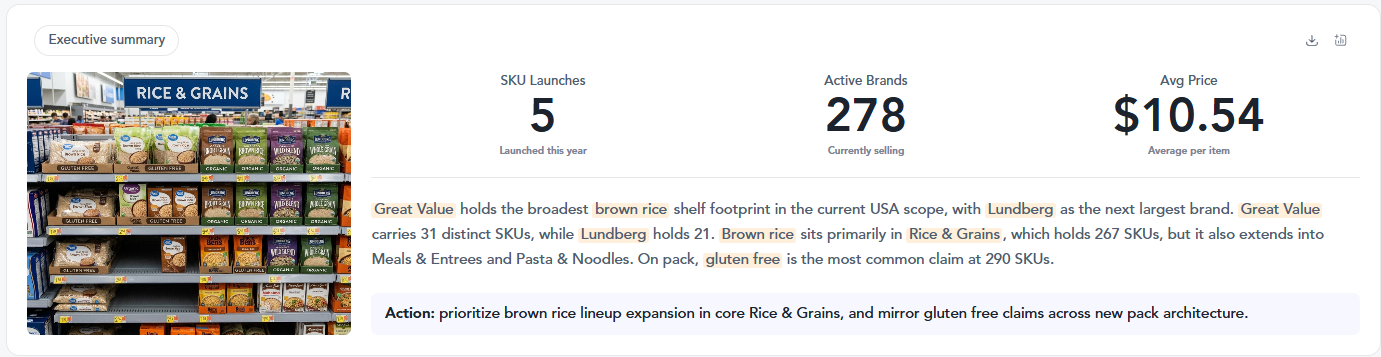
The shelf data settles the format. On US online shelves, brown rice in bags outnumbers brown rice in pouches about 5 to 1. Pouches average $7.62 against $8.26 for bags. A ready-to-heat cup or pouch enters a less crowded part of the aisle.
The team can then check which consumer segments respond to each claim and build the retail buyer story around the menu momentum. The decision is a cilantro-lime brown rice cup positioned for protein bowls, with a white rice cup alongside it for volume. Each step rests on data the team can show a buyer. The same approach to AI for CPG works for any grain, flavor or format decision.
The brown rice vs white rice decision is now a menu and shelf decision as much as a nutrition one. Brown rice leads on fiber and glycemic response, and it is reaching new US menus faster than white rice. White rice still holds the larger base. Teams that track both signals can time a launch to where demand is heading.
FAQs about brown rice vs white rice
For most people, yes. Brown rice keeps its bran and germ, so it carries more fiber, minerals and B vitamins than white rice and has a lower glycemic index.
White rice can suit people who need a low-fiber diet for a short time, such as during a digestive flare-up.
Brown rice has a glycemic index of about 68, which is medium. White rice sits at about 73, which is high.
Neither grain drives weight loss on its own, since a cup of each has a similar calorie count. Brown rice has the edge because its fiber adds fullness for 218 calories per cup of cooked medium-grain rice.
Slightly. Chipotle’s brown rice has the same 210 calories per serving as its white rice, with twice the fiber and about half the sodium.
Yes. Tastewise data shows US menu items featuring brown rice grew 15% over the past year, against 4.5% for white rice.
Mexican restaurants and cafes gained the most share of US brown rice locations over the same period.
Brown basmati keeps its bran and germ, while white basmati is milled down to the endosperm. Brown basmati brings more fiber and a chewier bite, and dishes featuring it average $16.40 on US menus.

Read more from Kelia Losa Reinoso



We’d love to learn your goals and see how Tastewise fits
We’d love to learn your goals and see how Tastewise fits
Get a personalized demo
Good taste. Wise move.
Your demo request is confirmed. We’ll reach out within one business day to schedule your walkthrough.
What happens next

See what’s driving demand, then turn it into a sell-in story for retailers and operators.
- Connect consumer panels, market trackers, and agents into one evidence view
- Get the “why” behind what’s changing, with explainable demand drivers
- Walk away with a buyer-ready narrative and next steps to activate
Trusted by


“Tastewise is my secret tool for knowing what consumers want next and why.“