





Soda water vs seltzer looks like a small labeling question until you have to choose one for a product, a menu or a shelf. Shoppers are buying plain bubbles at a steady clip. US dollar sales of unflavored seltzer, sparkling and mineral water grew 8.1% to $1.6 billion in the 52 weeks to April 19, 2026, according to Beverage Industry. Unit sales of bottled water overall slipped 0.5% over the same period. This guide covers what separates the two waters, where each one wins, and what Tastewise data shows about demand across homes, menus and the shelf.
Key takeaways
- US dollar sales of unflavored seltzer, sparkling and mineral water grew 8.1% to $1.6 billion in the 52 weeks to April 19, 2026.
- Consumer interest in seltzer water grew 17.6% over the past year, about twice the 8.6% growth for club soda.
- Club soda appears on about 26 times more US restaurant menus than seltzer water, and its menu presence grew nearly 20% in a year.
- Mocktail and zero-proof items on US restaurant menus grew 62% between October 2025 and September 2026.
- Convenience (up 11%) and ease (up 12%) are rising reasons US consumers choose sparkling water, while health as a reason fell 31%.
- In botanical mocktails, consumer interest in orange peel grew 49% while chamomile fell 17%.
What is the difference between soda water and seltzer?
Both are water carbonated with added carbon dioxide. The difference between soda water vs seltzer is minerals. Soda water, also sold as club soda, has added mineral salts such as sodium bicarbonate, potassium sulfate or disodium phosphate. Those salts give it a faintly salty, slightly alkaline taste. Seltzer is plain water with carbon dioxide and nothing else, so it tastes neutral and crisp.
Two other bottles often get confused with both. Sparkling mineral water, such as Topo Chico or Perrier, gets its minerals from the spring it comes from. Tonic water adds quinine and usually sugar, so it sits closer to a soft drink than to either soda water or seltzer.
Mineral composition, electrolytes & flavor dynamics
When you compare soda water vs seltzer water on the label, the added salts are the whole story. Club soda carries a small amount of sodium from those salts. Plain seltzer carries none unless the brand adds flavor or minerals, which is why it can wear a sodium free claim on pack.
The salts change how the water tastes and feels. Bicarbonate buffers some of the sharp acidity that carbon dioxide creates when it dissolves in water. The result reads as rounder and slightly mineral on the palate. Seltzer keeps the full bite of the carbonic acid, which comes across as cleaner and more cutting.
So in a seltzer vs soda water tasting, seltzer disappears behind other flavors and soda water adds a little body of its own. Neither is a meaningful source of electrolytes for hydration. The minerals in club soda are there to shape taste.
Mixology applications, RTD formulations & market formats
Behind the bar, the soda vs seltzer choice comes down to what the drink needs. Many bartenders use club soda in highballs, Collins drinks and spritzes because its slight salinity softens citrus acidity and lifts aromatics. Seltzer works when the spirit or syrup should do all the talking.
Across the Tastewise US consumer panel, berry, lime and lemon lead the pairings US consumers reach for with club soda and soda water. Tastewise data shows lime and mint carry the strongest affinity with soda water among the pairings it tracks. Interest in mint pairings fell 16% over the past year, which points to fruit-forward builds over the classic mojito profile.
Canned products pull the other way. Brands such as LaCroix, Polar and Spindrift build flavored lines on a seltzer base, because a neutral water lets fruit essence or real juice carry the flavor. In a seltzer vs soda format decision for ready-to-drink cans, seltzer is the default canvas. Soda water shows up more in mixer formats, such as Fever-Tree Club Soda in 200ml bottles, which appeared as a new item on US delivery menus this year.
The sparkling water trend data on Tastewise tracks how these waters move across menus, recipes and consumer interest month by month.
How Tastewise.io uses data-driven insights to predict sparkling beverage trends

Tastewise reads consumer interest at home, restaurant menus and the retail shelf in one connected dataset. That lets you watch demand for soda water vs seltzer move across all three in the same month, as the shift happens.
Across the Tastewise US consumer panel, consumer interest in seltzer water grew 17.6% over the past year, about twice the 8.6% growth for club soda. The menu picture runs the other way. Club soda appears on about 26 times more US restaurant menus than seltzer water, and its menu presence grew nearly 20% in a year. Seltzer water’s menu presence rose about 2%.
Read together, the two signals say seltzer is the water consumers choose for themselves, and soda water is the one operators build drinks around. Tastewise forecasts hold demand for both steady through September 2027.
Clean-label & hydration demand
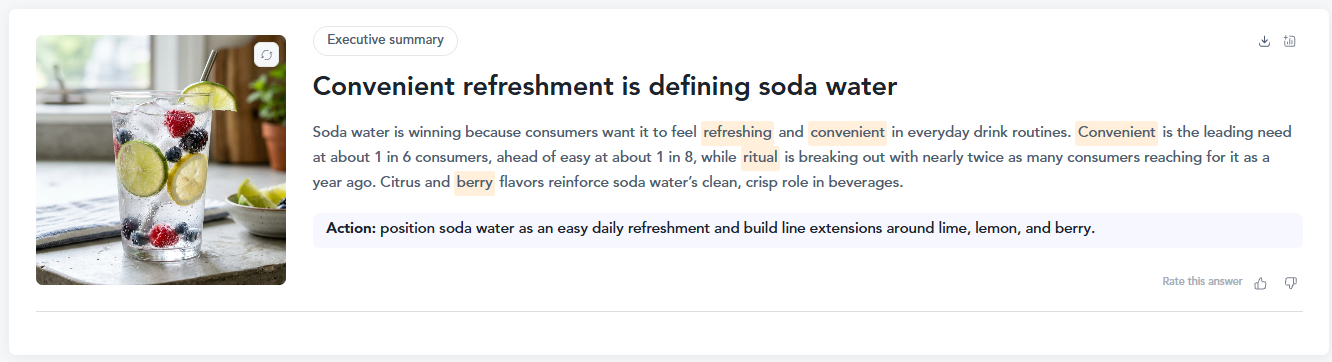
The reasons consumers give for choosing seltzer and sparkling water are shifting from health toward everyday ease. Refreshment and convenience lead the reasons US consumers choose sparkling water. Convenience (up 11%) and ease (up 12%) are rising reasons US consumers choose sparkling water, while health as a reason fell 31%. Taste as a stated reason also fell 24%.
For a retail brand, that means a zero-calorie, sodium free seltzer earns its place through habit and convenience. Lead with refreshment, format and occasion, and treat the clean label as the entry ticket. The online shelf is already crowded. Tastewise tracks nearly 600 brands in US sparkling and flavored water, with an average online price of $6.24. That is where a clear retail sell-in story matters, because a buyer has dozens of near-identical cans to choose from.
Foodservice & craft cocktail innovation
On menus, soda water is gaining ground in the places that sell volume. About 3 in 10 US restaurants that list club soda or soda water are American restaurants, and that slice grew by about half over the past year. In Tastewise menu data, the bestselling soda water items in coffee shops are Italian sodas, a syrup and soda water build that independent cafes price between $3.75 and $5.95.
Zero-proof drinks are the larger shift. Mocktail and zero-proof items on US restaurant menus grew 62% between October 2025 and September 2026. Operators that carry them now list 2.3 items on average, up from 1.6, while the average price per item eased from $8.27 to $7.67. Highballs moved from a much smaller base, with menu items up about three quarters and average price rising from $13.49 to $19.85.
Seasonal programs follow the same pattern, with spritzers and citrus coolers such as a Holiday Spritzer appearing as limited-time items. For brands that sell to foodservice operators, soda water vs seltzer water is a menu design question as much as a sourcing one. The foodservice forecast tracks where those beverage programs are heading next.
Real-world success: driving carbonated beverage growth through AI analytics

Beverage makers and mixer brands use Tastewise to check a sparkling formulation against real demand before they commit a line to it. Tastewise is the proactive AI food and beverage intelligence system that delivers before you ask, and it hands teams the product concepts and buyer story along with the signal.
Here is how that works for a company type that faces this exact decision. Take an enterprise beverage brand planning a line of ready-to-drink botanical mocktails. It needs to decide between a seltzer base and a soda water base before it locks the formulation, the pack claims and the launch channel.
The first question is which botanicals to build around. In botanical mocktails, consumer interest in orange peel grew 49% while chamomile fell 17%. Hibiscus (up 18%) and rosemary (up 15%) are trending, and roselle, a hibiscus variety, more than doubled. Ashwagandha fell 28%, so an adaptogen-led line carries more risk than a flavor-led one.
The second question is the story. Consumer interest in botanical mocktails framed around ritual grew 112%, and interest in intentional drinking grew 164%. That points to positioning the line as a considered evening drink with a calm, deliberate tone.
The third question is the base, and here the soda water vs seltzer data gives a clear split. A seltzer base fits the at-home channel, where consumer interest in seltzer water is growing faster and a sodium free claim reads cleanly on pack. A soda water base fits a foodservice or premium mixer line, where operators already list club soda on far more menus and mocktail menus keep expanding.
With that picture, the brand can match the base to the channel it plans to win first. It can test a hibiscus and orange peel concept with the consumer segments most likely to buy it, and run the shortlist through its product innovation pipeline before any can is filled.
The soda water vs seltzer choice will keep shaping how sparkling drinks are built, sold and served in 2026. The brands that read demand across homes, menus and shelves at once will pick the right base for the right channel first.
FAQs about soda water vs seltzer
No. Seltzer is plain carbonated water, while soda water has added minerals such as sodium bicarbonate. In the US, consumer interest in seltzer water grew 17.6% over the past year.
Soda water has more, because its added mineral salts include sodium. Plain seltzer has none, which is why many seltzer brands print a sodium free claim on the can.
Soda water is the usual bar choice for highballs and spritzes because its minerals soften acidity. US restaurants list club soda on about 26 times more menus than seltzer water.
Both are calorie free when unflavored, and seltzer has no added sodium. Health as a reason for choosing sparkling water fell 31% among US consumers, while convenience grew 11%.
No. Sparkling mineral water gets its minerals from its source, while seltzer is plain water with added carbon dioxide. US dollar sales of unflavored seltzer, sparkling and mineral water grew 8.1% to $1.6 billion in the 52 weeks to April 19, 2026.
Yes. Seltzer gives a cleaner, sharper fizz and soda water a rounder one, so the swap changes texture more than flavor. Mocktail and zero-proof items on US restaurant menus grew 62% between October 2025 and September 2026.

Read more from Kelia Losa Reinoso
We’d love to learn your goals and see how Tastewise fits
We’d love to learn your goals and see how Tastewise fits
Get a personalized demo
Good taste. Wise move.
Your demo request is confirmed. We’ll reach out within one business day to schedule your walkthrough.
What happens next

See what’s driving demand, then turn it into a sell-in story for retailers and operators.
- Connect consumer panels, market trackers, and agents into one evidence view
- Get the “why” behind what’s changing, with explainable demand drivers
- Walk away with a buyer-ready narrative and next steps to activate
Trusted by


“Tastewise is my secret tool for knowing what consumers want next and why.“