





Germany’s foodservice market is moving through a period of genuine structural change. Consumers are placing new demands on menus at every daypart, and the gap between what people want and what operators are serving is widening in some categories and narrowing sharply in others. If you work in menu development, product innovation, or foodservice sales, Germany menu trends 2026 deserve your full attention right now. Tastewise, the food intelligence and marketing platform, tracks these signals across consumer behaviour and operator menus in real time, and the picture is more nuanced than a simple comfort-versus-health narrative.
Key takeaways
- Schnitzel holds a 66% consumer reach and 3% menu share in Germany, making it the single most anchored dish on the market, but growth is flat and adjacent formats such as schnitzel bowls and baked schnitzel variations are picking up real momentum. Build around the platform, not just the classic preparation.
- The “takeaway” need signal is up 31% to 39% in the past year across both traditional and modern menu panels. Consumers are choosing portability as a primary criterion. Operators who have not reformatted signature dishes for off-premise are leaving volume on the table.
- Salad as a dish component is growing 18% to 21% depending on the menu context, and soup is up 30%, both moving from mature into trending lifecycle stages. These are not side-dish signals. They indicate a meaningful consumer shift toward lighter, fresher combinations at lunch.
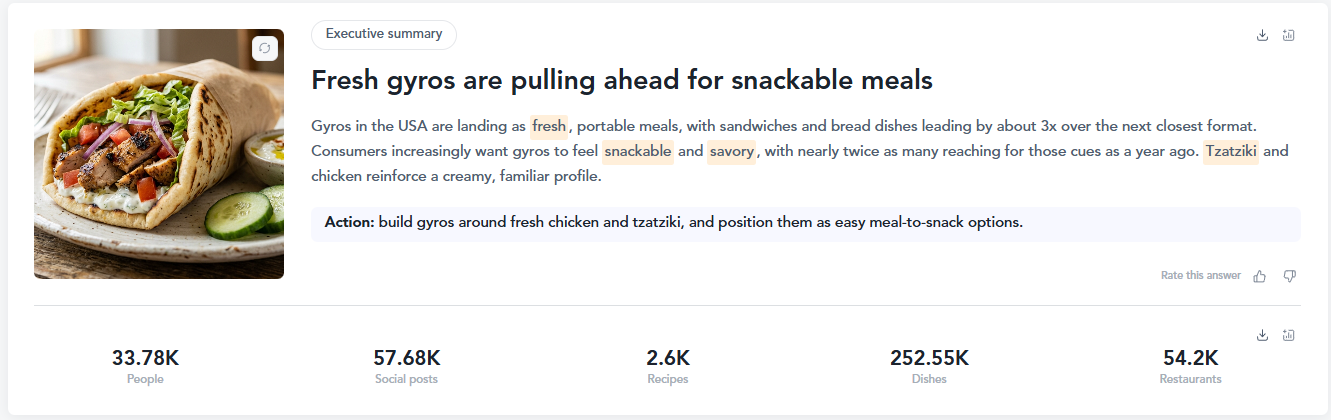
- Gyros is up 72% and hollandaise sauce up 55% in the past year, both in emerging lifecycle stages. Mediterranean and European flavour fusion is the most active whitespace on the German menu right now.
What is actually driving Germany menu trends 2026
German consumers are not abandoning comfort food. They are reframing it. The traditional categories, schnitzel, bratwurst, potato dishes, still anchor the market in reach terms: schnitzel reaches the largest consumer segment of any single dish tracked, and sauerbraten and bratwurst are stable on menus. But stability is not growth, and the signals sitting underneath those anchors tell a more forward-looking story.
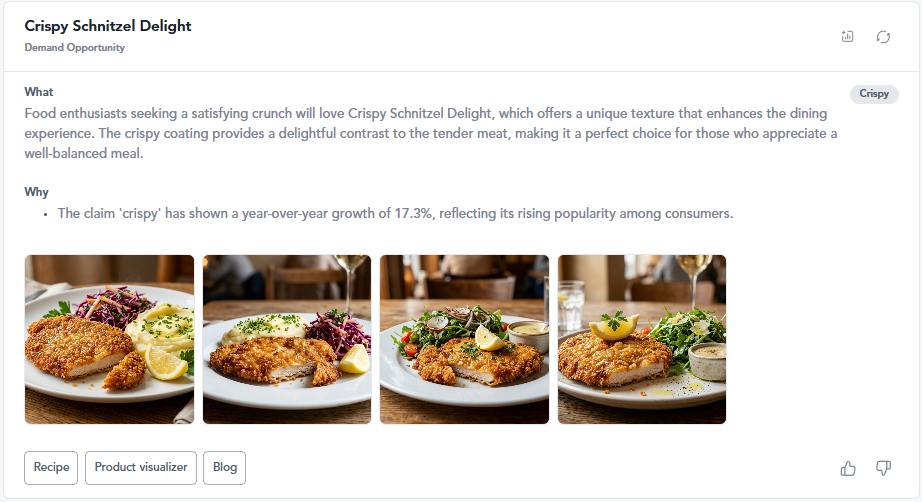
What the Tastewise consumer panel shows is that the attributes consumers associate with satisfying German meals are changing in character. “Hearty” (herzhaft) is up nearly 90% in the past year. “Crispy” (knusprig) is up 63%. “Fresh” (frisch) is up 58%. These are not contradictory preferences. They are a composite picture of a consumer who wants substantial, flavour-forward meals that are well-prepared and made with visible quality. It is the difference between a schnitzel that has been done well and one that was merely assembled.
At the same time, the takeaway signal is the single largest behavioural shift in the data. Across both traditional and modern menu contexts, “zum Mitnehmen” is growing by a third in the past year. That aligns with broader market projections: the German foodservice takeaway segment is forecast to grow at an 11% compound rate through 2031, the fastest of any service format in the market. Portability is no longer a channel feature reserved for QSR. It is a primary consumer expectation that is crossing into casual dining and fast-casual formats. Your team should treat this as a product brief, not just a packaging question.
For a closer look at how consumer data translates to operator strategy in the European foodservice market, the 2026 trend forecast is a useful starting point.
The dish-level data that matters for your menu
The most useful signal in Germany foodservice right now is the divergence between what is growing fast from a small base and what is stable from a large one. Both types of signal have value, but they require different strategic responses.
Schnitzel sits at 66% consumer reach with 3% menu share. That pairing tells you the dish is culturally entrenched and commercially proven. The opportunity is not to add another standard schnitzel. It is to innovate within the format. The data shows baked schnitzel, schnitzel bowls, and schnitzel with hollandaise are the adjacent preparations gaining ground. Hollandaise as a standalone sauce is up 55% in the past year and moving through the emerging stage. Gyros is up 72%. Both of these signals are telling you that German consumers are open to European flavour combinations on familiar protein bases.
Soup (suppe) deserves particular attention from menu developers. It grew 30% in the past year and moved into the trending lifecycle stage. This is not a soup revival driven by seasonal comfort eating. The data shows it alongside fresh and lightweight meal claims, which points to soup as a lunch-position dish, particularly in formats that can be served quickly and portably. Kartoffelbrei (mashed potato) is up 33% and knödel (dumplings) up nearly 20%, both emerging. There is a clear consumer appetite for warm, satisfying, broth-adjacent dishes that sit between snack and full meal.
Salad growth deserves the same attention. Running at 18% to 21% growth depending on the menu context, and now in the trending stage, salad is moving from a default accompaniment to a considered centrepiece. The data shows it most strongly in the burger and bowl category, where greens, fresh vegetables, and protein are combining in configurations that match the bowl-format momentum observed across European markets. Rainbow bowls, chicken bowls, and the dean&david chain’s format are among the most-listed menu items in Germany’s fast-casual operator data right now.
The declining signals are equally informative. Steak is down nearly 11%. Classic cheeseburger is down 16%. Wagyü beef is down 12%. These are not catastrophic declines, but they indicate that the premium indulgence category built around premium beef formats is losing consumer appetite, particularly among younger urban consumers who are shifting protein preferences toward chicken, pork in modern preparations, and plant-forward options. Veggie burger is up 17% and holding a 1.8% menu share, which is materially above most emerging plant-based signals.
See how Tastewise supports product innovation with real-time consumer and operator data for the German and European market.
Daypart shifts and where the growth windows are
Germany’s lunch daypart is the most active area of change. The combination of salad growth, soup growth, bowl format adoption, and the takeaway signal converge precisely at a midday occasion that is being reshaped by urban consumers who want a full meal that travels well and does not compromise on quality or satisfaction.
“Wochentag” (weekday) as a claim context is up 51% in the past year. That is a specific signal: consumers are thinking more deliberately about everyday eating occasions, not just weekend dining out. This shifts the priority question from “what makes a great weekend menu” toward “what does a great Tuesday lunch look like at scale.” For operators running fast-casual or casual concepts, this is a brief for a stronger everyday lunch offer.
Breakfast is a contrasting signal. Frühstück (breakfast) is down 22% in the panel, and breakfast-specific formats like the breakfast sandwich and breakfast bowl are declining. This does not mean German consumers have stopped eating breakfast. It means the foodservice version of the occasion is losing ground, possibly to home preparation. Your team should think carefully before investing in a new breakfast menu extension without consumer data to support the specific format and occasion in your market segment.
The evening remains stable rather than growing. Abendessen (dinner) is down 35%. The signal here points to the dinner occasion at restaurants holding steady but not expanding, while the mid-day and quick-serve occasions grow around it.
The emerging ingredient story your team should track
Four emerging signals in the Germany data are worth tracking as forward indicators rather than immediate launch priorities.
Spargel (asparagus) is up 18% to 35% depending on the menu context and is in the emerging lifecycle stage. White asparagus in particular retains strong cultural resonance in Germany, but the data shows green asparagus gaining ground as a year-round menu component rather than a seasonal feature. Operators who treat asparagus as a spring-only dish are missing the opportunity to use it as a freshness signal in salads and bowls across more of the year.
Pilze (mushrooms) are up 20% in the traditional menu context and moving through the emerging stage. Champignons and oyster mushrooms both appear with growing frequency in bowl and wrap combinations. For R&D teams developing plant-forward or flexitarian menu components, mushroom as a texture and umami carrier is the most commercially accessible emerging ingredient in the German data right now.
Paprika (bell pepper) is up 25% and emerging. Combined with the gyros signal and the broader Mediterranean flavour momentum, there is a clear direction toward roasted vegetable and pepper-based preparations as a flavour bridge between traditional German formats and more internationally influenced dishes.
Granatapfel (pomegranate) at 223% growth is still at a small base, which warrants caution on the volume side, but its direction is consistent with a broader shift toward vibrant, visually led garnishes and dressings that align with the digital aesthetics signal observed across European foodservice.
Wat to see how your team can track these emerging signals for Germany and European markets on the Tastewise platform?
What this means for foodservice operators and menu developers
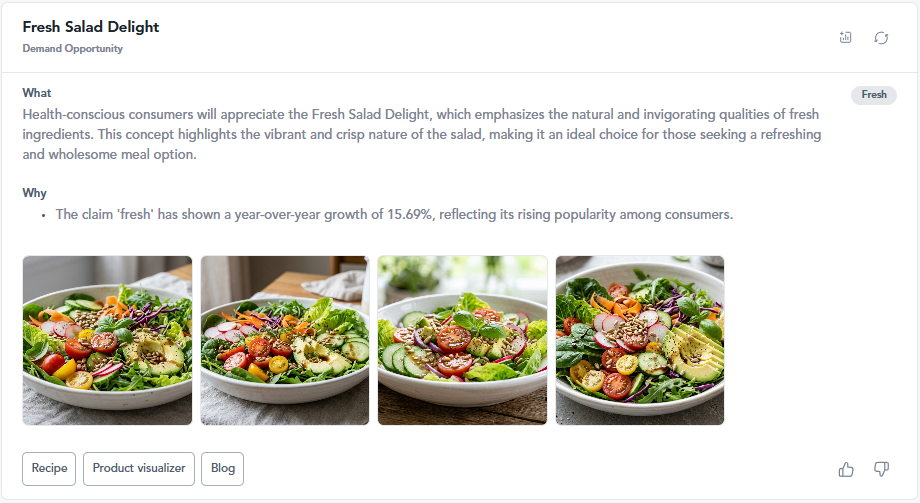
The overall picture from Germany menu trends 2026 is a market with a strong, anchored heritage base that is being overlaid by a set of consistent consumer pressures: portability, freshness, flavour complexity, and lighter meal formats at lunch. These are not fads. The takeaway signal, the salad and soup growth, and the daypart shift toward weekday lunch are all structural in their direction.
For operators, the practical implication is that your best menu investment right now is not a new hero dish. It is the adaptation of existing signature items into formats that meet these consumer expectations. A schnitzel that can be served in a bowl with seasonal vegetables and a fresh sauce is a better strategic position than a new premium beef format that is swimming against the tide.
For R&D and NPD teams feeding into operator menus, the emerging ingredient signals, mushroom, asparagus, bell pepper, and gyros-style Mediterranean combinations, give you a set of consumer-validated flavour directions that are still early enough to act as first-mover assets.
For foodservice sales teams, the consumer data behind Germany’s lunch daypart shift is the strongest sell-in story in the market right now. Operators need to be told, with evidence, that their weekday lunch offer is under-serving a growing consumer demand. That conversation leads to menu reviews and product placement opportunities.
The foodservice forecast 2026 covers the full signal set with operator-level data for teams building sell-in stories for this market.
Methodology note
This analysis draws on Tastewise consumer panel data and operator menu data for the Germany market, covering traditional German dishes, burger and bowl formats, and cross-category ingredient signals. Consumer panel figures represent the share of German consumers expressing preference for or engaging with the relevant dish or ingredient. Growth figures are calculated over the past twelve months. Operator data covers 873,821 restaurants and 26,438 chains. Lifecycle stages (emerging, early, trending, mature, declining) reflect the Tastewise dish lifecycle model. All data was pulled in May 2026.
FAQs about Germany menu trends
Salad growth in Germany is tracking with a broader shift toward lighter, fresher lunch formats rather than a general health trend. The data shows it growing most strongly in the burger and bowl category, where consumers are combining protein, greens, and fresh vegetables in meal-sized configurations. The growth is concentrated at the weekday lunch occasion and reflects consumer preference for satisfying meals that do not feel heavy. Operators positioned in fast-casual formats stand to benefit most directly.
The “zum Mitnehmen” (takeaway) signal grew 31% to 39% in the past year across both traditional and modern menu panels. This reflects a structural change in how urban German consumers approach everyday meals, particularly at lunch. It is not limited to QSR. The signal is appearing in casual dining contexts as well, which means operators across formats need to ensure their menu design and packaging are ready to serve the off-premise occasion without compromising food quality or presentation.
Hähnchen (chicken) is the most stable growing protein, holding strong reach across the consumer panel. Pulled pork is growing within the burger category. Gyros is up 72% and is the most dynamic protein format in the data, driven by Mediterranean flavour momentum. Traditional beef formats including steak, wagyü, and classic cheeseburger are declining, which points toward a consumer preference for lighter proteins and more globally influenced preparations over premium beef indulgence.




We’d love to learn your goals and see how Tastewise fits
We’d love to learn your goals and see how Tastewise fits
Get a personalized demo
Good taste. Wise move.
Your demo request is confirmed. We’ll reach out within one business day to schedule your walkthrough.
What happens next

See what’s driving demand, then turn it into a sell-in story for retailers and operators.
- Connect consumer panels, market trackers, and agents into one evidence view
- Get the “why” behind what’s changing, with explainable demand drivers
- Walk away with a buyer-ready narrative and next steps to activate
Trusted by





“Tastewise is my secret tool for knowing what consumers want next and why.“