







Feta vs goat cheese looks like a simple swap on a salad, yet the two cheeses are moving in different directions in the US. Across the Tastewise US consumer panel, the Mediterranean diet consumer need around feta grew 22% over the past year. A consumer need is the diet, health goal or claim people attach to a food when they choose it.
This guide compares the two cheeses on milk source and taste, then on calories, fat, protein and lactose. It then shows where each one is growing on US menus and with US consumers, and how a food brand can use that data to pick the right cheese for a launch.
Key takeaways
- Feta is on more than 3 times as many US restaurant menus as goat cheese, and restaurants that use feta list it in nearly twice as many dishes.
- Among US cheese consumers, feta’s consumer interest share grew 35% over the past year, about 4.5 times the pace of goat cheese at 8%.
- Per ounce, the two cheeses match on calories and fat in USDA nutrient data, but soft goat cheese carries about 30% more protein and one third of feta’s sodium.
- Soft goat cheese lists about 0.3 g of sugars per ounce against 1.2 g for feta, which makes it the lower-lactose option of the two.
- Goat cheese dishes sell at a premium, averaging $19.02 per US menu item against $15.25 for feta, and the gap widened over the past year.
- Fast casual leads feta’s restaurant footprint, while nearly half of US restaurants serving goat cheese are casual dining.
What is the difference between feta and goat cheese?
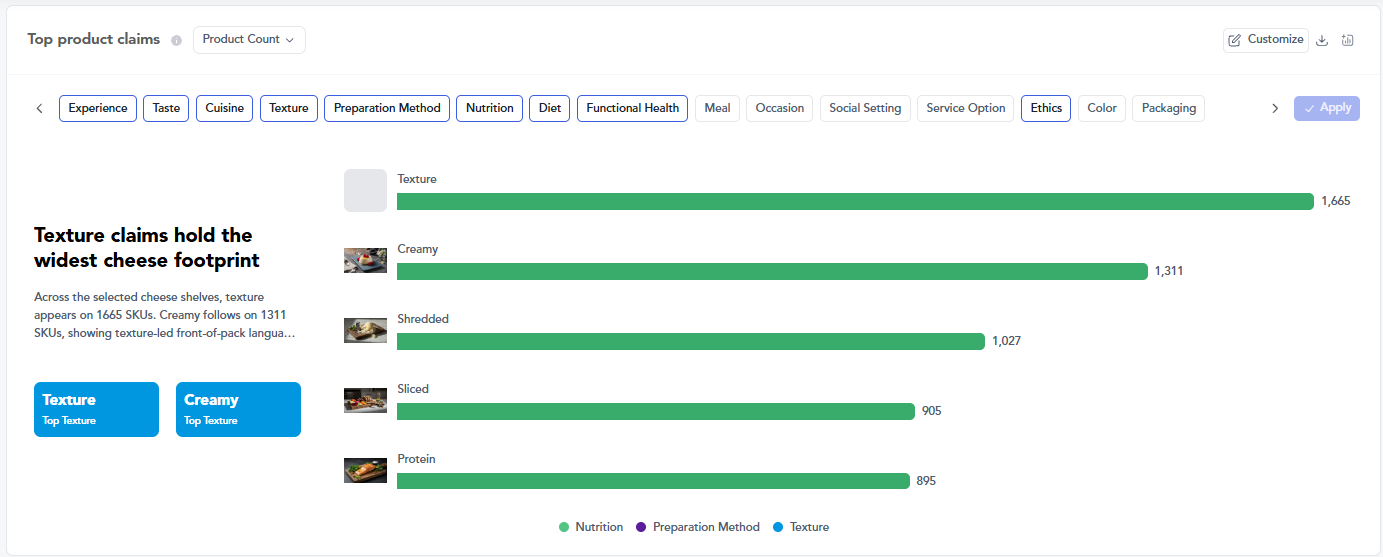
Feta and goat cheese are both tart, white specialty cheeses. Authentic feta is a brine-cured block made from sheep’s milk or a sheep and goat milk blend, which gives it a salty, crumbly texture. Goat cheese (chèvre) is made only from goat’s milk, and fresh styles are soft, earthy and spreadable.
Feta has carried a protected designation of origin in the EU since 2002. That limits the name to Greek cheese made from sheep’s milk with up to 30% goat’s milk. The name is unprotected in the US, so feta here is often made from cow’s milk. In any feta vs goat cheese comparison, the ingredient line on the pack tells you which milk you are buying.
Feta’s growth sits inside a wider move toward Mediterranean and vegetable-led eating, which the 2027 forecast tracks across categories.
Flavor profiles, texture & culinary applications
On feta vs goat cheese taste, feta is briny and sharp with a salty finish. Goat cheese is milder, with a bright tang and a creamy, slightly earthy body. Block feta holds its shape in the oven, which is why it works in baked feta pasta and Greek potatoes. Fresh goat cheese softens into sauces and spreads on toast.
Texture decides most swaps. In crumbled goat cheese vs feta, goat cheese crumbles are soft and smear when tossed, while feta crumbles stay distinct and dry. That makes feta the safer choice for bowls and kits that sit for hours before they are eaten.
Among US consumers choosing feta, the fastest-growing dishes are fresh and plant-led. Interest in cucumber and tomato salad with feta grew 188% over the past year, and the dish is still at the emerging stage. Greek potatoes grew 75%, bean salad 69% and chickpea salad 39%.
Goat cheese leans sweet and warm on menus. New items over the past year include a blackberry goat cheese salad at Minsky’s Pizza, a strawberry goat cheese salad at Cascadia Pizza Co. and spinach and goat cheese egg bites at Snap Kitchen. Nicholas Creamery ran a fig and goat cheese ice cream as a limited edition, and CRAFT Bayside serves goat cheese croquettes as a warm appetizer.
For feta vs goat cheese in salad, feta suits Greek, chopped and grain salads where its salt seasons the whole bowl. Goat cheese suits fruit, beet and nut salads where its creaminess balances sweetness. About 2 in 3 US restaurants that serve feta also list it in a salad. Menu items named feta salad grew their restaurant reach 11% over the past year, about 3 times the pace of named goat cheese salads.
Nutritional breakdown, protein & fat profiles
For feta vs goat cheese nutrition, the USDA reference entries for standard feta and soft goat cheese are close on energy and fat. The differences sit in protein, sodium and calcium. The table below shows one ounce (28 g) of each.
| Per 1 oz (28 g) | Feta | Soft goat cheese |
| Calories | 75 | 76 |
| Total fat | 6.0 g | 6.0 g |
| Saturated fat | 4.2 g | 4.1 g |
| Protein | 4.0 g | 5.3 g |
| Sodium | 316 mg | 104 mg |
| Calcium | 140 mg | 40 mg |
| Total sugars | 1.2 g | 0.3 g |
On feta vs goat cheese calories, the gap is one calorie per ounce. On feta vs goat cheese fat content, both carry about 6 g, two thirds of it saturated. On feta vs goat cheese protein content, soft goat cheese delivers about 30% more per ounce.
The clearest feta cheese vs goat cheese differences are minerals. Feta’s brine gives it about 3 times the sodium of soft goat cheese, and it carries about 3.5 times the calcium. Brands vary widely, so check the nutrition panel on the product you use.
Digestibility, lactose levels & health profiles
On goat cheese vs feta, which is healthier depends on the goal. Goat cheese is the better pick for lower sodium and more protein per ounce. Feta is the better pick for calcium. On calories and fat, goat cheese vs feta healthy comparisons come out even.
Both cheeses contain lactose, and neither is lactose-free. In plain cheese, the sugars on the nutrition panel are mostly lactose, so the USDA figures put soft goat cheese well below feta. That gap matters for people who manage their lactose intake and can handle small amounts.
Goat milk structure also plays a part. A review in Dairy Science and Technology reports that goat milk digests more easily than cow milk because of its smaller fat globules. It also carries more short and medium-chain fatty acids, such as caproic, caprylic and capric acid. Anyone with a diagnosed intolerance should still check with a clinician before changing their diet.
Consumers are adding clean-label reasons to choose goat cheese. Among US consumers choosing goat cheese, the seed oil free consumer need more than doubled over the past year, up 122%. The minerals consumer need grew 16%.
How Tastewise.io uses data-driven insights to predict specialty cheese trends

Tastewise.io reads consumer interest, home recipes and restaurant menus as one dataset, refreshed daily, so teams see feta vs goat cheese demand shift ahead of quarterly reports. Tastewise is the proactive AI food and beverage intelligence system that delivers before you ask. It resolves its consumer panel, social demand, NIQ retail lines and more than 4 million operator locations into one dataset across 72 markets.
Artisanal & better-for-you dairy demand
Consumer interest share is the portion of a category’s consumer interest that one food holds. Among US cheese consumers, feta’s consumer interest share reached 5.3% in August 2026, about twice goat cheese at 2.5%. Feta is also reaching new consumers faster than goat cheese, and Tastewise forecasts its demand to keep climbing through August 2027. Goat cheese demand is forecast to hold steady.
The Mediterranean diet explains much of the gap. The Mediterranean diet consumer need accounts for 2.2% of consumer interest in feta and 0.1% for goat cheese, a 20-fold difference. Vegetarians are the leading consumer segment behind feta, while Baby Boomers lead goat cheese. For product innovation teams, that points feta toward plant-forward formats and goat cheese toward premium and indulgent ones. Teams that want to size these groups can build custom consumer segments around them.
Foodservice & menu pairing analytics
Menu share is the portion of US restaurants with an item on the menu. Feta’s menu share is more than 3 times goat cheese’s, and both held steady over the past year. Restaurants that use feta list it in about four dishes each, against about two for goat cheese.
The operator mix differs sharply. Nearly 2 in 5 US restaurants serving feta are fast casual, and about 1 in 5 are quick service. Nearly half of the restaurants serving goat cheese are casual dining, and only about 1 in 30 are quick service. Slightly more fine dining restaurants serve goat cheese than feta, despite feta’s threefold lead overall.
Chains split the same way. Starbucks and Domino’s carry feta at the largest number of US locations, and Starbucks grew its slice of feta-serving locations over the year. The top goat cheese chains are First Watch, Sweetgreen and Carrabba’s Italian Grill. The largest feta chain reaches about 16 times as many locations as the largest goat cheese chain.
Price follows positioning. The average US menu item with goat cheese rose from $17.89 to $19.02 over the past year, an increase of about 6%. Feta items rose about 2% to $15.25. For menu planning decisions, goat cheese supports a premium tier, while feta carries volume. Suppliers can turn the same data into operator pitches matched to each segment.
See how these signals look for your own category and accounts.
Real-world success: driving specialty dairy growth through AI analytics

Dairy brands and foodservice operators use Tastewise.io to test alternative cheese formulations, choose which claims to lead with and bring retail buyers the consumer evidence behind a launch. Tastewise is trusted by 80% of the world’s leading food and beverage brands.
Take a packaged salad brand choosing between crumbled goat cheese vs feta for a new grab-and-go kit. The decision covers four questions: which cheese reaches more shoppers, which pairings are growing, which claims to print and where each cheese can carry a premium.
Reach and momentum point to feta for the core kit. It is on more than 3 times as many US menus, and its consumer interest share among US cheese consumers is growing about 4.5 times faster than goat cheese’s. Its fastest-growing pairings are cucumber and tomato salad and chickpea salad. A feta, chickpea, cucumber and tomato kit matches those dishes directly, and the Mediterranean diet consumer need gives the pack its lead claim.
Goat cheese earns a premium line instead. Its menu items average close to $4 more than feta’s, and that gap grew over the year. Menus pair it with strawberries, blackberries, beets and figs. A goat cheese, berry and walnut kit fits that pattern, and its lower sodium per ounce gives the team a nutrition comparison to test, subject to labeling rules.
With Tastewise AI agents, the team gets that read as finished work, with the product concepts and the buyer story built from the same figures. The retail buyer sees why the brand chose each cheese, and every figure carries its source.
The feta vs goat cheese decision comes down to role. Feta is the volume cheese with the stronger consumer momentum, and goat cheese is the premium cheese with pricing headroom. Tastewise shows which role your next product should fill before it reaches the shelf.
FAQs about feta vs goat cheese
Soft goat cheese has more protein and about one third of feta’s sodium per ounce, while feta has about 3.5 times the calcium. Calories and fat are nearly identical, so the healthier choice depends on whether you are watching sodium or calcium.
They are almost the same. USDA data lists 75 calories per ounce for feta and 76 for soft goat cheese.
Soft goat cheese has more protein, at 5.3 g per ounce against 4.0 g for feta. That is about 30% more protein for the same calories.
Yes, soft goat cheese is lower in lactose than feta, though neither is lactose-free. USDA lists 0.3 g of sugars per ounce for soft goat cheese and 1.2 g for feta, and in plain cheese those sugars are mostly lactose.
Feta tastes salty, briny and sharp, while fresh goat cheese tastes mild, tangy and creamy. Among US consumers choosing feta, cucumber and tomato salad is an emerging pairing that uses its salt to season fresh vegetables.
Yes, but expect a creamier, less salty result, because goat cheese crumbles soften and coat the leaves. On US menus, goat cheese salads lean on fruit and beets, while about 2 in 3 restaurants serving feta use it in a salad.



We’d love to learn your goals and see how Tastewise fits
We’d love to learn your goals and see how Tastewise fits
Get a personalized demo
Good taste. Wise move.
Your demo request is confirmed. We’ll reach out within one business day to schedule your walkthrough.
What happens next

See what’s driving demand, then turn it into a sell-in story for retailers and operators.
- Connect consumer panels, market trackers, and agents into one evidence view
- Get the “why” behind what’s changing, with explainable demand drivers
- Walk away with a buyer-ready narrative and next steps to activate
Trusted by


“Tastewise is my secret tool for knowing what consumers want next and why.“