







Avocado oil vs olive oil gets the same answer almost everywhere you look. Avocado oil has the higher smoke point, olive oil has the polyphenols, and both cost you about the same in calories. What that answer misses is the gap between what American consumers talk about and what they actually cook with. Avocado oil takes 2.83% of US social conversation about food and drink. Olive oil takes 0.59%. Then the ratio flips. Olive oil appears in 18.75% of US recipes against avocado oil at 2.68%. One oil owns the feed. The other owns the pan.
Key takeaways
- Avocado oil leads the conversation and olive oil leads the kitchen. Avocado oil holds 2.83% of US social food and drink conversation against olive oil at 0.59%, while olive oil appears in 18.75% of US recipes against avocado oil at 2.68%.
- Neither oil is emerging. Avocado oil moved from 3.73 to 3.17 of every 100 US menu items across the last 12 months. Olive oil moved from 11.81 to 11.43 over the same period.
- Health is not the growth story for either oil. The fastest growing claim attached to both is shortcut, up 170.0% for olive oil and 158.4% for avocado oil against the prior year.
- Family meal planners is the only audience growing for both, up 11.1% for avocado oil and 7.1% for olive oil. Keto, avocado oil’s highest affinity audience at 7.2 times the average, shrank 20.2%.
- Avocado oil is gaining in sauces and dressings, up 1.87%, in the same window that olive oil lost 1.87% there.
Source: Tastewise, USA, 12 months to July 2026, across social conversation, home recipes and restaurant menus.
The full read on where the oils and fats category goes next sits in the 2027 food trends forecast, which ranks next year’s demand shifts by channel.
What is the difference between avocado oil and olive oil?
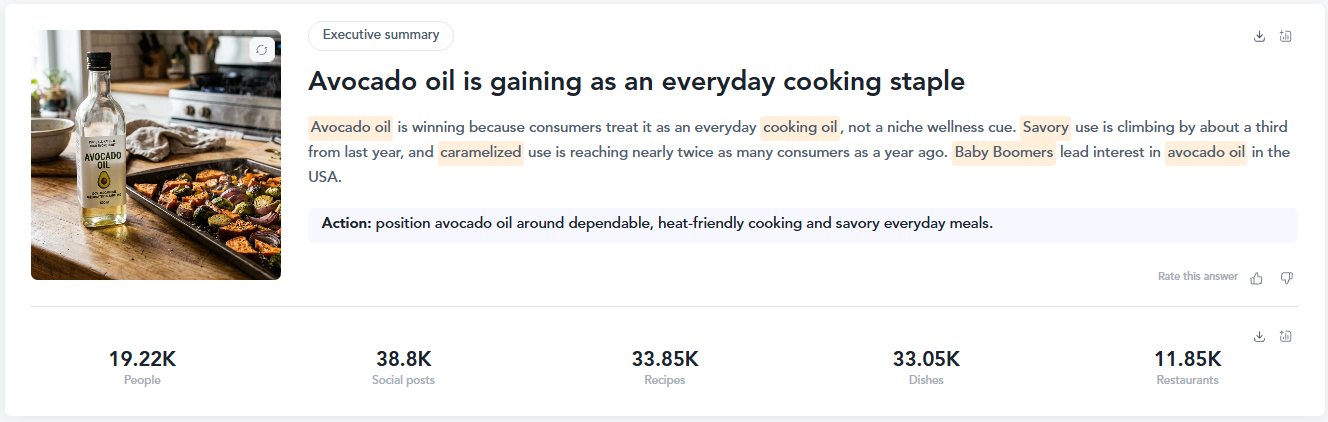
Both oils are pressed from whole fruit and both are dominated by monounsaturated fat, mostly oleic acid. Olive oil is pressed from tree olives and carries polyphenols that refining strips out. Avocado oil is extracted from avocado pulp and reaches a higher smoke point, which suits high heat cooking.
From there the two oils separate on four things a product or menu team has to decide between. Heat tolerance, evidence depth, calorie load and flavor contribution.
Smoke points and high heat performance
Refined avocado oil smokes somewhere between 480 and 520 degrees Fahrenheit. Unrefined avocado oil can be taken safely to around 480 degrees Fahrenheit, or 249 Celsius. Extra virgin olive oil runs 325 to 410 degrees Fahrenheit, and light refined olive oil 390 to 479. On the raw avocado oil vs olive oil smoke point figures, avocado oil has real headroom.
The number is softer than it looks. A 2025 analysis of 48 virgin olive oils found free fatty acid content was the main determinant of smoke point, in a strong inverse relationship. A fresh low acidity bottle smokes far higher than a tired one, so the olive oil vs avocado oil smoke point gap depends on which olive oil you actually buy.
Thermal stability is also a separate property from smoke point. Testing published in Acta Scientific Nutritional Health in 2018 found oils high in monounsaturated fat produced fewer aldehydes when pushed past their smoke point than oils high in polyunsaturated fat, with extra virgin olive oil the most stable oil in the set. So cooking with avocado oil vs olive oil at searing and roasting temperatures is closer to a tie than the search results suggest.
What to do with that. If the claim on your pack or your menu is deep frying or a commercial fryer, avocado oil earns it and avocado oil vs extra virgin olive oil is a genuine spec difference. If the claim is searing, roasting or sauteing, do not pay the avocado oil premium for heat you never reach.
Health benefits, cholesterol and lipid profiles
On fatty acids the two oils are close to twins. Avocado oil runs about 70.6% monounsaturated fat, of which 67.9% is oleic acid, alongside 11.6% saturated and 13.5% polyunsaturated fat. Olive oil’s oleic acid content ranges from roughly 66% to 75% depending on cultivar. Anyone comparing olive oil vs avocado oil health on composition alone will find very little to choose between them.
The real difference is how much human evidence sits behind each one. The European Food Safety Authority granted a claim in 2011 for olive oil polyphenols protecting LDL particles from oxidative damage. A 2023 meta analysis of ten randomized trials found olive oil polyphenols improved HDL cholesterol. A separate dose response meta analysis found high phenol olive oil lowered oxidized LDL compared with low phenol olive oil, and the effect tracked with phenolic content.
Avocado oil has no comparable body of work. Most of the trials people cite are on whole avocados rather than the oil, and they disagree. A systematic review of avocado consumption01257-6/fulltext) pooled nine randomized trials and one cohort study, and the pooled results found a change in total cholesterol without significant differences in LDL, HDL or triglycerides. Avocado oil itself has not been through long term human outcome trials.
So on avocado oil vs olive oil for cholesterol, and on avocado oil vs olive oil health benefits generally, olive oil has the deeper evidence base and extra virgin olive oil vs avocado oil is not a close contest on published trials. Neither oil treats anything on its own. Both are studied as part of a wider eating pattern.
What to do with that. If your pack claim leans on heart health, olive oil is the one you can substantiate to a regulatory reviewer. Avocado oil’s reputation comes from the whole fruit, and that halo does not transfer to the oil in the literature. Comparing avocado vs olive oil health on a label is a legal question before it is a marketing one.
Caloric density and weight loss
Both oils land near 120 calories and 14 grams of fat per tablespoon. On avocado oil vs olive oil calories there is nothing to separate them, and an avocado oil vs olive oil nutrition comparison comes down to micronutrients rather than energy. Avocado oil carries vitamin E and beta sitosterol. Olive oil carries the polyphenol load.
The honest answer on avocado oil vs olive oil for weight loss is that no trial shows either oil causing weight loss. The closest published finding is a meta analysis of olive oil in people with non alcoholic fatty liver disease, which reported a body mass index reduction of 0.57 kilograms per square metre in a clinical population on a controlled diet. That is a specific patient group, not a claim you can put on a bottle.
What to do with that. This query has real search volume and no defensible product claim behind it. Answer it straight in your content and you will earn the position on candour, because most of page one currently implies an effect the evidence does not support.
Sensory profiles and flavor in cooking
Olive oil is peppery and grassy with a bitter finish that comes from the same polyphenols carrying its health evidence. Avocado oil is buttery and mild, grassy at the edges, and disappears into a dish. That is the whole trade. One oil is an ingredient and the other is a carrier.
US recipe and dish data shows where each one actually lands. Olive oil’s largest dish context is salad at 19.89% of its recipe mentions, though salad fell 14.89% against last year, followed by broth at 9.63%, roasted vegetables at 7.26%, soup at 6.09% and toast at 4.05%. The formats gaining olive oil are warm and slow. Focaccia rose 6.34%, sourdough bread 3.59%, bone broth 20.25%, mezze 12.06% and chicken piccata 9.93%. Avocado toast fell 26.57%.
Avocado oil is moving in the opposite direction, into pourables. Avocado dressing rose 5.78% and is still early stage, while avocado mayo fell 22.8%. Around it the neutral oil shelf is contracting, with soybean oil down 31.3%, safflower oil down 25.5% and grapeseed oil down 5.4%.
What to do with that. On avocado oil vs olive oil for cooking, let the format pick the oil. For warm bread, braises and anything where bitterness is the point, olive oil vs avocado oil for cooking resolves in olive oil’s favour and you should say so on the label. For a pourable dressing where the herbs and acid need to lead, avocado vs olive oil resolves the other way. If you are still weighing olive vs avocado oil for a hot LTO, check the live food trends tracker for the dish first and the oil second.
How Tastewise uses data driven insights to predict culinary oil trends

Tastewise reads social conversation, home cooking recipes and restaurant menus inside the same window, so a shift in olive oil vs avocado oil demand shows up while it is happening rather than in a survey fielded a quarter later.
The clearest thing that shows up is that neither oil is growing on health language. Around avocado oil, the fastest rising claims are shortcut, up 158.4%, kettle cooked, up 109.3%, cozy, up 81.8%, and caramelized, up 58.9%. Around olive oil they are shortcut, up 170.0%, restaurant style, up 168.6%, intentional, up 164.4%, ritual, up 119.2%, and slow living, up 82.9%. Two different jobs. Avocado oil gets bought to make cooking easier and olive oil to make it feel considered.
The audience data says the same thing about who to talk to. Avocado oil’s strongest affinity is keto consumers, at 7.2 times the average, and that audience shrank 20.2% over the year. Protein prioritizers index at 5.6 times average for avocado oil and 3.5 for olive oil, and both fell around 9%. The audience growing for both is family meal planners, up 11.1% on avocado oil and 7.1% on olive oil. Sprouts shoppers grew 142.8% on avocado oil and Shoprite shoppers 104.5% on olive oil, so the retail conversation is moving faster than the diet conversation.
On menus the picture is flat to declining for both. Avocado oil moved from 3.73 to 3.17 of every 100 US menu items across the year, with a trough of 2.34 in May. Olive oil held in a narrow band between 11.16 and 11.81. Foodservice teams reading avocado oil as a growth ingredient are reading the social feed, not the menu.
Recent launches map onto this cleanly. Starbucks put olive oil into a beverage with Oleato and sold it on ritual rather than nutrition. Graza named its two bottles Drizzle and Sizzle, which is a shortcut claim in packaging form. Primal Kitchen built a condiment range on avocado oil and Chosen Foods built its range on the high heat spec. Those are four different jobs to be done, and the claim data now tells you which of them is growing.
That is the work the trends agent does on a category, and what a product innovation team uses to decide which claim to lead with before tooling gets committed.
Real world success: driving functional food growth through AI analytics

Food brands and operators use Tastewise to check a premium oil substitution against real demand before the formulation is locked, so the health claim on pack is one the evidence and the consumer both support. Here is how that decision runs, step by step, on a premium dressing line choosing between extra virgin olive oil vs avocado oil.
Step one is the claim you can defend. If the front of pack says heart health, the published trials point to olive oil and the avocado oil literature will not carry a regulatory review.
Step two is the format. A pourable dressing needs the herbs and acid to lead, which needs a neutral carrier. Avocado oil’s share of the sauces and dressings category grew 1.87% while olive oil’s fell 1.87%. That points to avocado oil.
Step three is the audience. Do not aim it at keto, which is avocado oil’s highest affinity group and its fastest shrinking one at 20.2% down. Aim it at family meal planners, the only audience growing for both oils.
Step four is the language. Lead with ease and comfort, because shortcut grew 158.4% and cozy 81.8% around avocado oil, and nutrition claims did not make the top ten at all.
Step five is the warning that stops the launch going wrong. Avocado mayo fell 22.8% in the same year avocado dressing grew 5.78%. Primal Kitchen runs avocado oil across both formats, and demand is now pulling them in opposite directions. The halo does not carry across every condiment, so validate format by format before you commit tooling.
The output is a dressing built on avocado oil, sold on ease and family cooking, with the heart health claim left to a separate olive oil SKU where it can be substantiated. That is two products from one data pull, and neither claim is one legal has to strip later. Brand management teams run the same sequence across a portfolio, and the food reports library covers the categories where the oils decision recurs.
Frequently asked questions about avocado oil vs olive oil
Olive oil has the deeper human evidence base, so on an avocado oil vs olive oil health comparison it is the safer answer. Both oils are close to identical on monounsaturated fat, at roughly 70.6% for avocado oil and 66% to 75% oleic acid for olive oil.
Olive oil polyphenols carry an approved European claim for protecting LDL particles from oxidative damage and have been tested in randomized trials. Avocado oil has not been through long term human outcome trials, and the studies most often quoted for it were run on whole avocados.
Yes for deep frying, where refined avocado oil smokes between 480 and 520 degrees Fahrenheit against 325 to 410 for extra virgin olive oil. For searing and roasting the practical difference is small.
Smoke point and thermal stability are not the same property. Extra virgin olive oil was the most stable oil in 2018 testing published in Acta Scientific Nutritional Health, producing fewer degradation compounds than polyunsaturated oils heated past their smoke points.
Olive oil, clearly. Ten randomized trials pooled in 2023 found olive oil polyphenols improved HDL cholesterol, while pooled avocado trials found a change in total cholesterol without significant differences in LDL, HDL or triglycerides.
Neither oil treats high cholesterol on its own. Both are studied as part of a wider eating pattern rather than as a single intervention.
No trial shows avocado oil causing weight loss, so avocado oil vs olive oil for weight loss has no evidence based winner. Both oils carry about 120 calories per tablespoon.
The nearest published finding is a small body mass index reduction of 0.57 kilograms per square metre from olive oil in people with non alcoholic fatty liver disease, in a controlled clinical setting.
Effectively yes. Both land near 120 calories and 14 grams of fat per tablespoon, so an avocado oil vs olive oil calories comparison is not a meaningful basis for choosing.
The nutritional difference sits in micronutrients. Avocado oil carries vitamin E and beta sitosterol, and olive oil carries polyphenols that refining removes.
Match the oil to the format rather than picking one bottle. Olive oil appears in 18.75% of US recipes against avocado oil at 2.68%, which reflects how much wider its everyday use already is.
Olive oil is gaining in warm formats, with focaccia up 6.34%, sourdough up 3.59% and bone broth up 20.25%. Avocado oil is gaining in pourables, with avocado dressing up 5.78%.
In conversation yes, in cooking no. Avocado oil holds 2.83% of US social food conversation against olive oil at 0.59%, but its menu presence fell from 3.73 to 3.17 of every 100 items across the last 12 months.
Olive oil held between 11.16 and 11.81 of every 100 US menu items over the same period. Both oils sit at a mature stage rather than an emerging one.




We’d love to learn your goals and see how Tastewise fits
We’d love to learn your goals and see how Tastewise fits
Get a personalized demo
Good taste. Wise move.
Your demo request is confirmed. We’ll reach out within one business day to schedule your walkthrough.
What happens next

See what’s driving demand, then turn it into a sell-in story for retailers and operators.
- Connect consumer panels, market trackers, and agents into one evidence view
- Get the “why” behind what’s changing, with explainable demand drivers
- Walk away with a buyer-ready narrative and next steps to activate
Trusted by





“Tastewise is my secret tool for knowing what consumers want next and why.“