







US shoppers spent $7.9 billion on plant-based foods in 2025, a 2% drop from the year before, according to Good Food Institute figures. Tofu, tempeh and seitan were among the few categories that grew, with a 1% gain while plant-based meat and milk declined. That split is why the tempeh vs tofu question matters for product and menu teams right now. Both are whole soy foods with short ingredient lists, and both are holding steady while engineered meat analogs lose ground.
This guide compares tempeh vs tofu on nutrition, fermentation, taste and footprint. It then shows how each one is performing in US consumer demand and on US menus, using Tastewise data from October 2025 to September 2026.
Key takeaways
- About 58 times as many US restaurant locations serve tofu as serve tempeh.
- Tofu’s share of US meat-alternative menus grew about 3% over the past year, while tempeh’s slipped 1%.
- More than half of US locations serving tempeh (53%) are fast casual, compared with more than 1 in 3 for tofu (36%).
- Per 100 grams, tempeh carries 20.3 grams of protein and 192 calories, while firm tofu carries 17.3 grams and 144 calories.
- Firm tofu set with calcium sulfate delivers 683 milligrams of calcium per 100 grams, about six times as much as tempeh.
- Consumer demand for tempeh links to fiber about 3.6 times as often as demand for tofu, and that fiber link grew 16% over the past year.
What is the difference between tempeh and tofu?
Both are whole-soy plant proteins. Tofu is made from coagulated soy milk pressed into soft or firm white blocks, while tempeh is made from whole fermented soybeans pressed into a dense, chewy cake with a nutty, savory flavor.
The process explains almost every other tempeh vs tofu difference. Tofu makers soak and grind soybeans, cook the mash into soy milk and strain out the fibrous pulp, called okara. They then set the milk with a coagulant such as calcium sulfate or nigari and press the curds into blocks. Tempeh makers dehull and cook whole soybeans, add a Rhizopus mold culture and incubate the beans for a day or two. The mold grows through the beans and binds them into a firm cake.
Nutritional value & protein density
For protein in tempeh vs tofu, tempeh wins by weight. USDA FoodData Central lists 20.3 grams of protein per 100 grams of tempeh, 17.3 grams for firm tofu and 8.1 grams for regular tofu. Tofu wins on protein per calorie. Firm tofu delivers about 12 grams of protein per 100 calories, against about 10.6 grams for tempeh.
| Per 100 grams (USDA FoodData Central) | Tempeh | Firm tofu, calcium sulfate | Regular tofu, calcium sulfate |
| Calories | 192 | 144 | 76 |
| Protein | 20.3 g | 17.3 g | 8.1 g |
| Fat | 10.8 g | 8.7 g | 4.8 g |
| Carbohydrates | 7.6 g | 2.8 g | 1.9 g |
| Fiber | Not reported | 2.3 g | 0.3 g |
| Calcium | 111 mg | 683 mg | 350 mg |
| Iron | 2.7 mg | 2.7 mg | 5.4 mg |
The tempeh vs tofu calories gap comes from the whole bean. Tempeh keeps the carbohydrates and fat that tofu loses with the okara, so it lands at 192 calories per 100 grams against 144 for firm tofu. Calcium runs the other way. Tofu set with calcium sulfate absorbs calcium from the coagulant, which is why firm tofu carries 683 milligrams per 100 grams.
Fiber needs a label check. USDA’s reference entry for tempeh does not report a fiber value, and fiber varies with the beans and grains a maker uses. Tofu’s fiber is low by design because most of it leaves with the okara. If your product leans on a fiber claim, test your finished tempeh rather than relying on a reference value.
For a nutrition comparison you can act on, match the protein to the claim. Tempeh reaches a high-protein serving with a smaller portion. Firm tofu fits a lean-protein or calcium claim.
Health benefits, fermentation & digestibility
Fermentation is the main tempeh vs tofu health difference. A 2021 review in Comprehensive Reviews in Food Science and Food Safety screened 321 papers on tempeh, 64 of them on health. Its authors concluded that the evidence supports tempeh fermentation as a low-cost and health-promoting way to make protein-rich food. They also noted that most soy research has studied unfermented beans and called for more human studies on tempeh.
During fermentation, the Rhizopus culture starts breaking down some of the bean’s complex proteins and carbohydrates before you eat it. That is the basis for tempeh’s gut-friendly positioning. Tofu takes a different route to digestibility. Removing the okara strips out most of the fiber and leaves a soft, light protein that many people find easy to eat.
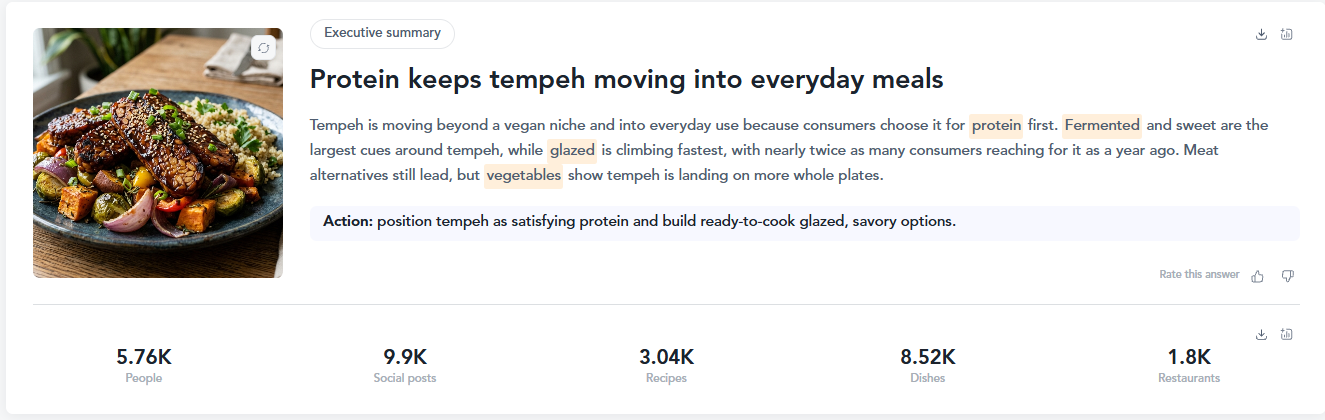
Consumers already sort the two this way. Across the Tastewise US consumer panel, demand for tempeh links to protein about 2.5 times as often as demand for tofu. Fiber is the claim gaining ground, with its link to tempeh up 16% over the past year against 6% for tofu. The generic healthy claim is fading for both, down about 21% for tempeh and 25% for tofu.
For your pack and menu copy, lead with grams of protein and fiber rather than a broad healthy label. Keep gut health language tied to evidence you can substantiate for your own product.
Sensory profile, cooking applications & environmental impact
On tempeh vs tofu taste, tofu is the blank canvas. It has a mild bean flavor and takes on whatever marinade or sauce you pair it with. Silken tofu suits sauces, smoothies and desserts, while firm and extra-firm tofu hold up in stir-fries, grills and fryers. Tempeh brings its own flavor, which is nutty and earthy with a slight mushroom note. Its bite is firm and chewy, and many cooks steam it before marinating to soften any bitterness.
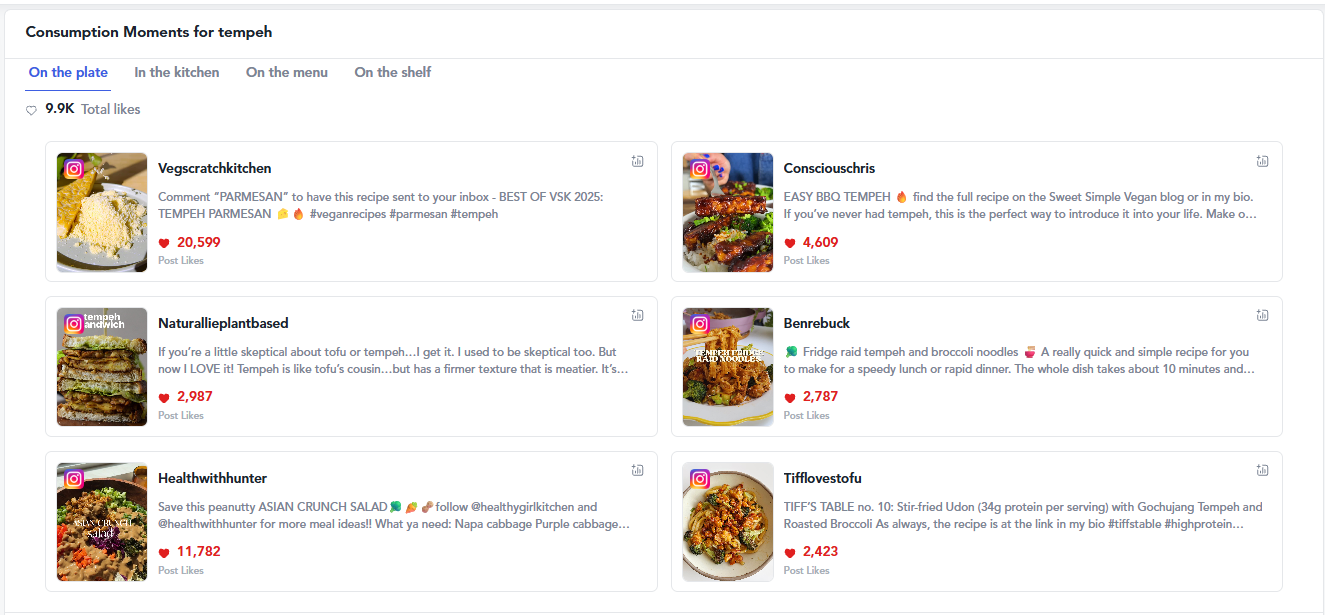
US menus show how differently operators use them. Tofu mostly appears in the dishes it comes from, such as mapo tofu, soon tofu and teriyaki bowls. Kitakata Ramen Ban Nai ran a mapo tofu ramen as a limited-time offer, and P.F. Chang’s lists Ma Po Tofu and Mongolian Tofu on its catering menu. Tempeh more often stands in for meat in American formats. Examples on the menu include a Tempeh Caesar salad at Seedz Cafe, a Whole Tempeh Reuben at Planet Sub and Tempeh Tacos al Pastor at Local Ocean Seafoods.
The tempeh vs tofu environmental impact picture has a data gap. In the Poore and Nemecek dataset, tofu averages 3.16 kilograms of CO2 equivalent per kilogram, against 99.48 for beef from beef herds. That dataset has no separate figure for tempeh. Tempeh uses the whole bean and skips the soy milk step, but no comparable lifecycle figure confirms a lower footprint. Use soy-level data in sustainability claims until you have product-level lifecycle data for your own tempeh.
How Tastewise.io uses data-driven insights to predict plant-based trends
Tastewise reads consumer demand, home recipes and restaurant menus together and refreshes them daily, so you can track tempeh vs tofu demand without waiting for quarterly research. It is the proactive AI food and beverage intelligence system that delivers before you ask. It resolves every food and beverage source into one dataset, then validates it, de-biases it and sets it in the context of your category.
Whole-food plant protein demand
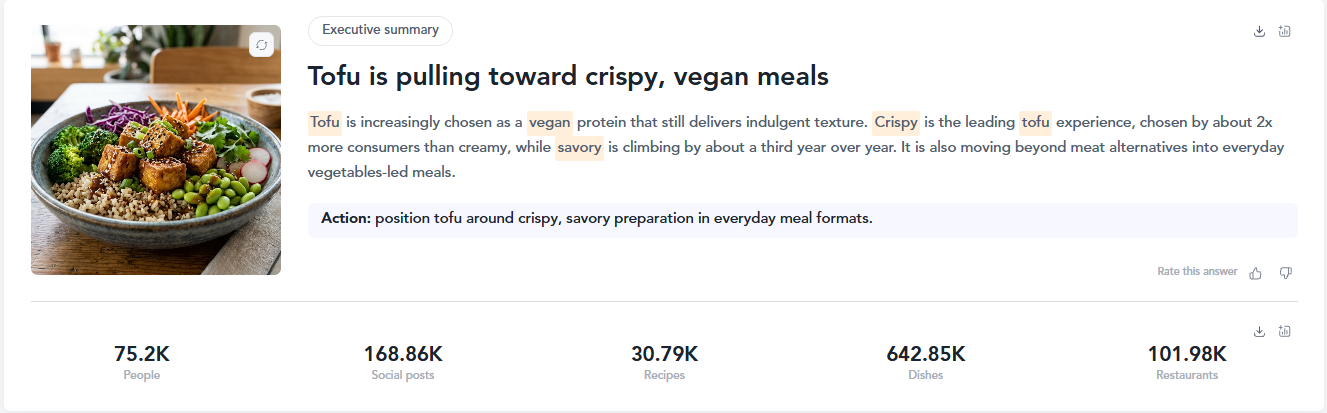
In home cooking, tofu leads by a wide margin. Across the Tastewise US consumer panel, tofu appears in about 15 times as many meat-alternative recipes as tempeh. Both have held steady over the past year, with tofu up 0.2% and tempeh down 0.4%. Online buzz around tempeh fell 12% over the same period, against 3% for tofu. Tastewise forecasts tempeh demand holding steady through 2027 and tofu demand edging up.
The demand that remains for tempeh is specific. It centers on protein, fiber and plant-forward eating, which is the clean-label profile CPG teams want for a hero ingredient. For product innovation teams, that makes tempeh a claim driver and tofu a familiarity driver.
Foodservice & restaurant menu adoption
On US menus, tofu is the default and tempeh is the specialist. About 58 times as many US restaurant locations serve tofu as serve tempeh. Tofu’s share of meat-alternative menus grew about 3% over the past year, while tempeh’s slipped 1%.
Tempeh is concentrated in fast casual, where more than half of its locations sit (53%). Casual dining accounts for nearly 1 in 4 (25%), and quick service only 3%. Quick service is where tempeh is gaining fastest, though, with its share of tempeh locations up about 8% over the past year. Tofu spreads more evenly, with fast casual at 36%, casual dining at 33% and midscale at 18%.
Three formats stand out in the menu data. In fast-casual bowls, you see a Vegan Chickpea Tempeh Bowl at Chorizo Hub Rice Bowls and tofu purple rice bowls at Lotus & Lime. In Asian-fusion concepts, tempeh takes the protein slot in Thai dishes like Tempeh Pad Karpow at Tekka Tiger and Chili Basil Noodle at Thai Pavilion. At breakfast, tempeh bacon sides at Off The Griddle and a potato tempeh hash at The Chicago Diner carry tempeh into the morning daypart. College dining halls also serve tempeh bulgogi and tempeh masala.
For teams selling into foodservice operators, the pattern is practical. Pitch tofu for reach across segments. Pitch tempeh to fast-casual and breakfast operators who need a protein that reads as new. The same menu signals feed menu planning decisions on the operator side.
Real-world success: driving plant-based growth through AI analytics
Food and beverage brands use Tastewise to validate formulations, choose claims and build the buyer story before a launch. Customers report 30% higher win rates and retailer-ready narratives 10x faster. Here is how a plant-based CPG brand would work through a tempeh vs tofu decision for a new ready-to-eat savory bowl.
Start with reach. Tofu is served at about 58 times as many US restaurant locations as tempeh and appears in about 15 times as many meat-alternative recipes. A tofu base lowers trial risk because shoppers already know how to eat it.
Next, choose the claim. Tempeh carries the protein and fiber associations, and fiber is the claim gaining ground. The generic healthy claim is losing ground for both proteins. That points to front-of-pack grams of protein and fiber, with tempeh as the visible differentiator.
Then run the nutrition math on a blend. Using USDA values, 100 grams of firm tofu plus 50 grams of tempeh delivers about 27 grams of protein and 240 calories. The tofu also brings about 680 milligrams of calcium to the bowl.
Pick flavors diners already order. Thai basil and bulgogi show up in US tempeh dishes, and chili sauces anchor new tofu bowls such as the Chili Tofu Noodle Bowl at Springbone Kitchen. A chili tofu bowl with crumbled tempeh in a Thai basil sauce pairs a familiar base with a differentiated protein.
Finally, keep watching. Track tempeh’s quick-service gains and the fiber claim each month, and build consumer segments around the shoppers who respond to both. AI agents can flag a shift in either signal before your next reformulation cycle. The same approach to AI for CPG applies to any dual-protein launch.
The tempeh vs tofu choice comes down to reach versus differentiation. Tofu gives you scale on menus and in home kitchens. Tempeh gives you a sharper protein and fiber story with less competition. Let real consumer and menu data decide which one leads in your 2026 launch.
FAQs about tempeh vs tofu
Tempeh has more protein by weight, with 20.3 grams per 100 grams against 17.3 grams for firm tofu, according to USDA FoodData Central. Firm tofu delivers slightly more protein per calorie.
Tempeh has 192 calories per 100 grams, firm tofu has 144 and regular tofu has 76. Tempeh is higher because it keeps the whole bean’s carbohydrates and fat.
Neither is healthier across the board. Tempeh is fermented and higher in protein per gram, while calcium-set firm tofu carries about six times as much calcium.
A 2021 review of 321 papers found evidence supporting tempeh fermentation as health-promoting and called for more human studies.
Tempeh tastes nutty and earthy with a firm, chewy bite. Tofu tastes mild and takes on the flavor of its marinade or sauce.
There is no direct comparison yet. Tofu averages 3.16 kilograms of CO2 equivalent per kilogram in the Poore and Nemecek dataset, which has no separate figure for tempeh.
Tofu is far more widespread, served at about 58 times as many US restaurant locations as tempeh. Tempeh is concentrated in fast casual, which holds more than half of its locations.




We’d love to learn your goals and see how Tastewise fits
We’d love to learn your goals and see how Tastewise fits
Get a personalized demo
Good taste. Wise move.
Your demo request is confirmed. We’ll reach out within one business day to schedule your walkthrough.
What happens next

See what’s driving demand, then turn it into a sell-in story for retailers and operators.
- Connect consumer panels, market trackers, and agents into one evidence view
- Get the “why” behind what’s changing, with explainable demand drivers
- Walk away with a buyer-ready narrative and next steps to activate
Trusted by


“Tastewise is my secret tool for knowing what consumers want next and why.“