





The food and beverage shelf is being reorganized by consumers, not by brands. Shoppers in 2026 are choosing products that do something specific for them, and the food categories growing fastest right now all reflect that same underlying logic. If your team is building a retail pitch, briefing an innovation sprint, or defending shelf space at the next category review, the retail category overview gives you the live consumer demand picture your planning needs. Tastewise tracks signals across retail and foodservice in real time, and the food categories growing in 2026 are clear enough to act on now.
Key takeaways
- Functional snacks are accelerating on the claim signals that matter most. “Protein” sits at a 44.9% consumer need share in this space and “convenient” is up 3.2% in the past year. Your buyers are already seeing the demand shift. Your brief should match it.
- Fermented beverages are crossing into the mainstream. “Gut health” holds a 66.8% consumer need share in this category. The sparkling format is up 48% in the past 12 months. Shoppers who used to visit the natural foods aisle are now expecting this on the main shelf.
- Plant-based protein is being rebuilt around high protein, not sustainability. “High protein” is up 8.9% in this category in the past year. “Energy” is up 60.4%. The brands recovering ground are the ones that dropped the ethics narrative and picked up a performance one.
- Korean and globally inspired formats are expanding fast. Korean barbecue is in the trending lifecycle. Banchan, bibimbap and galbi are all emerging. Bulgogi has a 26.1 social index. Your condiment and sauce brief has room to lead before the mainstream catches up.
Food categories growing in 2026: what the consumer is telling you
The fastest-growing food categories right now are not trend stories. They are consumer behavior stories. Shoppers are making consistent, repeated choices that favor function over indulgence, bold flavor over familiar, and products that justify themselves on the nutrition panel.
Tastewise data shows that across the top growing categories, three consumer motivations dominate: protein, gut health and energy. These are not niche motivations. They are showing up at scale, across age groups, across occasions, and across both retail and foodservice channels.
The opportunity for your team sits in the gap between what consumers are already choosing and what the shelf currently offers them. In functional snacking, that gap is the afternoon occasion. In fermented beverages, it is the RTD format. In plant-based protein, it is the performance-led positioning. In globally inspired sauces, it is mass retail distribution.
Explore how Tastewise’s product innovation solution helps your team identify exactly where each gap sits before a competitor fills it. Or, see how Tastewise maps consumer demand across the food categories growing fastest in 2026.
How to read Tastewise food category data: a quick reference
Consumer need share. The share of consumers in a category who express a specific motivation or benefit when they buy, out of all the consumer signals Tastewise tracks in that category. A 66.8% consumer need share for gut health in fermented beverages means about two-thirds of demand in that category is tied to the gut health motivation. This is not market share. It measures what consumers want from the category, not what they are buying today.
Social index. A normalized score for the volume and engagement of social and digital conversation around a food, ingredient, or format. A bulgogi social index of 26.1 signals meaningful, building cultural presence, and a higher score means stronger grassroots pull. It shows where consumer attention is gathering before it converts into retail velocity, so read it as an interest signal, not a sales figure.
Trending lifecycle stage. Tastewise sorts signals into four stages: emerging, trending, mainstream, and mature. Emerging signals are growing fast but have not reached wide retail or foodservice adoption. Trending signals have crossed into broad awareness and are starting to show retail velocity. Mainstream signals are widely available and still growing. Mature signals have plateaued. Korean barbecue at trending means it has passed discovery and is now actively sought by mainstream shoppers.
Growth rate. Every percentage on this page is the change in consumer signal volume, across social, search, menu, and retail data, over the prior 12 months. A 103.4% growth rate for tepache means the volume of consumer signals around tepache roughly doubled in that window. It is a leading indicator of where demand is heading, not a lagging record of sales.
Tastewise brings together consumer signals from social media, restaurant menus, recipe platforms, retail product data, and search behavior to build one view of where food demand is moving. The data updates continuously, so the figures on this page reflect current consumer behavior rather than a past survey or a projected forecast. When the fermented category shows a 48% rise in sparkling formats, that comes from live consumer signal volume, not a sample panel.
Functional snacks: the category where the brief writes itself
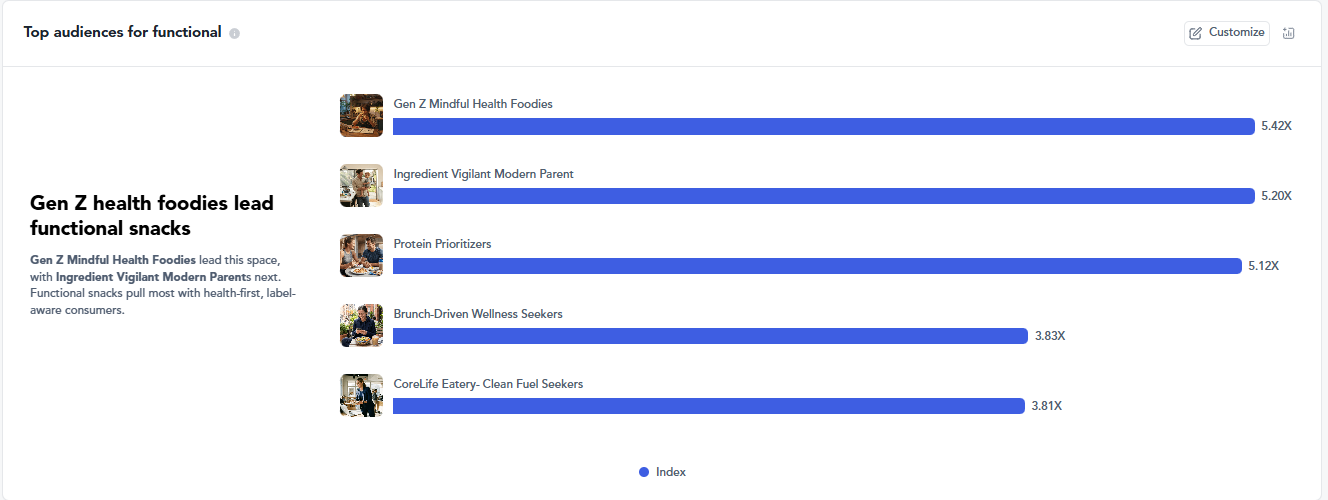
Functional snacking is one of the clearest commercial opportunities in the 2026 food landscape. Tastewise data shows that “protein” holds the second-highest consumer need share in this category at 44.9%, while “convenient” is growing at 3.2% in the past year and “easy” is up 10.2%. Shoppers are not looking for a specialty product. They are looking for an everyday snack that earns its place on the grocery list.
The afternoon occasion is the white space. Existing shelf options in that window are still dominated by sugar-forward formats. Consumers are telling you they want something that delivers energy without the crash, and your team has the data to walk into any buyer conversation with that argument ready.
On the ingredient side, protein powder is up 25.4% in the past year within functional snacks, while chia is up 12.2% and energy bites are growing at 36.5%. These are not fringe ingredients. They are moving into everyday snack formats, and the brands that launch now will own the shelf narrative before the big players consolidate it.
Fermented beverages: from specialty aisle to main shelf
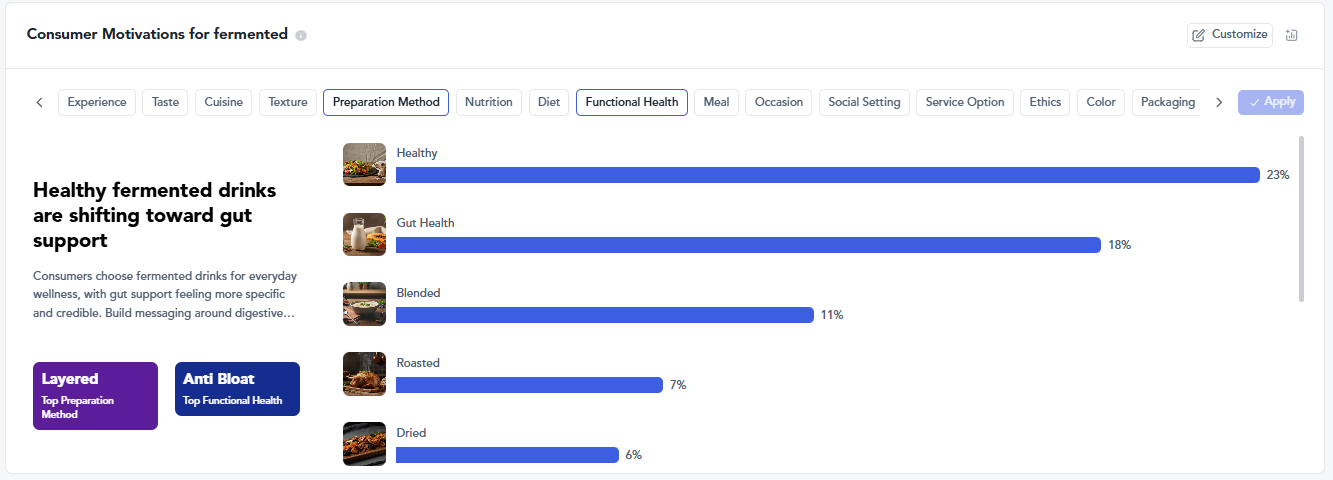
Gut health is no longer a niche concern. In the fermented beverage category, “gut health” holds a 66.8% consumer need share in Tastewise data. “Sparkling” is up 48% in the past 12 months, and “convenient” is growing at 14.5%. Shoppers are choosing these products because they believe in the functional benefit, and they want a format that fits their routine.
The lifecycle signal confirms the shift. Soda as a format within fermented beverages is at the emerging stage, growing 38.3% in the past year. Tepache is up 103.4%. These are signals that format innovation is outpacing the existing shelf offer, which means your team has room to move.
The practical implication for CPG brands is straightforward. A clean RTD format with a gut health claim, a sparkling profile and a flavor story that goes beyond the standard ginger and lemon defaults is a product your buyer can immediately justify. The demand evidence is there. The format gap is real. The shelf reset conversation is easier when you arrive with both.
Plant-based protein: the category that corrected and came back stronger
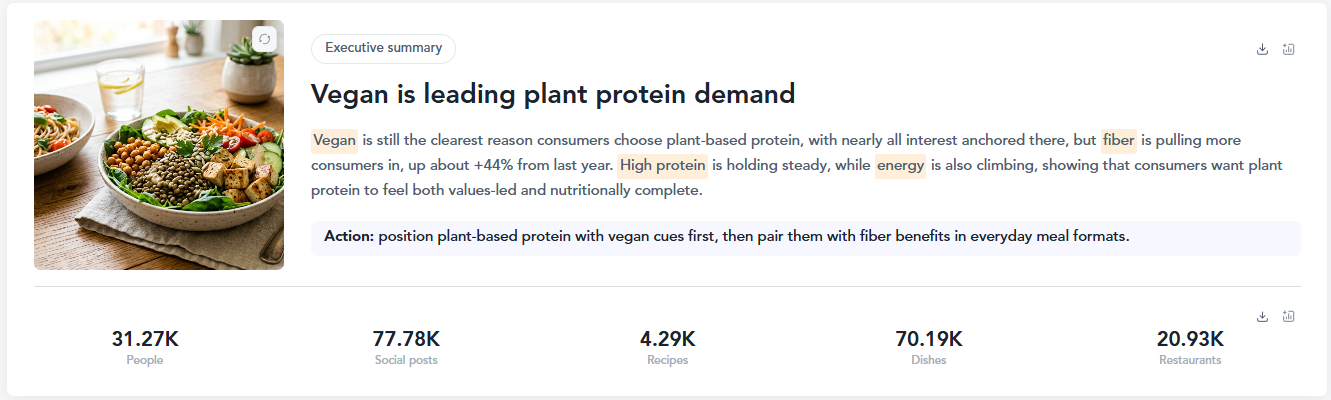
The plant-based protein category went through a difficult two years. Brands over-indexed on sustainability messaging and under-delivered on taste and convenience. Consumer interest pulled back. But the Tastewise data tells a more specific story about where the recovery is happening.
“High protein” is up 8.9% in the past year within this category. “Energy” is growing at 60.4%. “Gut health” is up 30.9%. “Nourishing” is up 57.1%. These are performance and wellness motivations, not ethical ones. The shoppers driving growth right now are not buying plant-based products to make a statement. They are buying them because the protein count works for their diet.
For your team, this reframes the brief. The product that wins in this category in 2026 is not the one with the strongest sustainability story. It is the one with the highest protein, the cleanest ingredients, and a flavor that lands the first time. White beans are up 55.8% and kidney beans are up 52.5% in the past year, pointing toward legume-forward product innovation as the emerging opportunity.
Globally inspired sauces and Korean formats: the fastest-moving flavor story in retail
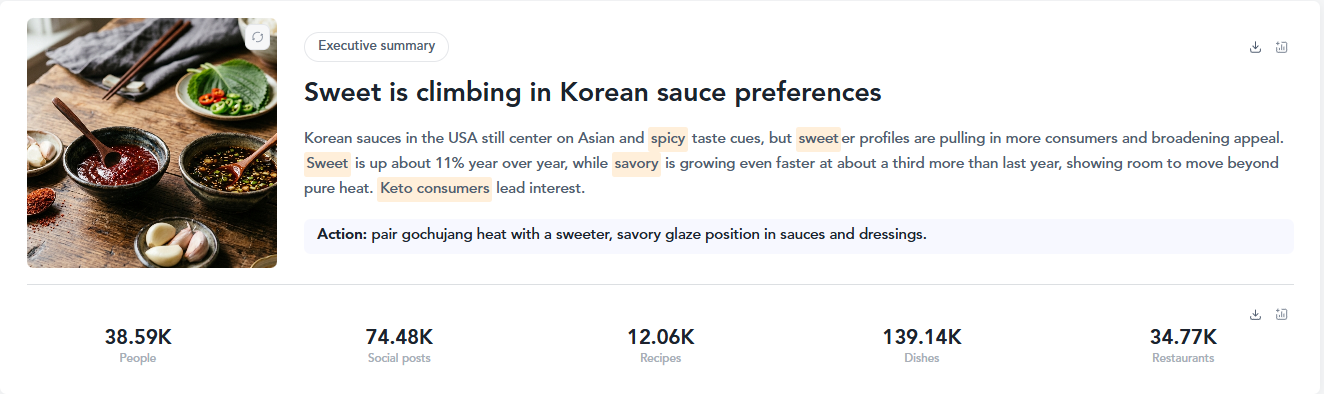
The Korean flavor story is moving from foodservice discovery into retail demand at pace. Tastewise data shows bulgogi at a 26.1 social index with 12.9% growth in the past year. Korean barbecue is in the trending lifecycle. Bibimbap is trending with a 41.7 social index and 25.5% growth in the past year. Banchan and galbi are both at the emerging stage.
This is a consumer who is already eating these flavors at restaurants and is now looking for the retail equivalent. The gap between foodservice familiarity and retail availability is where your brand’s opportunity sits.
Curry is in the trending lifecycle with 21.4% growth in the past year. Fermented formats including kimchi maintain a 30.9 social index as a mature signal. The flavor profile driving all of this is fermented, layered and heat-forward, which maps directly onto the broader consumer shift toward bold flavor in everyday formats. For CPG brands, a globally inspired condiment or sauce with an accessible use occasion and a retail-ready format is one of the highest-upside product conversations you can take into a buyer meeting right now.
Turning category data into sell-in stories that hold up
Data alone does not win shelf space. The brands winning listings in 2026 arrive with a category argument, not just a product claim. That means showing your buyer where consumer demand is moving, why your product fits that movement, and what happens to their numbers if they miss the window.
The food categories growing fastest right now all have specific, defensible consumer evidence behind them. Functional snacking has protein and convenience. Fermented beverages have gut health and sparkling format. Plant-based protein has performance and energy. Globally inspired condiments have social signal and lifecycle momentum.
In-store purchases still account for around 77% of FMCG sales, according to NielsenIQ Consumer Outlook 2026. The shelf remains the most valuable real estate in CPG. Your sell-in story needs to be current and evidence-led to earn placement in a competitive reset cycle. See also the how to prove your product deserves shelf space guide for a practical framework on building the pitch.
How CPG teams use food category data in practice: three scenarios
The scenarios below are illustrative, not case studies of named clients. Each shows how a team could turn a category signal into a decision, following a problem, approach, and outcome arc.
The functional snack brief that targets a retail listing. Problem: a mid-size snack brand performs in the natural channel but has not broken into conventional retail, and needs a category argument for a national buyer. Approach: the team leads with the consumer motivation data, protein sitting at a 44.9% need share in functional snacking and the afternoon occasion underserved by current formats, and builds the sell-in around the 3pm energy gap rather than product specs alone. Outcome: the brand walks into the category review with consumer evidence a buyer can carry into their own planning, which is a materially stronger listing case than a spec sheet. This is where a product innovation brief and a sell-in story line up.
The fermented beverage that moves from natural aisle to main shelf. Problem: a kombucha brand has sat in the natural foods section for two years with flat sales and wants mainstream placement. Approach: the team sees sparkling formats up 48% in the past 12 months and convenient up 14.5% as a motivation, reformulates into a sparkling RTD can, and shifts packaging language from culture-led to gut-health-on-the-go. Outcome: it pitches the main beverage aisle with a format and claim matched to where demand is moving, opening a placement conversation the natural-aisle position never could.
The plant-based brand that leads with performance, not ethics. Problem: a plant-based protein brand has seen velocity decline after launching on sustainability messaging. Approach: the marketing team reads the motivation data, high protein up 8.9%, energy up 60.4%, and nourishing up 57.1%, all performance signals, and rebuilds the campaign around protein per serving while exploring white beans, up 55.8%, for nutritional density. Outcome: the brand reframes its consumer marketing around the job the product does, giving it a performance story aligned to how the category is actually growing.
What this means for each function on your team
The food categories growing in 2026 show up differently depending on what your team is trying to do.
Innovation and R&D
The ingredient signals inside each growing category are your brief. Protein powder is up 25.4%, chia is up 12.2%, and energy bites are up 36.5% in functional snacks. Tepache is up 103.4% and sparkling probiotic formats are at the emerging stage in fermented beverages. White beans and edamame are both up over 50% in plant-based. These are the ingredients your next concept should be built around.
Category strategy
Use the lifecycle data to frame the timing argument. Korean barbecue at trending, banchan and galbi at emerging, fermented sodas at emerging. This is not speculation. It is evidence of where demand is heading with enough runway for your brand to move first.
Marketing
The motivation data is your campaign brief. “Gut health” at 66.8% share in fermented beverages. “Energy” growing at 60.4% in plant-based protein. “Convenient” at 44.9% share in functional snacks. The consumer language is already there. Frame your food and beverage marketing around the job the product does, not the product itself.
Sales
Your buyers respond to category-level evidence, not product-level claims. The retail category overview gives your team a live view of where each category is heading, and the new products in retail solution gives you the tools to build the pitch around it.
Your buyers want consumer evidence, not product claims. Request a Tastewise demo and see how your team walks into every meeting with the proof to back it up.
FAQ about growing food categories
Based on Tastewise data, the categories with the strongest consumer demand momentum in 2026 are functional snacks, fermented and probiotic beverages, plant-based protein and globally inspired sauces and condiments. Each is driven by specific, measurable motivations: protein and convenience in snacking, gut health and sparkling format in fermented beverages, energy and high protein in plant-based, and Korean and bold fermented flavors in condiments. The brands performing best have matched their positioning to the specific motivation driving demand in their category.
Start with the consumer motivation, not the product. Show your buyer where demand is moving in their category, what the lifecycle stage of the key signals is, and why your product owns the relevant occasion or claim. Retailers respond to consumer evidence because it gives them something to take into their own internal planning conversations. The category management vs consumer demand guide covers the practical steps for building that argument.
The categories growing fastest in 2026 are moving faster than annual planning cycles can track. Signals at the emerging stage today can reach trending within six months. A quarterly review tied to live consumer demand data is a minimum. For brands heading into a major shelf reset or innovation sprint, a current data read in the four to six weeks before that meeting is where the competitive edge lives. The Tastewise 2026 food and beverage trend forecast gives your team the category-level view to plan around.
Consumer need share is the share of consumers in a category who express a specific motivation or benefit when they buy, out of all the consumer signals Tastewise tracks in that category. A 66.8% consumer need share for gut health in fermented beverages means about two-thirds of demand in that category is tied to the gut health motivation. It is not market share. It measures what consumers want from the category rather than what they are buying today.
Tastewise sorts food signals into emerging, trending, mainstream, and mature stages. An emerging signal is growing quickly but has not reached wide retail or foodservice adoption, while a trending signal has crossed into broad consumer awareness and is starting to show retail velocity. In practice, emerging is the earlier, higher-runway window, and trending means mainstream shoppers are already seeking the item out.




We’d love to learn your goals and see how Tastewise fits
We’d love to learn your goals and see how Tastewise fits
Get a personalized demo
Good taste. Wise move.
Your demo request is confirmed. We’ll reach out within one business day to schedule your walkthrough.
What happens next

See what’s driving demand, then turn it into a sell-in story for retailers and operators.
- Connect consumer panels, market trackers, and agents into one evidence view
- Get the “why” behind what’s changing, with explainable demand drivers
- Walk away with a buyer-ready narrative and next steps to activate
Trusted by





“Tastewise is my secret tool for knowing what consumers want next and why.“