





The shelf is no longer won in the buyer meeting. It is won in the weeks before it, when your team has already mapped what consumers are moving toward and built a story the buyer cannot ignore. Category growth strategy in 2026 is about closing the distance between what the data is showing and what ends up in a pitch deck. The brands gaining ground are not guessing at white space. They are identifying it with real-time consumer evidence and arriving at every conversation with a proof deck, not a proposal. If you are building or defending a retail category position, this is where that work starts.
Key takeaways
- Comfort is the fastest-growing food motivation among US consumers, up 43% in the past year. If your category management strategy is still built around functional positioning only, your shelf narrative is lagging the consumer by at least a year.
- Protein demand is up 6% and high-protein is up 17% in the past 12 months, and both are already mainstream. The opportunity now lies in specific micro-signals: which protein formats, which occasions, which price tiers consumers are choosing. Category teams that surface this level of detail build more defensible sell-in stories.
- Creamy and crispy are among the fastest-growing texture signals, up 29% and 20% respectively since last year. These are shelf-story details, not just R&D notes. Your category management tools should be surfacing them before your competitors’ buyers bring them up in a meeting.
- Comfort, cozy and nostalgic are all trending simultaneously. That is a structural consumer shift toward reassurance, not a seasonal blip. Your category management analysis needs to reflect it, or your next reset proposal will feel out of step.
What the consumer demand gap actually looks like in practice
Category management has always been about aligning product assortment with what shoppers want. The problem is that traditional category management systems were designed for a world where that alignment could be updated quarterly. Consumer demand no longer moves on that timeline. The signals that matter for a shelf reset happening in six weeks are often invisible to teams relying on 90-day-old velocity data.
The disconnect is structural. Historical sales figures tell you what sold. They do not tell you why it sold, whether that demand is accelerating or fading, or what adjacent need a competitor could walk in and meet before your next review cycle. Real-time consumer demand data fills that gap. It shows your team what consumers are choosing right now, what is driving their choices, and where demand is moving before it shows up in POS data.
The most influential factor shifting consumer demand in 2026 is not a single ingredient or format. It is the direction of consumer motivation, toward comfort, toward texture, toward reassurance, and those shifts are readable weeks before they surface in scan data. Tastewise gives your team that visibility while it still has commercial value. Your retail category sell-in strategy starts with knowing what consumers are choosing before your buyer does.
Why traditional category management systems fail the 2026 reset cycle
Category management platforms built on historical sales data are structured to look backward. They are useful for understanding what has happened in a category, but limited when you need to argue for what should happen next on shelf. The challenge is that retail buyers are making forward-looking decisions. They want to know where consumer demand is going, not where it has been.
The most telling signal from Tastewise US consumer data is the simultaneous rise of comfort (up 43% in the past year), cozy (up 73%), and nostalgic (up 31% since last year). These are not overlapping words for the same thing. They are three distinct entry points to a structural consumer shift toward reassurance and familiarity in food choices. A category management analysis that captures only sales rank will miss this entirely. A team that can explain it to a buyer, in their language, with evidence, owns the meeting.
Traditional category management services also tend to aggregate at the category level. That works for defending existing shelf space. It does not work for winning new listings or arguing for expanded facings. For that, your team needs to show the buyer something they cannot see themselves. That is where micro consumer demand signals become the difference.
Analyzing micro consumer demand: the signals category teams miss most
Micro consumer demand refers to the granular, subcategory-level signals that sit beneath the headline trend. Not just “protein is growing” but which protein claims, in which formats, consumed at which occasions, by which consumer segments. This level of specificity is what separates a generic category sell-in from a buyer-ready narrative.
Consider the protein signal. Protein is up 6% in the past year as a food motivation across the US consumer base, and high-protein as a specific claim is up 17% in the same period. But those two numbers sit in very different commercial positions. Protein as a general motivation is already mainstream. It is a defend-and-extend play. High-protein as a functional claim is still building momentum, growing faster and reaching new consumers at a faster rate. For your category management analysis, these are two different shelf stories, two different retail pitches, and potentially two different product opportunities.
The same logic applies to texture. Creamy is up 29% in the past 12 months. Crispy is up 20% since last year. Neither of these is a trend. They are structural demand shifts that reflect what consumers are actively seeking across multiple categories. For a snack, sauce, or dairy brand, these are signals you can build a buyer argument around. The 2026 food and beverage trend forecast maps which signals are already shaping the next reset cycle.
Mini category snapshot: comfort food in retail, May 2026
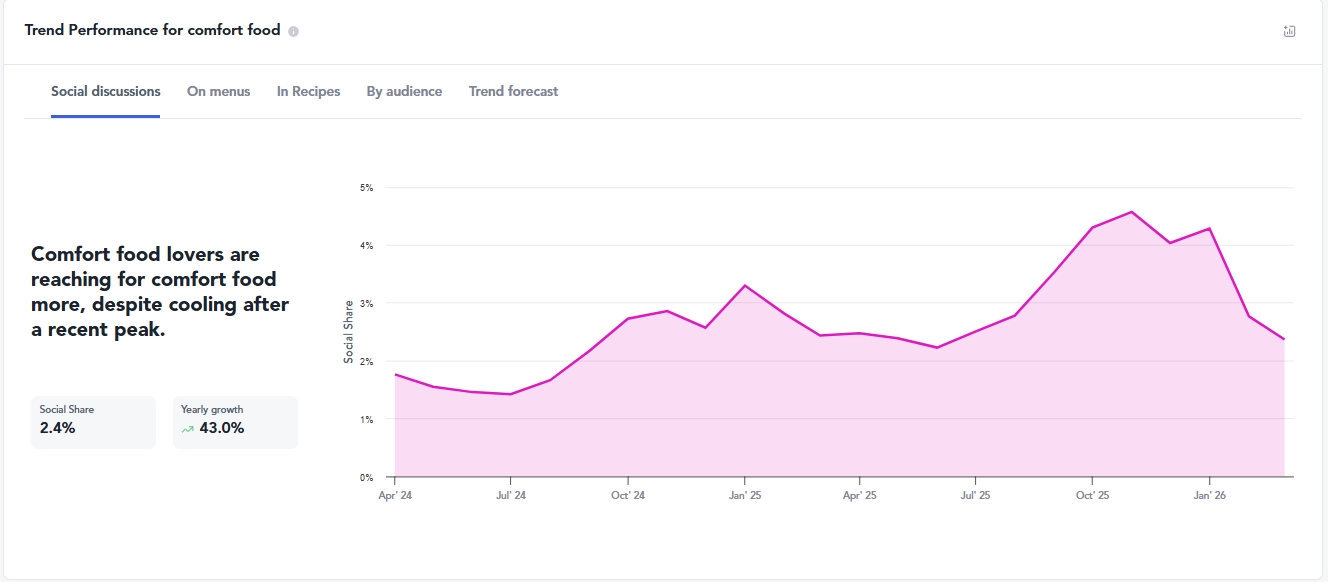
Signal: Comfort is the fastest-growing popular food motivation in the US, up 43% in the past year. It is reaching a large consumer base, not just a niche.
Why it matters to the consumer: Comfort in food is not about low quality or nostalgia alone. Consumers in 2026 are choosing comfort as a form of reassurance. They want food that feels familiar, satisfying, and emotionally rewarding. This shows up across categories: creamy textures, cozy formats, traditional recipes.
What your team should do with it: If you are managing a category that sits naturally in comfort territory, soups, dairy, frozen meals, baked goods, you have an argument for expanded facings right now. The demand evidence exists. Build the sell-in story around comfort as a growing consumer motivation, not just a generic descriptor. If you are managing a category that does not naturally sit there, look at whether your product has a comfort adjacency. Texture claims, occasion framing, and format choices can all anchor a comfort narrative on pack and in buyer conversations.
Gap in market: Comfort has grown 43% but it is still a relatively underrepresented claim in formal category management narratives. Most teams are not naming it explicitly in their buyer materials. That is your window.
How category management tools turn consumer demand data into shelf space
The job of a modern category management platform is not just to organize data. It is to translate consumer demand signals into arguments that move buyers. That translation step is where most teams lose time, confidence, or both.
Brands using Tastewise’s retail sales solution are building buyer-ready narratives that connect real-time consumer signals directly to shelf placement decisions. The process moves from signal to story in minutes: identify the consumer demand shift, frame it in the category context, pair it with the right product and format evidence, and deliver it in the buyer’s language. That is what a modern category management system should enable. Not a dashboard to browse, but a story your team can walk into a meeting with.
The value here is not just speed. It is defensibility. When a buyer pushes back, your team needs to explain the evidence, where it comes from, what is driving it, how confident you are it will hold through the next season. Real-time consumer demand data gives you that. Historical sales data gives you a number, not a conversation.
See how Tastewise turns category signals into a buyer-ready sell-in story.
Consumer spending and food demand indicators: what the data shows for 2026
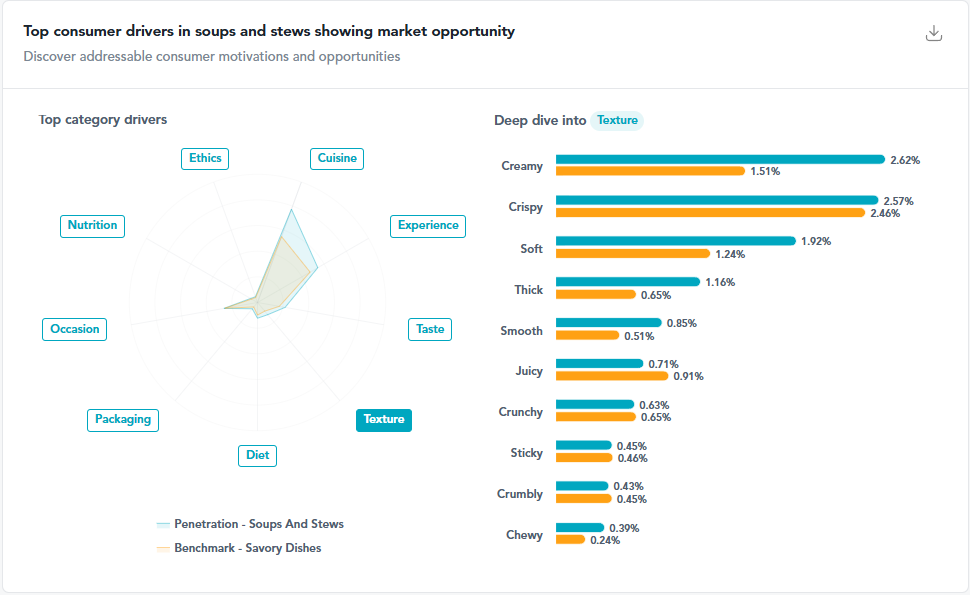
Understanding consumer demand at category level means reading willingness-to-choose signals, the motivations that drive product selection, not just purchase frequency. In 2026, the signals pointing to strongest consumer engagement across food categories are comfort (up 43%), creamy textures (up 29%), rich profiles (up 22%), crispy (up 20%), and fresh (up 11% in the past year).
These numbers are not independent. They describe a consumer who wants flavor intensity and sensory satisfaction, but wrapped in familiarity. That combination maps to a specific set of product attributes: texture-forward, flavor-layered, format-familiar. For your category management analysis, this is the consumer spending pattern worth building around. Not the generic “premiumization” story every competitor is using, but a specific, evidence-backed argument that your product meets a consumer need that is growing across the market right now.
The brands winning shelf resets in this environment are not spending more on trade. They are spending more time on the right evidence. That is a different kind of investment. One that pays off in every buyer meeting that follows.
What this means for CPG teams in 2026
- Innovation and R&D: Identifying whitespace with confidence means knowing not just what is trending, but which demand signals are growing fast enough to support a new SKU. Comfort (up 43%), high-protein (up 17%), and intense flavor (up 109% in the past 12 months) are all growing fast enough to build around. Your brief already exists in the data.
- Category strategy managers: Building a case to win listings or defend existing space requires evidence that buyers cannot replicate themselves. Real-time consumer demand analysis gives you that. Sales rank data does not.
- Insights and strategy: Democratizing consumer demand insights across your organization means having a system that produces explainable, bespoke evidence. Not a static report that goes out of date the week it lands. Your team needs to be able to run the analysis again in three months and carry a fresh story into every conversation.
- Sales teams: Securing placement during seasonal resets means aligning your pitch with the specific functional claims and consumer motivations your buyer’s shoppers are already choosing. The data is there. Teams using Tastewise agentic AI keep their category intelligence current between resets rather than rebuilding it from scratch each cycle.
Ready to close the gap between your category management strategy and real-time consumer demand? Request a demo and see how leading CPG brands are building buyer-ready narratives with Tastewise.
FAQs about Category Management
A category growth strategy is the approach a brand uses to identify where demand is building within a product category and use that evidence to secure distribution, defend shelf space, or launch new SKUs. In 2026, the most effective strategies are built on real-time consumer signals rather than historical sales data alone. Brands that lead with forward-looking evidence consistently outperform those that arrive at buyer meetings with category data that describes where the market has already been.
Start with consumer need signals, not just ingredient trends. If you know that clean label is growing 182% and intense flavor is up 58% in your category, you can build a buyer narrative around where the shopper is heading, not just what they bought last quarter. Pair that with lifecycle stage data for key ingredients and you can show a buyer precisely which gap their current shelf set has and why your product closes it. That is the conversation that gets a listing.
Most CPG teams run formal strategy cycles on a 12 to 18 month cadence, which aligns with retail reset schedules. The problem is that consumer signals move faster than that. Ingredients like matcha and pistachio are reaching new consumers at triple-digit growth rates, which means a signal that is early-stage today can be mainstream before your next planning round closes. Teams that track consumer demand continuously, rather than in quarterly snapshots, consistently have more defensible buyer conversations and shorter times from concept to shelf.


We’d love to learn your goals and see how Tastewise fits
We’d love to learn your goals and see how Tastewise fits
Get a personalized demo
Good taste. Wise move.
Your demo request is confirmed. We’ll reach out within one business day to schedule your walkthrough.
What happens next

See what’s driving demand, then turn it into a sell-in story for retailers and operators.
- Connect consumer panels, market trackers, and agents into one evidence view
- Get the “why” behind what’s changing, with explainable demand drivers
- Walk away with a buyer-ready narrative and next steps to activate
Trusted by





“Tastewise is my secret tool for knowing what consumers want next and why.“