





Own-brand attachment runs from 79% of Costco shoppers down to 18% of Kroger shoppers. Same category, same twelve months, four different businesses. A single national private label number averages those four together, which makes it the wrong number to carry into a line review. The spread comes out of the 2027 food trends forecast, which tracks how American shoppers split one weekly list across several retailers and attach to the own brand at each stop. Private label brands behave like a different competitor at every door you sell into, and the evidence to prove that already exists.
Key takeaways
- Own-brand attachment runs from 79% of Costco shoppers to 18% of Kroger shoppers, with Target at 44% and Walmart at 31%, measured August 2025 to July 2026.
- Costco reports Kirkland Signature at about a third of its business, while attachment says nearly 4 in 5 Costco shoppers reach for it at the shelf.
- Kirkland Signature reaches under 1 in 100 shoppers at the other retailers in the set, and Trader Joe’s own brand reaches four to seven times as many.
- More than $3bn left the US grocery channel in food and beverage over 52 weeks, and $635m of it moved from national brands into club private label.
- Convenience seekers buy store brand more often than value shoppers do, at 49% against 41%, which makes this a range and format problem before it is a pricing one.
- Private label matched name brands on seed-oil-free formulation growth at 4.2% each, so reformulation speed has stopped working as a defense.
Private label attachment, retailer by retailer
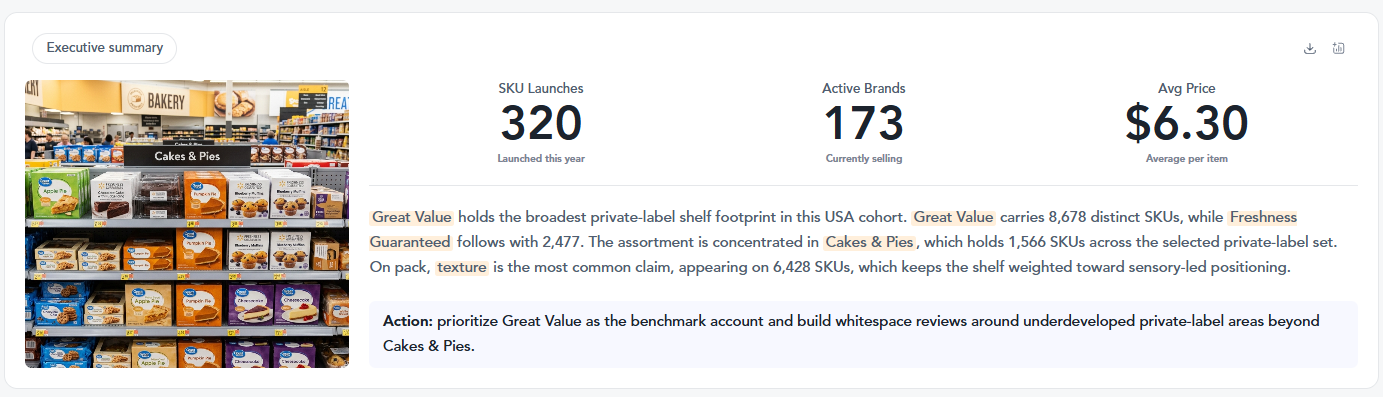
Retailer segmentation on own brand starts with one number, because attachment runs from 79% of Costco shoppers down to 18% of Kroger shoppers in the twelve months to July 2026.
Target sits at 44% and Walmart at 31%. The universe is US food and beverage consumers who shop each named retailer. Base sizes are 79,580 at Costco and 38,690 at Target. Walmart runs 79,290 and Kroger 14,580. The window is August 2025 to July 2026 and the source is the Tastewise consumer panel.
Across all US grocery shoppers, private label reaches nearly 3 in 10 (28%, or 1.66M of 6.02M food and beverage consumers). That is the line every retailer figure above should be read against.
This is point-in-time reach. No consumer comparison against the prior year exists on this panel for this window, so read the spread as a level rather than as a direction of travel.
The planning consequence is that micro-market targeting now has a retailer axis before it has a geographic one. A 79% exposure at Costco and an 18% exposure at Kroger are two different jobs. One asks how your brand survives next to a store brand most of the membership already reaches for. The other asks how you hold price in a store where four in five shoppers still pick a name brand.
Penetration against relationship
Costco tells investors Kirkland Signature is about a third of its business, and nearly 4 in 5 Costco shoppers (79%) reach for it over the alternatives in front of them.
The 33% comes from Costco management commentary for FY2026 and describes a share of sales. The 79% describes what happens at the shelf. Only the second one predicts how a line review goes, because the buyer across the table is holding a relationship rather than a revenue split.
Value messaging built against the 33% is aimed at an average. Value messaging built against the 79% has to answer a shopper who already trusts the store brand for most of the basket. Those are two different arguments and they need two different proofs.
Cross-retailer reach, or what crosses town
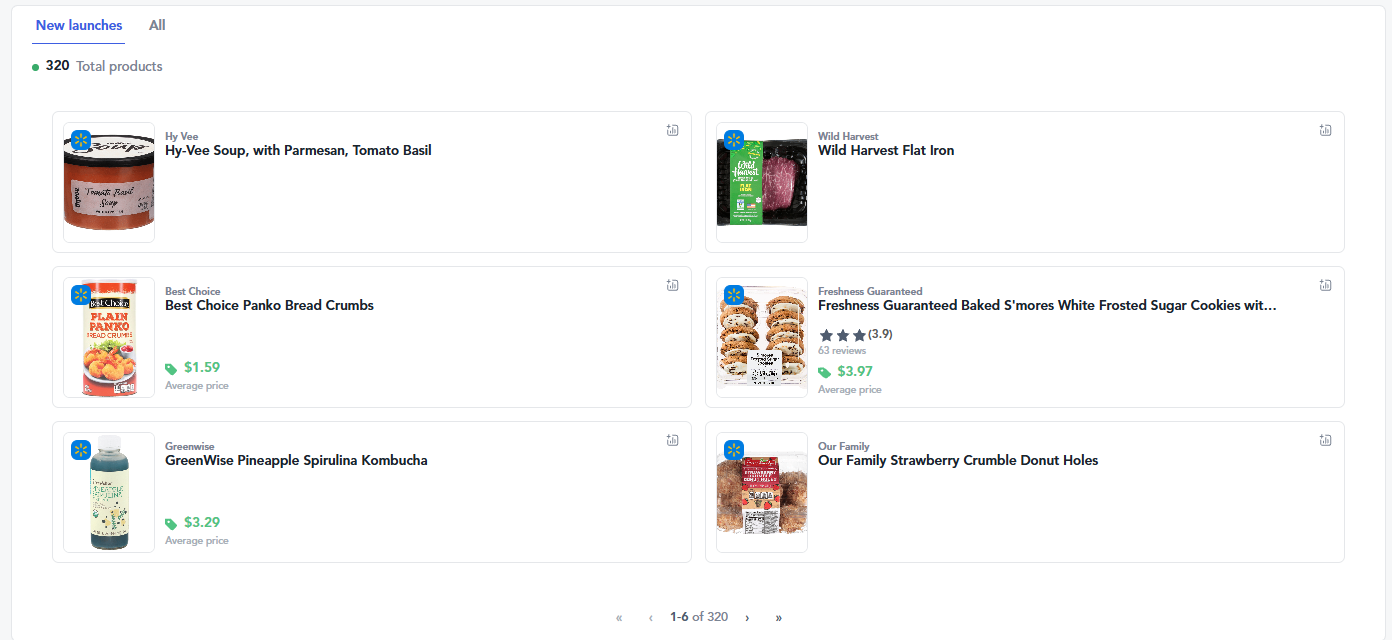
Kirkland Signature reaches under 1 in 100 shoppers at every other retailer in this set, at a mean of 0.76%, while Trader Joe’s own brand turns up in rival audiences at a mean of 4.3%.
Trader Joe’s is strongest on Aldi shoppers, at nearly 1 in 13 (7.4%). Cross-retailer reach for Aldi and Kroger rests on small bases of 872 and 495 consumers, so read those two as directional rather than as sized.
The pattern underneath is simple. What crosses town is a product a shopper cannot get anywhere else. Kirkland Signature holds the deepest own-brand relationship in American grocery and the least pull outside its own membership, because the membership is the mechanism. Trader Joe’s travels because its range is the reason people drove there in the first place.
Price tier has very little to do with it. A cheaper store brand stays in the store. A distinctive one follows the shopper out of it.
Grocery’s lost dollars, and where they went
More than $3bn left the US grocery channel in food and beverage in the 52 weeks to 4 October 2025, and $635m of that came off national brands and landed in club private label.
Club took 54% of the money that left grocery, mass took 41% and dollar took 5%. Within the club share, 41% went to club private label, worth more than $800m. Of that gain, $173m came from grocery private label. The balance, $635m, came from a name brand. Four dollars in five of the club private label gain was taken off a national brand rather than off another store brand.
NielsenIQ tracks the same households across every outlet they shop, which is what makes both ends of that move visible. The shopper who splits a list arrives at the club store with a basket already built.
For a retail sell-in conversation, that reframes what a shelf loss means. A decline at your grocery account can be a trip that moved to a channel your account team does not own. Household data carries that argument. Scan data from one banner does not.
Own brand sold on credentials
Hy-Vee launched a dietitian-built own brand in January 2026 that excludes more than 150 ingredients, which is a store brand competing on qualification rather than on price.
The line is called Nothing But The Truth and it arrived on 21 January 2026. Hy-Vee’s registered dietitians built it, and the launch named what it leaves out, including high-fructose corn syrup, artificial additives and dyes.
The formulation data says this is a pattern rather than an outlier. Across US food and beverage, products formulated without seed oils grew 4.2% for name brands and 4.2% for private label. Fiber formulation grew 2.1% for name brands and 2.6% for private label. Source: NIQ Qualified Claims powered by Product Insights, Total US Full View, food and beverage excluding non-UPC, 52 weeks ending 21 February 2026.
Private label now matches national brands on formulation speed, and on fiber it is moving slightly faster. Meijer launched over three hundred own brand items in April 2026, more than a hundred and twenty of them carrying at least five grams of fiber.
That lands directly on margin defense. A reformulation lead used to buy separation and a price premium. The gap in average unit price has narrowed two years running, from 5.3% to 4.8% to 4.5% in the most recent 52 weeks. Private label prices are rising faster than name brand prices, so a rollback defends ground private label is already walking away from. Brand management for retail CPG has to lead on the thing a store brand cannot copy inside a season, which is the product a shopper cannot get anywhere else.
Retail teams reading the private label signal
Three teams already run this read, and the fastest of them validates a concept in about a minute before formal research starts.
The Kroger innovation team checks an idea against demand signals in roughly one minute, ahead of concept testing. Natalie Taake, Senior Innovation Manager at Kroger, describes the job as predicting unmet needs and says, “I can’t do that without Tastewise.”
TreeHouse Foods sits on the manufacturing side of private label and used ingredient pairing insight to open 25% more sales opportunities across its retail book. The same evidence works for the brand defending the shelf and for the supplier building the store brand on it.
Waitrose took a Basque cheesecake from trend signal to a top-selling own-label dessert and shortened launch time by 25%. That is the pace a national brand is now competing against inside its own category.
Line review prep, four numbers to bring
To defend shelf space at your next line review, bring the retailer split rather than the national average, starting with the 61-point gap between Costco and Kroger attachment.
The segment ladder is worth reading in full. Convenience seekers sit at 49% and protein prioritizers at 44%. Value shoppers come third at 41%, ahead of global flavor hunters at 35% and foodies at 33%. The segment defined by price ranking third is the part most pricing plans get wrong, and it comes from the Tastewise panel read against all US grocery shoppers between August 2025 and July 2026.
- Split your own-brand exposure by retailer before the deck is built. Attachment runs 79% at Costco and 18% at Kroger, so one national figure costs you the argument at three accounts out of four.
- Build range and format against convenience seekers first. 49% of them buy store brand against 41% of value shoppers, so the shopper you are losing is usually the one who did not want to make a decision.
- Price against the gap you actually face. Average unit price sits 4.5% apart in the latest 52 weeks, down from 5.3% two years ago, so a rollback buys less separation than it did.
- Take door expansion to the account where your attachment is lowest. Kroger sits at 18% and reported 1,100 own-brand launches last year, which makes it the most actively contested of the four.
Where this leaves 2027
Own brand is a per-retailer problem with a per-retailer answer. The shopper most exposed to it is the one buying on convenience rather than on price, and the account most exposed is the one where attachment is already highest. Build the range, the format and the claim retailer by retailer through 2027, and walk into the review with four numbers instead of one.
Frequently asked questions about private label brands
Private label brands are owned by the retailer selling them, so the retailer controls formulation, price and shelf position. National brands are owned by the manufacturer and sold across many retailers. The difference shows up at the shelf, where 79% of Costco shoppers reach for Kirkland Signature.
Costco. Nearly 4 in 5 Costco shoppers (79%) reach for Kirkland Signature, against 44% at Target, 31% at Walmart and 18% at Kroger, measured August 2025 to July 2026. Costco separately reports Kirkland Signature at about a third of its business.
Two things move together. Shoppers split one weekly list across several stores and attach to the own brand at each stop, and retailers fund that with launches. Kroger reported 1,100 own-brand launches last year and Target 600 new items over two years, both from company disclosures.
Private label food is any grocery product sold under a retailer’s own brand rather than a manufacturer’s. Kirkland Signature at Costco is the clearest US example. The category now competes on credentials as well as price, which is what Hy-Vee’s dietitian-built line excluding more than 150 ingredients shows.
Account by account rather than nationally. Read own-brand attachment retailer by retailer, build range and format against convenience seekers, who buy store brand at 49% against 41% for value shoppers, and lead on what a shopper cannot get elsewhere. Tastewise measures that split by retailer.


We’d love to learn your goals and see how Tastewise fits
We’d love to learn your goals and see how Tastewise fits
Get a personalized demo
Good taste. Wise move.
Your demo request is confirmed. We’ll reach out within one business day to schedule your walkthrough.
What happens next

See what’s driving demand, then turn it into a sell-in story for retailers and operators.
- Connect consumer panels, market trackers, and agents into one evidence view
- Get the “why” behind what’s changing, with explainable demand drivers
- Walk away with a buyer-ready narrative and next steps to activate
Trusted by


“Tastewise is my secret tool for knowing what consumers want next and why.“