
Business
Korean Food Trends 2026: AI Analytics & Culinary Insights


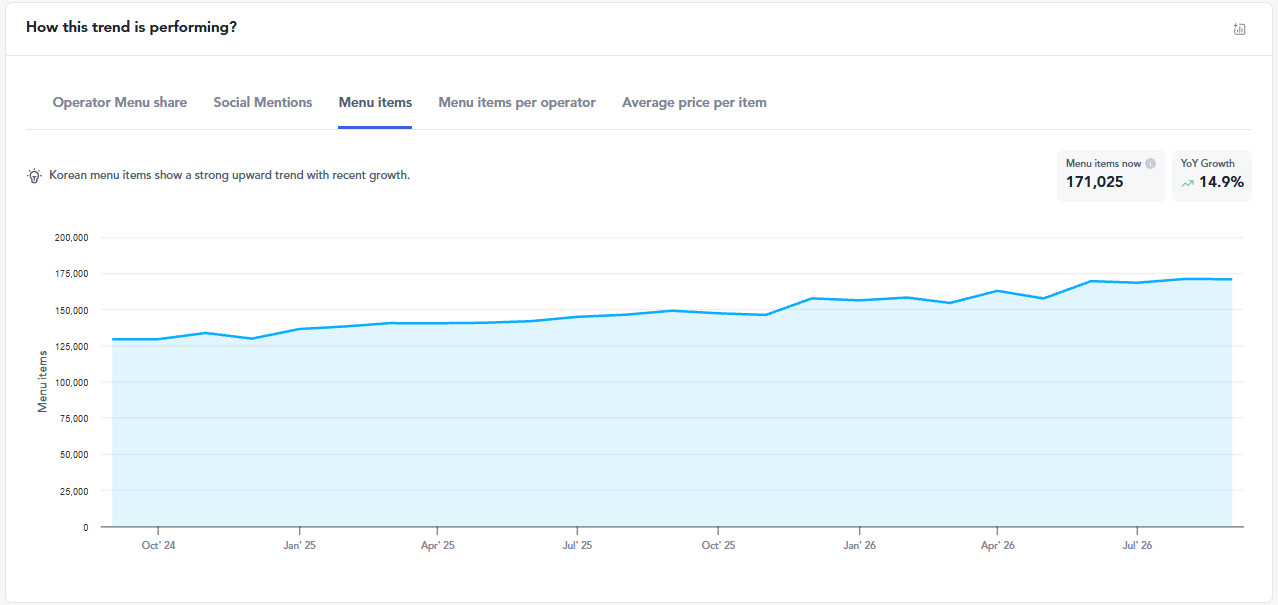
Korean food trends 2026 point to a cuisine that has settled into everyday American dining. Korean items on US restaurant menus reached 171,025 in the latest month, up 14.9% on a year earlier, according to Tastewise menu data. Trade figures tell the same story. The US was the largest buyer of Korean agri-food products in 2025, with shipments up 13.2% to $1.8 billion.
For food brands and operators, the opportunity sits in the detail: which flavors carry the cuisine, which dishes are rising and where the shelf lags the menu. This guide covers each one and the moves your team can make next.
Key takeaways
- Korean items on US restaurant menus reached 171,025, up 14.9% on a year earlier.
- Korean fried chicken menu items grew 35% between November 2025 and September 2026, while the average item price fell from $19.73 to $18.31.
- Gochujang menu items rose 19% over the same period, and the average gochujang item now costs $16.69, up 8%.
- Online buzz is moving from Korean barbecue, down 4%, toward samgyetang and tteok, up 44% and 42%.
- Flavor leads the buzz around kimchi and gochujang. Health cues account for 6.4% of that signal and fell 22% over the past year.
What defines Korean cuisine and its core flavor profiles?
Korean cuisine is built on fermented pastes and vegetables, umami-forward seasoning and shared banchan side dishes. Its flavor balance runs across spicy, savory, sweet and nutty notes.
What defines Korean cuisine?
Fermentation is the cornerstone. Gochujang (red chili paste), doenjang (soybean paste) and kimchi build deep umami over weeks or months. Meals center on rice with banchan, small shared side dishes. Online buzz around banchan grew 10% over the past year.
Key flavor profiles and signature ingredients
Short-grain rice acts as a neutral base for garlic, toasted sesame oil, scallions and gochugaru chili flakes. Bulgogi marinades bring sweet and savory depth. Gochujang is the anchor, with the largest share of Korean ingredient buzz in Tastewise social data at 3.3%.
Korean food fusion trends
Korean flavors now sit inside American and Latin formats. Korean-Mexican tacos, popularized by the Kogi food truck in Los Angeles, opened the door for gochujang burgers and kimchi fries. Around kimchi and gochujang, Mexican and Latin American cues grew 7% and 8% in Tastewise buzz data.
Regional variations within Korean cuisine
Seoul carries royal court traditions, Jeonju is known for bibimbap, Busan for seafood and Jeju for black pork. A regional name gives a product a specific origin story. Buzz for galbitang beef rib soup grew 13%.
Why Korean cuisine is growing in Western markets
K-pop, Korean dramas and viral spicy noodle challenges built awareness. Samyang’s Buldak noodles became the face of those challenges, and Bonchon and bb.q Chicken took Korean fried chicken national. Korean food trends USA 2026 build on that base, and Tastewise forecasts demand for Korean food to keep climbing through 2027.
How do Tastewise AI analytics track popular Korean food trends?
Tastewise tracks Korean food trends by resolving consumer, menu and retail sources into one connected dataset, then reading each signal in the context of your category. You see what US consumers engage with, what operators put on menus and what reaches the shelf, with every figure tied to its source.
A social post about gochujang wings, a menu line reading GOCHUJANG CHKN WINGS 8PC and a jar of hot pepper paste all read as one gochujang story. Korean dishes appear on 4.8% of US restaurant menus, up 3.2% on last year. For Korean food trends 2026, that steady base means growth now comes from specific dishes and ingredients.
What ingredients are driving current Korean food trends in the US?
Gochujang remains the anchor. Gochujang menu items grew 19% between November 2025 and September 2026. The average gochujang item price rose 8% to $16.69, so operators can charge more for it.

The faster movers are smaller. In Tastewise buzz data, honey sesame grew 79%, Asian pear 40%, enoki 36% and garlic sesame 30%. Garlic soy fell 20% and pork belly 10%, which signals fatigue with the most familiar barbecue flavors. Salad is also a growing pairing for Korean items on menus, up 2.3%.
How do consumer health perceptions influence the demand for fermented Korean foods?
Health supports the story, and its pull is weakening. In the buzz around kimchi and gochujang, Korean and Asian identity cues lead by a wide margin. The healthy claim accounts for 6.4% of that signal and fell 22% over the past year.
Fermentation still has room in newer ingredients, with fermented chile up 25% in early-stage buzz. Among diet-led audiences, vegetarians show the strongest interest in Korean food, ahead of keto followers and on-the-go snackers. Lead with flavor and authenticity, then use gut health as a supporting proof point on pack.
What actionable strategies enable brands in creating Korean food trends?

Brands help create Korean food trends by pairing authentic regional flavors with fast prototyping, clear ingredient sourcing and fusion concepts backed by data.
How do CPG product developers formulate successful Korean-inspired SKUs?
Take a snack company deciding whether to launch a gochujang-spiced chip line or a kimchi dip. Menus show the demand, and the shelf has not caught up. Tastewise retail data shows about 80 gochujang products online across 50 brands, with 3 new launches in the past year.
Korean-claim launches cluster in soups, frozen meals and sauces. Snack categories barely register, with 4 Korean-claim cookies online. This gap between menu and shelf is one of the clearest Korean food trends 2026 openings for CPG teams.
The team would build around gochujang and add a faster-rising pairing such as honey sesame, leading with Korean flavor on pack. Product innovation teams can then test the concept against consumer segments that over-index on Korean food. The same evidence becomes the retail buyer story for the line review.
How do restaurant operators capitalize on fast-moving Korean street food trends 2026?
Korean fried chicken menu items grew 35% between November 2025 and September 2026. The share of US restaurants listing it rose from 0.31% to 0.38%. Its average price fell from $19.73 to $18.31, so operators are using it to signal value.
Korean corn dogs grew 26% on menus at an average of about $8.25 per item. Korean menu concentration still varies by state, so start an LTO where Korean dishes already over-index. Pair a familiar format with a rising flavor, such as a gochujang honey sesame chicken sandwich. Hotteok sweet pancakes, with buzz up 22%, make a low-risk dessert add-on. The foodservice forecast adds context for timing, and the same data supports foodservice sell-in for suppliers.
5 steps to integrate Korean flavors into your product roadmap

- Audit cultural authenticity. Respect the balance of gochujang, garlic and sesame before you add a fusion twist.
- Check AI trend velocity. Confirm whether an ingredient is accelerating or plateauing in your region. AI agents can watch these signals and flag a shift before your next stage gate.
- Optimize for clean label. Put natural fermentation and recognizable ingredients on pack, with gut health as a supporting claim.
- Test cross-cultural pairings. Try Korean marinades in Western snacking formats and Mexican or Latin American builds.
- Monitor post-launch reception. Track consumer reach, menu adoption and shelf launches, then adjust flavor intensity or format.
Korean food trends 2026 reward teams that move from the familiar to the specific. Gochujang, Korean fried chicken and corn dogs carry the volume today. Samgyetang, tteok, perilla and honey sesame show where the next wave is forming. Whitespace data also shows chains such as Taco Bell, Kung Fu Tea, UNO Pizzeria & Grill and Long John Silver’s with low Korean menu share, a gap suppliers can pitch into.
FAQs about Korean food trends 2026
Regional comfort dishes are rising, led by samgyetang and tteok with buzz up 44% and 42%. On menus, street food formats like Korean fried chicken and corn dogs are growing fastest.
Yes. Korean items on US restaurant menus grew 14.9% on a year earlier, and Tastewise forecasts demand to keep climbing through 2027.
Korean fried chicken and Korean corn dogs lead. Korean fried chicken menu items grew 35% and corn dog items grew 26% between November 2025 and September 2026.
Gochujang is the base flavor, with menu items up 19%. For differentiation, watch honey sesame and Asian pear, with buzz up 79% and 40%.
Tastewise resolves consumer, menu and retail data into one connected dataset and reads it in the context of your category. That shows, for example, that Korean dishes now sit on 4.8% of US restaurant menus.
Sources cited in this article
- Korean agri-food products bernama.com
Cite this article
Reinoso, K. L. (2026). Korean Food Trends 2026: AI Analytics & Culinary Insights. Tastewise. https://tastewise.io/blog/korean-food-trends


