






Most of what the food industry knows about how people eat still comes from asking them. That method has a measurement problem. In a 2025 dietary recall study of 39 New York adults aged 50 to 75, about half of the recalls under-reported energy intake when checked against doubly labeled water. For brands building products around personalized nutrition at home, that gap matters. A formulation built on what people say they eat starts from a distorted picture.
AI dietary assessment changes the input. You read what people actually cook, order and buy, continuously. This guide covers how AI reshapes dietary assessment tools and how F&B teams turn that read into products. All Tastewise data below covers the US over the 12 months to August 2026.
Key takeaways
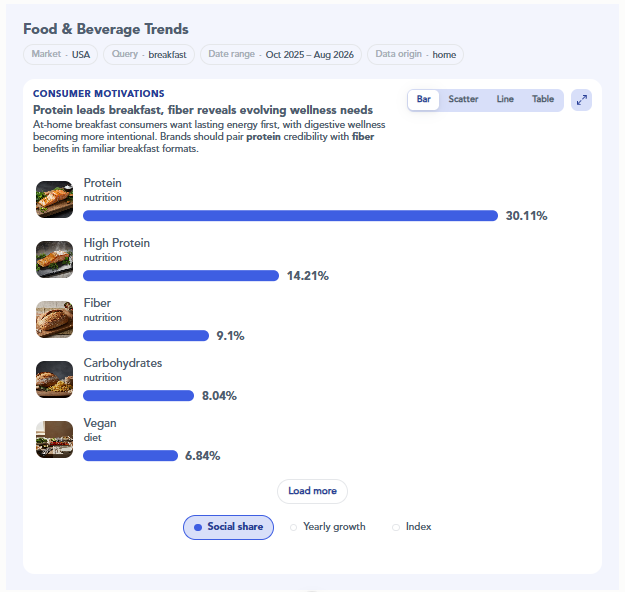
- Protein leads at-home breakfast, with nearly 1 in 3 at-home breakfast consumers (30%) focused on it, and it grew 4% over the year.
- Fiber reaches nearly 1 in 10 at-home breakfast consumers (9%) but grew 22%, so it is reaching new breakfast consumers about five times faster than protein.
- Diet identity labels are fading at breakfast, with vegan down 42%, plant based down 40% and gluten free down 23%.
- Blood sugar balance is moving onto plates, with its share of US restaurant menus up 48% even as online interest cooled 35%.
- In high-protein home cooking, cheesecake yogurt grew 90%, sugar substitutes grew 84% and green pea grew 65%.
- The US online shelf for high-protein breakfast is thin, with 30 products tracked and only 4 launched in the past year.
How can AI transform modern dietary assessment methodologies?
AI transforms dietary assessment by replacing one-off food logs with continuous signals from what people cook, order, buy and share. For F&B teams, that means you can evaluate dietary intake patterns across a population, by meal occasion, without waiting on a survey cycle.
The shift from stated recall to continuous intake tracking
Self-reported food diaries fail for predictable reasons. People forget snacks, misjudge portions and change what they eat when they know they are logging it. The authors of the 2025 recall study note that self-monitoring itself can lower intake during the recording period.
Home dietary tracking apps and continuous glucose monitors close part of that gap for individuals. A brand building for personalized nutrition at home needs something different. You need the pattern across a population, split by occasion and need state. Machine learning models trained on consumer behavior provide that view. Tastewise classifies home recipes, restaurant menus, retail products and consumer posts by ingredient, claim and occasion. It then tracks how each one moves month by month.
Deconstructing modern precision assessment frameworks
Digital dietary assessment for product teams works in four layers. The first is ingredient density, meaning which ingredients carry a need state. The second is macro emphasis across protein, fiber and carbohydrates. The third is functional benefit, such as energy, gut health or blood sugar. The fourth is the meal occasion itself.
Precision nutrition at population scale means reading all four layers together. Take breakfast at home. Across the Tastewise US consumer panel, protein leads the nutrition claims at-home breakfast consumers focus on, at nearly 1 in 3 (30%). Carbohydrates are moving the other way, down 5% over the year. A framework that only counted calories would miss both signals. The same classify-then-compare logic sits behind most AI for CPG work.
What are the most effective methods for assessing personalized nutrition needs?

The most effective methods pair continuous behavioral data with context, meaning the occasion, the setting and the goal behind each choice. Reading growth rates alongside that context separates lasting wellness shifts from short-lived diet fads.
At the at-home breakfast table, protein still leads, and it grew 4% over the year. Fiber is smaller, at nearly 1 in 10 at-home breakfast consumers (9%). It grew 22%, which means fiber is reaching new breakfast consumers about five times faster than protein.
Diet labels are moving the opposite way at the same table. Vegan fell 42%, plant based fell 40% and gluten free fell 23%. The breakfast needs that are growing are nutritional and specific. The identity diets are losing ground.
Balancing speed with nutritional depth
The test for a lasting trend is whether it shows up in more than one channel. Personalized nutrition as an umbrella term cooled 17% in consumer interest over the year, and its menu presence stayed flat. The label itself is a weak guide.
Blood sugar balance tells a more useful story. Online interest peaked in January and then cooled 35%. Over the same year, the share of US restaurant menus mentioning blood sugar balance rose 48%. When a need state moves from conversation onto menus, operators are putting money behind it. Value Shoppers lead consumer interest in blood sugar balance, so price will matter as much as the claim.
Integrating biometric context into CPG formulation
Biomarker data from glucose monitors and wearables stays with the individual and their device. What brands can see is how people act on it, through the ingredients they swap in, the claims they look for and the formats they cook.
Multi-dimensional scoring combines three reads: ingredient efficacy, adoption friction and the wellness goal an ingredient serves.
High-protein home cooking shows the method at work. Across the Tastewise US consumer panel, this view draws on 20,024 high-protein recipes and 45,876 posts from 18,326 home cooks over the past year. Among US consumers cooking high-protein food at home, skyr reaches about five times more people than cheesecake yogurt (0.19% against 0.04%). Cheesecake yogurt is growing nearly four times faster, up 90% against 25%. Sugar substitutes rose 84% and green pea rose 65% in the same cooking. Together they point to dessert-like flavor, less sugar and plant protein that fits everyday meals.
Consider a functional food brand planning a low-glycemic, high-protein breakfast line for consumers focused on personalized nutrition at home. It needs to decide what to lead with on pack and which format to launch first.
Start with the claim. Tastewise tracks 30 high-protein breakfast products on US online shelves, and only 4 launched in the past year. Fiber does not appear among the top claims on those packs, even though fiber demand at breakfast grew 22%. Lead with protein plus fiber, since protein is already standard on these packs.
For format and flavor, a skyr base with a cheesecake flavor, sweetened with a sugar substitute, matches three growing signals in one product. Frame the low-glycemic benefit as steady morning energy, which mirrors how operators are putting blood sugar balance on menus. The average price on that shelf is $6.06, and Value Shoppers lead blood sugar interest. Pricing near that average keeps the line within reach. Finally, keep vegan out of the lead claim at breakfast, where that label fell 42%.
How does personalized assessment drive commercial success for F&B brands?

Personalized assessment pays off when each product line maps to a defined group of people. Build your framework around three dimensions: metabolic health segment, life stage and lifestyle diet. Define each one as its own set of consumer segments before you brief R&D.
Audience data also surfaces tensions inside a segment. Vegan consumers lead interest in personalized nutrition as a topic, ahead of coffee lovers and chefs. Yet breakfast products that lead with a vegan claim face a shrinking audience. For a vegan segment, put the protein and fiber benefit first on pack and the vegan claim second.
Tailoring product strategy to household dining moments
Breakfast is a repeat occasion, so a product that fits the routine gets chosen again and again. That repetition supports subscription models and repeat retail purchase. A thin high-protein breakfast set combined with rising fiber demand gives you a clear retail buyer story for your next category review.
Continuous dietary tracking vs. one-time nutritional studies
A one-time nutritional study captures a single moment, and that moment changes fast. Vegan fell 42% at breakfast within twelve months, so a study fielded last year would now point your formulation the wrong way.
An agile tracking workflow fixes the timing problem. Review your category signals monthly, then adjust formulation and messaging as consumer goals shift. Teams that run on always-on intelligence can update brand campaigns as the data moves.
Personalized nutrition at home rewards the brands that measure what people actually eat. Pair protein with fiber, treat blood sugar balance as a menu-proven need and keep watching the data every month.
FAQs about personalized nutrition at home
Personalized nutrition at home is eating tailored to individual health goals, prepared or assembled in your own kitchen. At breakfast, protein leads that goal for nearly 1 in 3 at-home breakfast consumers in the US (30%).
Dietary assessment tools measure what people eat, from 24-hour recalls and food diaries to digital trackers and AI models. Self-reported methods carry real error, and in the 2025 recall study about half of recalls under-reported energy intake.
AI dietary assessment classifies recipes, menus, products and consumer posts by ingredient, claim and occasion. It then tracks how each one moves over time. That is how fiber surfaces as a breakfast need, with 22% growth at the at-home breakfast table.
The umbrella term cooled 17% in US consumer interest over the past year. Specific needs are proving more durable, and the share of US restaurant menus mentioning blood sugar balance rose 48%.
Brands can evaluate dietary intake through continuous behavioral data from home cooking, restaurant menus and retail shelves. For example, green pea grew 65% in US high-protein home cooking.





We’d love to learn your goals and see how Tastewise fits
We’d love to learn your goals and see how Tastewise fits
Get a personalized demo
Good taste. Wise move.
Your demo request is confirmed. We’ll reach out within one business day to schedule your walkthrough.
What happens next

See what’s driving demand, then turn it into a sell-in story for retailers and operators.
- Connect consumer panels, market trackers, and agents into one evidence view
- Get the “why” behind what’s changing, with explainable demand drivers
- Walk away with a buyer-ready narrative and next steps to activate
Trusted by





“Tastewise is my secret tool for knowing what consumers want next and why.“