






Pasta trends are no longer about novelty or rediscovery. Tastewise data shows a category that remains socially active while quietly losing ground in menus and recipes. That imbalance forces a decision: adjust how pasta shows up, or accept erosion in relevance.
Social discussions around pasta grew 11.45% YoY, while restaurant menus declined 2.06% YoY and recipe usage slipped 0.42% YoY. Demand did not disappear. Execution did.
For brands and operators, the question is no longer whether pasta belongs. It is where, how, and in what format it should be deployed.
Pasta trend overview
- Consumers are talking about pasta more (+11.45% YoY social growth)
- Operators are reducing pasta presence on menus (-2.06% YoY)
- At-home usage is flat, not growing, despite high familiarity
- Engagement concentrates around execution cues (texture, comfort formats) rather than novelty
Pasta is being treated as a solved, low-effort category, while consumers are behaving as if it requires precision. That mismatch causes quiet menu erosion, weak differentiation, and price compression.
Cooking precision is driving willingness to pay
Texture has become a decision variable. “Al dente” appears 32.9x more often in pasta conversations than in the broader food and beverage category.
This concentration points to execution sensitivity. Consumers are reacting to how pasta is cooked, not just what sauce is added. Overcooked, soft, or generic textures weaken perceived quality regardless of flavour.
This changes product and menu design. Pasta that cannot reliably deliver bite, firmness, or cook control loses pricing power. Brands should reformulate around cook tolerance. Operators should reduce prep variance rather than expand sauce variety.
Comfort formats are carrying volume while menus experiment elsewhere
Mac and cheese accounts for 8.09% of pasta-related social conversations, ranking among the most discussed pasta dishes alongside spaghetti and lasagne.
Despite limited menu growth, comfort-led preparations remain the most stable demand anchor. Consumers continue to rely on baked, creamy, and family-style pasta for shared occasions and predictable satisfaction.
The implication is structural. Comfort formats should not be treated as legacy SKUs. They are traffic drivers. Innovation should orbit them, not replace them. Limited-time variations, toppings, or protein swaps create movement without breaking familiarity.
Fusion growth is concentrated, not broad
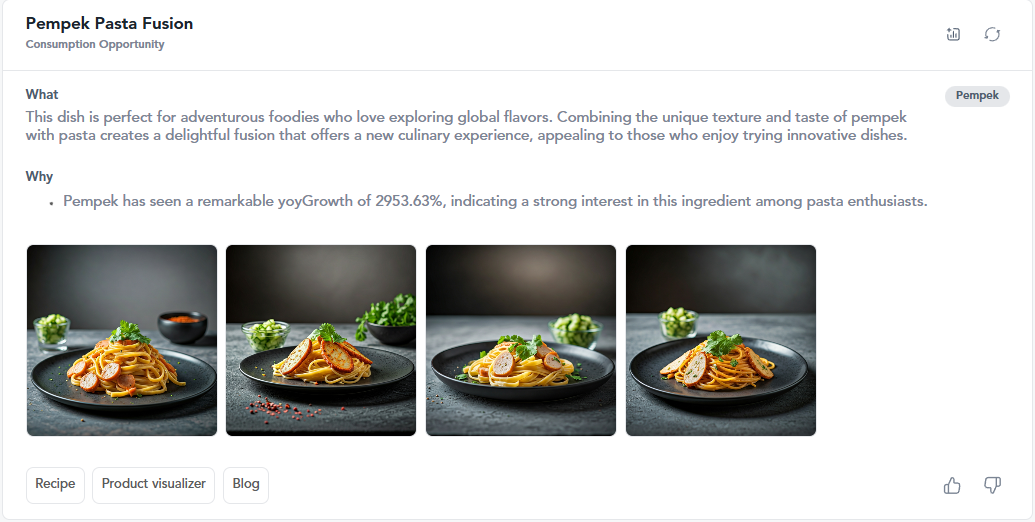
Not all experimentation performs equally. Pempek-driven pasta discussions grew 2,953% YoY, while Japanese–Italian fusion grew 18.51% YoY.
This growth is not random. Both pair unfamiliar cultural cues with a familiar base format. Consumers are engaging when the risk is controlled.
For R&D and menu teams, this supports selective fusion. Keep the pasta shape and preparation recognizable. Introduce novelty through sauces, fillings, or accompaniments rather than format overhaul.
Channel performance requires different pasta strategies
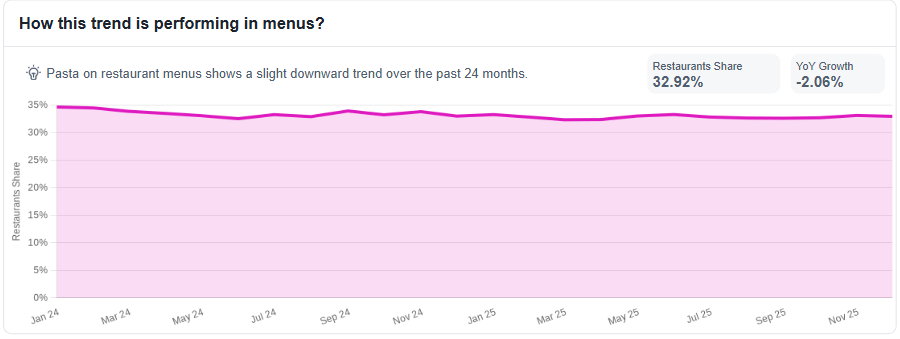
Tastewise Foodservice data shows pasta still appears on 32.92% of menus, despite decline. Home cooking data shows recipes holding steady share at 7.77%, with only minor contraction.
This split suggests pasta remains expected but under-activated in foodservice, while retail and home cooking maintain baseline relevance.
Operators should reduce menu breadth and focus on fewer, better-executed pasta dishes. Retail and ready-meal brands should prioritise formats that travel well, reheat consistently, and protect texture.
Ingredient choices are reinforcing familiarity, not disruption
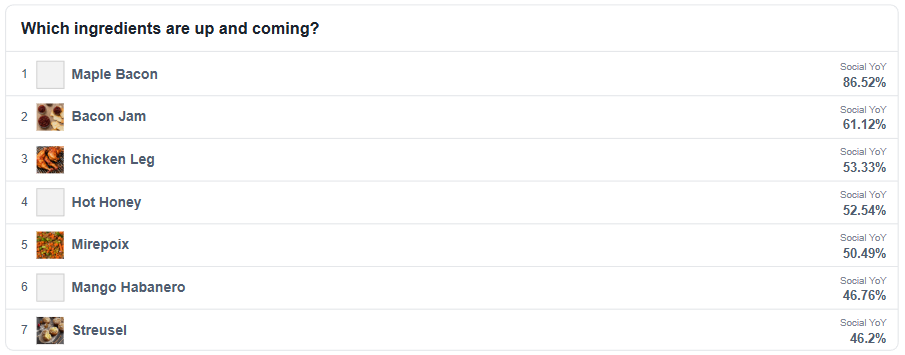
Top correlated ingredients include chicken, garlic, tomato, pork, and beef. These are not experimental signals. They confirm that consumers continue to associate pasta with familiar proteins and flavour bases.
At the same time, fast-growing adjacencies like hot honey (+52.5% YoY) and bacon jam (+61.1% YoY) indicate appetite for small twists layered onto known builds.
The action is incremental. Add contrast, heat, or sweetness without abandoning core flavour expectations. Large departures reduce repeat behavior.
Pasta trends point to execution discipline, not category reinvention
Pasta trends reflect a category that still earns attention but punishes weak execution. Social growth without menu growth is not a warning. It is a filter.
Brands, retailers, and operators that tighten formats, protect texture, and anchor innovation to comfort will keep pasta commercially relevant. Those chasing novelty without operational discipline will lose ground quietly.
FAQs about pasta trends
Pasta demand remains active in social discussion, with +11.45% YoY growth, even as menu presence declines. This indicates sustained interest paired with selectivity around execution rather than category fatigue.
Tastewise Foodservice data shows pasta menu share declining -2.06% YoY, suggesting operators are reducing pasta options due to operational or margin pressure, not lack of demand. Poor execution and menu redundancy are likely driving removals.
Comfort-led formats such as mac and cheese, spaghetti, and baked pasta dominate engagement. These formats show stable demand across social, menu, and recipe data, making them lower-risk anchors in both foodservice and retail.
Texture precision is a primary driver. “Al dente” appears 32.9x more often in pasta conversations than in the broader F&B category, indicating that cooking control directly affects perceived quality and willingness to pay.
Innovation performs when novelty is layered onto familiar formats. Fusion concepts like Japanese–Italian pasta (+18.5% YoY) and pempek-inspired pasta (+2,953% YoY) succeed by keeping the base recognizable while introducing controlled differentiation.
Yes, when execution is disciplined. High correlation with familiar ingredients like chicken, garlic, and tomato confirms pasta’s role as a reliable platform, while selective flavour adjacencies allow incremental innovation without sacrificing repeat demand.




We’d love to learn your goals and see how Tastewise fits
We’d love to learn your goals and see how Tastewise fits
Get a personalized demo
Good taste. Wise move.
Your demo request is confirmed. We’ll reach out within one business day to schedule your walkthrough.
What happens next

See what’s driving demand, then turn it into a sell-in story for retailers and operators.
- Connect consumer panels, market trackers, and agents into one evidence view
- Get the “why” behind what’s changing, with explainable demand drivers
- Walk away with a buyer-ready narrative and next steps to activate
Trusted by





“Tastewise is my secret tool for knowing what consumers want next and why.“