
Business
Winning Regional Retail Shelves With Kwanzaa Food Insights


Kwanzaa food sits in the busiest week of the retail calendar, yet few shelves are planned for it. Kwanzaa runs from December 26 to January 1, so its meals land right after the Christmas reset. In 2026, the Karamu feast falls on Thursday, December 31. This guide covers the dishes US consumers look for, where demand sits, and what to do about it in regional stores.
Key takeaways
- Kwanzaa food has no fixed menu. It draws on African American, African, Caribbean and South American cooking. The 2026 Karamu feast falls on Thursday, December 31.
- Nearly 1 in 4 US consumers who engage with Kwanzaa food (23%) connect it to family.
- Collard greens lead the core Kwanzaa dishes, reaching nearly 3 in 10 consumers of those dishes (29%).
- Texas, New York and Georgia hold the most restaurants serving Kwanzaa staples. Louisiana, Washington DC and Maryland over-index for their size.
- Walmart lists nearly 2 in 3 of the Kwanzaa staple products sold online (64%), ahead of Kroger and regional grocers such as Winn-Dixie.
- Kwanzaa-branded food is close to absent online. The only products tagged to Kwanzaa are holiday chocolate truffles from a single brand.
What Kwanzaa food means for consumers
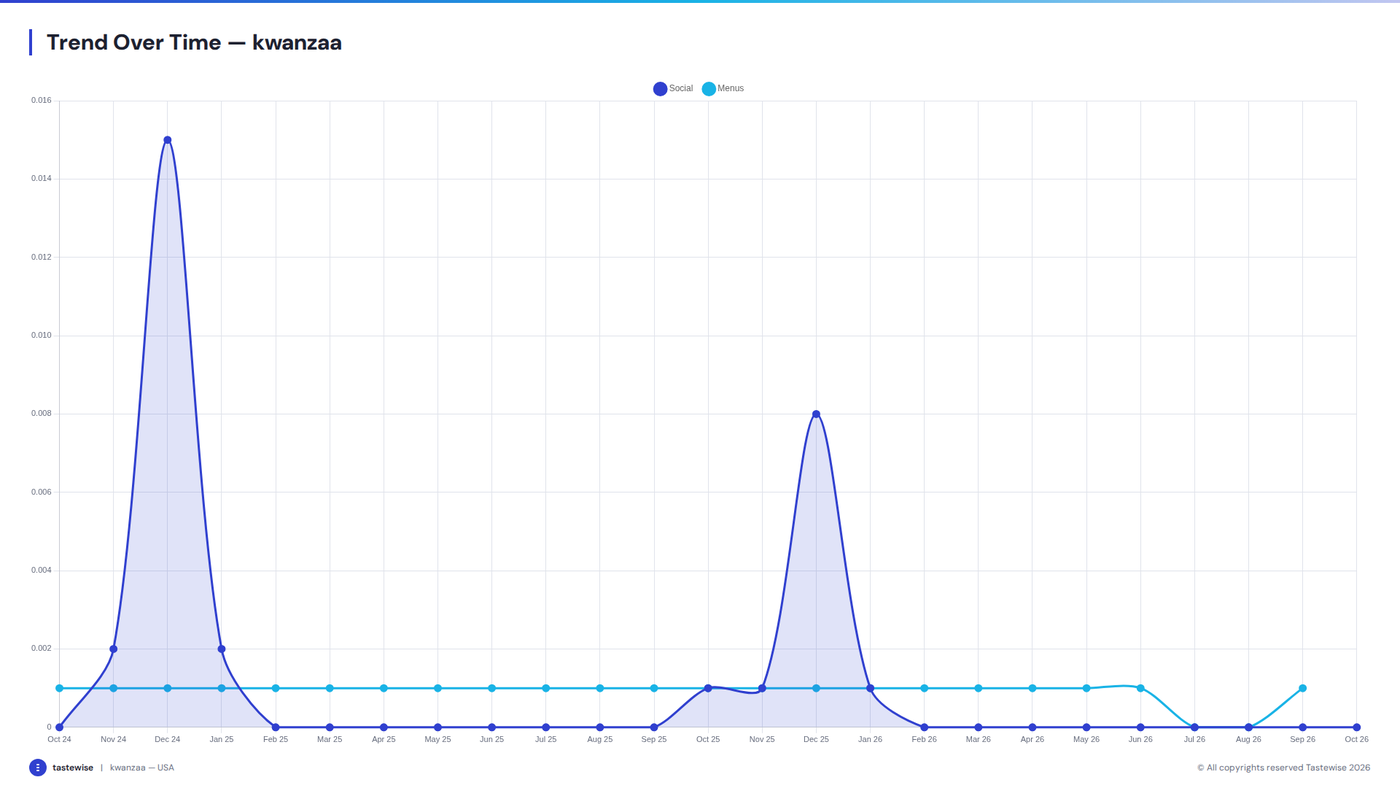
Kwanzaa food is the food families and communities share during Kwanzaa, a seven-day celebration of African American culture created in 1966 by Maulana Karenga. There is no fixed menu. The Smithsonian African American history museum describes Kwanzaa tables that mix favorite African American dishes with traditional African, Caribbean and South American recipes.
Across the Tastewise US consumer panel, Kwanzaa food is a December signal. It peaks around the holiday every year and stays quiet the rest of the year. About half of Kwanzaa food consumers (52%) connect Kwanzaa food to Christmas, and about 2 in 5 (42%) connect it to Hanukkah.
Heritage carries the rest of the story. About 1 in 6 Kwanzaa food consumers (16%) describe it as traditional, and nearly 1 in 10 (8%) tie it to African cuisine.
For you, this means Kwanzaa shoppers fill the same December basket as everyone else. The holiday trends 2026 report shows how the wider season is moving.
Traditional Kwanzaa food and dishes
Traditional Kwanzaa food centers on African American Southern cooking and dishes from the wider African diaspora. A practical Kwanzaa food list looks like this:
- Greens and beans: collard greens and black-eyed peas
- Sweet potatoes: baked into pie, biscuits or cornbread
- Rice dishes: jollof rice and gumbo served over rice
- West African and Caribbean plates: plantains, peanut stew and Senegalese chicken
- Seafood: red snapper creole and spicy catfish
Kwanzaa recipes in Tastewise data include Toni Tipton-Martin’s sweet potato biscuits, okra and corn, a sweet potato and peanut stew, and Pierre Thiam’s Senegalese chicken thighs with red palm and coconut rice.
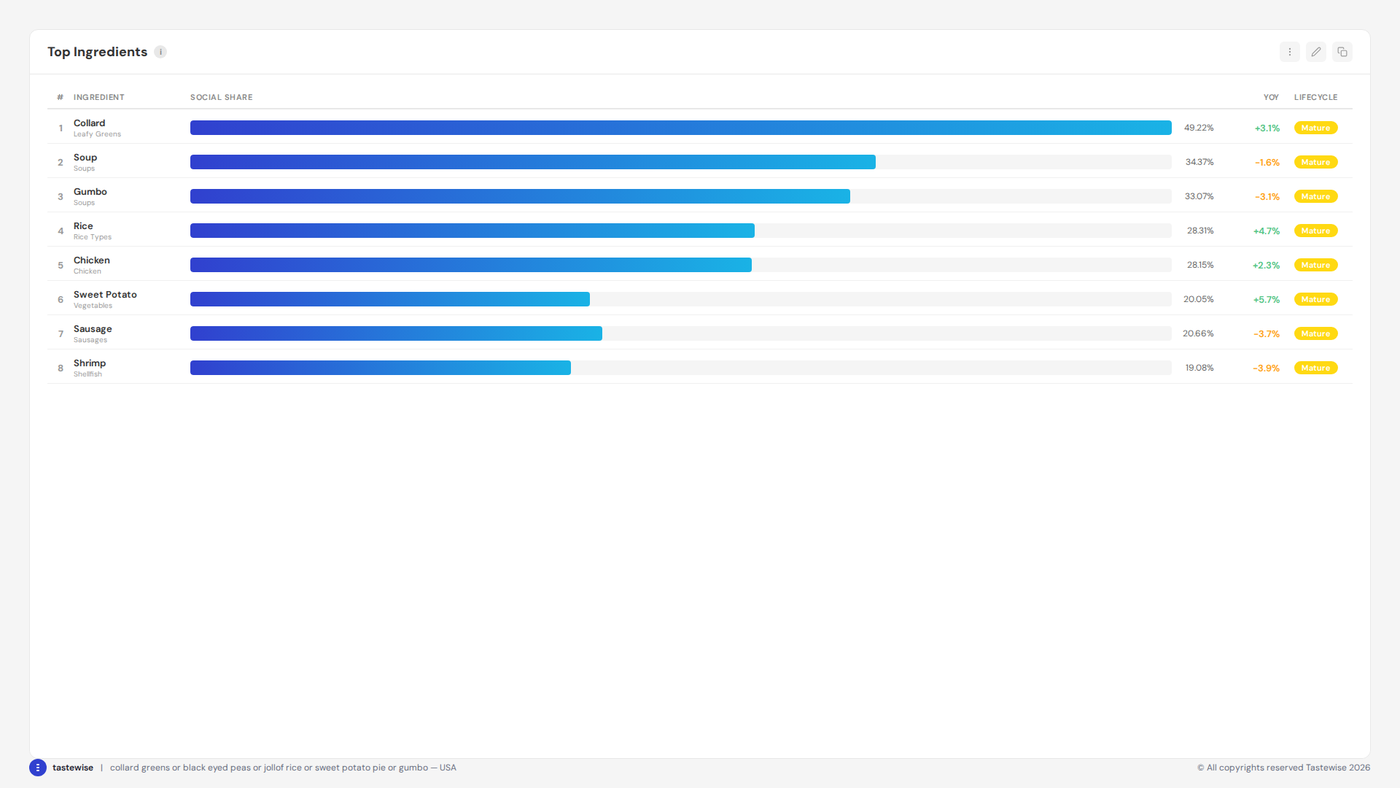
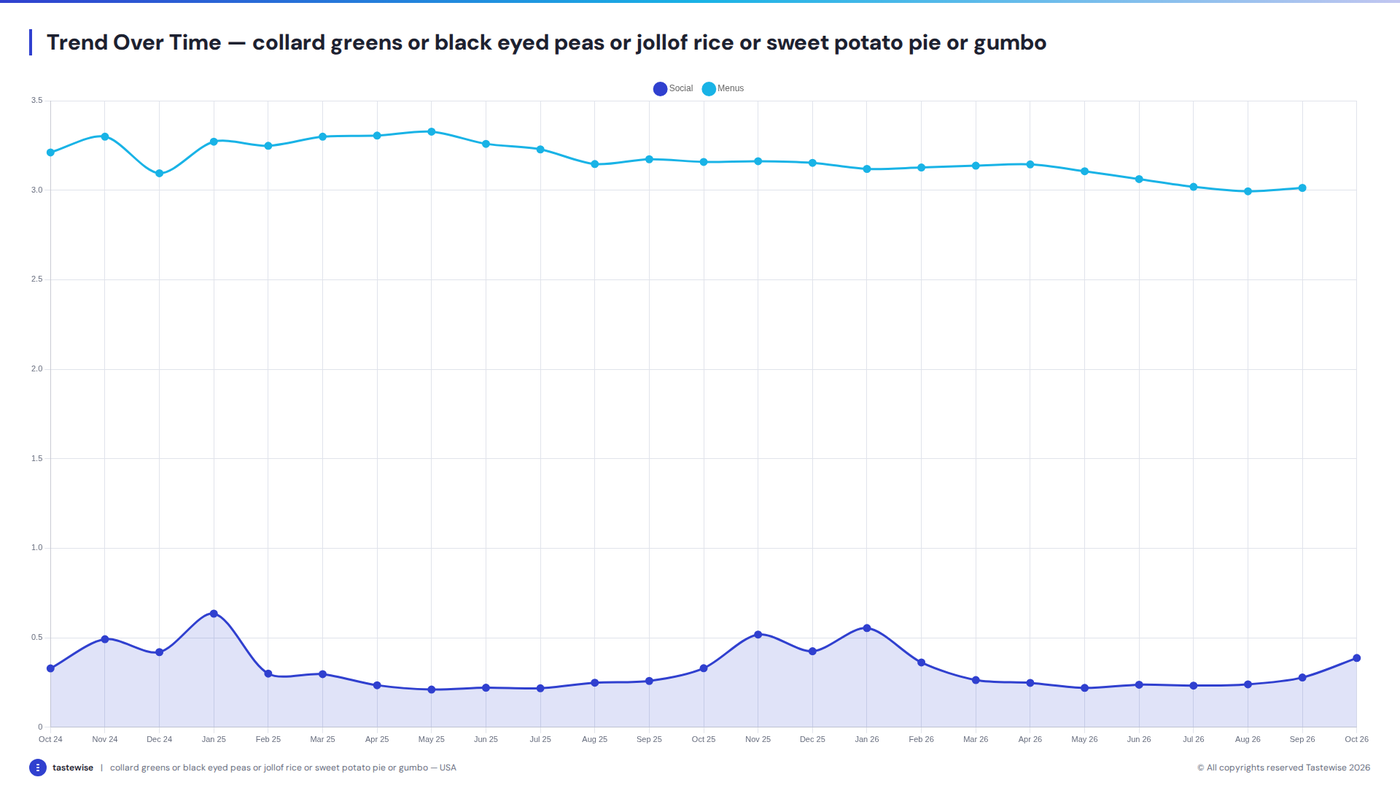
Collard greens lead these Kwanzaa food dishes on the consumer side. The core set also covers black-eyed peas, jollof rice, sweet potato pie and gumbo. Among US consumers who engage with it, about 1 in 8 engage with jollof rice (12%). The same share engage with black-eyed peas (12%), and nearly 1 in 10 engage with sweet potato pie (9%).
Online interest is moving toward the West African side of the table. Buzz around jollof rice grew 7.5% over the past year, while buzz around black-eyed peas slipped 4.7%.
On shelf, the staples are widely stocked online by brands such as Zatarain’s, Glory Foods, Great Value and Campbell’s. Products tagged to Kwanzaa itself are a different story. The only ones are holiday chocolate truffles from a single brand.
Kwanzaa food traditions and the Karamu feast
The central Kwanzaa food tradition is the Karamu, a communal feast held on December 31, the sixth day of Kwanzaa. According to the Smithsonian Kwanzaa guide, any dish can be part of the Karamu. Each day honors one of seven principles, from Umoja (unity) to Imani (faith).
The consumer data shows how social the feast is. About 1 in 7 Kwanzaa food consumers (13%) connect it to friends, and nearly 1 in 10 (8%) connect it to parties. Buzz around that party link rose 21% over the past year, the biggest rise among the top Kwanzaa occasions.
Timing shapes the basket too. Karamu always lands on New Year’s Eve, and about 1 in 16 Kwanzaa food consumers (6%) already link the two. Sweets lead the Kwanzaa ingredient list, with cookies, cake and chocolate ahead of the savory staples.
Where Kwanzaa demand is concentrated: regional data
Kwanzaa demand concentrates in the South, the Mid-Atlantic and the largest metro states. Tastewise tracks it through the US restaurants that serve the core Kwanzaa dishes named above.
About 1 in 8 of those restaurants are in Texas (12%), and 1 in 10 are in New York (10%). Georgia (8%), Florida (7%) and California (7%) follow.
Size alone hides the strongest markets. Relative to their restaurant base, Louisiana, Washington DC and Maryland over-index most on these dishes, followed by Georgia and Delaware.
The Gulf South is gaining ground. Over the past year, Mississippi’s share of these restaurants grew 25% and Alabama’s grew 15%. Louisiana’s share rose 13% and Florida’s rose 11%.
Restaurant listings named for Kwanzaa are rare, and sit mainly in New York, Georgia and Maryland.
Online grocery tells a similar regional story. Walmart carries the widest range of Kwanzaa staple products, followed by Kroger. The next three retailers are regional: Winn-Dixie in the Southeast, Key Food in the New York area and Piggly Wiggly in the South.
What retailers and CPG brands can do
Retailers and CPG brands can win Kwanzaa by planning around the dishes shoppers already cook.
- Build a Karamu display. Pair fresh and frozen collard greens with black-eyed peas, sweet potatoes and plantains. Lead with stores in Georgia, Maryland, Louisiana and Washington DC.
- Give jollof rice its own space. Stock jollof seasoning, parboiled rice and tomato paste beside the Southern staples, especially in Texas and New York.
- Plan sweets for New Year’s Eve. Sweet potato pie kits and dessert trays can serve both Karamu and New Year’s parties.
- Own the moment with content. Kwanzaa-branded product is close to absent, so a brand with collard, black-eyed pea or sweet potato SKUs can lead with Karamu recipes and in-store signage.
- Reflect Ujamaa. Cooperative economics is one of the seven Kwanzaa principles, so featuring Black-owned food brands on your display matches the spirit of the week.
To tailor these moves by store cluster, you can build consumer segments for each region. They become a retail buyer story your category team can take into a review. The same signals support product innovation when a brand wants a seasonal SKU.
Our look at holiday retail trends covers the wider December basket, and the CPG retail guide covers retail partner pitches.
Kwanzaa food is a small December signal with clear regional roots. When you plan for it by region, you give a loyal group of shoppers the dishes they already cook for the Karamu.
FAQs about Kwanzaa food
Kwanzaa food mixes African American Southern dishes with African, Caribbean and South American recipes. Common dishes include collard greens, black-eyed peas, sweet potatoes and jollof rice. Cookies lead the Kwanzaa ingredient list, reaching about 1 in 8 Kwanzaa food consumers (12%).
Karamu is the communal Kwanzaa feast held on December 31, the sixth day of the celebration. Because it always lands on New Year’s Eve, about 1 in 16 Kwanzaa food consumers (6%) link the two occasions.
Stock the staples together from December 26 to 31 and lead with stores in Louisiana, Washington DC and Maryland. Ready-to-cook formats help, since nearly 1 in 10 Kwanzaa food consumers (8%) value convenience.
Online interest is rising for yams and cornbread, up 10% and 5.8% over the past year. Jollof rice is also gaining, with buzz up 7.5%.
Sources cited in this article
- Smithsonian African American history museum nmaahc.si.edu
Cite this article
Reinoso, K. L. (2026). Winning Regional Retail Shelves With Kwanzaa Food Insights. Tastewise. https://tastewise.io/blog/kwanzaa-food-trends